Joining the Renewable Heating Hub forums is completely free and only takes a minute. By registering you’ll be able to ask questions, join discussions, follow topics you’re interested in, bookmark useful threads and receive notifications when someone replies. Non-registered members also do not have access to our AI features. When choosing your username, please note that it cannot be changed later, so we recommend avoiding brand or product names. Before registering, please take a moment to read the Forum Rules & Terms of Use so we can keep the community helpful, respectful and informative for everyone. Thanks for joining!
The board you have includes several RCBOs and I assume all are being protected by a single B curve 40A MCB.
STOP right there.
There is no such concept as an MCB protecting RCBOs.
Wait until I have time to clarify this later this evening.
Sorry if I have confused things. Here's a summary which I hope will help:
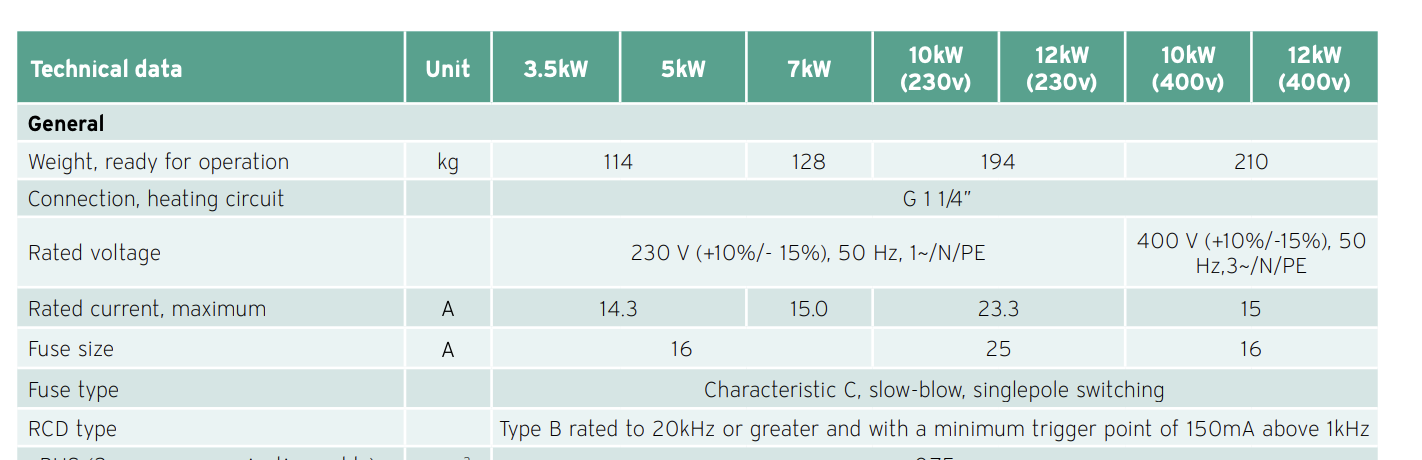
Vaillant require this breaker:
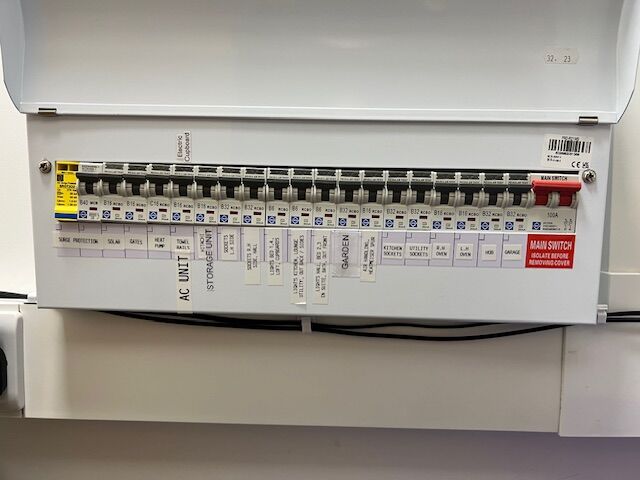
The installer is saying that the new breaker needs to be fitted in a new consumer unit as the breaker is larger than my current CU. This is full view of my CU.
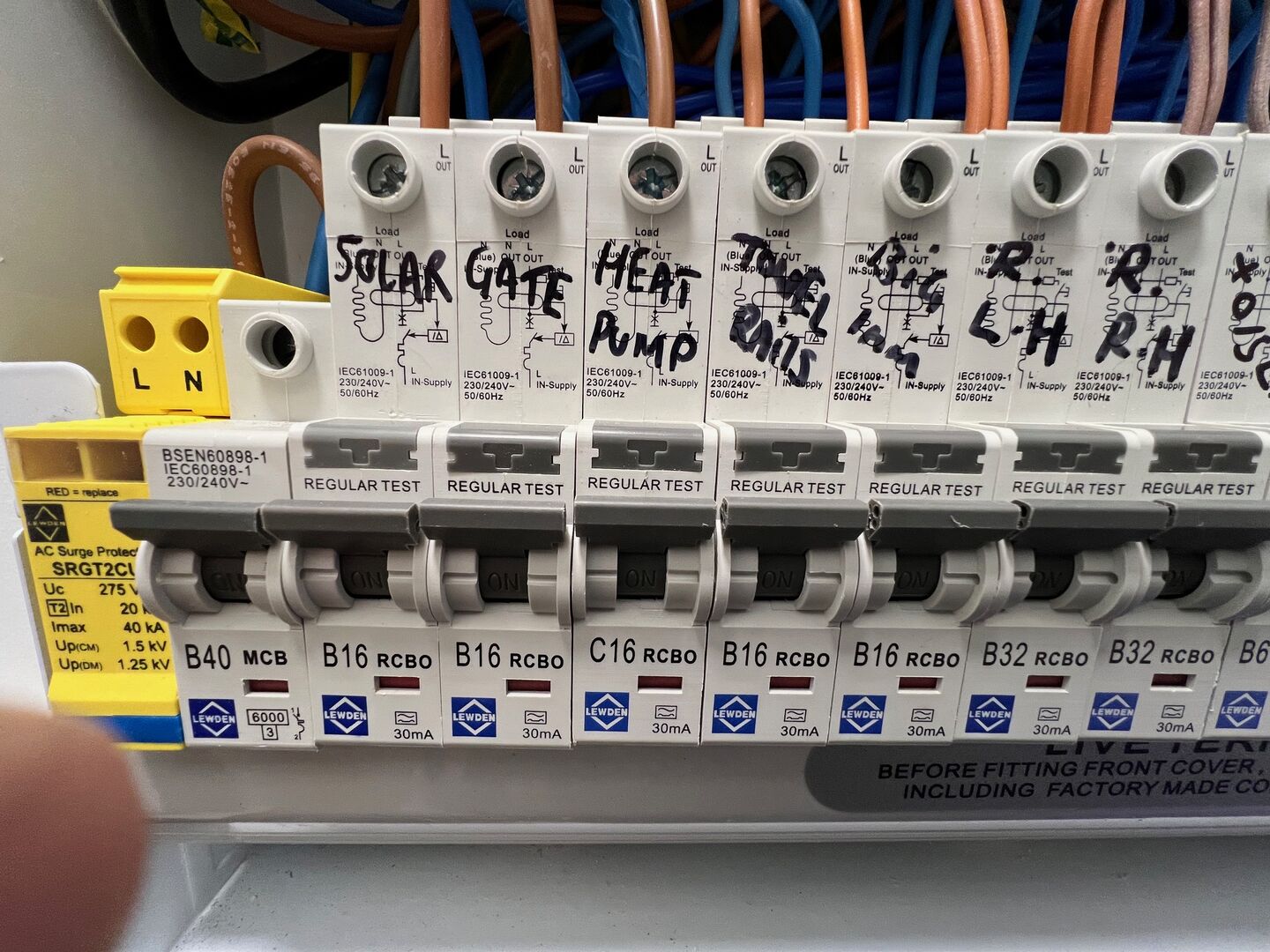
This is inside, showing the breakers in question:
Hope this helps.
This post was modified 8 months ago by trebor12345
2024 build bungalow, Southern England, 179 m2, 12w/m2 Underfloor heating, fully open
Vaillant aroTHERM plus 3.5kW
50 litre volumiser
3.6KW solar panels Tesla 13.5kw Powerwall 3
8kW Solis S6-EH1P8K-L-PLUS hybrid inverter; G99: 8kW export; 16kWh Seplos Fogstar battery; Ohme Home Pro EV charger; Vaillant Arotherm Pro 7kW; 100Amp head, HA lab on mini PC
I'll let @transparent reply to the points in the above posts as they appear knowledgeable and doing a good job of sorting out the confusion that has occurred since my first post.
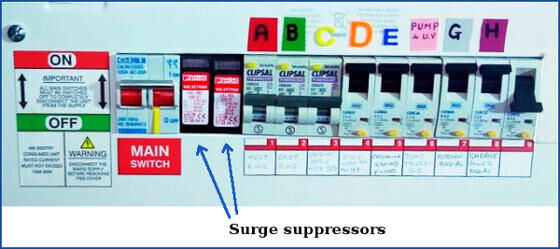
The 40A MCB looks like it is protecting the surge protection device.
I assume you mean the MCB is limiting various RCBOs to a total of 40A. So in case the heatpump is loosing power, this could be because other circuits are drawing more than 24Amp.
No, I was trying to explain that an RCBO has the functions of an MCB and RCD combined in to a single device.
See @transparent 's various replies for explanations of ratings, types and curves!
No, I was trying to explain that an RCBO has the functions of an MCB and RCD combined in to a single device.
See @transparent 's various replies for explanations of ratings, types and curves!
All this reminds me why electricians insist to look at a photo of the open CU, full-width.. There seems to be a lot in a Vaillant heatpump circuit. I am sure my sister's Panasonic AC unit runs on a normal socket circuit. 🙂
8kW Solis S6-EH1P8K-L-PLUS hybrid inverter; G99: 8kW export; 16kWh Seplos Fogstar battery; Ohme Home Pro EV charger; Vaillant Arotherm Pro 7kW; 100Amp head, HA lab on mini PC
The 100A Main Switch is on the right, correctly labelled.
It supplies a row of 18 RCBOs. Each RCBO provides two types of protection to the circuit it feeds:
over-current protection; just as with a fuse, the circuit gets switched off if too much current is drawn
earth-leakage protection; if the current returning on the neutral wire is 30mA (or more) different to that being supplied on the live wire, the circuit switches off
At the far left-end of the Consumer Unit is a yellow anti-surge device.
It's an unusual place to find a Surge Protection Device. My SPDs are right next to the Main Switch, before the live busbar encounters any trips.
If you imagine a lightning strike a couple of miles away, there will be a high voltage spike which gets propagated along nearby grid cabling. It moves at two-thirds the speed of light and enters your consumer unit.
Depending on the magnitude of the spike(s) and the energy they carry, there is a risk that in-home appliances will be damaged. The SPD needs to sense the over-voltage spikes and provide a rapid path to earth (ground).
Placing an SPD at the furthest point away from the Main Switch allows such spikes to pass through the RCBOs and onto the household wiring before the SPD even 'realises' it has work to do!
At these speeds, a transient spike will be 300mm along the first couple of mains circuit before it reaches your SPD.
Even so, lightning usually occurs as a series of 20+ high-voltage pulses, of which numbers 10-13 are usually carrying the most energy. The surge protection needs to quench the first pulses and re-heal itself each time before it meets the main bulk of the energy. In doing so, it will be offering a 'short-circuit' to earth, carrying in excess of 10,000A
... except in your case it won't.
From what I can see, it appears that you have a 40A MCB between the SPD and the live copper busbar which is carrying those rapid surges.
As the first spike hits that MCB, its contacts will start to open, thereby neatly preventing the SPD from remaining in circuit.,
Whilst your hob, heat pump and solar-inverter are being assaulted by thousands of volts, your SPD will be quietly sat there, twiddling its thumbs and wondering where all the sparks are coming from! 🤦🏼♂️
I would love you to tell me I'm wrong, and that the label below that MCB saying "Surge Protection" should really only be beneath the SPD, but I won't hold my breath for your positive answer!
Compared with the above observation, replacing an existing 18mm-wide C-curve RCBO with another one, also 18mm wide, is completely trivial.
Simply ask your local electrician to replace the Lewden unit with the one I identified above. You don't need a new Consumer Unit.
It will take him far longer to relocate the SPD next to the Main Switch, where it should be, whilst ensuring that it's connection wires for Neutral and Earth are at least 10mm²
Now would be a great time to ask for clarification of anything I've just written! 😎
This post was modified 8 months ago 4 times by Transparent
All this reminds me why electricians insist to look at a photo of the open CU, full-width.. There seems to be a lot in a Vaillant heatpump circuit. I am sure my sister's Panasonic AC unit runs on a normal socket circuit.
The version of the Vaillant installation manual I have says that a Type B RCD must be used 'if these are specified for the Installation Site'.
So far as I can tell from publicly accessible materials, the IET wiring regulations say that the use of RCDs on circuits feeding external fixed plant is (with the exception of certain specified types of plant) at the discretion of the electrician according to his/her assessment of the risks. My electrician has the same view.
My interpretation is therefore that it is acceptable (according to the version of the Vaillant Installation Manual I have) to protect my Vaillant Heat pump (and others with the same installation manual) with an MCB only or on an MCB+Type B RCD or equivalent RCBO. In the first case RCDs are not specified for the installation site'. My electrician has the same interpretation.
When/if I eventually replace my CU the heat pump may well get an RCD, until then the 16A MCB will have to do. because (a) thats what is fitted and (b) an RCBO of the right type is not available for my CU.
IET writing regulations do not normally require existing installations to be upgraded to latest standards; if they did we would be requiring our houses every year! There are plenty of fuse boxes still out there!
I will not make any comment about your CU, others can do (and have done) that.
Just saying!
This post was modified 8 months ago 10 times by JamesPa
4kW peak of solar PV since 2011; EV and a 1930s house which has been partially renovated to improve its efficiency. 7kW Vaillant heat pump.
When/if I eventually replace my CU the heat pump may well get an RCD, until then the 16A MCB will have to do. because (a) thats what is fitted and (b) an RCBO of the right type is not available for my CU.
The road to upgrading to the latest CU standard is often a winding one...
I made sure to not allow all the old ones to be removed. For "flexibility" in the road ahead..
8kW Solis S6-EH1P8K-L-PLUS hybrid inverter; G99: 8kW export; 16kWh Seplos Fogstar battery; Ohme Home Pro EV charger; Vaillant Arotherm Pro 7kW; 100Amp head, HA lab on mini PC
Most electricians are going to be guided by manufactures instructions and the IET's BS7671.
If it's stated that a given SPD requires MCB protection I don't know how you would justify not including it.
The SPD in my consumer unit (Fusebox pink SPD) is direct to busbar, relying on the DNO fuse for protection, the previous model (Fusebox orange SPD) required MCB protection.
The question of an MCB upstream of an SPD has always intrigued me but reading up on the topic has given some insights regards how the 'instantaneous' trip mechanism of the MCB might deal with high frequency, high voltage transients.
In the end we're relying on the manufacture to have designed and tested a functional device, and that the standards they design to being adequate, but that's a whole different discussion.
2. Selection of protective devices
As this topic shows the correct selection of a protective device is more involved than appears at first glance and requires consideration of the supply characteristics, cable type, installation method, location, required disconnection times. As well as the requirements of the equipment being fed
Most electricians are going to be guided by manufactures instructions and the IET's BS7671.
If it's stated that a given SPD requires MCB protection I don't know how you would justify not including it.
..
In the end we're relying on the manufacture to have designed and tested a functional device, and that the standards they design to being adequate, but that's a whole different discussion.
Agreed, CU manufacturers provide a warranty that their CUs comply with IET's BS7671, only if used according to instructions.
While I agree with what @transparent stated, it is going to be up to the electrician who will make the changes. I cannot see moving the SPD and MCB causing any queries with the warranty. But if I was an electrician, I would not remove the MCB unless the CU manufacturer would confirm they would still provide warranty of compliance with IET's BS7671.
For what it is worth, the main 100A CU we had installed about a year ago (from Contactum) does have an MCB protecting the SPD. But the SPD is next to the main CU isolator!
As this topic shows the correct selection of a protective device is more involved than appears at first glance and requires consideration of the supply characteristics, cable type, installation method, location, required disconnection times. As well as the requirements of the equipment being fed
Yes, and even if I think Vaillant have not helped (by for example not stating their requirement in terms of curve and type of the protective device(s)), customers should be still well protected when using a registered electrician and keeping the records of the work carried out, etc.
I also understand the original poster querying this.. Common sense may tell me I do not need so many CU boxes under my stairs but once I consider the way in which accountability for safety of an installation is split, I can see it makes sense.
8kW Solis S6-EH1P8K-L-PLUS hybrid inverter; G99: 8kW export; 16kWh Seplos Fogstar battery; Ohme Home Pro EV charger; Vaillant Arotherm Pro 7kW; 100Amp head, HA lab on mini PC
For what it is worth, the main 100A CU we had installed about a year ago (from Contactum) does have an MCB protecting the SPD. But the SPD is next to the main CU isolator!
Oops, I meant to say that our Contactum CU does NOT have an MCB protecting the SPD.
8kW Solis S6-EH1P8K-L-PLUS hybrid inverter; G99: 8kW export; 16kWh Seplos Fogstar battery; Ohme Home Pro EV charger; Vaillant Arotherm Pro 7kW; 100Amp head, HA lab on mini PC
@transparent Having seen what you wrote I had a look at my 1 year old CU. It has the surge protector away from the main switch and has an MCB "protecting" it. I will take the cover off tomorrow and send a photo. As far as I can tell it is a Steeple CU which appears to be a midrange Lewden product, (or Crabtree or Wylex depending on who on the internet you believe)!!
Daikin 6Kw ASHP. MG4 EV, Solis 8KW inverter, 32KWh battery 1926 Semi with loft and wall cavity insulation, all radiator.