Joining the Renewable Heating Hub forums is completely free and only takes a minute. By registering you’ll be able to ask questions, join discussions, follow topics you’re interested in, bookmark useful threads and receive notifications when someone replies. Non-registered members also do not have access to our AI features. When choosing your username, please note that it cannot be changed later, so we recommend avoiding brand or product names. Before registering, please take a moment to read the Forum Rules & Terms of Use so we can keep the community helpful, respectful and informative for everyone. Thanks for joining!
This Topic has been changed by the Moderators in order to address only the fitting of Surge Protection Devices (SPDs) to consumer units.
The Original Post, which follows here, concerned the type of protection device which supplied a heat pump. That portion of the discussion has been deleted as it gave incorrect information on the subject of electrical safety devices.
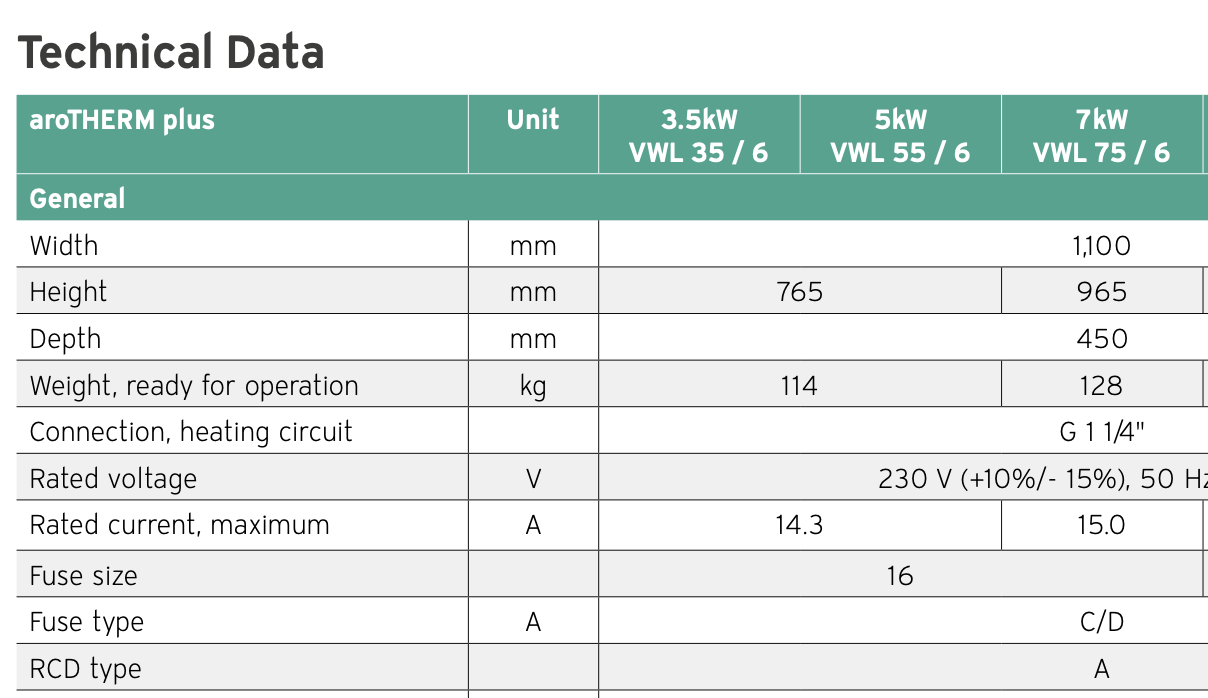
I am having my existing heat pump changed to a Vaillant (another story). The question of fuse type has come up in conversations. According to the Vaillant spec I need this:
It's not marked if it is the required c or d curve. If it is b curve, it may cause nuisance tripping more easily. The electrician should be able to confirm and get it swapped if it is not the recommended one. But as far as I am aware, a b curve is more sensitive and so would still trip in any situation it would be expected to (for safety).
8kW Solis S6-EH1P8K-L-PLUS hybrid inverter; G99: 8kW export; 16kWh Seplos Fogstar battery; Ohme Home Pro EV charger; Vaillant Arotherm Pro 7kW; 100Amp head, HA lab on mini PC
C or D curve breakers are often required when equipment has high inrush currents (typically seen in motors) that can result in nuisance tripping of B curve breakers.
Depending on your supply type fault protection may be provided by the the MCB portion of the breaker, or may be relying on the RCD component for both fault and additional protection.
C or D curve breakers are often required when equipment has high inrush currents (typically seen in motors) that can result in nuisance tripping of B curve breakers.
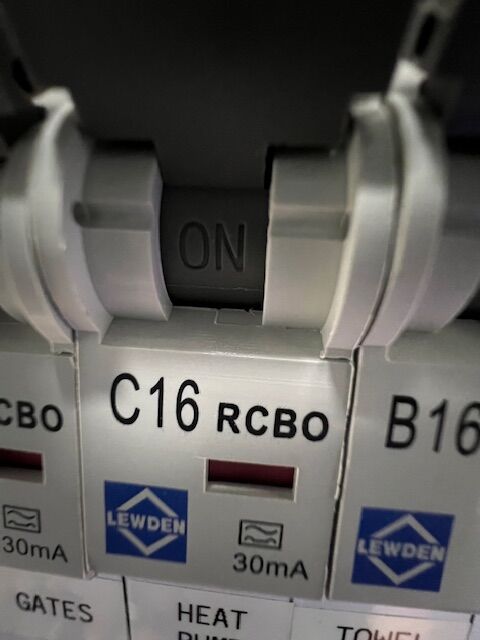
Thanks for confirming. I should have suspected "C16" (instead of "B16") would mean C curve on Lewden´s! 🤭 This Vaillant requires at least C, so all good.
Depending on your supply type fault protection may be provided by the the MCB portion of the breaker, or may be relying on the RCD component for both fault and additional protection.
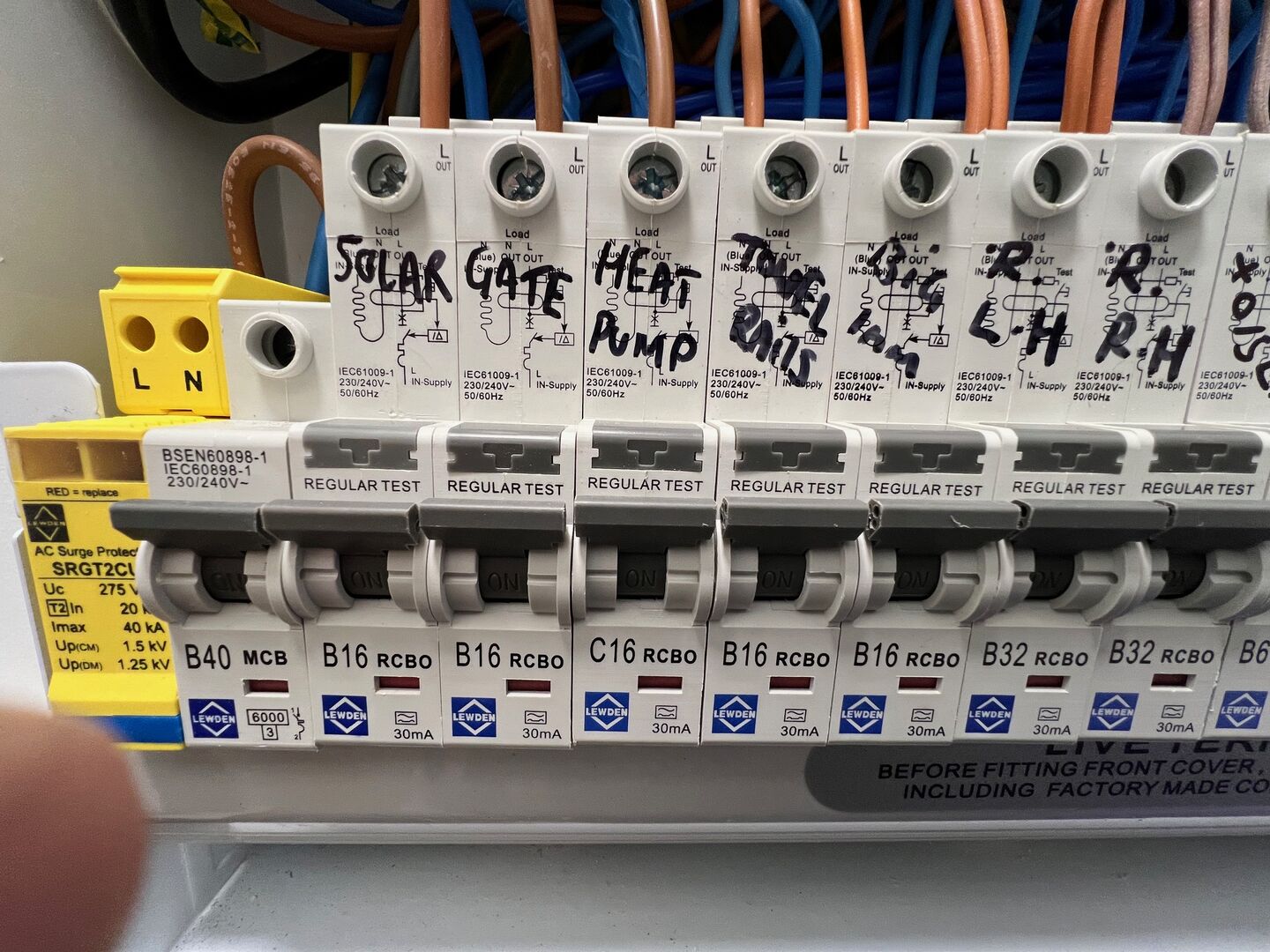
I assume you mean the MCB is limiting various RCBOs to a total of 40A. So in case the heatpump is loosing power, this could be because other circuits are drawing more than 24Amp.
8kW Solis S6-EH1P8K-L-PLUS hybrid inverter; G99: 8kW export; 16kWh Seplos Fogstar battery; Ohme Home Pro EV charger; Vaillant Arotherm Pro 7kW; 100Amp head, HA lab on mini PC
I am having my existing heat pump changed to a Vaillant (another story). The question of fuse type has come up in conversations. According to the Vaillant spec I need this:
It would appear that the installer has sent me an out of date spec document on the Vaillant heat pump. It now appears that I require a type B.
This means an additional consumer board needs to be fitted along with this new breaker.
This post was modified 8 months ago by trebor12345
2024 build bungalow, Southern England, 179 m2, 12w/m2 Underfloor heating, fully open
Vaillant aroTHERM plus 3.5kW
50 litre volumiser
3.6KW solar panels Tesla 13.5kw Powerwall 3
It would appear that the installer has sent me an out of date spec document on the Vaillant heat pump. It now appears that I require a type B.
This means an additional consumer board needs to be fitted along with this new breaker.
I suppose electricians prefer to have a consumer unit of the same brand as the RCBO. But if an EICR is carried out, if a different brand was used, this is rated amber, not red.
@transparent may be able to advise on what could work, essentially it seems to need to be 16Amp type A, B curve. Screwfix seems to have a wide range of Lewden
If Vaillant is that prescriptive about the type of RCD/RCBO, it is a shame they do not incorporate it into the appliance..
8kW Solis S6-EH1P8K-L-PLUS hybrid inverter; G99: 8kW export; 16kWh Seplos Fogstar battery; Ohme Home Pro EV charger; Vaillant Arotherm Pro 7kW; 100Amp head, HA lab on mini PC
I suppose electricians prefer to have a consumer unit of the same brand as the RCBO. But if an EICR is carried out, if a different brand was used, this is rated amber, not red.
If Vaillant is that prescriptive about the type of RCD/RCBO, it is a shame they do not incorporate it into the appliance..
Batpred I have limited knowledge of electrics, but I believe you are saying its not a good idea to fit RCBO's of a different manufacturer in the same consumer unit.
I also assume that there is not Vaillant spec RCBO that would be a direct replacement to my existing Lowden RCBO and consumer unit.
2024 build bungalow, Southern England, 179 m2, 12w/m2 Underfloor heating, fully open
Vaillant aroTHERM plus 3.5kW
50 litre volumiser
3.6KW solar panels Tesla 13.5kw Powerwall 3
There is absolutely no reason why modules from different manufacturers can't be installed into the same consumer unit.
The issue which electricians don't like is that there is no standard distance between the DIN rail and the height of the copper busbar which carries the live feed to the bottom of each trip. If the new/replacement trip is different to the others, the usual workaround is to place it on the end of the line, then use a pair of pliers to bend that end of the busbar to suit.
Before posting anything more, just think what it is that Vaillant are stating.
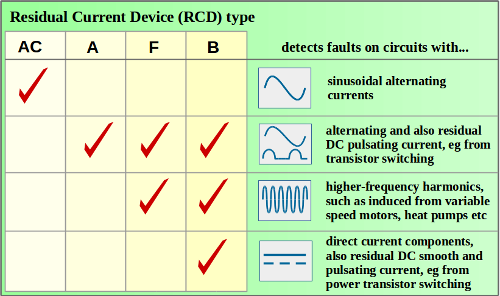
The document refers to an RCD, which means the Type-A or Type-B refers to whether it will trip due to the level of the DC component in the leakage current.
Type B is a fair bit more expensive, and normally only contemplated for supplying an EV charger.
@batpred then refers to an RCBO, which is a different device anyway, and not suggested by the Vaillant literature.
Either the heat-pump will be on a circuit fed from an RCD and an MCB, or else it will be fed by an RCBO.
Type B on an RCD, is totally different to 'curve B' (or curve-C) on an MCB. I've just re-read what you've both been writing above, and you've referred to those concepts inconsistently.
I'd suggest start again, and forget what you've already been trying to clarify to each other.
This post was modified 8 months ago by Transparent
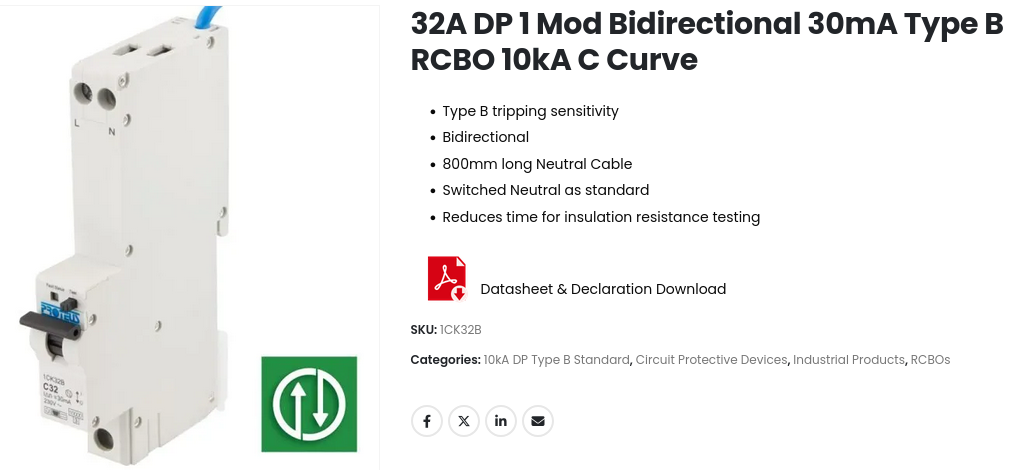
Type-B for the sort of earth leakage current it can detect
C-curve for the speed of high-current overload
bi-directional
... which is a stunning combination to find in a single unit.
Don't believe what you see on the Screwfix site. I've complained to them about their haphazard way of mixing up the concepts of 'curves' and 'types'. However the polite email I received in response told me that customer support didn't understand the problem in the first place.
If you want an accurate description, first go to an electrical wholesaler such as CEF or TLC. Once you've found a device which appears to fit the required description, download the manufacturer's own technical specification to check. Note the manufacturer's part-number and use that when ordering!
This post was modified 8 months ago 3 times by Transparent
It would appear that the installer has sent me an out of date spec document on the Vaillant heat pump. It now appears that I require a type B.
This means an additional consumer board needs to be fitted along with this new breaker.
From this table, I understand the following is needed in sequence to feed the heatpump:
the fuse/mcb is characteristic C - so C curve
the rcd is type B
An RCBO performs both functions.
The board you have includes several RCBOs and I assume all are being protected by a single B curve 40A MCB.
The heatpump cannot be fed by the same MCB. It needs a separate C curve MCB. But it also needs RCD type B.
If the MCB could be changed by a C curve one (and not invalidate manufacturers warranty, etc), perhaps you could avoid a separate Consumer unit.
But the main thing to focus is that a Type B RCD is needed. Wylex may be is a good brand that supplies them. It makes sense your electrician is suggesting they would use a separate CU (even if sometimes it could be avoided, the electrician that will sign it off ultimately decides).
8kW Solis S6-EH1P8K-L-PLUS hybrid inverter; G99: 8kW export; 16kWh Seplos Fogstar battery; Ohme Home Pro EV charger; Vaillant Arotherm Pro 7kW; 100Amp head, HA lab on mini PC