

Notifications
Clear all
Joining the Renewable Heating Hub forums is completely free and only takes a minute. By registering you’ll be able to ask questions, join discussions, follow topics you’re interested in, bookmark useful threads and receive notifications when someone replies. Non-registered members also do not have access to our AI features. When choosing your username, please note that it cannot be changed later, so we recommend avoiding brand or product names. Before registering, please take a moment to read the Forum Rules & Terms of Use so we can keep the community helpful, respectful and informative for everyone. Thanks for joining!

Topic starter
15/06/2026 6:11 pm
I thought people here might find this interesting, even if it is a new US company so probably not available here for a while, if ever. I need to think about it for a while to decide on the pros and cons compared to using electric batteries.
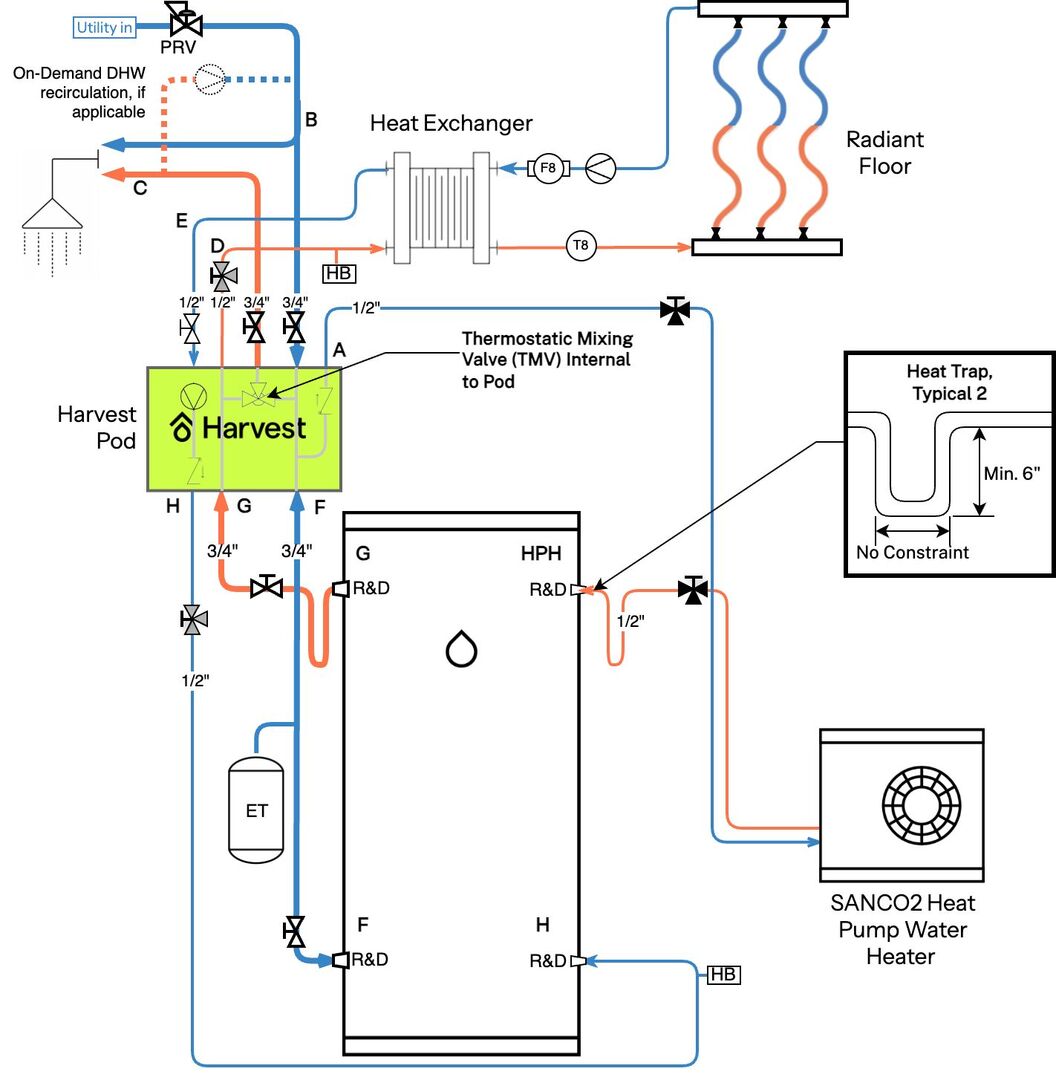
The idea is to use the ASHP to heat a large water tank. The minimum they work with is 300 l, so roughly 10kWh. The ASHP feeds hot water in at the top so it's stratified and stores a variable amount of heat energy. The new bit, called the Harvest pod, connects to the heat store to deliver hot water, there's also a heat exchanger to transfer heat to radiators or underfloor heating. Diagram below.
The claim is it can cut bills by 30%.
The smart bit is that it looks at your usage patterns for heating and hot water and the weather forecasts to determine how much energy you need and when. It then supplies that heat into the tank by running the heat pump at the most efficient times taking advantage of higher air temperatures, time of use tariffs and solar PV where it can.
It was developed by a married couple of engineers in California when they put in their own heat pump. Though one of the advantages they have is that their renewable electricity has a lot of solar, meaning electricity is cheap when the air is comparatively warm.
I found it on YouTube here Harvest Thermal at Amply Energy It's an exceptionally clear discussion with an amazing lack of waffle. The designer really knows her stuff and the podcast hosts are good on both heat pump technology and the needs of installers. A word of warning though, it's very American full of unfamiliar terms and archaic units, Fahrenheit, BTU's, Gallons (presumably US not imperial).
Their website it pretty good too Harvest Thermal Amongst other things I found this general schematic. They did mention it also works for 'European style radiators'.
I'd be interested to see what anyone thinks. I suspect it may seem dangerously similar to the dreaded buffer tank...

15/06/2026 8:17 pm
The idea is to use the ASHP to heat a large water tank. The minimum they work with is 300 l, so roughly 10kWh.
As its using ToU tarrifs then its totally believable so long as it heats the water to a reasonably high temperature when leccy is cheap.
Basically its an alternative to a battery. There is no doubt that storing energy in water is cheap. That's why I would advise anyone without an ASHP who has an immersion and solar to get a solar diverter in preference to a battery, and anyone who does have an ashp to heat their DHW on the cheap rate even though its a bit less efficient if cheap rate is when its cold outside.
The only problem is the energy density. US homes are big, UK homes aren't. Many here have problems finding space for a 200l DHW tank let alone another 300l tank.
If you have the space then its great for sure and very likely more cost effective in winter than a battery. In summer not so useful, although as climate change hits the UK you could cool the water instead of heating it, with the same effect. However the latter is a minority of days so probably, at least for now, think of it as a winter battery.
Its definitely good to remind people that storage of energy in water is an alternative worth considering, even if, for most houses, it isnt practical due to space. As I have personally been unable to make the case for a battery work, I may, having been reminded, do some back of the envelope calculations! An arrangement of valves and a couple of sensors would achieve most of the core functionality so it could be implemented in the UK with or without the company promoting it (and I am sure some have already done so).
This post was modified 4 months ago 4 times by JamesPa
4kW peak of solar PV since 2011; EV and a 1930s house which has been partially renovated to improve its efficiency. 7kW Vaillant heat pump.

15/06/2026 10:21 pm
The cooling side works much better if you can figure out how to get the energy out. The amount of kWh involved in freezing or melting a cubic metre of ice is crazy.
Topic starter
16/06/2026 6:18 am
Thanks @jamespa many good points.
I'm one of those struggling to find somewhere for a hot water tank. Though to be fair the heat battery is instead of a DHW tank not in addition. Which means it's much more economic if you don't already have a DHW tank.
You still need more space, also a strong floor. The tanks are tall for stratification so the load per square meter is pretty high. On the podcast they were talking mostly about basements and garages.
@etchedpixels nice image.
It makes me wonder if you could make a more compact version using the kind of phase change material as, say, in a sunamp heat battery. I don't know enough to say if they get the same stratification.

16/06/2026 7:31 am
It makes me wonder if you could make a more compact version using the kind of phase change material as, say, in a sunamp heat battery. I don't know enough to say if they get the same stratification.
I think the answer must be yes, but the cost advantages over a battery probably vanish (and a battery will always be more flexible). Im not sure if stratification is relevant to phase change because the phase change, which is what releases most of the energy, happens at constant temperature (think of ice melting!).
Though to be fair the heat battery is instead of a DHW tank not in addition.
OK but that means you need to subtract your DHW tank storage capacity from the heat battery capacity if you are looking at added value.
However its an interesting thought. I heat 210l of water to 48C in my DHW tank. My ASHP is capable of heating it to 70C (and does so once a week for the legionella cycle). The difference is about 5kWh. Currently my daytime rate is 32p and my nighttime rate 8p (Intelligent Go), so in principle I could save £1.20 per day by heating my DHW tank more and releasing the excess to heating during the day.
This would apply for half the year, so about £200 per year. With Cosy the tariff differential is smaller, but you get to do the trick three times a day not just once. A bit of electronics and some valves (including some temperature limiting valves) could make this happen. If someone could productize a way of doing this as an add on to any heat pump cylinder/system, sell it for say £600 installed (or maybe up to £1000) it could be a compelling alternative to a battery albeit at the expense of a little comfort during 'diversion'. I guess thats what Harvest is trying to do, and maybe succeeding. Can that hydronic circuit be simplified down so that its a simple addition to an existing system?
When I get some spare time from my other heat pump thought experiment (how to solve the 'boiler failed' market) I may give this some mental attention.
This post was modified 4 months ago 6 times by JamesPa
4kW peak of solar PV since 2011; EV and a 1930s house which has been partially renovated to improve its efficiency. 7kW Vaillant heat pump.
16/06/2026 1:18 pm
@etchedpixels nice image.
It makes me wonder if you could make a more compact version using the kind of phase change material as, say, in a sunamp heat battery. I don't know enough to say if they get the same stratification.
Stratification and size changes too. Phase change materials tend to change size and thus need a rather more flexible containment.
There has been a decade of excitement in academia about phase change materials and buildings, some experiments but afaik not really anything in mass usage yet. Generally though it's not about tanks and containing it but putting it within the building fabric so that the building has a very high thermal mass at the desired temperature. That avoids all the complexity of putting the energy into a box and taking it back out again.
This post was modified 4 months ago by EtchedPixels
16/06/2026 1:26 pm
@etchedpixels nice image.
It makes me wonder if you could make a more compact version using the kind of phase change material as, say, in a sunamp heat battery. I don't know enough to say if they get the same stratification.
Stratification and size changes too. Phase change materials tend to change size and thus need a rather more flexible containment.
There has been a decade of excitement in academia about phase change materials and buildings, some experiments but afaik not really anything in mass usage yet. Generally though it's not about tanks and containing it but putting it within the building fabric so that the building has a very high thermal mass at the desired temperature. That avoids all the complexity of putting the energy into a box and taking it back out again.
Thats a very good point; as you say the other approach to energy storage is to use the fabric of the building, albeit at the expense of some variation in IAT. Homely, Passiv and Adia all, I believe, do that, turning the flow temperature up (and thus heating the building more) when leccy is cheap.
4kW peak of solar PV since 2011; EV and a 1930s house which has been partially renovated to improve its efficiency. 7kW Vaillant heat pump.

16/06/2026 1:46 pm
@jamespa The technique of ‘overheating’ the fabric of the building during cheapest tariff times may or may not suit everyone; the Homely smart controller when set to ‘Smart+’ does this and having tried this, I switched Smart+ off. I found the overheating just too uncomfortable and as my cheapest 8 hours of Cosy tariff are stored in a battery, there is very little to be gained anyway. Regards, Toodles.
Toodles, heats his home with cold draughts and cooks food with magnets.
16/06/2026 1:47 pm
@toodles With a phase change material the point is that the building doesn't change temperature due to the phase change. Instead it sits stubbornly at the same temperature unless you put a vast amount of energy in or take a vast amount out.
The same way an ice block sits at 0C until it melts even if you stick it on a radiator.
16/06/2026 1:52 pm
@jamespa The technique of ‘overheating’ the fabric of the building during cheapest tariff times may or may not suit everyone; the Homely smart controller when set to ‘Smart+’ does this and having tried this, I switched Smart+ off. I found the overheating just too uncomfortable and as my cheapest 8 hours of Cosy tariff are stored in a battery, there is very little to be gained anyway. Regards, Toodles.
I agree entirely. My heat pump is entirely capable of programmed 'set forward' without resorting to on/off control but, as yet, I haven't tried it, largely for the reason you state.
I may try it this coming season, perhaps setting forward 3C for the 6 cheap rate hours at night and then back 3C in the morning. Its possible it works for us because the room in which we spend most of the morning time is in part heated by a fancoil with its own thermostat (which modulates the fan not the water feed), so will be more stable than the rest of the house. I suspect I will have to turn the bedroom rad down even further, which will be challenging because its already 50% oversized relative to most of the others
This post was modified 4 months ago by JamesPa
4kW peak of solar PV since 2011; EV and a 1930s house which has been partially renovated to improve its efficiency. 7kW Vaillant heat pump.
16/06/2026 1:54 pm
@etchedpixels My comment was in reply to @jamespa commenting on devices that overheat the fabric. As to PCM, I have a Sunamp Thermino ePV 210 for my DHW requirements as the space requirement is a smaller problem altogether.😉 Regards, Toodles.
Toodles, heats his home with cold draughts and cooks food with magnets.
Topic starter
17/06/2026 7:01 am
Thanks again, that's really helping to move my understanding forward.
This business of storing heat in the fabric of the building might work for me. My 100+ year old mid terrace has brick internal walls, less external area and is well insulated. Even when it's zero outside the indoor temperature only drops 2 or 3 C overnight.
On Intelligent Octopus Go, as I am, that isn't a good fit. I'm in all day and, naturally, like it warmest in the evening. However, when it's not so cold outside it might work. A tariff like Cosy would be much better for comfort. It would be more expensive though as I do a lot of miles and so my car uses more electricity than a heat pump would.
Out of curiosity I dusted off my 40+ year old physics knowledge and tried to measure the heat capacity of my house. More of a very rough estimate. The equation is blessedly simple:
Heat Capacity (Joules per degree C) = Time constant (seconds) x Heat Transfer Coefficient (Watts per C).
But the values are very difficult to measure.
The Heat Transfer Coefficient is the heat loss/temperature difference. My heat loss is in the range 3.6-5.4kW, so HTC of 150-225 W/C. The lowest measured from gas consumption and degree days (over a month with the house at a constant 18C), the highest calculated from a heat geek survey.
Time constant is worse - that's the time for the temperature difference to decrease by 37% (1/e). So starting at 21C inside -3C outside that's the time for the indoor temperature to drop to 15C. Only in reality the outside temperature isn't constant, I don't have data logging thermometers. Also there's always a heat input from the houses either side. Me and the dog put out some 100s of watts. (Seriously, the temperature in the living room often rises when we're in there.) All that said I think it's in the range of 10-15 hours.
Which all puts my heat capacity in the range 1.5-3.4 kWh/C.
So, quite a big heat battery, no?
Page 1 / 2
Next
SPONSORS

Degrees of Separation
Latest Posts
-

RE: How will removing the standing charge on gas bills benefit heat pumps?
The shoulder months are very difficult to judge COP on ...
By scrchngwsl , 25 minutes ago
-
RE: Indevolt Batteries UK Support & Info Thread
@editor Hi, To resolve this, please tap on the A...
By Indevolt Tech , 7 hours ago
-
RE: How much of your renewable and home setup would still work if the internet went down?
Interestingly we had an internet outage about a month a...
By Rob of York , 22 hours ago
-
RE: Double or Triple Glazed Windows?
Posted by: @singlespeed With 9 years repairing windo...
By Rob of York , 22 hours ago
-
@transparent we’re still running a secure version of PH...
By Mars , 1 day ago
-
RE: How quickly would you want/expect heat recovery to take from setback?
Much longer than that here. The heating isn't even on. ...
By bobflux , 2 days ago
-
RE: Passiv Smart Thermostat - Help & Forum Support
Obviously the weather is changeable but there's a defin...
By Singlespeed , 2 days ago
-
RE: The Changing Jet Stream Could Challenge UK Air Source Heat Pumps
@rob-of-york I must admit that when we had a Daikin hea...
By Toodles , 2 days ago
-
RE: Forum updates, announcements & issues
Get the Renewable Heating Hub heads-up on WhatsApp. I...
By Mars , 2 days ago
-
RE: Safety study for plug in batteries out to tender - looks like Q3 2027 at best before legal
@editor I pointed out to the one of the Fuse execs that...
By dansus , 2 days ago
-
RE: 15kw pump for 225m2 1990's house - over kill?
@seaviews As well as loft insulation, there are othe...
By Rob of York , 2 days ago
-
RE: BT cuts you off, Plusnet blames Openreach... welcome to “seamless” broadband switching
Both of which (in most cases) use Openreach for the las...
By JamesPa , 2 days ago
-
RE: Renewables & Heat Pumps in the News
Yes, this is a swiss and german standard I believe, Vai...
By Batpred , 3 days ago
-
RE: Octopus Cosy 12 Heat Pump Regret: Incredibly Loud, Poor Heating & Constant Hum - Help!
@editor FWIW my problem was resolved, eventually, after...
By BigFish , 3 days ago


SPONSORS