

Notifications
Clear all
Joining the Renewable Heating Hub forums is completely free and only takes a minute. By registering you’ll be able to ask questions, join discussions, follow topics you’re interested in, bookmark useful threads and receive notifications when someone replies. Non-registered members also do not have access to our AI features. When choosing your username, please note that it cannot be changed later, so we recommend avoiding brand or product names. Before registering, please take a moment to read the Forum Rules & Terms of Use so we can keep the community helpful, respectful and informative for everyone. Thanks for joining!

31/01/2025 12:14 pm
With our house it takes 12hrs to lost 1° but only takes about 6-8hrs to heat it up. So our schedule is heat from 08.00hrs to 16.00hrs then off for the rest of the time. All I do is change the length of the running time to match the conditions outside. At present the house is gaining about 0.1 to 0.2° each day, but next week it might lose that as it gets colder.
At present we can run the house on either WC or flow temp, but it only needs to run at 25-27° flow, to get the house to 20°. Next year I'm hoping we can get it down to 23° and still maintain the same degree of comfort.
With a very low loss house running at very low flow temperatures its true that the reduction in efficiency from running at the only slightly higher flow temp required for part time heating may be outweighed by other factors (particularly if you have multiple pumps) thus making part time heating cost effective. I can see that your house may well fall into this category.
In the more common case its nevertheless worth bearing in mind that the house continues to lose heat even when the heat pump is off, and you have to replace that heat when its switched back on. In your example, where the house takes 12 hrs to fall 1C and 6hrs to heat up, the heat loss from the house to the outside air is only 5% less than if you were to keep it at a constant temperature 24*7. You have to replace this heat loss, so you will need to supply 95% of the energy (relative to the full time heating case) in half the time, which means that a detlaT somewhere has to be double or more.
For radiators its the deltaT between radiator and room, and actually it will have to be 2.3 times as much (because radiator emissions scale with deltaT^1.3). In this case the reduction in COP will almost certainly wipe out the 5% saving in energy lost by the house, even allowing for fixed loads.
With UFH its not quite clear what deltaT has to double to deliver 95% of the energy in half the time. Its probably the deltaT between pipes in the UFH and the screed, which is small. Furthermore at the low FTs typical of UFH systems, the variation in COP with FT is less severe. Thus other factors may dominate. Furthermore if, in this case, you can heat only when electricity is low cost, you will be well cheaper.
4kW peak of solar PV since 2011; EV and a 1930s house which has been partially renovated to improve its efficiency. 7kW Vaillant heat pump.

31/01/2025 1:17 pm
@jamespa thank you for that, I never understand the full maths behind it all and things like that. I just did it on my findings.
We did try on a couple of days, at the start of Jan and found running at 23° flow for 24hrs kept the house at the right temp all the time, but the actual running cost where 3 times normal.
In the end I just extended the run time to 12hrs on, 12hrs off and that kept the temp to within 1° loss.


31/01/2025 2:37 pm
@iraknic we just discussed you buffer tank “design” on our latest podcast recording (it will be out this Wednesday) and @heacol was actually ‘impressed’ that you were even able to get a DT of 1 with the way it’s been piped in.
🔥 Britain’s Heat Pump Shitshow
How Installing a Heating System Became a National Nervous Breakdown
Free UK shipping.
📗 Heat Pumps Explained
A Jargon-Free Guide for Homeowners
Rewritten and updated for 2027
📘 From Zero to Heat Pump Hero
🛠️ Bodge Buster
New to heat pumps?
Take the Heat Pump Fundamentals course and use INTRO50 at checkout for 50% off.
1

Topic starter
31/01/2025 3:02 pm
@editor 🤣 thanks. Please provide is with a link for the podcast when its out.
1


31/01/2025 3:03 pm
@iraknic we just discussed you buffer tank “design” on our latest podcast recording (it will be out this Wednesday) and @heacol was actually ‘impressed’ that you were even able to get a DT of 1 with the way it’s been piped in.
I’m assuming that this means that as installer mistakes go this way of piping up a buffer is pretty bad? The correction should be to re-pipe it as a volumiser?
2kW + Growatt & 4kW +Sunnyboy PV on south-facing roof Solar thermal. 9.5kWh Givenergy battery with AC3. MVHR. Vaillant 7kW ASHP (very pleased with SCOP >4) open system operating on WC
31/01/2025 4:49 pm
@judith the correct is to repipe as a volumiser or correctly as a 4-port buffer, with proper balancing on both sides of the hydraulic separation to minimise distortion (aka, blending).
🔥 Britain’s Heat Pump Shitshow
How Installing a Heating System Became a National Nervous Breakdown
Free UK shipping.
📗 Heat Pumps Explained
A Jargon-Free Guide for Homeowners
Rewritten and updated for 2027
📘 From Zero to Heat Pump Hero
🛠️ Bodge Buster
New to heat pumps?
Take the Heat Pump Fundamentals course and use INTRO50 at checkout for 50% off.
31/01/2025 10:24 pm
@editor I must learn how to select an emoji to indicate extreme irony, or probably better still don’t indulge it in writing.
You kindly showed the right way to pipe up a 4 port buffer in post 2 for @iraknic but I don’t believe we have enough information to know whether it is needs to be piped as a volumiser instead. Unless I missed details of the whole house design earlier such any difference between flow temperature in the 2 zones. The flow temperatures given earlier are much too high for good efficiency.
2kW + Growatt & 4kW +Sunnyboy PV on south-facing roof Solar thermal. 9.5kWh Givenergy battery with AC3. MVHR. Vaillant 7kW ASHP (very pleased with SCOP >4) open system operating on WC
1
31/01/2025 10:50 pm
@judith, I completely missed the irony. My bad. An irony emoji would have been perfect here, but I can’t think of one either! 😂
After recording with our guests today, it’s clear that the volumiser (if additional volume is even needed) is by far the most sensible solution. The complexity of balancing flows pre- and post-buffer is huge, and it’s easy to see why so few systems with buffers work efficiently.
🔥 Britain’s Heat Pump Shitshow
How Installing a Heating System Became a National Nervous Breakdown
Free UK shipping.
📗 Heat Pumps Explained
A Jargon-Free Guide for Homeowners
Rewritten and updated for 2027
📘 From Zero to Heat Pump Hero
🛠️ Bodge Buster
New to heat pumps?
Take the Heat Pump Fundamentals course and use INTRO50 at checkout for 50% off.


01/02/2025 11:10 am
it’s easy to see why so few systems with buffers work efficiently.
Erm...is it? 🤔
I'm finding this discussion very difficult to follow without diagrams.
Even tho' I can broadly understand the text when reading it multiple times,
I'm losing track of who is advocating what changes.
Save energy... recycle electrons!
1
01/02/2025 12:20 pm
@transparent I lack the skills as an animator to illustrate stratification and how it gets affected by distortion. I'm hoping we explained it better in our podcast video.
🔥 Britain’s Heat Pump Shitshow
How Installing a Heating System Became a National Nervous Breakdown
Free UK shipping.
📗 Heat Pumps Explained
A Jargon-Free Guide for Homeowners
Rewritten and updated for 2027
📘 From Zero to Heat Pump Hero
🛠️ Bodge Buster
New to heat pumps?
Take the Heat Pump Fundamentals course and use INTRO50 at checkout for 50% off.
01/02/2025 12:33 pm
I had assumed this subject could be described with static diagrams,
which I could create if members here posted a doodle - literally on the back of an envelope...
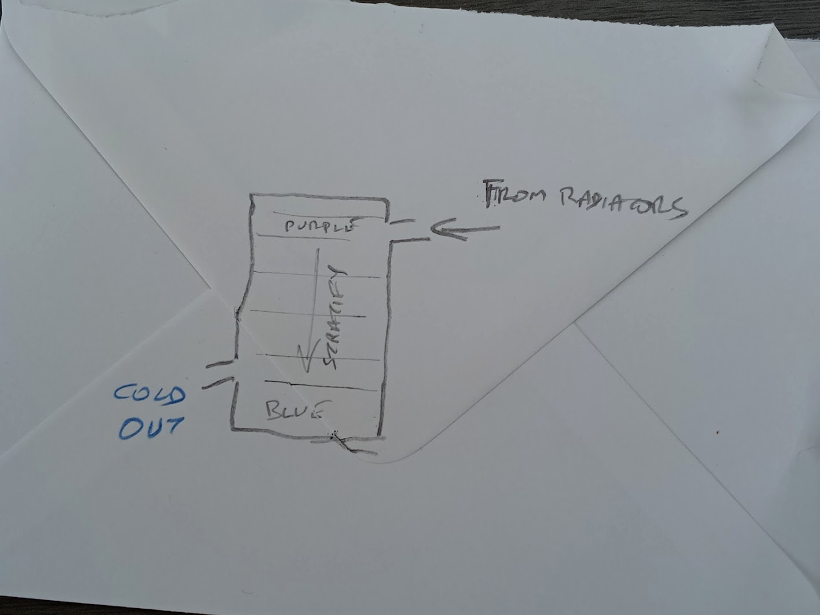
If we need animation,
then we ought to find someone who can create this using ChatGPT.
Save energy... recycle electrons!
1

01/02/2025 3:58 pm
Just dug this up with google
https://www.youtube.com/@ThermalStratifier
A properly designed buffer vessel shouldn't be impossible to achieve.
Bob
1

SPONSORS

Degrees of Separation

Latest Posts
-

RE: How quickly would you want/expect heat recovery to take from setback?
@jamespa no particular problem, just generally interest...
By AndrewJ , 36 minutes ago
-
RE: Renewables & Heat Pumps in the News
Yes, I am a member of the SEC, and therefore aware of t...
By Transparent , 14 hours ago
-
RE: Renewable Heating Hub Homeowners' Q&A Podcast
Come for the low-carbon homes. Stay for George Clarke’s...
By Mars , 17 hours ago
-
RE: Octopus Cosy 12 Heat Pump Regret: Incredibly Loud, Poor Heating & Constant Hum - Help!
@razz, as we head into the heating season, I just wante...
By Mars , 19 hours ago
-
RE: How should the Boiler Upgrade Scheme be reformed?
Not quite, regular A2W heat-pumps need a load of extra ...
By Temperature_Gradient , 2 days ago
-
RE: Heat Geek installations: share your experiences
one thing i learnt from reading people’s comments and e...
By Batpred , 3 days ago
-
RE: Cooling/heating with one unit
"The way we use A2A on a cheap overnight EV tariff is t...
By mrkfm , 3 days ago
-
RE: Do I add Air Con or MVHR to existing A2W ASHP?
We have ‘signed on the dotted line’ today for a Panason...
By Toodles , 3 days ago
-
RE: Heat pump branding. Clever, contemporary… or a bit too much?
...or it was there and was lost thanks to laziness and ...
By Majordennisbloodnok , 3 days ago
-
@bobflux Thank you for your response. I am trying to ...
By RonV. , 3 days ago
-
Bufferless design & control of Chinese air to water monoblock hybrid heat pump in Alberta, Canada
This post is about how I successfully configured a buff...
By Tony.Stolz , 3 days ago
-
The installer visited yesterday and suggested the noise...
By JamesChatz , 3 days ago
-
RE: HeatGeek vs Octopus surveys: puzzling disparity - any ideas why?
Your house sounds a lot like mine. 2 surveyors each sp...
By JamesPa , 3 days ago
-
RE: Heat Geek Zero Disrupt: Are We Sleepwalking Into Another Race to the Bottom?
Thats true only if you do the wrong experiment. Done c...
By JamesPa , 3 days ago






SPONSORS