Further to the post above I have now worked out (I think) 2 port buffers. The conclusion is, just like 4 port buffers - avoid. Here is the explanation and if anyone thinks I have got it wrong I am happy to be corrected!
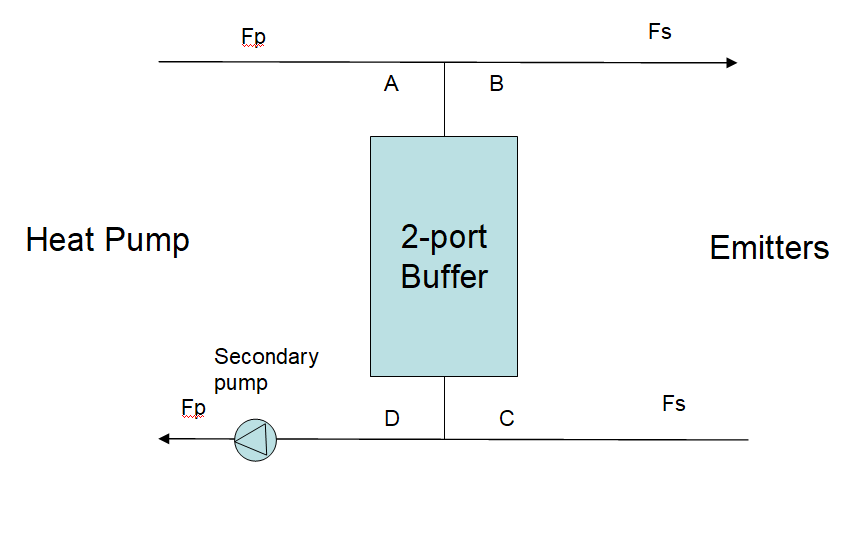
The above diagram illustrates the 2 port buffer arrangement such as in the installation reported by @mike-camelot. In this scenario what was billed as a volumiser (in the flow or in the return) was in fact plumbed as a 2 port buffer (ie like the above diagram) and subsequently defended by the installer.
Note that, although the buffer represents a shunt between flow and return, water will still flow in the secondary, the water flows will distribute themselves between the two 'routes' through the system to equalise pressure drops, resulting in potentially different flow rates through the primary and secondary, represented by Fp and Fs respectively. These will be determined buy the speed (head) of the pumps in the ASHP and the secondary, and the relative resistance of the loops. They may change if (a) the heat pump modulates its pump speed to achieve a particular DT (some do, some dont) or (b) the emitter resistance changes because of valves opening and shutting.
Ta, Tb, Tc, Td represent the water temperatures at points A, B, C, D
There are three scenarios
If Fp=Fs, ie the circuits are balanced, all the water flowing from the heat pump also flows through the emitters and the system operates as if there were no buffer. In this case there is no distortion, no mixing, and the DT across the emitters will be the same as in a system without a buffer. However no water flows through the buffer which, as a result, does not heat up (in practice it will almost certainly heat up slowly), compromising its function as a volumiser.
If Fp >Fs then some of the flow is diverted through the buffer. This will increase Td relative to Tc, because some of the return water is diluted by the flow. Ta will equal Tb so the flow temperature to the emitters will not be reduced relative to case (a) but, because there is a lower rate of flow in the secondary, DT across the emitters will be increased. This will reduce the average surface temperature of the emitters which will in turn reduce their output leading to a requirement to increase flow temperature relative to case 1, reducing efficiency by roughly 1.5% for each degree that DT (=Ta-Tc) rises above the nominal 5C for which most heat pump systems are designed.
If Fp<Fs then some of the return is diverted through the buffer. This will reduce Tb relative to Ta because the flow water is diluted by recirculating return water. DT across the emitters will be the same as in case (1) but, because the flow has been diluted and is thus cooler, the output will be reduced, leading to a requirement to increase flow temperature relative to case 1, reducing efficiency by roughly 3% for each degree degree that Tb is lower than Ta.
In summary case 1 reduces or eliminates the effectiveness of the buffer as a volumiser. Cases 2 and 3 result in the need to increase flow temperature thus compromising efficiency. In practice all 3 cases may occur from time to time in any given system if the heat pump modulates its water pump as a function of output, or the system is zoned so the secondary resistance changes. In both case 2 and 3 there is the additional concern that the heat pump 'sees' a different DT to that seen by the emitters. Since some heat pumps modulate their water pump to control DT, this is clearly undesirable.
So why fit a 2 port buffer at all? Well because it acts as a shunt, it fools the heat pump into thinking that there is a high flow rate whatever the state of the secondary and thus stops 'low flow' errors. This will 'proof' the system against multiple zones simultaneously shutting down and avoid installer call outs. However the latter shouldn't happen in a properly designed properly operated system where the majority of the emitters are operated open loop. Furthermore the same effect, but without the undesirable side effects, could be achieved by fitting a pressure operated shunt which opens only when there is excess pressure in the secondary.
In conclusion, for at least the majority of houses where a single water pump (eg the one included in the body of most heat pumps) has sufficient head to achieve the required flow rate with the emitters open, I can see only harm in fitting a 2 port buffer as a substitute for a volumiser.
4kW peak of solar PV since 2011; EV and a 1930s house which has been partially renovated to improve its efficiency. 7kW Vaillant heat pump.
@mike-camelot I have used Heatpunk as well as my own spreadsheet and got both to align with annual heating bills. I have a copy of heat engineer but got indigestion at yet again having to enter all of the dimensions. Heatpunk was fine however.
Are you entitled to to a BUS grant? I thought it was to replace an existing boiler?
2kW + Growatt & 4kW +Sunnyboy PV on south-facing roof Solar thermal. 9.5kWh Givenergy battery with AC3. MVHR. Vaillant 7kW ASHP (very pleased with SCOP 4.7) open system operating on WC
@mike-camelot, addressing your invoicing and billing, under the Boiler Upgrade Scheme, the grant is normally applied at point of sale and deducted directly from the invoice. The homeowner should not be left guessing whether an application has been submitted or who submitted it. You should have clear written confirmation of if and when the BUS application was made, under which MCS number, and by which company.
A key question: does your formal invoice show the £7,500 BUS grant clearly deducted?
If it doesn’t, or if you paid the full amount up front with vague assurances it would be “sorted later”, that is not how the scheme is intended to operate and puts you in a very exposed position.
Please let me know if your final invoice has factored in the deduction for the £7,500. Also have you made the final payment?
@kenbone just sent across his technical observations to me which I will share on his behalf:
The cylinder does not appear to conform to G3 requirements.
The D1 discharge pipe run looks excessively long, which may be non-compliant.
The two-pipe buffer/volumiser arrangement shown would normally require an additional pump downstream of the buffer, or alternatively a properly specified automatic bypass valve installed on either the inlet or outlet side.
As installed, the heat pump is likely short-cycling around the buffer, effectively switching on and off “like a yo-yo”, with very little usable heat actually being delivered to the emitters.
Ken does note one possible caveat: if this is a UFH system and there are independent pumps on the UFH manifolds, that may partially change the hydraulic behaviour, but this would still need to be confirmed against the design intent and manufacturer guidance.
Taken together, I think Ken's points suggest the system is not hydraulically optimised and may explain both the high consumption and the poor performance being reported.
Excellent information. The NIBE "myuplink.com" give access to about 30 parameters which has been a great help in adjusting the system. I had planned to start checking the supply and return temperatures at points that are not displayed through Myuplink only to find the temperature probe had failed! I have ordered a new unit. Once I have it I will carryout the checks you suggest.
Thank you for your remarks about my installer. Next week I will move to a more demanding phase.
With my heat pump being 12Kw, even with it running at "low" output and the sizeable volume of the UFH it is still running a 1 to 1 ½ hours cycles. I will be installing more monitoring once I sort the installer problem.
The house is a new build so I have all the plans, insulation values, and leakage. Just have sit down and do the calculations.
Once I have it I will carryout the checks you suggest.
If you measure temps at A, B, C and D in my diagram above it should be possible to work out exactly what is going on. Best done on (a) a very cold day when the heat pump is working hard and (b) a mid-season day when its working at typical load. Obviously if its cycling you need to make the measurements some way into an 'on' phase and operating stably. Make sure the probe is well in contact with the pipe and preferably put some insulation over, so you are definitely measuring pipe temperature. Take a note of what the heat pump thinks FT and RT are at the same time.
This post was modified 1 month ago 2 times by JamesPa
4kW peak of solar PV since 2011; EV and a 1930s house which has been partially renovated to improve its efficiency. 7kW Vaillant heat pump.
I had planned to start checking the supply and return temperatures at points that are not displayed through Myuplink only to find the temperature probe had failed! I have ordered a new unit. Once I have it I will carryout the checks you suggest.
Mike, I suggest you order a set of cheap digital temperature units with remote probes. These from Amazon would be fine; and would arrive tomorrow (Sunday) if you have a Prime account.
You can push the sensor probes between the pipe and insulation, and move them along as you gradually discover what's happening.
If you want a couple of these today, then your local Garden Centre might have them... but not at that price of course!
You need to scroll down for English (sorry that's rather obvious). It would seem that my installer has used option 2
"Volume and flow increaser and reduction in heat spikes"
I am not familiar with G3.
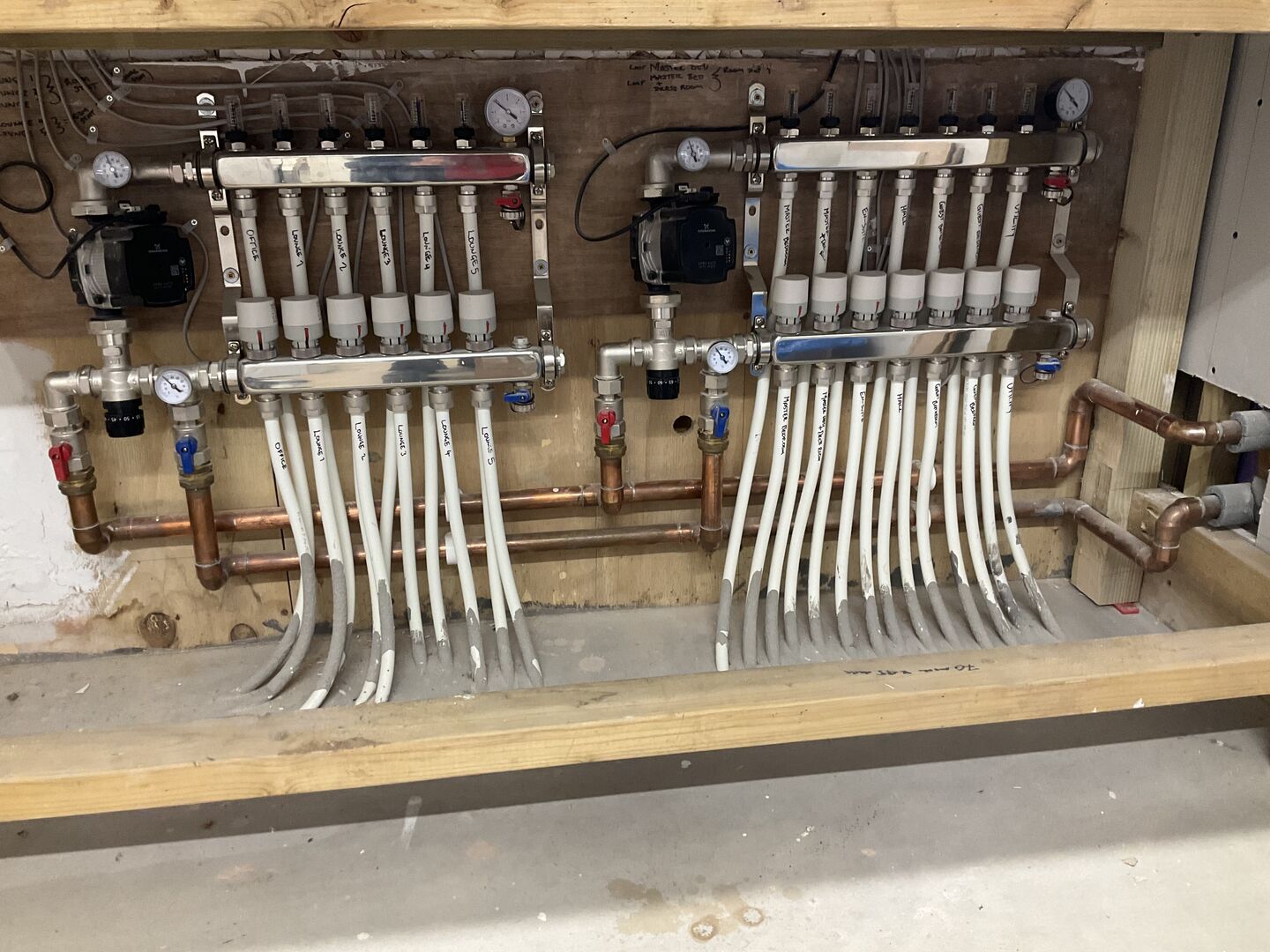
I'm having trouble attaching a photo of my UFH manifolds. Basically I have 2 manifolds with 7 loops on one and 6 loops on the other. There is a pump for each manifold.
The heat pump is cycling at approximately 1 to 1 ½ hour intervals between 26C to 33C. This obviously varies with the weather compensation.
I would definitely agree that the system needs optimisation. Since the installer has not completed the "heat loss" calculation I will attempt it myself.
G3 is the building regulation related to safety of unvented cylinders. It requires certain safety measures be implemented to prevent explosion due to overheating/boiling. One of these is a vent pipe with a tundish (a point open to the air) which must be able to conduct steam/water to a place of safety in the event of overpressure. D1 and D2 are the pipes either side of the tundish, both of which have fairly tight specifications in the 'guidance' in the approved document, to which installers pretty rigidly adhere.
I'm having trouble attaching a photo of my UFH manifolds. Basically I have 2 manifolds with 7 loops on one and 6 loops on the other. There is a pump for each manifold.
I'm going to write my initial observations of the manifolds photo, not just for Mike's benefit, but so that others can follow.
1: These two pumps do indeed pull water from the volumiser. That answers what @editor wrote above.
2: The 22mm supply and return pipes should, of course, be insulated, and with a 13mm wall thickness, rather than the 9mm we can see on the right.
3: Right-angle bends on pipes shouldn't be used. For low-temperature installations, the loss of flow pressure becomes significant. Either a 'swept bend' should've been used, or else make the bends out of straight pipe using a former/bending jig.
Three right-angle bends within 30cm of pipe is indicative of poor planning. If those pipes really did need to follow those paths, then I could've done it with a pair of 45° elbows on each of flow and return.
4: The pump arrangement includes a mixer-valve below it.
You wouldn't expect to need that type of manifold on a system with a heat-pump. The flow temperature doesn't need reducing by mixing with a proportion of the Return (lower section of the manifold).
Manifolds with Mixer-Pumps are used when the flow temperature will be too high to run straight into the floor. Typically that's because there's a top layer of engineered wood, which will warp if the pipework is too hot (above 50°C at the manifold)
5: There's no air-release valves on these manifolds.
There should be one at every point where the entry point is below a section of pipework. In this case the entirety of the two manifolds is above the hot/cold feed pipes.
6: We need to consider what happens if all those motorised valves shut off because the connected thermostats no longer 'call for heat'.
In your case, I think the heat-pump will remain on... simply keeping the volumiser nice and warm!
Ideally you shouldn't have thermostats and motorised valves there at all. The lower manifold (the return) would have manual valves, which you'd adjust to make the flow even throughout the different lengths of UFH pipe. The top manifold has flow-indicators to facilitate that balancing.
The heat-pump will then adjust its output according to the temperature of the return water.
7: I'm dubious about that plywood backing board.
It should be a water resistant, structural element. I would've used Fermacell, or similar cementitious board. (Mike - this is stocked by Bradfords in the West Country).
And I'd have left a gap below it. If there's a flood due to a broken pipe, then you don't want the bottom of the backing board sitting in the water.
This post was modified 1 month ago 2 times by Transparent