

Notifications
Clear all
Joining the Renewable Heating Hub forums is completely free and only takes a minute. By registering you’ll be able to ask questions, join discussions, follow topics you’re interested in, bookmark useful threads and receive notifications when someone replies. Non-registered members also do not have access to our AI features. When choosing your username, please note that it cannot be changed later, so we recommend avoiding brand or product names. Before registering, please take a moment to read the Forum Rules & Terms of Use so we can keep the community helpful, respectful and informative for everyone. Thanks for joining!

06/03/2026 9:53 am
@batpred You are correct, for new customers. If I switch to Flux in April, when I want to switch back to Go in October, the rates I get might be different and even higher than 9.5 p.
Not a big deal, but as Outgoing Octopus has dropped to 12 p, and given that our South West facing array produces good chunk from 4 pm to 7 pm, thought moving to Flux is probably a good move. But, if that means we would have to pay higher rates when the HP is running whole day and EV needs more charging due to lower efficiency and pre entry climate control, then probably this move for summer is not worth it. I might do some modelling to see at what rates would it tip over the balance. At least Octopus makes such analysis easy by letting you download half-hourly consumption and export data.
16 * 435 watts PV
13 kWh Growatt battery
1 EV - Mercedes EQB
6 kW Aira Heat Pump
Bosch Induction Hob
Pod Point Solo 3 charger
2

06/03/2026 12:15 pm
Thanks for sharing your thinking. It made me think how many factors need to be considered to optimise the tariffs when you have so much renewable technology..
8kW Solis S6-EH1P8K-L-PLUS hybrid inverter; G99: 8kW export; 16kWh Seplos Fogstar battery; Ohme Home Pro EV charger; Vaillant Arotherm Pro 7kW; 100Amp head, HA lab on mini PC
1
06/03/2026 12:54 pm
Electricity retailers offer fixed price deals. By agreeing the purchase price in advance they can manage the risks. Electricity generators probably buy fuel in advance as well (obviously not renewables). All this trading creates a market for data centres.
I assumed you were joking here.
Hence my joke about a data centre in planning consultation stage: the backup diesel generators are so large that they led some people to start questioning whether they would just be used in regular tests.
Clearly industrial electricity prices have been rising very significantly in the UK, according to DESNZ:
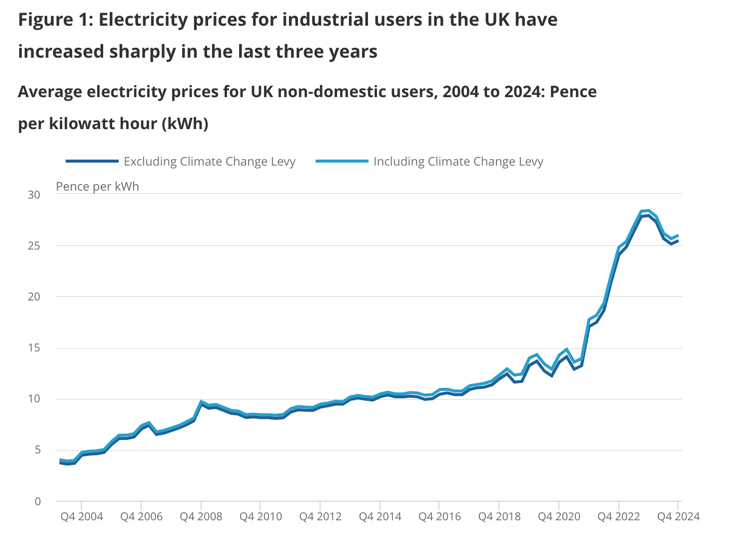
Could we say that the UK market protects consumers better than in the US, where domestic prices rose by 6% in 2025?
8kW Solis S6-EH1P8K-L-PLUS hybrid inverter; G99: 8kW export; 16kWh Seplos Fogstar battery; Ohme Home Pro EV charger; Vaillant Arotherm Pro 7kW; 100Amp head, HA lab on mini PC

15/04/2026 4:21 pm
Mention on the news about Octopus and one or two other providers (re)introducing free or cheap HH’s when the wind doth blow and the Sun doth shine but irrespective of tariff as I understand it though there will obviously still be the requirement of the supply having a smart meter in the circuit. In the past, when such offers appeared, I found it difficult to take advantage much of the time as those periods tended to occur when my own solar generation was highest and the battery was well charged. Does anyone have any information on these latest proposals and how (if in any way at all) they may differ from previous offers please? Rewards, Toodles.
Toodles, heats his home with cold draughts and cooks food with magnets.


16/04/2026 2:23 pm
@toodles Exactly my own thoughts when I read about this. It would be so much more effective if it was available to all, regardless of tariff, PV, battery, etc.
I am not holding my breath.
21/04/2026 9:50 pm
Interesting to see some new proposals being floated by the UK government on how to.delink gas and electricity prices. Not sure how and when, but if this could happen, there would be a renewed push towards electrification and increase in adoption of EVs and heat pumps.
And when this becomes a reality, hopefully energy companies would reduce the rates across the spectrum of all their tariffs and for both off-peak and peak rates. This would potentially reduce the export rates too, but then we could increase self consumption and not touch the grid in the peak solar generation months.
This post was modified 6 months ago by ChandyKris
16 * 435 watts PV
13 kWh Growatt battery
1 EV - Mercedes EQB
6 kW Aira Heat Pump
Bosch Induction Hob
Pod Point Solo 3 charger
1

21/04/2026 11:14 pm
It’s difficult to understand what Milliband is saying at the best of times. But I heard him trying to suggest that by increasing taxation on renewable energy suppliers that would magically result in unit costs reducing for domestic and business users.
I can only imagine he’d been on the shrooms when he came up with that cunning plan.
I didn’t realise that HMRC was taxing generation businesses about 50% on their profits, so in reality this is an indirect tax on all users of electricity whilst blaming the generators whereas it is the state that is, in effect, wringing us dry.
This post was modified 6 months ago 2 times by Papahuhu

22/04/2026 6:53 am
I didn’t realise that HMRC was taxing generation businesses about 50% on their profits, so in reality this is an indirect tax on all users of electricity whilst blaming the generators whereas it is the state that is, in effect, wringing us dry.
Yes,the government is increasing the Energy Generators Levy (EGL) from 45% to 55% on profits of renewable energy generators (above £75MWh). This is an additional levy (tax) on profits after other taxes such as corporation tax (currently 25%) have been paid.
The high rates of taxation combined with the ever changing political landscape (how can we extract more tax from you this week) simply serves to drive up the strike price developers are demanding to invest in the sector. Investors don't need to invest in the renewables sector, there are plenty of other sectors willing to absorb their investment dollar/pound at high(er) rates of return and with less political risk.
To the point you raise, the government sees these punitive rates of taxation as a way to force these generators onto it's CfD scheme which fixes the price and removes large price fluctuations caused by external factors, such as war. In other words, we will tax the hell out of any profits you may make above the CfD price, but you get to absorb the risks and losses when prices are low. Which only serves to stifle free market investment in the sector.
Samsung 12kW gen6 ASHP with 50L volumiser and large radiators. 7.2kWp solar (south facing), Tesla PW3 (13.5kW). Net Zero

22/04/2026 8:14 am
Well, that's one sureshot way to ensure smart money stays away! Then in a few years' time we would be wondering why new large scale renewable energy investments are drying up.
In other words, we will tax the hell out of any profits you may make above the CfD price, but you get to absorb the risks and losses when prices are low.
16 * 435 watts PV
13 kWh Growatt battery
1 EV - Mercedes EQB
6 kW Aira Heat Pump
Bosch Induction Hob
Pod Point Solo 3 charger

22/04/2026 8:30 am
To the point you raise, the government sees these punitive rates of taxation as a way to force these generators onto it's CfD scheme which fixes the price and removes large price fluctuations caused by external factors, such as war. In other words, we will tax the hell out of any profits you may make above the CfD price, but you get to absorb the risks and losses when prices are low. Which only serves to stifle free market investment in the sector.
It’s difficult to understand what Milliband is saying at the best of times. But I heard him trying to suggest that by increasing taxation on renewable energy suppliers that would magically result in unit costs reducing for domestic and business users.
I can only imagine he’d been on the shrooms when he came up with that cunning plan.I didn’t realise that HMRC was taxing generation businesses about 50% on their profits, so in reality this is an indirect tax on all users of electricity whilst blaming the generators whereas it is the state that is, in effect, wringing us dry.
I dont see whats difficult to understand about what Milliband is saying, as long as you actually listen to him not what some hack has written about him! You may not agree with it but its pretty straightforward.
With regard to contracts I think the word is 'encourage' rather than 'force', and thats for good reason as I understand it.
One of the issues we have is that about 30% of our renewable energy is tied to old contracts where the price paid is linked to the price of gas (more recent contracts dont work this way). This is part of the reason why electricity prices are linked to gas prices, which almost everyone here complains about time and time again. At present this is resulting in the renewable producers making high profits because gas has gone up due to the war but their costs have not. People also complain about that. Now you are complaining that the Government is doing something to change that - some people are never satisfied!
The Government cant unilaterally change those contracts (well it could, but that would be catastrophic for the economy because no business will ever trust the Government ever again if it starts reneging on contracts) but it can offer a switch to an alternative and encourage the switch. That's exactly what its doing!
Its taking a carrot and stick approach. The carrot is stability, the producers know what they will earn. Businesses value that and will generally accept a lower overall profit in return for certainty. The stick is taxation, if they continue with the current contracts they can expect to have the peaks lopped. Seems pretty sensible to me.
What else do you suggest the Government does to delink renewable energy prices from gas prices? Whats your solution, magic? more subsidies? ending the presumption against retrospective legislation? breaking existing contracts? I dont know, but Im not so convinced that what is being proposed is the wrong answer. Since you - are what is the right answer?
This post was modified 6 months ago 5 times by JamesPa
4kW peak of solar PV since 2011; EV and a 1930s house which has been partially renovated to improve its efficiency. 7kW Vaillant heat pump.
1
22/04/2026 9:45 am
I hadn’t read any opinions on this matter. But, it’s common sense that by increasing taxation, those charges are going to come back to the consumer.
I don’t claim any insight into how to structure internal energy markets, it’s not my expertise. But I do know from direct experience that in second homes I have in Shanghai and Basel that the energy prices are proportionally significantly lower than in the UK, relative to the cost of living. Furthermore, I recall never even considering electricity or gas or water prices back in the 80s, so something has deteriorated since then.
I have to admit I’m not a fan of champagne socialists and Trots like Miliband.
1
22/04/2026 10:27 am
I hadn’t read any opinions on this matter. But, it’s common sense that by increasing taxation, those charges are going to come back to the consumer.
I see your point.
But without getting very deep, my thinking is if this tax leads to those old contracts moving to other types of contracts, that tax avoidance measure works with no tax being paid. It seems from @jamespa comment that the objective is not to raise tax.
It would just reduce that gas linkage that we dislike.
8kW Solis S6-EH1P8K-L-PLUS hybrid inverter; G99: 8kW export; 16kWh Seplos Fogstar battery; Ohme Home Pro EV charger; Vaillant Arotherm Pro 7kW; 100Amp head, HA lab on mini PC
1

SPONSORS

Degrees of Separation

Latest Posts
-

RE: Heat pump branding. Clever, contemporary… or a bit too much?
I think Heat Geek have done an amazing job on their bra...
By Tomtheheatingengineer , 6 hours ago
-
RE: HeatGeek vs Octopus surveys: puzzling disparity - any ideas why?
I have just had 3 heat loss surveys, one by heat geek o...
By David , 6 hours ago
-
RE: Heat Geek Zero Disrupt: Are We Sleepwalking Into Another Race to the Bottom?
I think that's the key question. After all inverter uni...
By Prunus , 8 hours ago
-
RE: battery storage without solar
As of October 1st they need specific qualifications to ...
By EtchedPixels , 9 hours ago
-
RE: How should the Boiler Upgrade Scheme be reformed?
A unit which uses water to transfer the heat/chill from...
By Temperature_Gradient , 9 hours ago
-
RE: Renewables & Heat Pumps in the News
With regards to the BUS grant raid, I gave it more thou...
By ASHP-BOBBA , 9 hours ago
-
RE: Why are ASHP installs so expensive?
The whole system seems to work on the basis of...
By ian33a , 10 hours ago
-
RE: Missing flow temperature in Heat Geek proposal
Good plan. If you can get half hourly meter readings a...
By JamesPa , 15 hours ago
-
RE: Heat Pumps Without Grants: Would You Have Installed One & Will You Now?
@editor Most certainly. The heat pump was an ideal s...
By Abernyte , 15 hours ago
-
Although regulations may well vary from country to coun...
By Majordennisbloodnok , 16 hours ago
-
RE: Does anyone have experience of a smart water meter?
Yep I caught our slow leak from a £100 bill rise 8)
By EtchedPixels , 16 hours ago
-
RE: Do You Need a Buffer Tank or Low Loss Header for Underfloor Heating in a Large Property?
@jamespa in some cases, failing the Turing test might b...
By GrahamF , 19 hours ago
-
RE: Passiv Smart Thermostat - Help & Forum Support
@energystoragetech The heat capacity of some...
By JamesPa , 21 hours ago
-
RE: tepeo ZEB UK Support & Info Thread
Sorry you are correct, I was remembering figures from t...
By JamesPa , 1 day ago




SPONSORS