Joining the Renewable Heating Hub forums is completely free and only takes a minute. By registering you’ll be able to ask questions, join discussions, follow topics you’re interested in, bookmark useful threads and receive notifications when someone replies. Non-registered members also do not have access to our AI features. When choosing your username, please note that it cannot be changed later, so we recommend avoiding brand or product names. Before registering, please take a moment to read the Forum Rules & Terms of Use so we can keep the community helpful, respectful and informative for everyone. Thanks for joining!
The Reality Behind a Failed Heat Pump Installation – and an IWA Insurance Rejection
We are an unremarkable couple in our 60s, living in a 1900 three-bedroom terraced house in South Manchester. In 2022, after receiving a small inheritance from our parents, we decided to take the plunge and invest in a new central heating system to replace our temperamental 30-year-old boiler.
After much research and deliberation, we decided to ‘do the right thing’ environmentally and invest in an air source heat pump. The environmental credentials were appealing (roughly four units of electricity generated for every unit consumed), as was the government’s support in the form of a BUS (Boiler Upgrade Scheme) grant which, at the time, was £5,000. We would also be able to get rid of the gas supply completely and save additional costs by not having to pay the monthly gas standing charge.
We didn’t know of anyone else who had installed an ASHP, so we were in unfamiliar territory and learning one step at a time. There were so many acronyms to come to terms with (EPC, MCS, NAPIT, BTU values, BUS grants, CWI…).
It was complicated and confusing, and we felt quite overwhelmed and lacking in confidence. It would have been so helpful to have had some independent, easy-to-understand overview of the process... a metaphorical 'holding of our hand' through it all. We didn’t know where to look. Advice seemed patchy and far too technical for us newbies to understand. We were both working full time, still supporting adult children, having building work done and had very little spare time to deep dive into the world of heat pumps. But we took it one step at a time, researched as much as we could, and kept asking lots of questions.
The first step was to find an ASHP installer. We knew from online research that it was important for the installer to be MCS registered. We contacted ten installers based in and around Manchester, all of whom were MCS registered. After asking some basic questions as part of the initial enquiry, we shortlisted these down to five. We invited them to come and look at our property with a view to providing advice, a quote and a recommendation for which model of ASHP they thought would best suit our home. From the quotations received, we chose RA Renewable Solutions. We discussed the pros and cons of different ASHP models and settled on the 11kW Vaillant aroTherm. They were also happy to install underfloor heating in the kitchen as part of the installation, which some installers were not willing to do.
To qualify for a BUS grant, we had to commission an EPC (Energy Performance Certificate) assessment and implement any recommendations, particularly in terms of insulation. The assessment recommended cavity wall insulation (CWI). However, because of the age of the house (1900), our walls only had finger cavities which were too narrow to accommodate regular insulation. This all had to be proved and documented.
Firstly, we had to commission a chartered surveyor to inspect our walls. He asked us to commission a CWI installer to inspect the walls with a borescope and send him the photos, which we did. Three reports later (and a rapidly depleting budget), we were finally able to complete a ‘Cavity Wall Insulation Exemption Form’. Instead of CWI, we committed to removing the existing plaster on the two external walls (front and back) and replacing it with new thermally insulated plasterboard, which would have the same effect. With this in place, we were finally eligible for the Government’s BUS grant.
The next step was to buy radiators so that the builders knew where to put the pipe centres when installing the plumbing first fix. The ASHP installer commissioned an assessment of the BTU values required for each room. This came to us in the form of a rather blurry, difficult-to-read WhatsApp screenshot, rather than the detailed report we were expecting. However, we took it along to a radiator retailer and asked them to interpret the values for us so that we could properly size the radiators. Radiators were ordered and pipe centres marked on the plans.
An ASHP system needs a large water tank. We had originally specified a Vaillant uniTower hot water cylinder. However, after discussions on site, the installer suggested we change this to a horizontal hot water cylinder, which would fit under the eaves in the loft and be a better use of space. We emailed the installer to ask if the new cylinder (Joule) was compatible with a Vaillant ASHP system and whether it had a warranty comparable to the Vaillant uniTower. We received a reply confirming that the Joule cylinder was compatible with our ASHP system and had a 25-year guarantee.
There were some delays to the building work. Some were the fault of the builder (subcontracted suppliers were not organised in a timely manner). Others were caused by unforeseen structural issues. After removing the old plaster to replace it with thermally insulated plasterboard, it was discovered that the front elevation of the house was structurally unsound and had to be rebuilt. We provided the ASHP installers with the builders’ contact details and vice versa so they could coordinate timescales. We asked the installers whether the delays would affect the BUS grant (given the three-month expiry period) and were assured that it would not.
Once the installation was completed and we had paid in full, we received an MCS certificate and an IWA Insurance Certificate by email. The installers received a £7,500 BUS grant as part of the final payment. We did not receive a formal ‘handover pack’ explaining how to use and maintain the system, which we later learned should have been provided. Instead, the installer verbally explained the controls. There was no independent verification that the system met required standards, and as homeowners, we were not qualified to assess whether everything had been done correctly.
Four months after completion, we experienced a serious water leak from the area of the water cylinder. The leak was severe; water came through the ceiling and ran down the walls below. We tried contacting the installers via WhatsApp and email but received no response.
Following guidance from Ofgem and MCS, we contacted the MCS helpdesk. They advised us to write to the installer by letter and allow 14 days for a response. NAPIT provided the same advice. We were also warned that using another installer could invalidate warranties and insurance.
This advice was impractical. We had to turn off the water to prevent further damage and could not realistically live without heating or hot water for two weeks. We eventually found another engineer who agreed to help as an emergency. He fixed the immediate issue (a failed automatic air vent) and identified multiple problems with the installation. We commissioned a report detailing faults, non-conformities and recommendations.
The scale of the issues was a shock. We followed the formal complaints process, but the installer denied any problems. One key issue was the hot water cylinder, which was not a high-gain model suitable for a heat pump system. The installer claimed it was. We contacted the manufacturer directly, who confirmed it was not suitable.
We then commissioned a second independent report from a Vaillant engineer, which corroborated the findings and identified further issues, including electrical faults.
Shortly afterwards, we discovered the installer had ceased trading. We submitted a claim to the insurance provider (IWA), which was rejected because we had not contacted them within 30 days of the issue arising, despite following official guidance at the time.
After escalating to the Financial Ombudsman, we initially won our case, but the insurer rejected the claim again under a different clause. Ultimately, only two minor issues were accepted for coverage. The majority were deemed ‘upgrades’ rather than defects.
After months of further reports, evidence gathering and correspondence, we were left with an expensive, poorly installed system and no meaningful recourse.
We didn’t know where to turn until another engineer pointed us towards Mars and Renewable Heating Hub. For the first time, we felt we had found someone willing to listen and help. It became clear that our experience was not unique. There are systemic issues: poor oversight, weak enforcement and inadequate consumer protection.
We have now contacted our MP, Jeff Smith MP, and will be meeting him in April 2026 to discuss our case.
Thanks for the post @ian-w and I find stories like yours deeply frustrating.
What stands out most isn’t just the installation issues (which are serious enough), but the complete breakdown in consumer protection once things started to go wrong. The fact that you followed the prescribed process (MCS, NAPIT, Ofgem guidance) and still ended up effectively locked out of any meaningful support is a real concern.
That said, I’d be really keen to understand a bit more detail on the insurance side, if you’re happy to share.
Specifically, do you have clarity on exactly which clauses IWA relied on when rejecting your claim, both the initial 30-day notification issue and the later "upgrades vs defects" argument? And did they provide any detailed justification as to why something like an incompatible cylinder wouldn’t be considered a fundamental installation defect?
Also, when they re-rejected the claim after the Financial Ombudsman ruling, did they explicitly reference different policy wording, or was it more of a reinterpretation of the same terms?
I’m asking because I’d like to dig into this further and because I've heard some really dodgy things about IWA. There are some pretty serious implications here around how these policies actually function in practice (particularly when installers cease trading) and whether homeowners are being given a false sense of protection. Just another policy blunder IMO with no real backbone.
Once I have the reasoning, which I would like to document publicly, I will take this up with the chiefs at IWA because it's simply unacceptable.
We didn’t know where to turn until another engineer pointed us towards Mars and Renewable Heating Hub. For the first time, we felt we had found someone willing to listen and help. It became clear that our experience was not unique. There are systemic issues: poor oversight, weak enforcement and inadequate consumer protection.
We have now contacted our MP, Jeff Smith MP, and will be meeting him in April 2026 to discuss our case.
Firstly can I say how sorry I am to hear your story. Water leaking isn't bad design or anything to do with ASHPs, its just shoddy workmanship which (sadly) can happen with any plumbing work, which is neither a comfort nor an excuse. Poor oversight and weak enforcement/consumer protection is, sadly, true of the construction industry generally, its not confined to heat pumps.
Often in these circumstances self help (or an element of self help) is the best help. If you would like to post the report on the problems (redacted if you choose) and summarise those that actually remain, we may able to give some simple pointers/advice. It can almost certainly be broken down into several individually fairly easy changes, which it may well be possible to advise on. The basic kit you have, a Vaillant 10/12kW heat pump, is a very good piece of kit indeed and, connected directly to a heating system, should be returning about 4* the energy you put into it and keeping the house much more comfortable than you can ever achieve with a conventional boiler set up. As you have swapped from a 30 year old boiler you should be saving money and be more comfortable, as well as doing 'the right thing'.
Your alternative is a long complaints process. If you paid anything on Credit Card then section 75 protection may well apply and at least one person here has been successful in using that.
If you would like to explore 'self help' or even just receive a commentary on the severity of the problems that remain, please do post further.
This post was modified 6 months ago 3 times by JamesPa
4kW peak of solar PV since 2011; EV and a 1930s house which has been partially renovated to improve its efficiency. 7kW Vaillant heat pump.
Thank you for looking into this on our behalf Mars. I can’t tell you what a relief it is to finally find someone who is: taking us seriously; who has a good handle on the issues; and who doesn’t just pass us on to another unhelpful organisation.
Firstly, I would like to reiterate that we didn’t go into choosing an ASHP lightly. We did a lot of research and followed all advice to the letter. We’ve spent a lot of money and didn’t cut any corners. Yet we still ended up with a poor installation. We are determined to fight this battle to the bitter end for a number of reasons:
We want the problems with our installation to be rectified, at no additional cost to ourselves, so we have an efficient, reliable, solid central heating system that we can rely on.
We want to hold to account the organisations that are profiting from this market, and that are supposed to protect us, so that other people who decide to have an ASHP installed don’t have to go through a similar ordeal to us.
Millions of pounds in taxpayers’ money (in the form of BUS grants) is being tied up in systems that are underperforming, incorrectly designed or fundamentally flawed. There seems to be little oversight, and enforcement mechanisms are ineffective or absent. Additionally, there is very little consumer protection when things go wrong. The system seems to be, frankly, badly broken. Only the Government has the power to investigate the current framework and rectify the problems so that it delivers value and protection for consumers. This is obviously very important for environmental reasons as we endeavour, as a country, to move towards Net Zero. In the light of events in Western Asia, we also want to urge the Government to look into this market as a matter of urgency for reasons of energy security long-term.
I just wanted to explain our perspective – and that this isn’t just about getting recompense for our own poor installation, but an attempt to highlight systemic issues that will only become entrenched if not dealt with effectively as a matter of urgency.
I will answer your specific questions in the following reply...
Our initial claim was rejected by IWA under Clause 2 of their T&Cs (… “providing that (a) the IWA has been notified within 30 days of the fault first occurring…”).
After the first rejection of our claim, we went to the Financial Ombudsman. They found that this clause was unfair because:
The advice we received from the MCS Help Desk was to contact the original installer and give them 14 days to respond. They did respond (after 18 days), stating that there was “nothing wrong with the installation". We replied to them, attaching the report listing all the faults, and then had to wait another 14 days for a further response which took us over the 30 day limit.
IWA Insurance only provides cover in the event of an installer ceasing to trade. At the time of the fault first occurring, our installer was still trading. We would therefore have had an ineligible claim.
So essentially, whatever action we took when the fault first occurred would have resulted in our claim being rejected by IWA. We were in a “no win” situation.
The Financial Ombudsman stated that IWA Insurance should reconsider our original claim. IWA came back to us and told us that they would be rejecting the original claim based on two further clauses in their T&Cs:
"Clause 4: No cover is provided for faults that occurred (whether notified or not) prior to the supplier ceasing to trade other than breaches of building regulations which will be covered"
“Clause 5: No cover is provided for any items or work carried out that is not a result of faulty workmanship"
We replied to IWA with a tabulated document, listing all the faults that had been listed in the two reports (one from an independent ASHP installer, and one from an independent Vaillant engineer, both of which corroborated each others’ reports). Next to each system fault or issue of non-compliance, we stated where this did not meet building regulations.
IWA Insurance replied and stated that:
“…unfortunately we regard the majority of faults as upgrades to an existing installation to improve its performance and efficiency, we do not regard the replacement of parts for more efficient parts to be a breach of building regulations and also not a fault of poor workmanship"
This reply was bewildering. Our original installation was still intact and at no point had we “replaced parts for more efficient parts”. It felt like IWA was inventing things that hadn’t happened in order to wriggle out of its obligations to us.
IWA did, however, agree to accept liability for two minor faults:
“To replace/re-route the discharge pipework from the unvented cylinder to make it compliant", and
“To replace external pipe insulation"
I would like to point out that, as consumers, we had no say in the appointment of IWA Insurance to underwrite our installation. The company that installed our ASHP and central heating system were responsible for this choice. If we had read the IWA Trustpilot reviews, we would have avoided them at all costs. I looked at the Trustpilot reviews in June 2025 and found that 60% of customers that had reviewed them gave them only 1* (out of 5) and there were a plethora of complaints, which included:
“Doing everything possible to avoid paying out”,
“Avoid.cowboy warranty”
“Open to fraud by unscrupulous trades who can take money inform you that you are covered by IWA, only for IWA to reject the claim"
“The IWA deserve a minus review"
“Beware of IWA attempts to invalidate your warranty” etc etc
Also, IWA stated on the home page of their website:
“We protect our contractors’ customers with policies that are user-friendly, easy to understand and with no hidden small print"
However, the clauses that IWA relied on to reject our claim were buried in tiny print on page 3 of a 4 page document. (I noticed that IWA have recently removed this statement from the front page of their website).
As consumers, it’s very difficult to know whether a system has been installed correctly or not as there’s no independent verification or oversight. Most domestic customers are not engineers! That’s why we commissioned (and paid for) three independent engineers’ reports. However, it has been fairly easy to check whether the hot water cylinder was compatible with an ASHP run system as we simply rang Joule (the cylinder manufacturer) and asked them. They categorically stated (and confirmed in a follow up email) that the cylinder that had been installed in our system was NOT compatible with an ASHP system. IWA Insurance have NOT provided any detailed justification as to why faults such as the installation of an incompatible cylinder were not considered as ‘faulty workmanship’.
IWA seems to have a policy of rejecting claims on very tenuous grounds. They also put responsibility back on the customer by asking them to provide quotes (ASHP engineers are incredibly busy people and it’s very difficult to get them to come out and provide quotes for fixing small issues caused by another installer), which adds to the delays in resolving the claim. After two years of pursuing this, many customers would have given up on their claim because of the huge amount of time and additional expense it incurs. I believe that this is the outcome that IWA are hoping for.
Questions need to be asked about whether IWA’s dubious practices are legal. At the very least, our experience is evidence that they have acted in “Bad Faith” and avoided their obligations under the Insurance Backed Guarantee. Regulators need to ask whether IWA can continue to provide insurance for ASHP installers, especially as the victim of their unscrupulous methods of rejecting claims are not the person that took out the insurance, but the customer of the installer. This customer, by default, is already undergoing the ordeal of trying to get recompense for a poor installation and none of it is their fault.
Hi James
Thank you for taking an interest in our predicament.
Tbh I’m very surprised that you suggest we pursue a ‘self help’ option. We have paid £14,000 of our own money and the Government have contributed an additional £7,500 BUS grant, meaning that the installers walked away with £21,500 after completing an installation that was not fit for purpose. Why should we have to fix a plethora of serious problems ourselves after paying out such an enormous sum of money?
We have no engineering qualifications or experience. If we try to fix some of the problems ourselves, we run the risk of making things worse because we don’t know what we’re doing, as well as invalidating the insurance.
We didn’t pay on credit card unfortunately. The money came from my hard working Mum in the form of an inheritance after she died. This is another reason that we’re so upset that this has been squandered by people who didn’t do a good job, and that the people who are supposed to be regulating them and protecting us have also failed to do their job properly.
Tbh I’m very surprised that you suggest we pursue a ‘self help’ option.
Noted.
Im being pragmatic, recognising the reality that (a) you presumably want working heating and (b) the complaints path is long and tortuous (and not always successful) and you appear to have hit a bit of a brick wall (c) you appear to have no section 75 protection which can be an option of last resort and (d) the insurer is being uncooperative.
Im not defending the position, just saying it as it is. Unfortunately there are scum out there who will rip people off and, whilst we have much better consumer protection than many countries, it is still not bombproof.
Given that the ombudsman suggested that IWA should reconsider the claim and they did but still rejected it, is it open to you to go back to the ombudsman? Presumably you could take IWA to court if you believe that they are in breach of contract?
I completely understand your entirely reasonable desire to get it fixed at no cost to yourself, and wish you the best of luck in doing so. Like you I have recently been the victim of poor workmanship by the construction industry (which, lets face it, is notorious for poor workmanship) and know just how frustrating it is.
This post was modified 6 months ago 2 times by JamesPa
4kW peak of solar PV since 2011; EV and a 1930s house which has been partially renovated to improve its efficiency. 7kW Vaillant heat pump.
@ian-w, thank you for the detailed update and for not letting this drop after two long years. Reading through the contradictory rejections again, the ‘upgrades not faults’ line, the buried small print and the mountain of effort you’ve put into independent reports (Vaillant + specialist + manufacturer confirmation on the incompatible cylinder), it’s exhausting just to follow. You’ve done everything right, followed the advice and still hit a brick wall. That’s not bad luck … it’s a symptom of how broken the safeguards really are, and the forums and my inbox are filled with similar cases.
I’m taking a straight stance here… successes in these complaints are slim. The system is hideously broken. Your “no win” situation with the 30-day clause, the Ombudsman nudge and then the pivot to other exclusions is classic. Many people simply give up because of the time, stress and extra cost involved, and I suspect that’s exactly what some in the chain are banking on. It’s a ridiculous system.
We’ve helped hundreds of homeowners tackle similar issues with different installers, warranties and faults over the years, and the honest truth is that very few of the overseeing organisations have been of any real assistance. The responses are often slow, defensive or pass-the-buck, which only adds to the frustration.
The IWA model (which I’ve not really dealt with much) feels particularly flawed. Installers hand over a policy customers never shopped for, with the reassuring “user-friendly, no hidden small print” claim on the old homepage (now removed). MCS itself stopped allowing IWA policies to be bought through the MID back in December 2024, and the whole Insurance Backed Guarantee (IBG) approach is being phased out during the 2026 redevelopment of the MCS scheme. The new setup brings in mandatory MCS-approved financial protection products with a minimum 6-year workmanship cover, simpler claims routes, stronger consumer focus and even direct outreach from MCS to households after installation. I’ll caveat that by saying it looks lovely on paper, but MCS do not have a great track in implementing anything of substance.
On the wider picture, we’re funnelling public money into this transition at a time when energy security and genuine Net Zero progress is more vital than ever. Underperforming or non-compliant systems don’t cut emissions efficiently, they drive up running costs and they undermine confidence in clean heat exactly when we need it most. Your fight isn’t just about getting your own installation sorted properly at no extra cost to you… it’s about forcing accountability so others don’t have to go through the same ordeal.
I will personally bring this thread to the attention of the organisations responsible for oversight (MCS, DESNZ/BUS team, Ofgem) and see what they say.
Out of interest, who was your installer’s consumer code… was it HIES or RECC? That can open up another route for escalation and arbitration, even if the main warranty battle is with IWA.
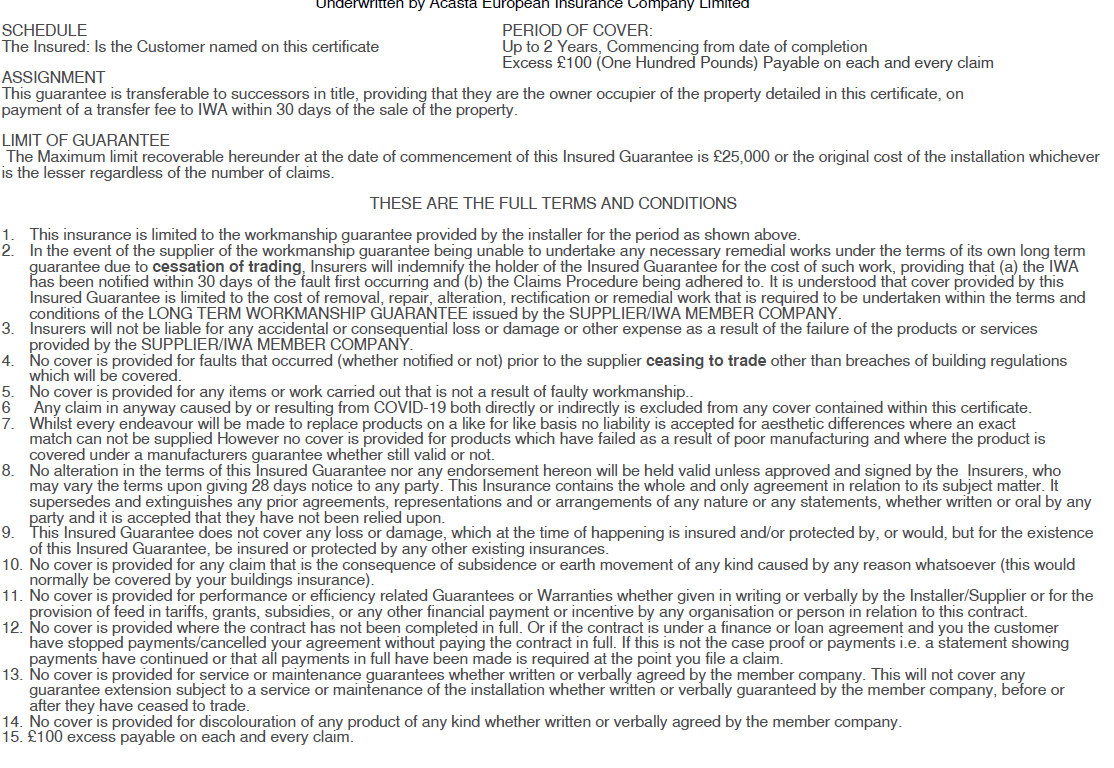
I have just dug out my own guarantee (which is by IWA) and read the conditions, which I reproduce below.
Its pretty limited. Its cover applies only if the supplier has ceased to trade. Faults must be notified within 30 days otherwise they are not covered. Faults which occurred before the supplier ceased to trade are not covered, whether or not they were notified.
The effect of this in practice is to exclude pretty much any poor workmanship (because the fault occurred before the supplier ceased to trade). Essentially, as I read it, it would cover only failed parts occurring after cessation of trading, which would probably anyway be covered by manufacturers warranty. So it's only obvious value is cover for fitting the parts. Also crucially it won't cover anything if the fault occurs before a supplier ceases to trade, they fillibuster, and then cease. This is another hole in something that is already a collander masquerading as a saucepan.
I would personally rate this insurance as near worthless.
I must admit the very strict limits of cover, some of which I can understand but some of which I can't, have come as a surprise to me. Its not positioned this way by the industry imho. The old saying 'insurers never take risks' certainly applies here!
Nevertheless, shocking though it may seem, I can see no way that this can be reinterpreted to cover poor workmanship occurring before the supplier ceased to trade. @ian-w it might be worth your while reviewing your list in case there are further elements you could dispute. I'm presuming the installer went into administration in which case you may have a claim on that, but you are not a preferential creditor so in practice the probability of getting anything is small.
I know this is not what you want to hear but it's probsbly better to be realistic about the prospects, as @editor says above.
I'm sorry to have to say this, it shouldn't be this way!
This post was modified 6 months ago 6 times by JamesPa
4kW peak of solar PV since 2011; EV and a 1930s house which has been partially renovated to improve its efficiency. 7kW Vaillant heat pump.
I have just dug out my own guarantee (which is by IWA) and read the conditions, which I reproduce below.
Its pretty limited. Its cover applies only if the supplier has ceased to trade. Faults must be notified within 30 days otherwise they are not covered. Faults which occurred before the supplier ceased to trade are not covered, whether or not they were notified.
The effect of this in practice is to exclude pretty much any poor workmanship (because the fault occurred before the supplier ceased to trade). Essentially, as I read it, it would cover only failed parts occurring after cessation of trading, which would probably anyway be covered by manufacturers warranty.
I would personally rate this insurance as worthless, in the sense that I would not pay even a penny for it.
I know you have a pretty good eye for detail, @jamespa, but even then I wonder if you spotted at the time of install just how toothless the guarantee was.
It highlights to me something I've seen plenty of times before - and been guilty of myself plenty of times too - which is that no matter how rigorously you try to research something new before committing to it there will still be a lot of important things you don't know you don't know. I was just plain lucky when we had our install that, each time I learned something new on this forum, I went back to my system to check and found the installers had followed best practice. I was far less prepared than @ian-w and it's pure good fortune we managed to pick an honest and competent installer.
IMHO, industry bodies (like MCS) should be protecting the customer from the consequences of ignorance in things only a professional should be expected to know, but as we've seen so many times before that simply doesn't happen. I know I'm not saying anything new, but it's such a significant failing within the industry that it bears repeating again and again. As things stand, it seems customers are expected to be heating system experts to spot design flaws, project managers to keep installers on track, professional negotiators to avoid unnecessary hidden costs, contract solicitors to ensure the safety nets are actually fit for purpose and clairvoyants since even the best installers may well encounter the unexpected.
105 m2 bungalow in South East England
Mitsubishi Ecodan 8.5 kW air source heat pump
18 x 360W solar panels
1 x 6 kW GroWatt battery and SPH5000 inverter
1 x Myenergi Zappi
1 x VW ID3
Raised beds for home-grown veg and chickens for eggs
"Semper in excretia; sumus solum profundum variat"
I know you have a pretty good eye for detail, @jamespa, but even then I wonder if you spotted at the time of install just how toothless the guarantee was.
Simply put, no I didn't.
That said I didn't place much mental value on the insurance element. I watched the installer carefully to ensure that they did what they contracted to do, and made sure I had the manufacturer guarantees. I was confident in the design so this element wasn't a consideration.
4kW peak of solar PV since 2011; EV and a 1930s house which has been partially renovated to improve its efficiency. 7kW Vaillant heat pump.