

Notifications
Clear all
Joining the Renewable Heating Hub forums is completely free and only takes a minute. By registering you’ll be able to ask questions, join discussions, follow topics you’re interested in, bookmark useful threads and receive notifications when someone replies. Non-registered members also do not have access to our AI features. When choosing your username, please note that it cannot be changed later, so we recommend avoiding brand or product names. Before registering, please take a moment to read the Forum Rules & Terms of Use so we can keep the community helpful, respectful and informative for everyone. Thanks for joining!

21/01/2026 4:25 pm
You should expect well over 90% efficiency. I never measured my Solis inverter myself but have no reasons to think I get less than the 95% that others see (comparing the AC power going in to the AC power coming out).
8kW Solis S6-EH1P8K-L-PLUS hybrid inverter; G99: 8kW export; 16kWh Seplos Fogstar battery; Ohme Home Pro EV charger; Vaillant Arotherm Pro 7kW; 100Amp head, HA lab on mini PC

17/03/2026 6:48 pm
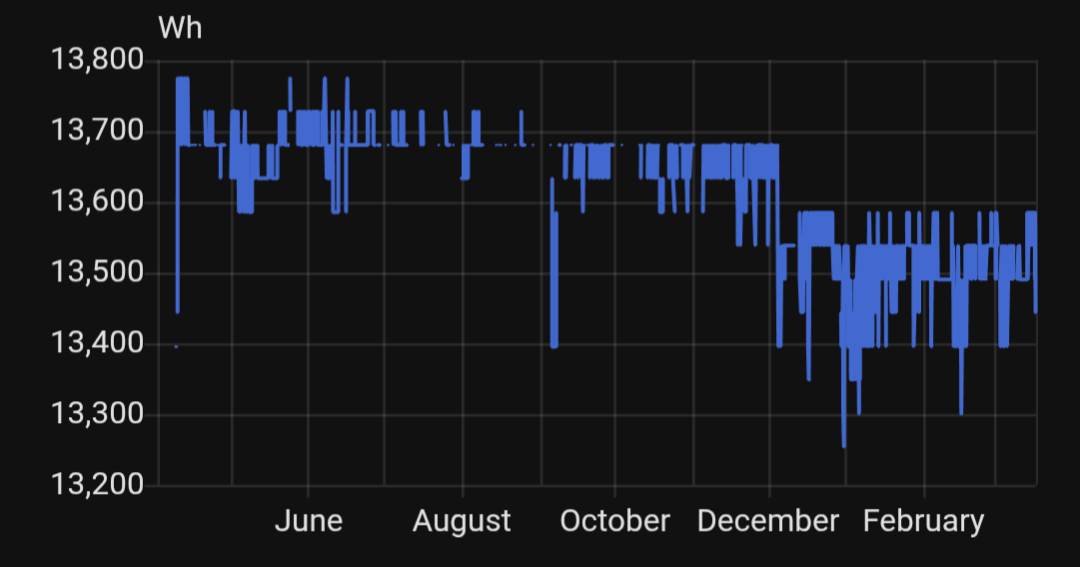
On a slightly different topic, I had a calibration today and it's almost the 1y anniversary of the install
Capacity at install was 13.7kW and now sitting just under 13.5kW. So around 1.5% in the last year
The values seem to jump around, the last proper calibration was the beginning of December

17/03/2026 7:59 pm
@f1p I am too mean to pay the NetZero programmer £80+ per annum to enable me to see some additional data about my Powerwall 2’s - thus I must remain ignorant of deterioration😳 Toodles.
Toodles, heats his home with cold draughts and cooks food with magnets.
1
17/03/2026 8:13 pm
Not quite the case, NetZero is free (including the capacity monitoring) but things like automations and diagnostics are part of the NetZero Pro subscription
My screenshot is actually from Home Assistant (free) and provides a hybrid local (monitoring)/cloud (control)
This post was modified 7 months ago by F1p


17/03/2026 10:18 pm
Every power conversion circuit has an optimum efficiency point. At low load, power required by the circuit itself becomes a significant part of the total, so efficiency drops. At high load, I²R losses matter, so efficiency also drops. Somewhere in the middle, efficiency peaks.
Same as a car, gas mileage goes down at high speed (air drag ~v²) and at low speed (when the air conditioning sucks more power than actually moving the car)
DC voltage is supposed to stay still. So if you make a DC-DC converter, you can stick a big capacitor on the output. At light load, the DC-DC converter sleeps while the load is powered by the output capacitor, which slowly ramps down output voltage. Then the DC-DC converter periodically wakes up to recharge the output cap. This adds a bit of ripple on the output voltage, it looks like a sawtooth, but it allows very low losses at light load, as the circuit can be run at its optimum efficiency point, then turned off, then repeat.
On the other hand, AC is constantly wiggling, so an inverter can't go to sleep. It has to constantly remain on and switching its PWM to follow the AC voltage waveform. The above trick used in DC circuits does not apply to AC. Therefore even if the load is zero, the idle power consumption of the inverter cannot be turned off.
Typically, in a PV hybrid:
- MPPT is a simple DC-DC boost converter between the PV panels and the inverter's DC bus, that is very efficient over a wide range of power, so the posted "MPPT efficiencies" around 98% are believable. It depends on voltage though, a boost converter is most efficient when it has to boost only a little bit, which is why the usual recommended input PV voltage is something like 330-350VDC, which is then boosted to 400VDC by the MPPT, which powers the inverter.
- Battery <-> DC Bus, that depends on battery voltage. If it's a high voltage battery, maybe you get a non isolated buck boost. With a low voltage battery it'll probably be some kind of resonant converter with a transformer for isolation. In any case this should also be very efficient over a wide range of loads due to the above mentioned DC-DC trick. Ballpark numbers 90-95% for low voltage battery, better for high voltage battery. So for roundtrip, maybe 80-95%. I²R losses are a problem at 100 Amps.
- DC bus <-> AC, now that's the issue, because the inverter can't sleep. As long as its working, it's going to waste about 1% of its rated power, for example about 50-60W for my Solis S5 6kW. That's pretty decent actually, but if the house is only using 100W then the efficiency is going to suck quite substantially. It's possible to do better with more modern tech like silicon carbide or GaN but it doesn't change the nature of the game.
3.8 kWh/day means about 150W continuous which is quite high idle consumption, even for a 11kW inverter, but that number probably includes losses when it is actually working and doing something useful. So basically... nothing to see here.
The idea is to put enough PV to make the inverter losses insignificant. Also at night when the battery is empty and the thing just sits there doing nothing useful wasting power, it should turn off automatically. My Solis S5's don't so I had to make a script to send ON/OFF commands via modbus. Also when the weather is terrible and PV produces close to zero, these things tend to eagerly turn on just in case and actually waste more power than they generate.
Why would anyone stick such a powerful inverter on such a tiny battery, I have no idea, though. I wonder if you want more battery do you add another powerwall with an inverter in it and double your idle losses? Or is it smart enough to be DC coupled or use other tricks?... hmmm
Also note efficiency measurements are tricky. If you measure input energy at 1kWh with 1% accuracy, and output energy at 950 Wh with 1% accuracy, then the actual efficiency could be between 93% and 97%. In other words even with 1% accurate measurements, no idea whether it's wasting 3% or 7%, so the error margin on actual power loss is huge. Accuracy and precision cost money, and money is expensive, especially if it comes out of the manufacturer's bottom line, so unless it is specified, don't count on readings from inverters in general being anywhere reasonably close to the truth lol
Say you want to measure efficiency around 95%, with reasonable accuracy of 5% on losses, ie it gives you losses between 5.25% and 4.75% so you can state with confidence that efficiency is 94.75-95.25%. Then you need to measure input and output power to 0.1% accuracy overall... but if it charges at 5kW for 1h and discharges at 500W for 10h, you also need 0.1% on 500W (0.5W), which means you need a meter for 5kW full scale and 0.5W accuracy, ie 0.01%. If it's relative accuracy, it's okay, but if you want to factor in energy coming from PV, then you need another meter for DC, and you need absolute accuracy. This lab grade equipment will cost a lot more than the power wasted by the inverter...
This post was modified 7 months ago 2 times by bobflux
2
18/03/2026 12:32 pm
@f1p Ah! Thank you, I had missed that the capacity estimates were still part of the free facilities in the app. Having checked the 2 Powerwalls, I find that I still have full capacity and a little bit more after 3 years plus. (estimated at 27.457 kWh) so mollycoddling the Powerwalls inside so the temperature range stays within ~12 - 30 degrees C, no rain and clear ventilation all round seems to be paying off so far. Regards, Toodles.
Toodles, heats his home with cold draughts and cooks food with magnets.
Page 2 / 2
Prev
SPONSORS

Degrees of Separation
Latest Posts
-

RE: New Build 3 Phase or 1Phase
Not so. 1: It's now the case that the Service Fuse wi...
By Transparent , 2 hours ago
-
RE: How will removing the standing charge on gas bills benefit heat pumps?
I think it has an enormous impact on air/air users. The...
By EtchedPixels , 9 hours ago
-
@editor Ouch, sorry to re start the tick. I had assume...
By DavidB , 1 day ago
-
RE: Say hello and introduce yourself
@e-a-west as the good Major said, welcome to the forums...
By Mars , 1 day ago
-
RE: How much of your renewable and home setup would still work if the internet went down?
Yes I actually have a copy of a tool that whenever a ce...
By EtchedPixels , 2 days ago
-
RE: Indevolt Batteries UK Support & Info Thread
@editor Hi, To resolve this, please tap on the A...
By Indevolt Tech , 2 days ago
-
RE: Double or Triple Glazed Windows?
Posted by: @singlespeed With 9 years repairing windo...
By Rob of York , 2 days ago
-
@transparent we’re still running a secure version of PH...
By Mars , 3 days ago
-
RE: How quickly would you want/expect heat recovery to take from setback?
Much longer than that here. The heating isn't even on. ...
By bobflux , 3 days ago
-
RE: Passiv Smart Thermostat - Help & Forum Support
Obviously the weather is changeable but there's a defin...
By Singlespeed , 3 days ago
-
RE: The Changing Jet Stream Could Challenge UK Air Source Heat Pumps
@rob-of-york I must admit that when we had a Daikin hea...
By Toodles , 3 days ago
-
RE: Forum updates, announcements & issues
Get the Renewable Heating Hub heads-up on WhatsApp. I...
By Mars , 3 days ago
-
RE: Safety study for plug in batteries out to tender - looks like Q3 2027 at best before legal
@editor I pointed out to the one of the Fuse execs that...
By dansus , 3 days ago
-
RE: 15kw pump for 225m2 1990's house - over kill?
@seaviews As well as loft insulation, there are othe...
By Rob of York , 3 days ago



SPONSORS
