

Notifications
Clear all
Joining the Renewable Heating Hub forums is completely free and only takes a minute. By registering you’ll be able to ask questions, join discussions, follow topics you’re interested in, bookmark useful threads and receive notifications when someone replies. Non-registered members also do not have access to our AI features. When choosing your username, please note that it cannot be changed later, so we recommend avoiding brand or product names. Before registering, please take a moment to read the Forum Rules & Terms of Use so we can keep the community helpful, respectful and informative for everyone. Thanks for joining!
Energy Storage
233
Posts
20
Users
170
Reactions
127.9 K
Views

Topic starter
08/06/2022 9:55 pm
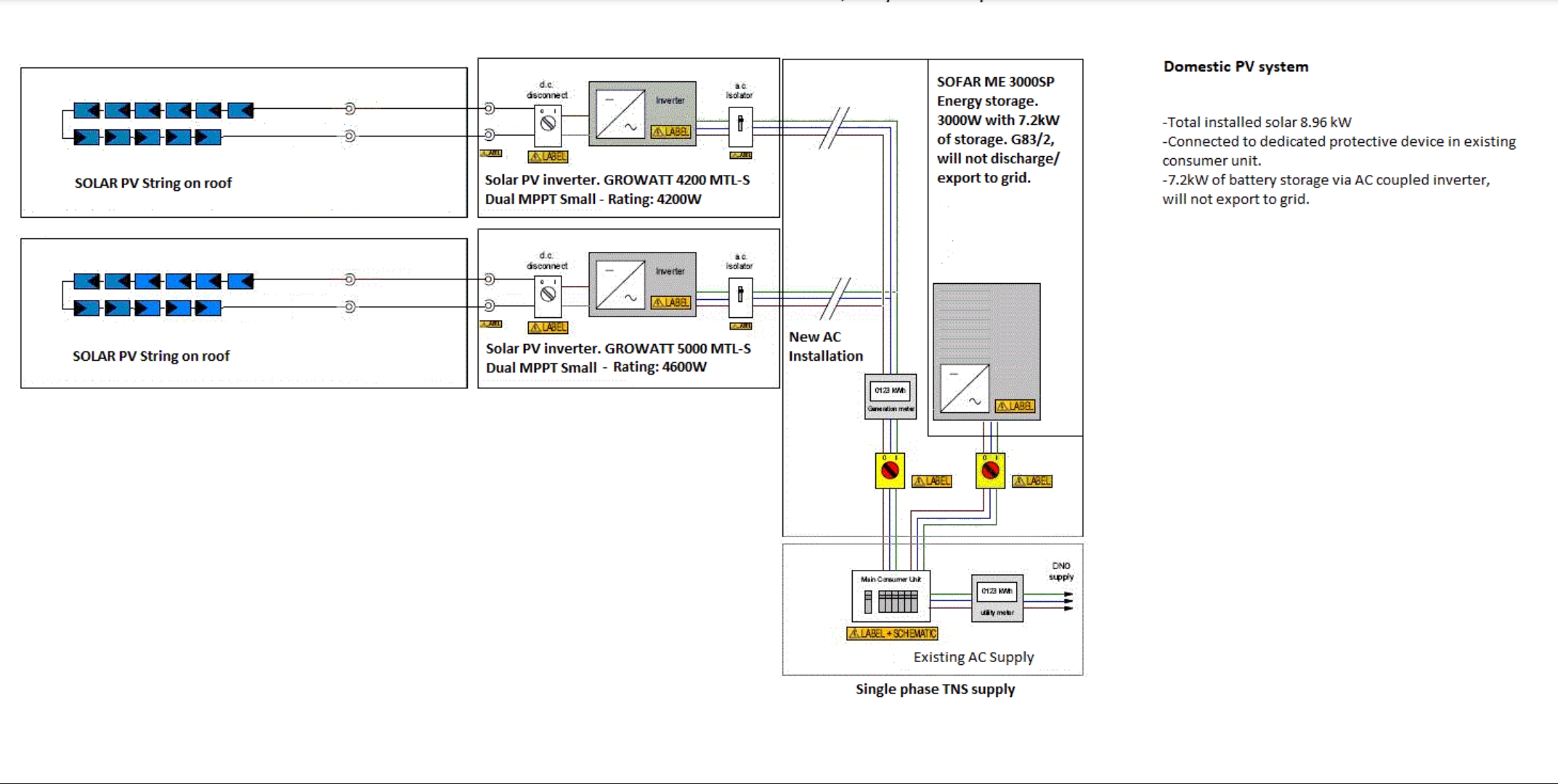
@transparent this is my current layout (but I have a bigger battery now). Ideally I just want to put it along side after the first one to pick up anything excess. Because my PV is over 8kw I often have excess PV in the summer. We do dump a lot into AC, or the swimming pool heater, but there is always plenty left. Ideally I also want grid tie to make maximum use of Octopus Go in the winter.

10/06/2022 11:51 am
@transparent Can I query the mechanism you use to prevent grid export for your system, as described in one of your previous posts in this thread?
It currently supplies a 14kWh battery from either the Grid or solar.
Alternatively, what was the plan for the retrofit system for @hydros in this post?
because that combination wasn't on the ENA list, the current-limiting system within the existing (G98-installed) PowerVault battery was no longer 'trusted'
I take it the problem is coordinating two independent limiting systems to limit the total power exported at any given moment, hence the combination needs approval. Would some kind of independent G100 limiter device somewhere between the meter and the exporting unit meet the DNO's requirements? Yes, the linked to device does not have a price, and if you have to ask ...
After this journey into uncertainty about fitting batteries/inverters, I can't decide between
- getting no storage (and probably not bothering with solar panels);
- getting solar panels and storage installed in one go (and have the batteries cause the ceiling to sag, and lithium plate/cook in the loft);
- getting solar panels, DIY-ing batteries and taking the bulk of the house off grid (topping up in winter using a battery charger to ensure energy can never flow back to the grid).
The first option will probably happen in my case, since the group-buy scheme has 35% more takers than expected, and I suspect finding more capacity for installers in the area will be pretty tricky/unprofitable.

10/06/2022 12:46 pm
Let me address the point made by @batalto first...
Because my PV is over 8kw I often have excess PV in the summer.
Exactly. You've hit the nail on the head.
What you need is a double-pole switch to divert one of your two solar arrays from the existing grid-tied inverter, and connect instead to a separate off-grid system. This video clip shows the arrangement operating in a self-built "string combiner" box.
Please note that the double-pole Manual Transfer Switch must be DC rated. Each of the four pairs of switching contacts has its own arc-suppression 'ladder'. When the contacts open, a pair of magnets pulls the resulting arc into the ladder's plates and quenches it. This is a safety requirement.
DC switches/MCBs like this are marked with their polarisation and must be connected the right way around.
The switch in the above video is manufactured by FEEO in China. The coloured tags on the levers have been added by me.
Save energy... recycle electrons!
10/06/2022 1:03 pm
Can I query the mechanism you use to prevent grid export for your system, as described in one of your previous posts in this thread?
Yes, please do query. This is a very important point!
I alluded to the mechanism I use to prevent grid-export higher up this thread, but it warrants being repeated here for clarification.
The sort of inverter I've been investigating over the past year is the type which does not (and cannot) export back to the Grid.
This design has its own internal 50Hz generator, thus making its 240v AC output unsynchronised.
And here's a generic diagram of such an arrangement:
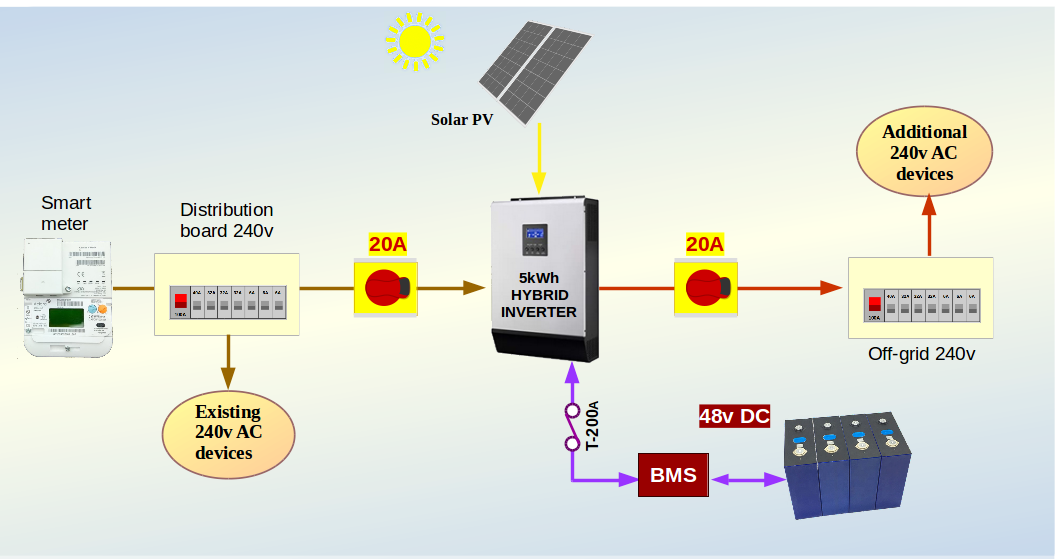
There is only one parameter on the UK electricity grid that is a constant - and that's the 50Hz frequency.
It is not possible to connect any generation source to the grid unless the frequency is first aligned.
I've seen this for myself at a hydro-electric plant where a turbine was being run up. The engineer watched a gauge until the arrow pointed directly upwards. At that point it was safe to 'throw the switch' without the fuses blowing!
Exactly the same principle applies to my tiny 5kW inverter. Since it contains its own 50Hz oscillator, it is unsynchronised to the national 50Hz grid. If I were to try connecting it to the grid then it would be pitched into an unequal battle against the combined power from all the commercial generation plants of Europe. Guess who's going to win?!
In conclusion, a solar inverter must fall within one of two possible categories:
- it is grid-tied, using the external 50Hz frequency to synchronise its output to that of the National Grid
- it is off-grid, creating its own 50Hz for its output from an internal oscillator
Save energy... recycle electrons!


10/06/2022 2:32 pm
...
2. getting solar panels and storage installed in one go (and have the batteries cause the ceiling to sag, and lithium plate/cook in the loft);
...
I realise your installer wants to install the batteries in the loft, but let's not forget you're the customer. You don't even need to argue on technical grounds; if you want to retain the loft space as somewhere to install your Scalextric track, that's what the installer must work around.
105 m2 bungalow in South East England
Mitsubishi Ecodan 8.5 kW air source heat pump
18 x 360W solar panels
1 x 6 kW GroWatt battery and SPH5000 inverter
1 x Myenergi Zappi
1 x VW ID3
Raised beds for home-grown veg and chickens for eggs
"Semper in excretia; sumus solum profundum variat"
2
10/06/2022 5:22 pm
I have a Growatt SPF5000ES here, operating as a totally off-grid inverter. It currently supplies a 14kWh battery from either the Grid or solar.
OK, so I mis-read the post about your current setup and assumed that there was an AC link from the grid to the inverter. I am now just a little unclear about how you charge your battery from the grid. Do you use some kind of high powered charger (e.g. an Elcon 3.3kW battery charger which can be controlled over CANBUS) to move energy one way (from the grid down to the batteries) with no possibility of trying to feed the energy back? If this is the case (and similar to the V2G trial mentioned) what are your efficiencies like?
10/06/2022 8:17 pm
@chickenbig - my storage battery configurations are under perpetual development, which means that the connections are being changed weekly. I'm attempting to provide answers here on the Forum, whilst simultaneously altering the arrangement. So apologies if what I wrote a week ago has been insufficiently clear. Mea culpa.
It is currently the case that my Growatt SPF5000ES hybrid inverter is indeed receiving sufficient solar input such that it is not configured to charge the 14kWh battery from the grid. However it has the capability to do so. It does not require a separate battery charger unit.
As matters stand the SPF5000SPF has to be configured via its inbuilt screen and menu buttons. Its firmware is designed to give priority to keep the load(s) alive rather than make best use of available storage capacity. That's not what I want, and it's also probably beyond the capability of most people to correctly configure both the Growatt inverter and the battery's BMS to handle the required battery charge/discharge parameters.
You will therefore be unsurprised to learn that I am part of an engineering group who are designing a control system to do this automatically. 🙂
You asked about "moving energy one way (from the grid down to the batteries) with no possibility of trying to feed the energy back". In a word - yes!
The whole point is to have 240v AC devices being powered from the storage battery (off-grid) for most of the time. This means that the electricity being used can be obtained at the cheapest/greenest point.
The main target is to operate a heat-pump by this strategy... which is why it's a subject of considerable interest on this particular forum! But to start with I will be using other existing 240v devices which I can switch between grid-connected and off-grid during short-term test runs. Ie this is a prototype development set-up, as opposed to the fixed installations which usually get mentioned here.
Of course you are quite right to enquire about efficiencies, but that's not an issue which occupies our time at the moment. Once the software is substantially in place, then it will rise higher on the priority list.
Let me also point out that I actually have two separate battery storage systems on trial here.
There is also a grid-tied 8kWh PowerVault unit with a different Growatt inverter supplying solar power to it at 240v AC.
So I'm in a good position to evaluate and offer opinions on both approaches to electricity storage... which I hope will continue to be welcomed here on the forum.
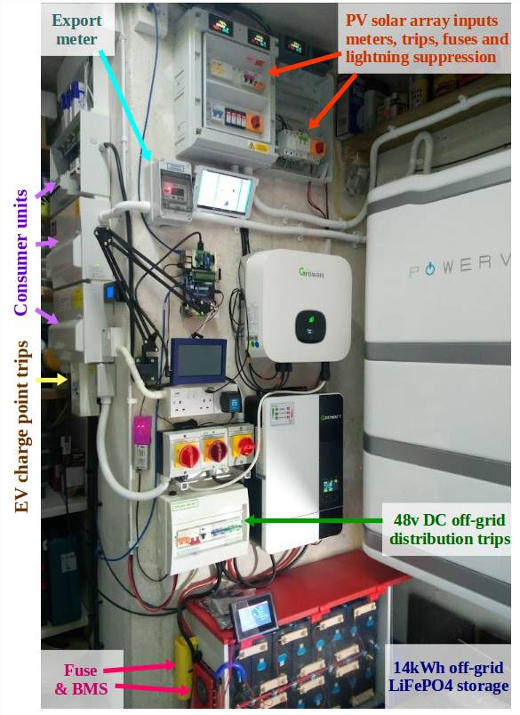
Here's a brief glimpse of the test-rig as it stands today (10th June '22). But there's a lot more still to be installed.
Save energy... recycle electrons!
2
10/06/2022 8:36 pm
I've re-jigged the colours/labels on the diagram I posted on the previous page earlier today.
Does this make things clearer?

The inverter in the middle is connected to the 240v grid.
But it cannot export back to the grid. The 240v AC output on the right is unsynchronised and entirely separate.
Save energy... recycle electrons!
2


10/06/2022 8:50 pm
If you are not already doing so, why don't you use a Programmable Logic Controller (PLC) to control the operation of the system?
10/06/2022 8:59 pm
The control system under investigation/development is to receive data inputs which require a lot more software than just a PLC can offer. These include
- weather-forecast (analogue) to assess the heat-requirement for the following day
- sunshine forecast (analogue) to assess how much solar generation is likely
- ToU tariff data per 30min, including one-off changes to a day's schedule
- regional renewable generation data (ie just on the Distribution Grid)
- energy-mix variations per hour
These are subject to licensing arrangements, and can only be addressed by a commercial approach. Open-source hardware/software is not an option.
There must also be a fail-safe arrangement to prevent erratic operation in the event of a hostile 3rd party attack on the UK domestic energy supply.
Does anyone buying a new Smart EV charger even consider that, I wonder?
Save energy... recycle electrons!
10/06/2022 11:07 pm
The control system under investigation/development is to receive data inputs which require a lot more software than just a PLC can offer. These include
- weather-forecast (analogue) to assess the heat-requirement for the following day
- sunshine forecast (analogue) to assess how much solar generation is likely
- ToU tariff data per 30min, including one-off changes to a day's schedule
- regional renewable generation data (ie just on the Distribution Grid)
- energy-mix variations per hour
These are subject to licensing arrangements, and can only be addressed by a commercial approach. Open-source hardware/software is not an option.
There must also be a fail-safe arrangement to prevent erratic operation in the event of a hostile 3rd party attack on the UK domestic energy supply.
Does anyone buying a new Smart EV charger even consider that, I wonder?
You are obviously not fully aware of the capabilities of modern PLC's, which are used throughout industry to control very complex systems and of course have to be fully protected from outside interference.
Topic starter
11/06/2022 6:52 am
@transparent the Sofar inverter I own has a group on Facebook which has built a controller to do most of this via a raspberry pi. Certainly the forecasting part to optimise the charging on Go based on weather and sunshine. I'm sure the others could be implemented as long as the data is present.
2
SPONSORS

Degrees of Separation

Latest Posts
-

RE: 15kw pump for 225m2 1990's house - over kill?
@editor sorry should have been clearer - the whole hous...
By Carpenterstation , 2 hours ago
-
RE: Safety study for plug in batteries out to tender - looks like Q3 2027 at best before legal
Maybe this is why Octopus and Fuse are hell bent on plu...
By dansus , 3 hours ago
-
RE: Indevolt Batteries UK Support & Info Thread
@editor Manually setting the charging times and rates o...
By dansus , 3 hours ago
-
RE: How much of your renewable and home setup would still work if the internet went down?
Ours is similar to James, but with a few optional tweak...
By Batpred , 6 hours ago
-
RE: Renewables & Heat Pumps in the News
Yes, this is a swiss and german standard I believe, Vai...
By Batpred , 6 hours ago
-
RE: BT cuts you off, Plusnet blames Openreach... welcome to “seamless” broadband switching
My Vodafone FTTP broadband was down for a month when I ...
By JamesPa , 10 hours ago
-
RE: Octopus Cosy 12 Heat Pump Regret: Incredibly Loud, Poor Heating & Constant Hum - Help!
@editor FWIW my problem was resolved, eventually, after...
By BigFish , 13 hours ago
-
My heating has been off and DHW on throughout the summe...
By DavidAlgarve , 16 hours ago
-
RE: Anyone concerned about GivEnergy?
The GivE forum seemed to have survived the collapse of ...
By downfield , 17 hours ago
-
RE: How quickly would you want/expect heat recovery to take from setback?
@singlespeed I had better explain how my radiators are ...
By Toodles , 17 hours ago
-
RE: Cooling/heating with one unit
@mrkfm The Solo has a small capacity and only suitable ...
By dgclimatecontrol , 17 hours ago
-
First you need to know how much thermal energy you'll n...
By bobflux , 1 day ago
-
RE: Renewable Heating Hub Homeowners' Q&A Podcast
Come for the low-carbon homes. Stay for George Clarke’s...
By Mars , 2 days ago
-
RE: How should the Boiler Upgrade Scheme be reformed?
Not quite, regular A2W heat-pumps need a load of extra ...
By Temperature_Gradient , 4 days ago
-
RE: Heat Geek installations: share your experiences
one thing i learnt from reading people’s comments and e...
By Batpred , 4 days ago






SPONSORS
