

Notifications
Clear all
Joining the Renewable Heating Hub forums is completely free and only takes a minute. By registering you’ll be able to ask questions, join discussions, follow topics you’re interested in, bookmark useful threads and receive notifications when someone replies. Non-registered members also do not have access to our AI features. When choosing your username, please note that it cannot be changed later, so we recommend avoiding brand or product names. Before registering, please take a moment to read the Forum Rules & Terms of Use so we can keep the community helpful, respectful and informative for everyone. Thanks for joining!
Air Source Heat Pumps (ASHPs)
98
Posts
17
Users
53
Reactions
7,398
Views


Topic starter
21/10/2026 10:59 am
@techgeek, I think that's a very fair challenge and it probably deserves more attention than I gave it in the original article, which I did write a while ago.
It's almost counterintuitive that a heat pump might experience more defrost cycles at -2C than at -10C, but your explanation is correct. Those damp, near freezing conditions can be particularly troublesome because there's still plenty of moisture available to accumulate on the evaporator. As temperatures fall further, the air generally contains considerably less water vapour, so frost accumulation can actually become less of a problem. That's not to say defrosting disappears altogether, because humidity, evaporator temperature and local conditions still factor into things, but it does suggest Damon's original statement was probably too categorical.
And I think this helps sharpen the discussion we've been having with @susannasaunders. The challenge of prolonged extreme cold isn't necessarily that heat pumps become trapped in endless defrost cycles, but whether they can continue delivering sufficient heat as the building's demand increases and the machine's available output and efficiency potentially decline. I also continue to have massive issues with manufacture's labels and published outputs that don't deliver heat at temps below 0.
Your experience at -7C is particularly interesting because it challenges the assumption that colder conditions automatically mean greater operational difficulties. I'd be interested to know whether you noticed any meaningful deterioration in efficiency or heating performance during those days, despite the absence of defrost cycles. I know our bodged heat pump system failed miserably when we had a prolonged -7C spell 4 or 5 winters ago, while consuming over 100kWh of electricity every day.
It's also a useful reminder that heat pump behaviour isn't always as intuitive as we might assume, and that real world events can add important nuance to theoretical concerns and assumptions. I'm glad that this conversation is challenging my original article! Very interesting indeed.
Dad’s Outside with the Heat Pump Again
He wanted to save the planet. His family just wanted him to come inside.
Get the book → · Free UK shipping
The Ultimate Guide to Heat Pumps · Britain’s Heat Pump Shitshow
Heat Pumps Explained · From Zero to Heat Pump Hero · Bodge Buster
From Zero to Heat Pump Hero and Bodge Buster are rewritten and updated for 2027.
New to heat pumps? Heat Pump Fundamentals course — 50% off with INTRO50.

21/10/2026 10:59 am
I really wouldn't worry too much about the heating at -20
At a sustained -20 a large number of UK permeable brick and stone houses with water in the bricks will simply fall down, our water supply will fail and lots of people will die. Heating is not going to be the top issue.
This post was modified 3 weeks ago by Mars
1
Topic starter
21/10/2026 11:14 am
@etchedpixels, jovial thought for the day 🤣
Dad’s Outside with the Heat Pump Again
He wanted to save the planet. His family just wanted him to come inside.
Get the book → · Free UK shipping
The Ultimate Guide to Heat Pumps · Britain’s Heat Pump Shitshow
Heat Pumps Explained · From Zero to Heat Pump Hero · Bodge Buster
From Zero to Heat Pump Hero and Bodge Buster are rewritten and updated for 2027.
New to heat pumps? Heat Pump Fundamentals course — 50% off with INTRO50.

21/10/2026 11:19 am
But what happens in a -10C or even -20C winter, which has a once per decade probability (10%), in the event that the AMOC continues to shut down over the next decade? In this situation, I presume that the heat pump will be significantly under sized and will not keep your house warm! How can this issue be managed with a heat pump without 'over sizing' it?
The only solution I could see is having a secondary heat pump that could be called upon by the controller to help boost the primary heat pump when outside temperatures drop below a certain level. This would increase the volume of air to extract more heat, however I am no expert on the subject! 🙂
This post was modified 3 weeks ago by Mars
5 Bedroom House in Cambridgeshire, double glazing, 300mm loft insulation and cavity wall insulation
Design temperature 21C @ OAT -2C = 10.2Kw heat loss, deltaT = 8 degrees
Bivalent system containing:
12Kw Samsung High Temperature Quiet (Gen 6) heat pump
26Kw Grant Blue Flame Oil Boiler
4.1Kw Solar Panel Array
34Kwh GivEnergy Stackable Battery System

21/10/2026 11:37 am
Your experience at -7C is particularly interesting because it challenges the assumption that colder conditions automatically mean greater operational difficulties. I'd be interested to know whether you noticed any meaningful deterioration in efficiency or heating performance during those days, despite the absence of defrost cycles.Regarding my system performance, the HP did manage to maintain the house to 21c during this cold spell of -7c, which I was very pleased about! My Wife did not notice any change in temperature either, which was a great relief on my my part! 😀 As expected there was a significant up tick in power consumption, my system usually consumes approximately 800Wh with an OAT of +7c however during this period of -7c, the consumption was in the region of 2.5 to 3 kWh. Sadly I do not own heat meters etc so can only go be the electric power consumed. Generally I get a SCOP of 3.9 using the figures produced by the HP controller.
This post was modified 3 weeks ago by Mars
This post was modified 3 weeks ago by TechnoGeek
5 Bedroom House in Cambridgeshire, double glazing, 300mm loft insulation and cavity wall insulation
Design temperature 21C @ OAT -2C = 10.2Kw heat loss, deltaT = 8 degrees
Bivalent system containing:
12Kw Samsung High Temperature Quiet (Gen 6) heat pump
26Kw Grant Blue Flame Oil Boiler
4.1Kw Solar Panel Array
34Kwh GivEnergy Stackable Battery System

21/10/2026 12:36 pm
@editor Thank You Mars!
You Raise some very valid points to my post and I appreciate the feedback!
"The difficulty is that homeowners are rarely shown what those margins actually are, so they have little idea whether their proposed system would cope comfortably at -10C or begin struggling almost immediately."
This is a key point that installers and system designers need to be doing! What is the impact going to be around the heating capacity envelop of a given system design, it's likely increased costs at a range of operational temperatures [outside the design envelop], additional wear and tear [e.g. increased flow rates increases wear within the pipework] and the expected drop in efficiency as flow temperatures are ramped up to increase heat output. This would be a key consideration I would certainly want to understand! Under what conditions would the system cease to keep my home at the desired 22-23C and what steps can be included to mitigate these conditions, both with the heating system and any secondary heating systems. The discussions I have had with a couple of installers to date have been careful NOT to go anywhere near this territory.
"I'm not qualified to judge which climate model will ultimately prove most accurate, and I don't think homeowners should have to become climate scientists to make sensible decisions about their heating."
I'm most certainly NOT qualified to judge such issues either! But I can at least be aware of these issues and try to draw some broad opinions about where our climate MIGHT go... As for the Manufacturers/Installers - it's a s**t sandwich they are very much trying to dodge atm and hoping that the customer simply won't think to ask."There are heat pump systems capable of operating in a cascade arrangement, where two or more units work together. Mitsubishi Electric has offered this with Ecodan, and Panasonic has cascade-control systems for its Aquarea range. So the underlying concept certainly exists. The limitation is that adding another heat pump isn't remotely as straightforward as adding another battery module." ...
Thanks for this info! I'll look into these offerings to see what they are about. And yes, I appreciate that adding flexibility into any system design adds cost, complexity and potential redundancy. All issues that the industry would rather duck out of... It's not going to be as easy as sticking another battery or DCEV charger on top of the stack. But it's a direction of travel the industry should be thinking about imo.
"As crazy as it sounds, the hybrid boiler approach still makes most sense to me. The heat pump does 95% of the winter work, and if we have a crazy winter spell of low temps, the boiler (gas or oil) happily takes over. But in the current grant language, to avail of BUS, the boiler has to go."
And therein lies another problem we have with the current government initiatives... It's all black and white thinking [most to avoid cheating and manipulation of the system aka just add a A2A aircon system for free]. But also to benefit the rich that can afford a complete system swop too... You need a significant pot of money to take advantage of the BUS schemes 'as is', which might become mute anyway if they are scrapped in the forthcoming budget.
"Another possibility, depending on the property's layout, might be an air-to-air heat pump serving particular rooms. That could provide additional heating during exceptional cold weather while also delivering something increasingly valuable during our hotter summers... cooling. Given your experiences in Somerset this year, I suspect that dual benefit might be worth considering."
This is very much the direction I am heading towards given the summer we have just endured! If you had asked me last year when we have the solar PV and batteries installed I'd have said go with A2W and be done. This year I'm very much looking at a combined A2W for heating and DHW and an A2A for cooling and *additional* heating capacity! The points made about the available additional range of operational temperatures discussed above again comes into play, along with the potential impact upon running costs etc. We specifically bought a new build in 2024 with a south facing roof [in hindsight I wish we had bought an East/West roof but that's another story] for the purposes of solar PV and future electrification with a heat pump to help mitigate the heat losses during colder winters. The house purchase was one of the worse decisions of my life [because of the property developers!] but it is certainly warm and well insulated!
"In fact, I'd also propose a fourth... commission a properly considered heat pump design that includes a documented assessment of what happens outside the normal operating assumptions, alongside an affordable plan for future adaptation.
...This wouldn't eliminate every uncertainty, but it would give you something considerably more reassuring than a sales proposal promising an attractive SCOP and little explanation of what happens when conditions depart from expectations."
That is indeed exactly the plan I have for myself! It should be the default for all ASHP installations imo. At the moment though, I don't think we are going to have the money [circa £5-7k cash plus the BUS grant] so it might be kicked into the long grass anyway. But a plan and a vision of where the industry is going would be helpful.
"That doesn't automatically mean they are acting irresponsibly IMO, but I do think the industry has been too narrowly focused on demonstrating compliance with current design requirements rather than discussing longer term adaptability with the people paying for these systems."
Agreed. System 'Adaptability' has an uncomfortable *smell* of eating away profitability so the industry is probably reticent to open this particular pandoras box (especially in a 'young' industry in the UK) and is instead turning a blind eye to it. That's my opinion anyway.
"I would also argue that any future changes in our understanding of the climate should be reflected in national design guidance, rather than expecting individual installers to interpret AMOC research. The industry needs a credible mechanism for reviewing those assumptions as evidence develops. We had a rough summer this year; now let's see what this winter brings."
This is where I think the government should be doing more - providing national guidance on adaptability both for our current housing stock and for future electrification and progression in the housing market more broadly. We should have an independent government body to help advise the heating (and cooling) industry about likely future housing needs and strategies. But, in the UK, we are lucky if we can even get the property developers to put up some houses with the bare minimum [G98/3.68 kW cap] amount of solar panels! The MCS certification process is I suppose a step in the right direction but it's barely a minimum and does nothing to address the issues I raise in this thread!
"Where I think your contribution is particularly valuable is that you're approaching this as somebody who actively wants to install a heat pump, not somebody searching for reasons to reject the technology. You're asking for greater confidence before committing your money, and I don't believe that is an unreasonable expectation. I think this is sensible and this is what I'm all homeowners to deliberate."
Indeed! This is where the industry needs to go! Lets have a frank and honest discussion with the manufacturers and installers AND the government... Tell us clearly and precisely what variance we are likely to have to deal with and advise us on the best mitigation strategies rather than offer us Black and White solutions that paper over the real issues that we face as we go forwards with electrification!
As for myself, yes I have obtained a number of basic quotations but without a proper heat loss evaluation as of yet as these cost money and only provide refunds of this expenditure with the installer that you go with. So I could spend £150-250 on a heat loss evaluation and then find I can't get that knocked off the install bill because I've gone with a different installer... Another cart before the horse issue. Coupled with the 1st April VAT deadline etc... Irksome!
I'm starting to work through my own heat loss calculations [or at least hoping too! Help!]. I have two years worth of heating data for this house already and that is also helping to guide my thinking on heating needs. I've been looking into degree days https://www.degreedays.net I plan to take a look at Heatpunk over the next month or two as well. https://heatpunk.co.uk What happens in the pending budget though will also impact what we do. I suspect the the BUS scheme will be raided by BS Burnham [I'm a Green party voter] to pay for the increased military expenditure...
This post was modified 3 weeks ago by Mars
Installed solar [7.44 kWp] and batteries [Sigenstor 3 x 8kWh] and 12 kW inverter in July 2025.
1
21/10/2026 1:04 pm
@etchedpixels
😯
Well that wasn't a reply I was expecting. Winter temperature's as low as -20C would certainly cause widespread issues throughout the country [including loss of life and a national emergency more generally] but these changes are likely to evolve over time with increasingly cold winters over a decade or more... It's not likely to be -2C one winter and -20C the next... although that too can happen.
That said, while you might be right that "Heating is not going to be the top issue." It certainly will be a significant one for millions of people! I'd rather future proof myself to some degree by at least considering that scenario and having some idea of how my house will function during such a winter... Especially when considering purchasing an ASHP solution for my home heating needs.
If you are in doubt of whether such things might happen, the coldest temperature has been -27C and this has occurred on three occasions:
11 February 1895 at Braemar, Aberdeenshire (East Scotland)10 January 1982 at Braemar, Aberdeenshire (East Scotland)30 December 1995 at Altnaharra No 2, Highlands (North Scotland)
This post was modified 3 weeks ago by Majordennisbloodnok
Installed solar [7.44 kWp] and batteries [Sigenstor 3 x 8kWh] and 12 kW inverter in July 2025.
21/10/2026 1:33 pm
The critical bit is whether it's sustained. Sustained it will crack and destroy bricks and foundations, the water supply will freeze and so on. A couple of days of it won't, especially if heated.
The lifespan of a heatpump is about 15 years realistically so whilst I agree it will be a longer term factor potentially it's not yet that urgent. The imminent necessity for air conditioning is going to be much more relevant I suspect.
Will the specs be different a decade from now - probably quite a bit, and the technology somewhat.
This post was modified 3 weeks ago by Majordennisbloodnok

21/10/2026 2:30 pm
@susannasaunders
We have gone down the hybrid route a somewhat different way. Having become fed up with multiple nights of poor sleep due to high temperatures, we got an air-to-air system fitted with 2.5kW and 3.5kW units upstairs and downstairs. This is sufficient to easily keep the house (a 4-bed detached) at 24C when it is 34C for hours on end outside (efficiency on cooling 9.3). Then in the heating season, we used cheap rate overnight electricity and solar PV electricity to heat using the A2A for at most 2.4p per kWh of heat (efficiency on heating 5.2) to supplement the gas central heating. At present, our gas boiler uses about 8400 units of gas per year for heating, hot water, and cooking, supplemented by about 6000kWh of heating from the A2A.
When we first moved into the house, our gas consumption was 25000 units, so we are now around 1/3rd of that and hence 1/3rd of the CO2 emissions. Lots of insulation and a new boiler were responsible for bringing consumption down to around 14000 units, with the A2A providing the final reduction.
With the retrofit insulation, the heat loss of the house is now around 6.5kW, while the existing radiators are sized to give an output of about 12.5kW at dT50, so the radiator output is enough at an outside temperature of -20C and the 24kW heat only boiler should still work at that temperature with some extra lagging on the condensate pipe. The A2A (Daikin Perfera) is also rated to -20C, so should keep working, although I would expect the overall output to be substantially down on the headline 6kW.
At some point, the gas boiler will be replaced by an air-to-water heat pump. Most likely that will be a 7kW unit, if done under the BUS grant with a requirement to match the whole house heat loss. If, as seems more likely at present due to better economics under almost all foreseeable circumstances, I stick with the current hybrid of gas boiler plus A2A until they reach the end of their lives, then I'll likely swap the lot for a combined heat pump that can run both air-to-water and air-to-air. Such technology is in its relative infancy, but some units are now coming onto the market.
It may not be a perfect solution in terms of reducing CO2 emissions to zero, but adding A2A and keeping your existing gas boiler, until it reaches the end of its life can be a highly cost effective approach. It is likely the most economic approach if the BUS grant for A2W disappears or is substantially reduced. It has a lot of other positives, including cooling, redundancy of heating systems, hedging on gas and electricity prices, and capability to deal with extreme of temperature (hot and cold).
I did a deep dive into the economics in this thread: https://renewableheatinghub.co.uk/forums/renewable-heating-air-source-heap-pumps-ashps/analysis-of-the-economics-of-switching-to-an-a2w-ashp-compared-to-other-heat-sources/ , which might be of interest.
Finally, aside from winters potential being very cold at times, we are all getting older. When my parents were in their late 80s and early 90s, their comfortable set point for the central heating was 24-25C for the whole house. Hopefully, we will all get to that age at some point ourselves and may need a much warmer set point than the usual 19-20C. This is another way in which the design temperature difference can increase. Instead of -3C to 21C (24C difference) for my house, perhaps I should really consider -5C to +25C (30C difference). Then the heat loss goes from about 6.4kW implying a 7kW heat pump to 8kW needing a larger heat pump...
This post was modified 3 weeks ago by Majordennisbloodnok
1

21/10/2026 3:38 pm
@rob-of-york I must admit that when we had a Daikin heat pump fitted in February 2023, we gave little thought to the increasing summer temperatures; we have made do during the hottest times with closed windows and blinds on whichever side the solar energy was shining and making judicious use of floor standing fans.
The time has come* and we now await the fitting of Panasonic AC in four rooms next Jan/Feb. (Supply of equipment is still experiencing long delays due to abnormally large demand this summer). The AC will also provide a back up for the heat pump; it did cope quite happily to provide us with 22.5 degrees inside when it was minus ~7 or 8 degrees C outside a year or two back but is is still reassuring to know we have a backup plan😉.
*Due to nature, we seem to grow a year older every year and biology finds increasing ways of trying us with increasing summer heat.
Looking on the bright side, with our need for elevated temperatures to be comfortable, we will probably not tax the AC so heavily and the heat will be accompanied by sunshine so our solar panels should be able to power the system - no sweat! Regards, Toodles.
This post was modified 3 weeks ago by Majordennisbloodnok
Toodles, heats his home with cold draughts and cooks food with magnets.
1

25/10/2026 10:44 am
Thanks @susannasaunders for reviving the topic I find it interesting and there's been many good points made. I'm in a similar position with a lump sum I'd like to use to decarbonise.
Actually the likelihood of a reduced AMOC and the possibility of colder winters and hotter summers is one of the factors that made me look more closely at an air to air heat pump system for my home.
The summer we've just had in the UK seemed like a taste of what might be to come. In Yorkshire the temperatures weren't so extreme 32 C or so. To me the new factor this year was the overnight temperatures. Previously I'd always been able to keep my house reasonably cool by ventilating overnight. I'm not sure how much this might become a problem with further weakening of the AMOC, or general climate change. So far I've only seen the headline that summer maximum temperatures in the UK could commonly be 40C. In lots of ways its the minimum summer temperatures that determine whether a well insulated house with lots of thermal mass (like mine) can be kept cool or not.
Even so I mostly see the cooling side of air to air as a bonus rather than a need. I take the points made in other threads that passive ways to reduce solar gain, blinds, awnings and so on, are more economic and probably sufficient even for a future more extreme UK climate.
I think there's advantages to air to air heating in extreme cold as well. It comes down to zoning. I'm not sure who it was earlier in this thread who mentioned that when the cost of heating is a serious consideration you might want to reduce the indoor temperature to 16C. I've been in that situation, for example during the beast from the east. To keep my bills down I let the spare room and bathroom get down to 10-12C, the bedroom and kitchen to 14C but kept the living room at 18C. A bedroom at 14C is fine with a good thick duvet, especially during the day when I'm not there. But even with warm clothes sitting around at less than 18C is not comfortable. But I found quite a saving on my bills to let its temperature drop overnight only heating it again when needed. That is easy to achieve with air to air but not really with air to water.
My house has a total heat loss of about 4kW when 21C inside and -3 outside, i.e. a difference of 24C. If it got to -20C that difference becomes 41C, 38C if you drop the inside temperature to 18, 36 @ 16C inside. So the heat loss goes up to 6-6.8kW. However if my living room has a heat loss of 1kW (it's a bit less) that only goes up to 1.5-1.7kW which is still comfortably within the capacity of both indoor and outdoor units in an air to air system.
One final point occurs to me as I write. Are we really looking at -20C as a possible day long temperature or is that a night time minimum? Makes a difference to just how much doom and gloom is predicted.
This post was modified 2 weeks ago by Mars
2
25/10/2026 2:28 pm
@toodlesles Hiya,
Thanks for your contribution to this discussion! It's most helpful!!!
It is indeed this past summer of exceptional heat waves in the UK and uncomfortable nights, as well as days, that has focused my attention on A2A systems as well as A2W ASHPs... 😓 And it is certainly now part of my strategy for managing and including additional heating redundancy capacity into any ASHP (A2W) solution as a secondary means of heating my home during exceptionally cold spells! As well as obviously providing cooling during our ever hotter summer months. What I'm still struggling to understand and what is NOT explained by the array of verbiage that I see that abounds about ASHPs is the available (spare) heating capacity in any given system...
So - for example: I want to heat my house to around 22-23C. I have my internal doors all open as a rule (I'm just not someone that likes closed doors and we treat the house as a single zoned space for all practical intents and purposes). I have modelled my home in Heatpunk which for a house at 21C (I don't know how to change the room temperatures in the Heatpunk model yet 😐 ) and it comes out that my house needs around 4.2 kW of heating at an external temperature of -0.2C. I don't know how to change the external temperature either! But anyway...
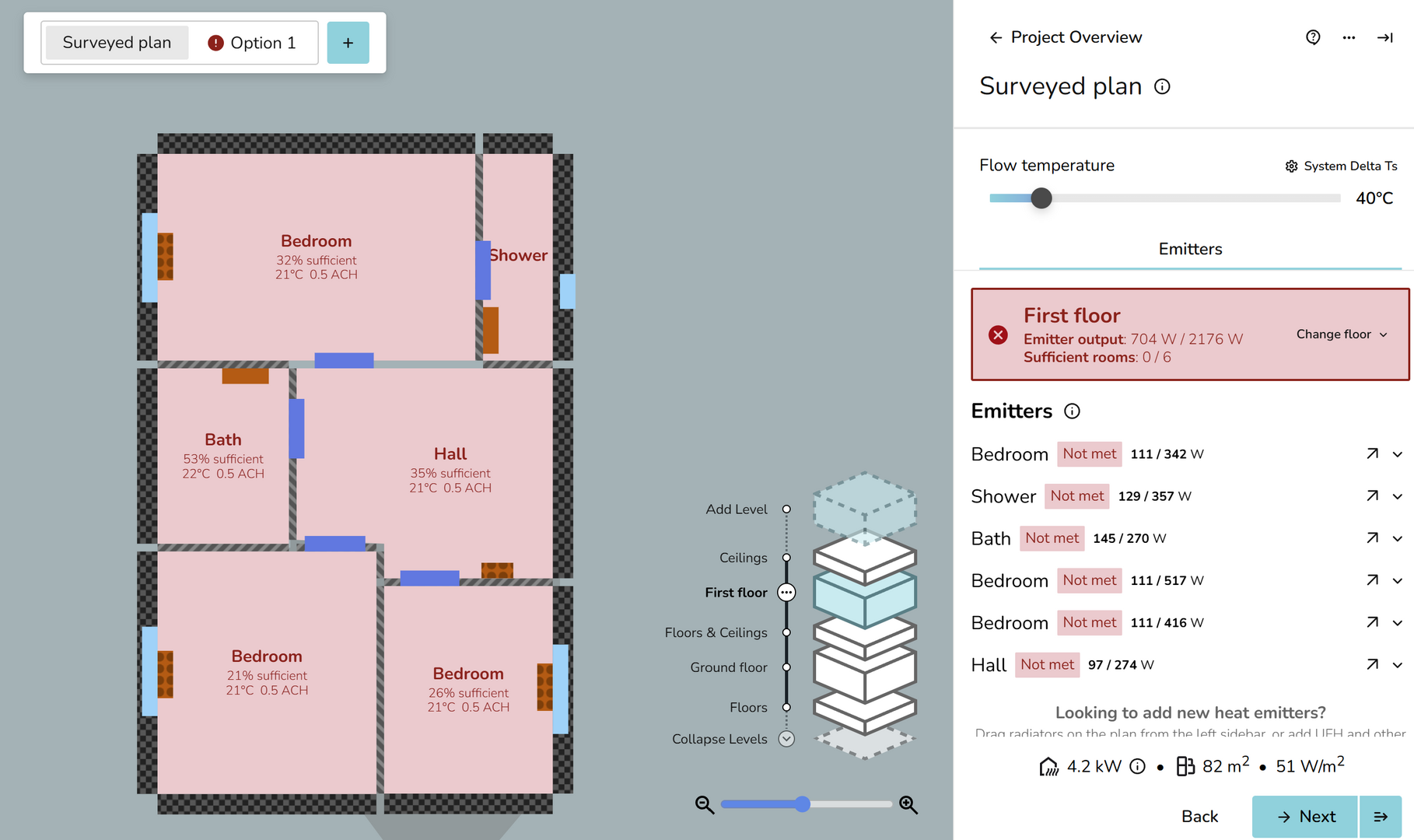
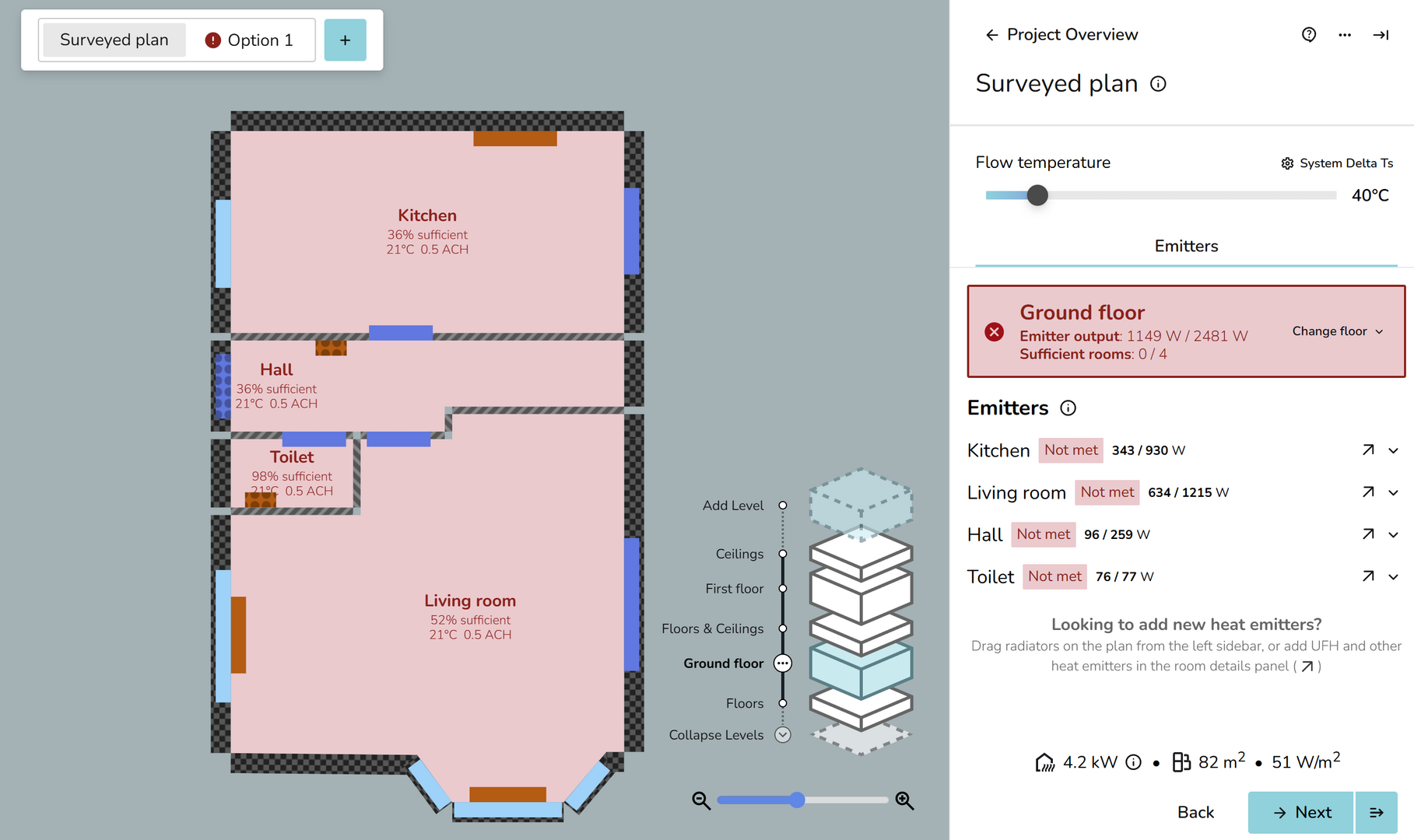
The above has the flow temperature set to 40C but again, I don't know what flexibility a given HP would have to vary this flow temp through the radiators? Presumably from 35C up to around 50C? With a commensurate lose of efficiency! Again, I don't know what this drop in efficiency curve looks like as you ramp up the HP flow temperature!? These are not things that are readily in the sales info...
Obviously, the current radiators are woefully inadequate for a low flow rate (assuming I got even half of this house plan in Heatpunk correct). The flow temperature needs to be increased to 60C to turn the ground floor green at 21C room temp [Emitter output 3,313W / 2481W)]. And even at a flow temp. of 75C with emitter output at 3,148/2,176W for the first floor, Bedroom 2 is still only at 92% sufficient...
That said, back in the real world of lived experience - the current gas boiler doesn't warm the downstairs enough during winter and it usually feels colder than I would like downstairs but the upstairs is usually too warm even with ALL of the radiators turned off except for the two towel rails in the en-suite and bathroom. This is contradictory experience to what the Heatpunk model is predicting. Albeit, the Heatpunk model assumes all of the doors are closed! I presume I could model the 'open plan' variant by just deleting all of the doors from the plan?
You said:
"My house has a total heat loss of about 4kW when 21C inside and -3 outside, i.e. a difference of 24C. If it got to -20C that difference becomes 41C, 38C if you drop the inside temperature to 18, 36 @ 16C inside. So the heat loss goes up to 6-6.8kW. However if my living room has a heat loss of 1kW (it's a bit less) that only goes up to 1.5-1.7kW which is still comfortably within the capacity of both indoor and outdoor units in an air to air system."
How did you calculate the increased heat loss at different temperatures [from 4kW to 6-6.8kW] when going from -3C to -20C external temperature?
What I'm fundamentally trying to understand is the available 'headroom' for say a 5kW ASHP for a house with a heat loss of say 4.5 kW @ 0C? How can I calculate the required flow temp for this HP to heat my house to the desired temperature [mostly about 23C in my case - I like it fairly warm! 😊] given a range of external winter temperatures [for example, 0C, -5C, -10C, -15C and -20C] and how this factors into the resultant increased running costs of that system and at what external temperature the HP runs out of headroom in the form of increasing the flow temperature to offset the increased heat loss as the external temperature goes down? So, the External Air Temperature along the X-axis, ASHP Flow Temperature along the Y-Axis and Cost per kWh along the Z-axis... Does such a graph exist and if so where can I find it for some typical ASHP models please? I realise this depends upon the Heat Loss for the property and the pipework bore diameter too - I believe mine is 10mm. There are probably a bunch of other parameters that I'm still completely ignorant of (by all means educate me)! But for arguments sake - lets assume a Heat Loss of 4.5 kW for the house (0C External, 22C Internal] and a 5kW heat pump. What would this look like please?
How would that graph change for an external temp of -10C or -20C?
A further complication [which it might be better to ignore for the moment but anyway - humour me] is the input from any secondary heating sources like an A2A system whose primary purpose is to provide cooling during the summer months. There is again a trade-off in efficiency between running the A2A system in heating mode vs increasing flow temperature of the A2W HP system. At what point does it become cheaper to provide increased heating from the A2A system vs increasing the A2W flow temp? I presume pretty quickly! Even a 5C increase in the flow temp is probably more expensive to run than turning on the A2A system to provide additional heating? Is this hunch correct or am I way off base? But this is just working on a hunch - what would be break points be in this scenario? What additional headroom from a heating perspective would a typical A2A system installed to provide some cooling during summer (as opposed to being installed for heating purposes) provide when working in this mode? I presume a couple of kW of heating capacity?
I get your worked example where you cite in your post above [aka the A2A system needing to provide an additional 1.5 to 1.7 kW of heating for the living room], with a house differential of around +2.8kW in the -20C scenario [4kW to 6.8 kW]. Even if I don't understand how you got to this figure! I'm unsure if this would work on a whole house though, even with open doors (i.e. no zoning) as would be the case for myself because I don't understand what additional heating capacity a heat pump could be increased to I guess?
@editor, if you have some thoughts/info on this I'd love to hear them too!
Overall, my expectation is that seasonal temperatures will become more extreme with increasing winter and summer extremes... Possibly as much as the occasional -20C to +40C once or twice a decade. So what does a robust ASHP design look like assuming this long term projection of our weather in the UK over the next couple of decades? Assuming that this holds some water? 😜
This post was modified 2 weeks ago by SusannaSaunders
Installed solar [7.44 kWp] and batteries [Sigenstor 3 x 8kWh] and 12 kW inverter in July 2025.

SPONSORS

Degrees of Separation
Latest Posts
-

Just switched from Agile to 100Green
I've been on Octo Agile since about Dec 2024 and for th...
By downfield , 14 minutes ago
-
-
RE: Should Households Who Can Afford It Pay More for Energy to Help Those Who Can't?
@batpred I mentioned earlier that targeting the payment...
By Toodles , 1 hour ago
-
Buffer tank on a 2 x 14kw Ecodan system
We have a setup where there are 2 x 14kW Ecodan units (...
By fosterl2 , 3 hours ago
-
RE: Why don't people choose heat pumps?
@rob-of-york The Panasonic units also have a microscopi...
By Toodles , 3 hours ago
-
RE: Adventures in heat loss calculations
@toodles thanks! So as suspected, around a doubling of ...
By SusannaSaunders , 4 hours ago
-
Six books in three years and I think I’ve now covered j...
By Mars , 4 hours ago
-
RE: Grant Aerona3 13kw - Buffer Tank - Heating Journey
@heymikey Well done in achieving as nearer a match acro...
By Toodles , 10 hours ago
-
Grant Aerona - Weather Compensation and Schedules
Im trying to set up a friends Grant Aerona. The WC curv...
By bontwoody , 1 day ago
-
RE: Air-to-Air Heat Pumps & Air Conditioning: UK Heating and Cooling Q&A
@jamespa I agree, the efficiency of Cosy Cooler ought...
By Rob of York , 2 days ago
-
RE: How much of your renewable and home setup would still work if the internet went down?
I think you're right! 🤨
By Transparent , 2 days ago
-
RE: Renewables & Heat Pumps in the News
ECO4 muddies the water somewhat, and then some. I thi...
By cathodeRay , 2 days ago
-
RE: Vaillant ecoTEC Plus - Flow Temp and Set Up
If there is a drain nearby that's exactly what I would ...
By JamesPa , 2 days ago
-
I think that CCGT plant in Lingen is more likely to suc...
By Transparent , 3 days ago
-
RE: Heat Geek installations: share your experiences
@l8again fwiw my experience (Valiant but not with heat ...
By JamesPa , 3 days ago


SPONSORS

