

Notifications
Clear all
Joining the Renewable Heating Hub forums is completely free and only takes a minute. By registering you’ll be able to ask questions, join discussions, follow topics you’re interested in, bookmark useful threads and receive notifications when someone replies. Non-registered members also do not have access to our AI features. When choosing your username, please note that it cannot be changed later, so we recommend avoiding brand or product names. Before registering, please take a moment to read the Forum Rules & Terms of Use so we can keep the community helpful, respectful and informative for everyone. Thanks for joining!
Air Source Heat Pumps (ASHPs)
98
Posts
17
Users
53
Reactions
8,618
Views

25/10/2026 3:50 pm
@susannasaunders
I can help you with some of the fundamental physics.
Heat loss has a linear dependence on temperature difference according to the Heat Transfer Coefficient (HTC) for your house. Assuming that IAT is the Indoor Air Temperature and OAT the Outdoor Air Temperature, then:
Heat Loss = HTC x (IAT - OAT)
Your heat loss worked out at 4200W for a temperature difference of 21.2C, so HTC is 198.1 Watts per degree Kelvin or Centigrade (W/K) for your house. You can lower HTC by improving insulation etc.
If you want the heat loss for a different temperature difference, just multiply HTC, i.e. 198.1 by that new temperature difference. So for an IAT of 23C and and OAT of 0C, -5C, -10C, -15C, and -20C, the heat loss will be 4556W, 5547W, 6537W, 7528W, and 8518W respectively (equivalent to adding 198W for every extra degree of temperature difference).
What I'm fundamentally trying to understand is the available 'headroom' for say a 5kW ASHP for a house with a heat loss of say 4.5 kW @ 0C?
There is almost no headroom with a 5kW heat pump and 4.5kW heat loss at 0C. Assuming that was calculated for IAT of 21C, you have 500 / 198 = 2.5C to play with. So you can have +23C indoors and -0.5C outdoors and that's it! However, that would also have the heat pump running flat out all of the time, with nothing spare for your hot water!
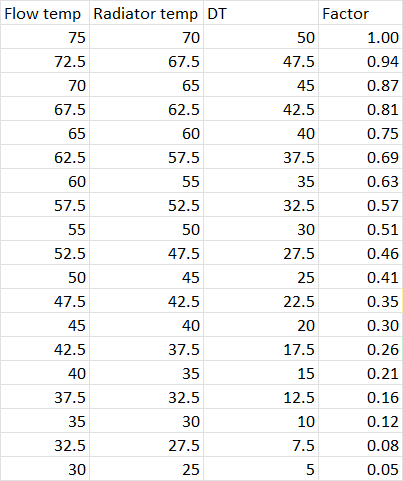
Radiator output depends on the temperature difference delta-T (DT) between the room e.g. 20C and the average temperature of the radiator. Assuming a temperature drop of 10C from flow to return of the radiator, the table below shows the multiplying factor to use to find radiator outputs. For example at DT30 degrees, radiators output 51% of the quoted power at DT50. At a flow temp of 40C, the output is just 21%. However, as most heat pumps work on a flow minus return difference of just 5C, you really need to look at the factor where the radiator temperature is 37.5C, which is 0.26 or 26%. Gas boilers typically work at flow minus return of 20C, so 80C flow is needed to get a 70C average radiator temperature. You can work out radiator power output by taking the quoted value at DT50 and multiplying it by (new DT value / 50) to the power 1.3. That's all the multiplicative factor are in the table.
This is contradictory experience to what the Heatpunk model is predicting.
The reality is that with likely no insulation between your downstairs ceilings and upstairs floors and an open door policy, a lot of the heat in your house is drifting upstairs. We also keep all the doors open and upstairs typically ends up 1 degree or slightly more warmer than downstairs, when the opposite would be ideal.
This table shows how Vaillant Aerotherm heat pump efficiency drops with flow temperature. It also shows how the maximum output drops with outdoor temperature.
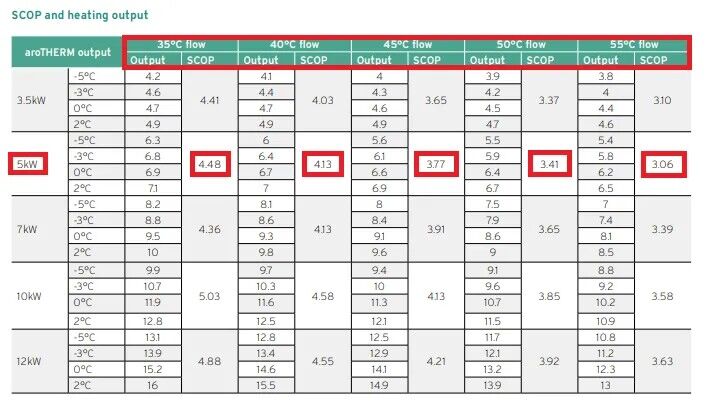
There is a double cost hit in coping with lower outdoor temperatures. The efficiency of a heat pump depends on the difference between the outside temperature and the flow temperature required. Lower outdoor temperatures increase that difference directly and also via the higher flow temperature needed to compensate for the higher heat loss.
The point that you are getting at, effectively a sensitivity analysis for both cost and performance capability with decreasing minimum temperatures is a really good one. I'll give it some thought and see if I can come back with at least a partial answer.
This post was modified 3 weeks ago by Mars

3
25/10/2026 5:32 pm
This info from the installer manual for Vaillant Aerotherm Plus shows the drop off in maximum output with very low temperatures. The lines are green 5kW, brown 7kW, blue dashed 10kW, blue 12kW.
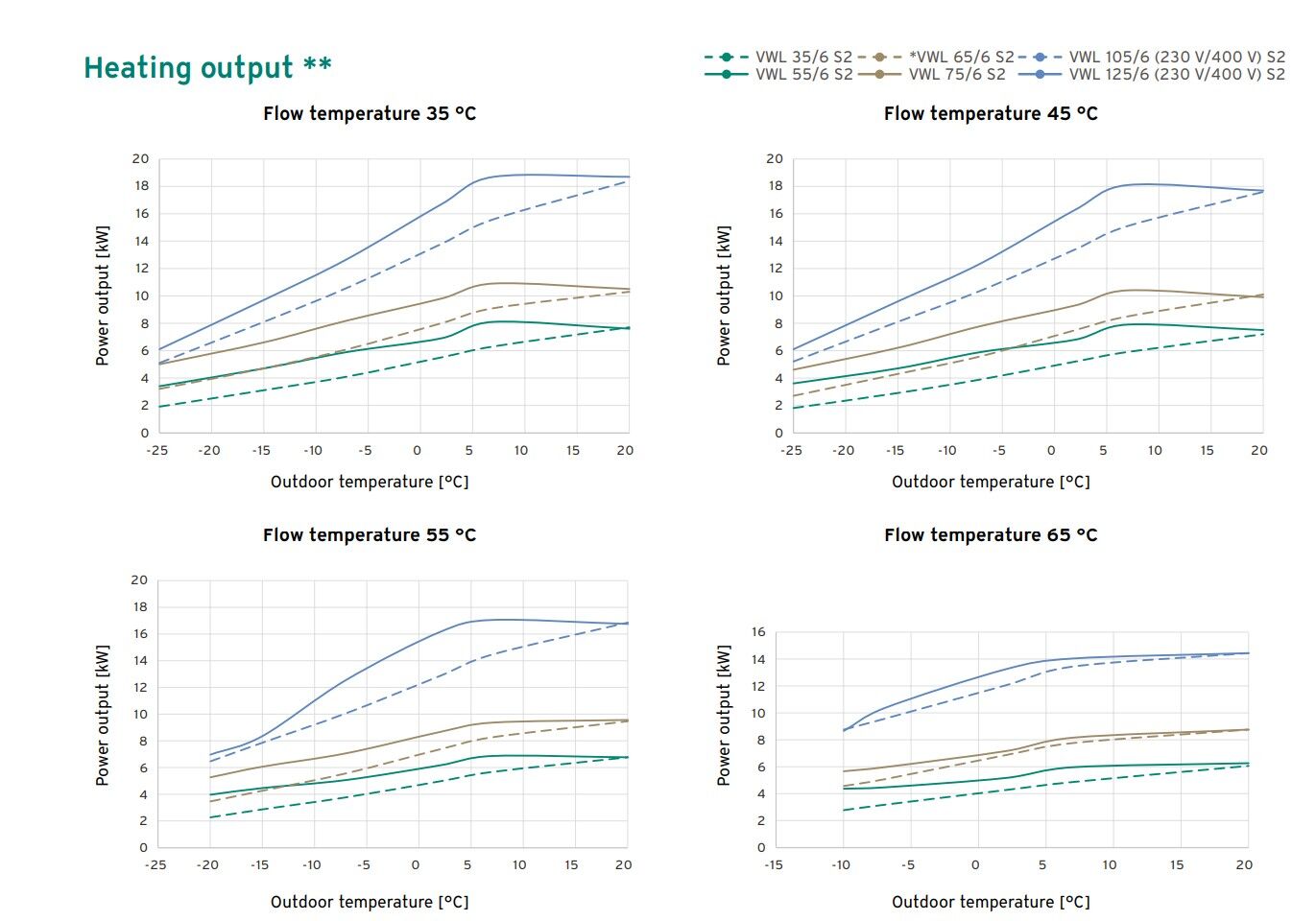
Not even the 12kW unit, which would be massively over-sized leading to other issues in normal circumstances, would give you the 8.5kW needed at -20C outside temperature, regardless of flow temperature.
Specific cold climate heat pumps are sold in countries where -10C and below is the norm in winter. It is notable that in the Scandinavian countries with cold winters and very high levels of heat pump adoption the vast majority of heat pumps used are air-to-air, over 90% in the case of Norway. In Germany, which also has some very cold periods during winter, the Govt. provides subsidies for installing a heat pump alongside a gas boiler, i.e. a hybrid approach.
At what point does it become cheaper to provide increased heating from the A2A system vs increasing the A2W flow temp?
With a good quality A2A system versus A2W, it is unlikely to ever be cheaper to use the A2W unless the maximum design flow temperature is below 35C. As a comparison with the Vaillant Aerotherm Plus, which is an excellent A2W heat pump with a SCOP of 5.03 at 35C flow for the 10kW unit, the mid-range Daikin Perfera A2A system that I have has a SCOP of 5.2. The high end Daikin Ururu Sarara has a SCOP of 5.9. There are plenty of A2A heat pumps with a SCOP of over 5, but relatively few A2W systems.
The issue with using A2A to heat the entire house is simply one of getting the heat into all of the rooms. If you fitted an A2A indoor unit in your living room and another in your upstairs hallway, that would give you plenty of options, e.g. opening and closing upstairs doors to heat / cool those rooms. We run close to 50-50 gas and A2A heating in a 146 sqm house with one upstairs and one downstairs A2A unit. We alternate between A2A and gas CH throughout the day to keep temperatures reasonably even. A2A runs overnight on cheap electricity and then again 10am - 3pm using whatever solar production there is and electricity from the home battery otherwise. The gas CH comes on in the morning and late afternoon to average out the temperatures. A little experimentation and we have reached a setting that works very well.
So what does a robust ASHP design look like assuming this long term projection of our weather in the UK over the next couple of decades?
I think it looks like a combination of what is done in Germany and Scadinavia. Germany traditionally had wet systems like the UK and now subsidises hybrid systems keeping the gas boiler alongside an A2W heat pump. The Nordic countries has a surplus of cheap electricity (hydro) and a low population density (an issue for gas networks) and so focused on A2A heat pumps.
Considering your concerns regarding temperature extremes both hot and cold, I would suggest going step-by-step. There is a lot to be gained from fitting A2A and seeing how much of your gas consumption you can replace with A2A heating. Assuming that you are using roughly the Ofgem average of 9500 kWh of gas per year, then I expect you could get to roughly 50% heat from gas and 50% from A2A. 4750kWh of gas gives about 4275kWh of heat (assuming a boiler efficiency of 0.9), which needs about 855kWh of input electricity to an A2A system (with a SCOP of 5) to replicate. Gas will be about 9.76p per unit from Jan 2027 and full price electricity will be about 30.28p per unit (Cornwall Insight). Heat pump tariffs available to homes with A2A provide half price electricity overnight and in other time slots e.g. mid afternoon. Running your A2A 50% on full price electricity and 50% on half price electricity would cost £194 for A2A heating as opposed to £464 for the equivalent gas heating, a saving of £270 per year. The more you could do with the A2A, the more you would save.
I suspect that the inevitable changes to the BUS grant coming down the line will make this the logical way forward for many people for a variety of reasons including: heating system redundancy, capability in extreme weather both hot and cold, ability to quickly heat a cold house, simplicity of installation, and the lack of problems that the design and install of A2W often creates.
This post was modified 3 weeks ago by Rob of York
2

25/10/2026 8:51 pm
This info from the installer manual for Vaillant Aerotherm Plus shows the drop off in maximum output with very low temperatures.
One solution is a heat-pump with 'Enhanced Vapor Injection' (EVI) or the manufacturer's term for their equivalent, it's a modification to how the refrigeration cycle works that maintains heat output even at very low outdoor temperatures.
For example, the Samsung EHS Mono HT Quiet units, which are R32 units with 'Flash Injection Technology' (appears to be their version of EVI) the capacity tables indicate they can maintain full, or virtually full output all the way down to -25 deg C, even at 65 deg C flow. The CoP falls away, to 1.38 at -25/+65, but I think that's still pretty impressive.
This post was modified 3 weeks ago by Mars
1

25/10/2026 10:50 pm
There are a collection of tools around on the internet that will generate R and U value approximations for walls and give you graphs. It's never simple though - any battens, window edges and so on will completely change the wall performance at that spot. They don't generally account for leaks, and for cavities if you don't know how the cavity is arranged for airflow within the cavity.
Some of them will let you work out what your heat loss is across a given temperature pair, and where the dew point is (also a rather important consideration with high insulation levels).
All of it ends up being very approximate. Houses are not built like physics experiments and something as daft as a leak under a window, or airflow around the edge of a timber floor, or even how the cavity and roof are connected can mess up your numbers a bit let alone all the guess work on how much bridging you've got hidden away in lintels and window frames
This post was modified 3 weeks ago by Majordennisbloodnok


26/10/2026 10:11 am
I'm with EtchedPixels. Heat pumps designed for -6C won't keep a house warm at -20C, that is true, but it is hardly unique to heat pumps. Nothing in our country is designed for -20C. I can't think of a single aspect of my daily life that would operate comfortably at -20C.
The solution, on a personal level, is to install more heat pumps. Specifically air-to-air heat pumps that will also help when the reversal of AMOC turns our mild, short summers into 4 month long 40 degree hellscapes.
This post was modified 3 weeks ago by Majordennisbloodnok
ASHP: Mitsubishi Ecodan 8.5kW
PV: 5.2kWp
Battery: 8.2kWh
26/10/2026 10:15 am
@etchedpixels
I agree, the modelling can never be that accurate due to all manner of variations in build even between two ostensibly similar houses. The RdSAP10 manual takes a broad brush approach to estimating the total thermal bridging via a simple factor determined by groups of age bands that is added to U-values. 0.15, 0.11, and 0.08 for homes built in or before 2002, 2003-06, and newer respectively. Similarly, an estimate of 0.5 that is now applied for Air Changes per Hour (ACH) for all homes. On the carefully worked through heat loss calculation for my house, thermal bridging and air changes each account for about 20% of the heat loss, with thermal conduction the other 60%. In practice the effects of thermal bridging and air changes could be significantly more or less than that due to higher variability than thermal conduction based on U-values, which again may not be that precise.
The equation for heat loss = HTC(IAT - OAT) provides the principle component of heat loss, but doesn't account for differences due to high wind speed, heavy rain etc., nor the more subtle effects around dew point and freezing point that you mention. Nevertheless, it is a valid way of comparing the heat loss that can be expected at different temperatures, e.g. a still day at -15C versus a still day at -5C.
For the BUS grant, heat loss modelling is required to MCS standards. In my opinion, it would be helpful if some account could be taken of practical measurement-based estimates of heat loss. Currently, they do at least provide a way of sanity checking some of the outlandish heat loss estimates that can come out of the models.
@susannasaunders
To get a good measurement-base estimate of heat loss needs data to be collected over a heating season, ideally at least 100 days (e.g. Nov, Dec, Jan, Feb). The equation for thermal equilibrium can then be used.
Heat supplied = heat lost = HTC(IAT - OAT)
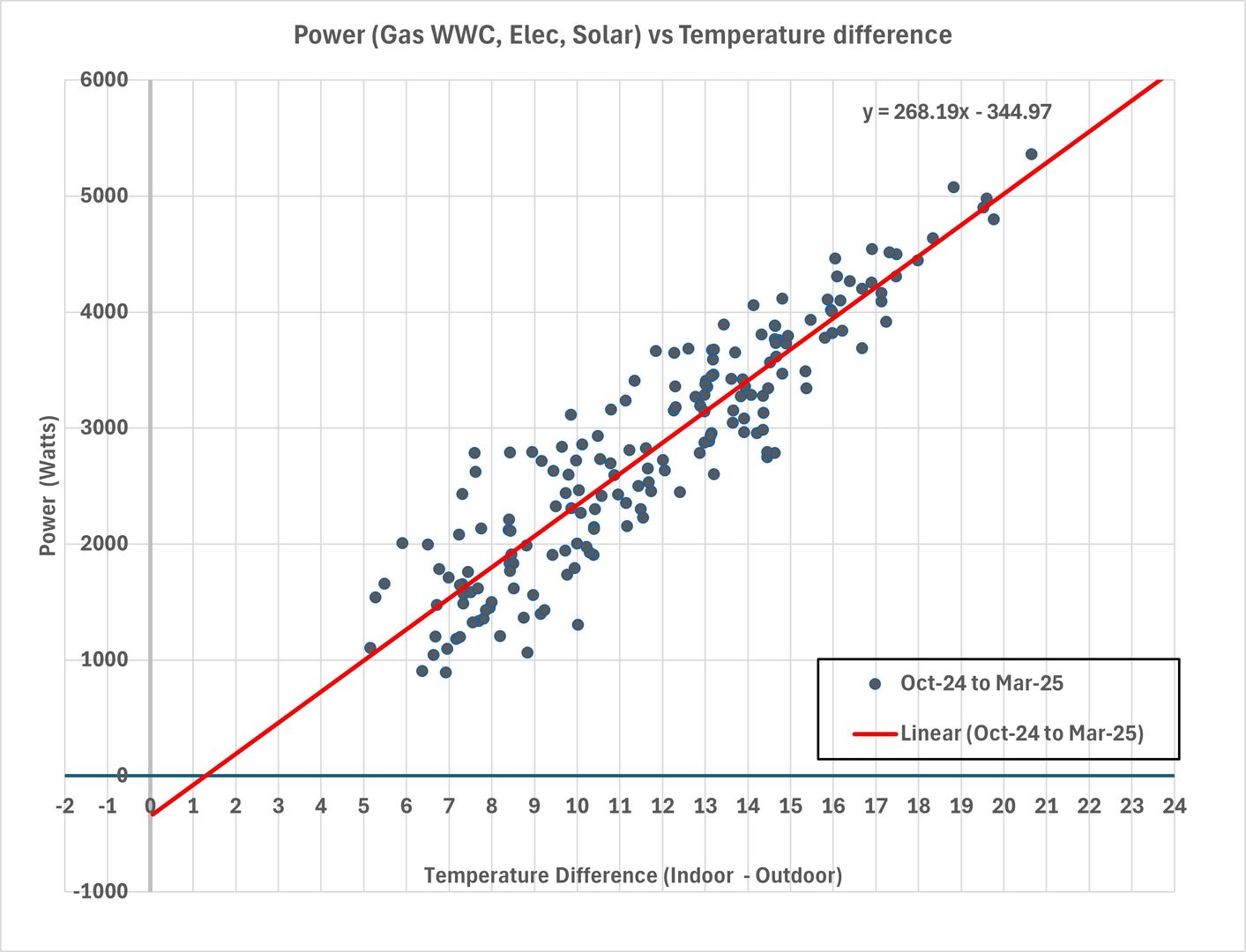
The data required are daily gas and electricity consumption along with daily average indoor and outdoor temperatures. For each day, an (x,y) coordinate is plotted on a graph of heat supply (y) versus temperature difference (x). Once all of the points have been plotted, a best fit line can be drawn through them (linear regression line). The slope of this line is the Heat Transfer Coefficient (HTC). HTC can then be used to estimate the heat loss at any given temperature difference.
The heat supplied should be calculated as gas kWh x boiler efficiency (e.g. 0.9) plus electricity kWh. Note the boiler efficiency is better slightly overestimated here, so that the heat loss is not under estimated.
The graph below shows this data for my house during winter 2024/25.
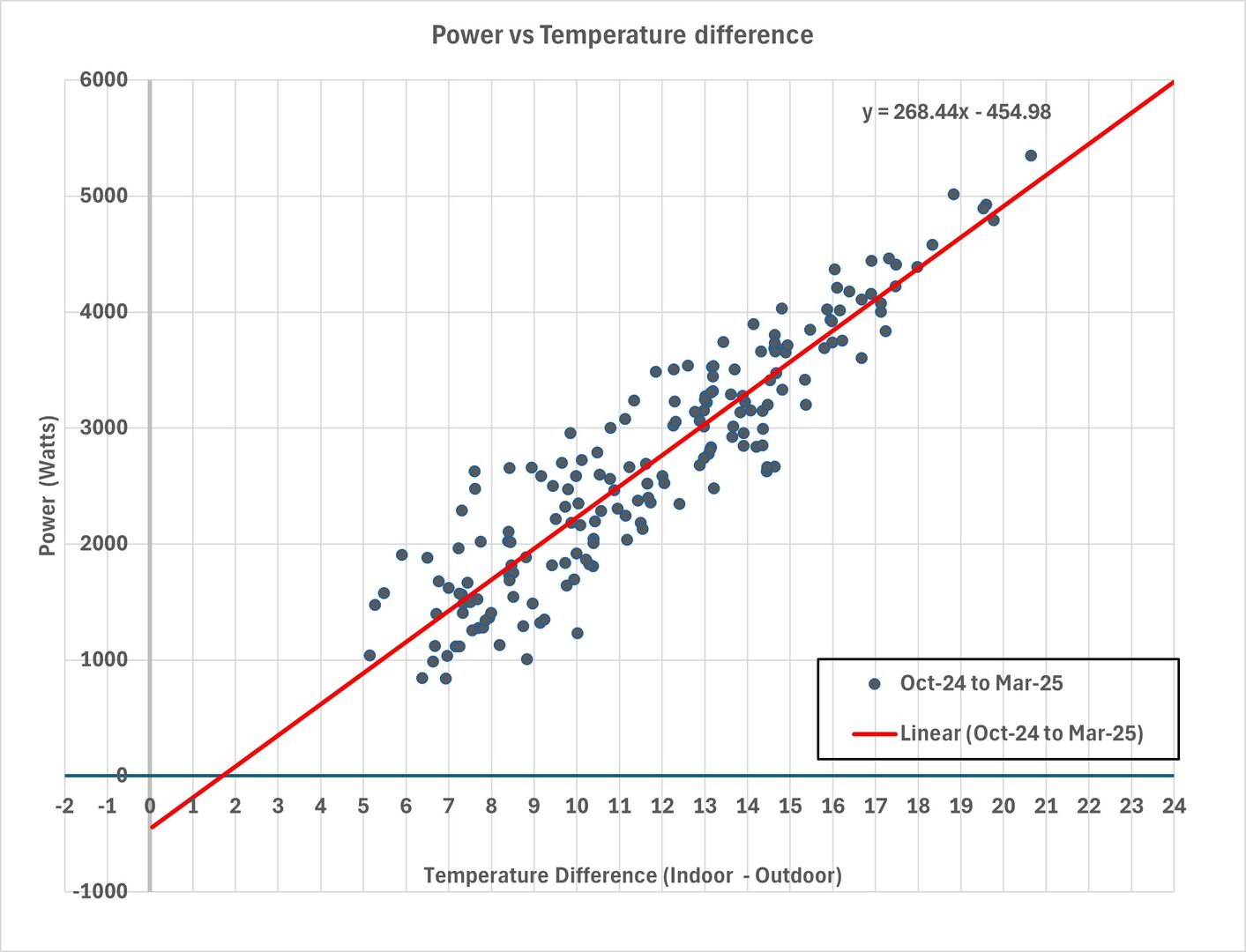
The value of HTC comes out at 268W/K, which equates to about 6.4kW heat loss at a 24C temperature difference. This is in close agreement to the modeled value that I got of around 6.2kW. This gives me confidence that the actual heat loss is likely somewhere in the range 6kW to 6.6kW and hence a 7kW heat pump would likely be fine.
Note the spread of points, there are some days above the line where the heat loss was higher even though the temperature difference wasn't that large. I expect that they were somewhat milder wet and windy days. Other days, below the line may have been very still but cold, perhaps with a little more solar gain, they appear to have lower heat loss.
I did a deep dive into this and included solar gain (using my solar PV output to get a good estimate of this) and also adjusted the gas boiler efficiency based on the weather compensation curve that I use, however, the HTC result was effectively the same as shown below.
If you can get daily indoor and outdoor temperature data from your own hobby weather station, then the above is an excellent way of getting a practical heat loss estimate. If not, then it is possible to use outdoor temperature data from the nearest local Met Office weather station and make an estimate of indoor temperatures. If your heating is on 24/7, then you can use the set point as your average temperature. However, if your heating goes off at night, then you need to account for the fact that the indoor temperature will drop more when it is cold outside. Say the heating is off for 8 hours overnight and when it is 0C outside, the indoor temperature drops by 6C in that time. On average for those 8 hours its 3C colder than the set point, in other words the average is 1C colder than the set point over 24 hours. It is possible to account for this by plotting heat supplied versus 0.95 x temperature difference. The graph below effectively does that. It plots Adjusted Degree Days* (i.e. 0.95 x (15.5C - Outdoor temperature)) against heat supplied. Note this gave a similar value for HTC of 263, which is pretty close given the removal of all indoor temperature information. Also, it only used gas consumption figures, on the grounds that electricity was not directly used for heating and so averaged out at about the same values all of the time, no dependence on hot or cold days.
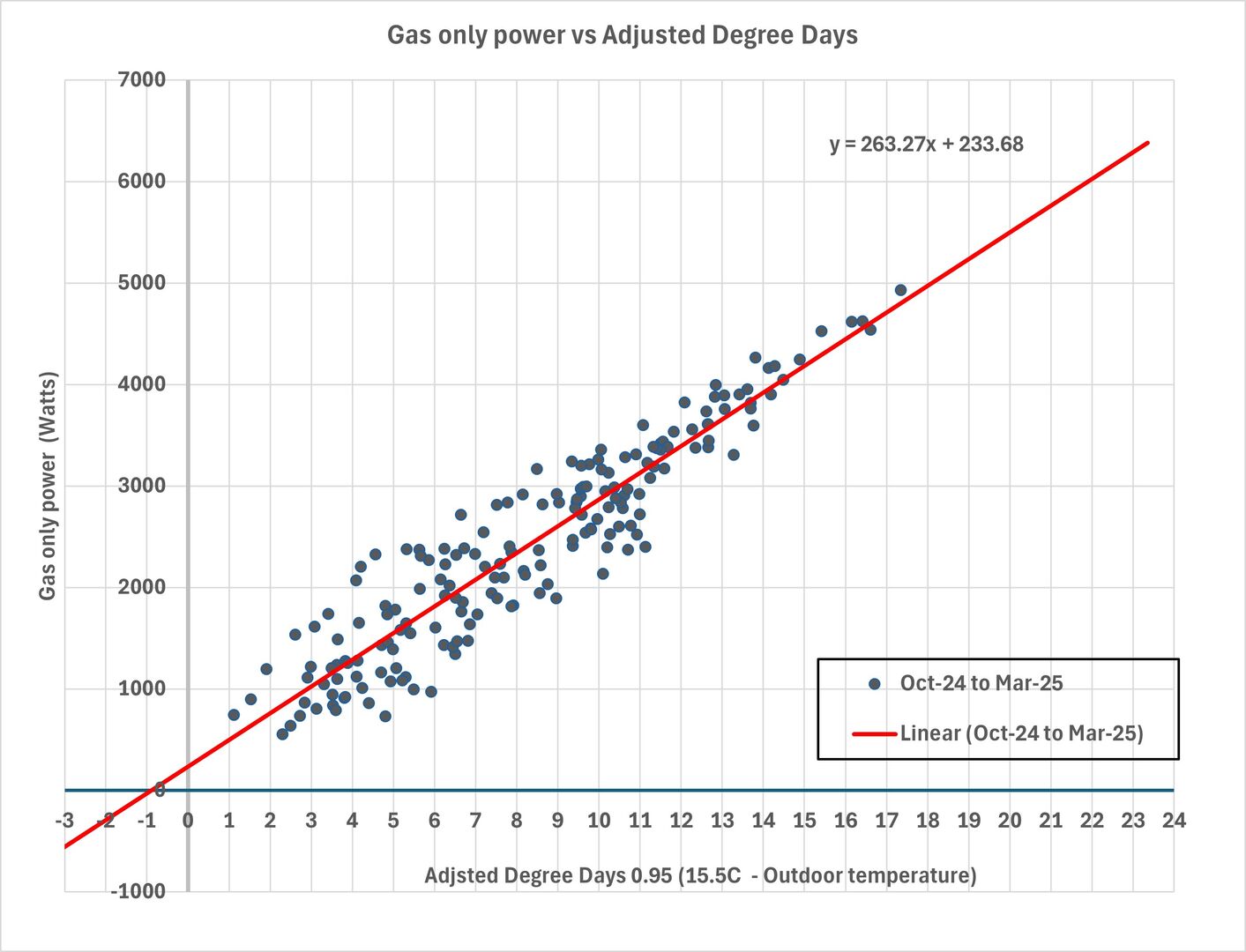
It is well worth a little time with a spreadsheet to get a practical estimate of heat loss based on real data that can then be used to sanity check values from heat loss models. You can just follow (extrapolate) the line up to the right to much larger temperature differences to see what the heat supply would need to be if it were -10C, -15C etc outside.
This post was modified 3 weeks ago by Majordennisbloodnok
26/10/2026 11:04 am
Posted by: @scrchngwsl
"Nothing in our country is designed for -20C. I can't think of a single aspect of my daily life that would operate comfortably at -20C."
I agree few things would be at all comfortable at that temperature.
A few things are however specifically designed to cope with that temperature and below - petrol cars for example, since they are sold into markets that do experience those temperatures e.g. parts of Germany, Scandinavia etc.
The lowest maximum daily temperature ever recorded in the UK was -19.1C at Braemar, Aberdeenshire on 10 January 1982, the same day and location also holds the record for the lowest daily minimum of -27.2C.
7th to 20th Jan 1987, much of England experienced very heavy snow fall and extreme cold. The maximum daily temperature in Warlingham, Surrey on 12th Jan was -9.1C and the minimum -23.3C in Caldecott, Rutland on the 13th. On the 12th Jan the maximum temperature over most of England was between -6C and -8C. The snow fall was over 50cm where I was living in Kent at the time. A consideration of temperatures in the range -5C to -15C is therefore arguably already necessary for most of the UK. Certainly, I wouldn't want to end up with no way of adequately heating my house should we get another persistent cold wave like that.
This post was modified 3 weeks ago by Majordennisbloodnok
26/10/2026 1:33 pm
@rob-of-york Yes, true, petrol (but also electric) cars sold here work fine in Norway too. I wouldn't necessarily be comfortable in one though!
The other thing I'll say is that, from memory, those cold snaps resulted in homes being, well, cold. I think there was a bit more acceptance of wearing outdoor clothes indoors back then.
Again this isn't to minimise the effect of climate change at all -- I got a heat pump precisely because of how much I care about protecting our planet from climate change. I'm saying that heat pumps aren't uniquely bad at dealing with -20C. Most things in this country are bad at dealing with -20C, including old homes with gas boilers.
Let me put it this way, if someone wanted to replace their old gas boiler with a new gas boiler, we wouldn't suggest they get better insulation and larger radiators too, just in case AMOC reverses and we get -20C winters. Perhaps it is sensible to do that, but this wouldn't be a routine recommendation for a boiler replacement.
This post was modified 3 weeks ago 2 times by scrchngwsl
ASHP: Mitsubishi Ecodan 8.5kW
PV: 5.2kWp
Battery: 8.2kWh

26/10/2026 2:13 pm
And for a bit of context 1962-63.
The winter of 1962–1963, known as the Big Freeze of 1963, was one of the coldest winters (defined as the months of December, January and February) on record in the United Kingdom.[1] Temperatures plummeted and lakes and rivers began to freeze over.
In the Central England Temperature (CET) record extending back to 1659, only the winters of 1683–1684 and 1739–1740 were colder than 1962–1963. The winter of 1962–1963 remains the coldest since at least 1895 in all meteorological districts of the United Kingdom, although in north Scotland the winter of 2009–2010 was equally cold.[2]January 1963
With an average temperature of −2.1°C (28.2°F),[9] January 1963 remains the coldest month since January 1814 in Central England, although for the UK as a whole[10] and in Northern England,[11] Scotland[12] and Northern Ireland[13] February 1947 and February 1895 were colder, whilst December 2010 was also colder in Northern Ireland. Much of England and Wales was covered in snow throughout the month.[7] Scotland experienced temperatures as low as −19.4°C (−2.9°F) at Achany in Sutherland on the 11th. Freezing fog was a hazard for most of the country.[14]
At various locations in the UK, it had been the coldest January on record for long established stations such as Newquay and Ross-on-Wye with the coldest January on record since 1891 and 1877 respectively. It was the coldest January at Kew since 1838.
In January 1963, the sea froze for one mile (1.6 km) from shore at Herne Bay, Kent.[16][17] The sea froze inshore in many places, removing many British inland water birds' usual last resort of finding food in estuaries and shallow sea. The sea froze 4 miles (6 km) out to sea from Dunkirk.[7] The upper reaches of the River Thames froze over.
In those days very few people had central heating, most houses were heated with coal fires. Our house had a coal fire in one room which meant that the rest of the house was very cold. Funnily enough we managed to survive with just a few chilblains.
Our ASHP system in this house was designed to maintain 20C with an OAT of -3.4C. On the 5th of January the mean OAT was -6C and the lowest was -10.6C. The mean room temperature was 20.1C, so even an under sized and less than ideal R32 system can cope with low temperatures. R290 in a larger machine would cope much better.
Even if that temperature had lasted for several days, undoubtedly the internal temperature would have fallen somewhat, but adding a layer or two of clothes and a bit of supplementary heat would have let us survive without undue discomfort.
I'm all for forward planning, but trying to design a system to cope with a possible but reasonably unlikely event several years in the future seems a bit much. If we did get to a state where average temperatures dropped to -20C for weeks at a time we're going to have much more serious problems than an undersized heat pump.
This post was modified 3 weeks ago by Majordennisbloodnok
2

26/10/2026 2:29 pm
@hml1827 1962 / 3 winter is remembered by me as my last winter at boarding school; going out for walks around Exeter and seeing the River Exe frozen with icicles drooping down below the bridge over the River Exe near St. David’s Station and seeing frozen weirs as if in a photograph. And yes…. our dormitory windows had permanent ice glazing on the inside, it was COLD! Ancient Toodles.
This post was modified 3 weeks ago by Toodles
Toodles, heats his home with cold draughts and cooks food with magnets.
26/10/2026 5:54 pm
I'm not overly concerned about the potential for really extreme events such as AMOC switching direction and plunging the UK into -20C winters. As others have said, if that happens whether the heating can achieve a warm house without supplementary help is going to be a long way down on the list of priorities.
What this thread has made me think about a lot more though is resiliency. Most gas heating systems have a massively over-sized boiler because no one can be bothered doing heat loss calculations for them and a 30kW model costs two hundred pounds more than a 18kW one and impacts the installation hardly at all. The fact it can't modulate down as far hurts efficiency, but not massively so and most customers don't notice anyway since the new one is more efficient than the 15 year old 30kW one that it replaces. It doesn't last as long as it should due to short cycling but the customer doesn't know that...
Heat pumps are different in that a lot of time and effort goes into actually designing the heating system for a specific minimum temperature that depends on the region of the country the house is in and prescribed room temperatures e.g. 21C. Now if this is done right, and the heat pump is accurately sized on that basis, then it potentially doesn't leave much headroom.
I have tried to get accurate heat loss estimates using both theoretical models and practical measurements for my house and come up with values around 6.4kW. Taken at face value, it would appear that a 7kW heat pump would be a perfect fit.
However, in terms of resilience, that may not necessarily be a good idea. As I get older, I may want a 24C rather than a 21C set point, and at the same time, we may get another cold spell like the one I experienced in the early 1980s where we have outside temperatures in the range -11C to -5C, call it -8C average for a few days. Then the temperature difference is 32C rather than 24C, and that 6.4kW heat loss turns into 8.5kW. Suddenly, an apparently over-sized 10kW heat pump looks like it could be a good option after all.
What I'm saying is we could usefully use designs that work very well for the expected temperature range - i.e. achieve a high coefficient of performance and avoid lots of undesirable short-cycling during the expected annual temperature range, but are also capable of providing resilience, i.e. will keep working well when asked to deliver for a bigger temperature difference and cope with colder outdoor temperatures.
Going back to my own circumstances, resilience considerations may means that a 10kW heat pump could be a better choice than the equivalent 7kW unit, which has other implications for retrofit such as pipe sizing to support the necessary flow rates to transport 10kW. (The radiators that I have planned would deliver this at a flow temperature of 45C rather than 40C for 7kW, so no issue there). Unfortunately, there is an issue here somewhat inherent in the physics / mechanics of heat pumps that means they cannot modulate down particularly low - usually a floor of around 30% of headline output, which leads to cycling on and off when the heat demand of the house is below that level. By comparison some gas boilers can modulate down to around 10%, which ends up with the same situation if they are in fact 300% over-sized!
The alternative approach is to recognise that under exceptional circumstances supplementary heating is required, size the A2W heat pump for expected temperatures and deliver extra heat via a separate A2A heat pump when necessary, and hence also have a solution for extremely hot outdoor temperatures.
This post was modified 3 weeks ago by Majordennisbloodnok
26/10/2026 6:57 pm
I agree that you need more headroom than 6.4kW vs 7.0kW, what you're said is entirely reasonable. I would add that (a) there is an error margin on the heat loss calculation and (b) the risk is asymmetric: if you oversize you have a less efficient heat pump, but if you undersize you have a very cold house. If they get it wrong you'll know about it straight away. If things change in the future you can always adapt your house in the future. My view is it's pretty cheap and not too disruptive to add a A2A heat pump down the line.
This post was modified 3 weeks ago by Majordennisbloodnok
ASHP: Mitsubishi Ecodan 8.5kW
PV: 5.2kWp
Battery: 8.2kWh
2

SPONSORS

Degrees of Separation
Latest Posts
-

-
RE: Why don't people choose heat pumps?
By the same measure we should be insisting that all gas...
By Batpred , 3 hours ago
-
RE: How quickly would you want/expect heat recovery to take from setback?
True but .. because the room is colder dt rad to room i...
By JamesPa , 3 hours ago
-
Got two or three heat pump quotes that don’t agree? Post them here.
One of the biggest sources of confusion I see on Renewa...
By Mars , 3 hours ago
-
RE: Load Shift and Lifestyle Shift Complete - our journey has ended, for now
I do not disagree with the concept of wanting to live a...
By Batpred , 4 hours ago
-
RE: Buffer tank on a 2 x 14kw Ecodan system
@singlespeed I am going to put a temperature sensor on ...
By fosterl2 , 5 hours ago
-
RE: Grant Aerona - Weather Compensation and Schedules
@taffonthetaff Yes, I have now gotten to the bottom of ...
By bontwoody , 6 hours ago
-
RE: Grant R290 DHW Cycle Interuption
Occasionally our Grant R290 activates all three circuit...
By TaffontheTaff , 6 hours ago
-
RE: Peak Energy Products V therm 16kW unit heat pump not reaching flow temperature
@davec 47kwh for 3 days is very low, compared to what I...
By johnd , 8 hours ago
-
RE: Our 10 year old Grant heat pump failed
As I understand it it was working then stopped. More l...
By JamesPa , 12 hours ago
-
@pipcart, Wattson is back... please go to the homepage ...
By Mars , 12 hours ago
-
Do heat pump defrost cycles impair heat pump efficiency (COP values)?
The short answer is no, as far as I can see from data f...
By cathodeRay , 13 hours ago
-
RE: Are We Sleepwalking Into Another Race to the Bottom?
That is a good approach and an excellent result. For co...
By Judith , 1 day ago


SPONSORS
