Notifications
Clear all
Joining the Renewable Heating Hub forums is completely free and only takes a minute. By registering you’ll be able to ask questions, join discussions, follow topics you’re interested in, bookmark useful threads and receive notifications when someone replies. Non-registered members also do not have access to our AI features. When choosing your username, please note that it cannot be changed later, so we recommend avoiding brand or product names. Before registering, please take a moment to read the Forum Rules & Terms of Use so we can keep the community helpful, respectful and informative for everyone. Thanks for joining!
Air Source Heat Pumps (ASHPs)
98
Posts
17
Users
53
Reactions
8,616
Views

26/10/2026 7:21 pm
@rob-of-york Thanks Rob!
A LOT to digest here!
Please give me a day or two to work through this and it's implications!
That table of Flow Temp vs radiator output factor... 😬 🤯 Does this mean you need to increase the radiator surface area by 5 times to operate at a flow temp of 40 [Rad temp of 35C]! Even achieving 45C/40C with a factor of 0.3 so aka about 0.35 or roughly 1/3rd 'rule of thumb' of the radiator nominal power output. It seems that operating below this threshold, while theoretically plausible is practically unfeasible because the radiators would need to be enormous...
The Vaillant Aerotherm Plus installer manual graphs are very counter-intuitive as well as power output falls as the flow temperature increases... 🙃 How does that even happen??? 😲
The heat pump efficiency tables are very interesting too. Very Alarming! But very interesting too! To maintain any kind of half decent SCOP you need a fairly good amount of headroom to enable you to run the system at a low flow temp... Above 45C becomes punishingly low SCOP. Increase the HP capacity up to 7 or 10kW gives more head room but presumably higher running costs too. It would be interesting to know by what percentage increase across the size options (a complicated question I know because of the shorter cycling times and increased wear and tear issues). The 'sweet spot' is a complicated zone!
Thank you for all of this very valuable info!! 😘 🍻 you have increased my knowledge a fair bit so thank you for this! I'll come back to you once I've had some thinking time.
This post was modified 3 weeks ago by Majordennisbloodnok
Installed solar [7.44 kWp] and batteries [Sigenstor 3 x 8kWh] and 12 kW inverter in July 2025.
26/10/2026 9:36 pm
@rob-of-york Thank you for this!!!I'll set this up and start monitoring from tomorrow... I have a bunch of ThermPro thermometers so I can do this relatively easily (one on my desk and one in the garage or garden with a suitable 'weather cover').
What I do have is the gas consumption data for Sept 2024 to 25 [6,257 kWh] and Sep 25 to 2026 [6.442 kWh].
Both of these winters were very mild though! So probably atypical figures...
The first year (2024-25) the wall thermostat was pretty much on 22C for the bulk of the winter months. For the 2nd year (2025-26) it was probably nearer 23C most of the time as I was feeling cold much of the time the first year.
I also started looking at this last year: How big a heat pump do you need? A simple Rule of Thumb.
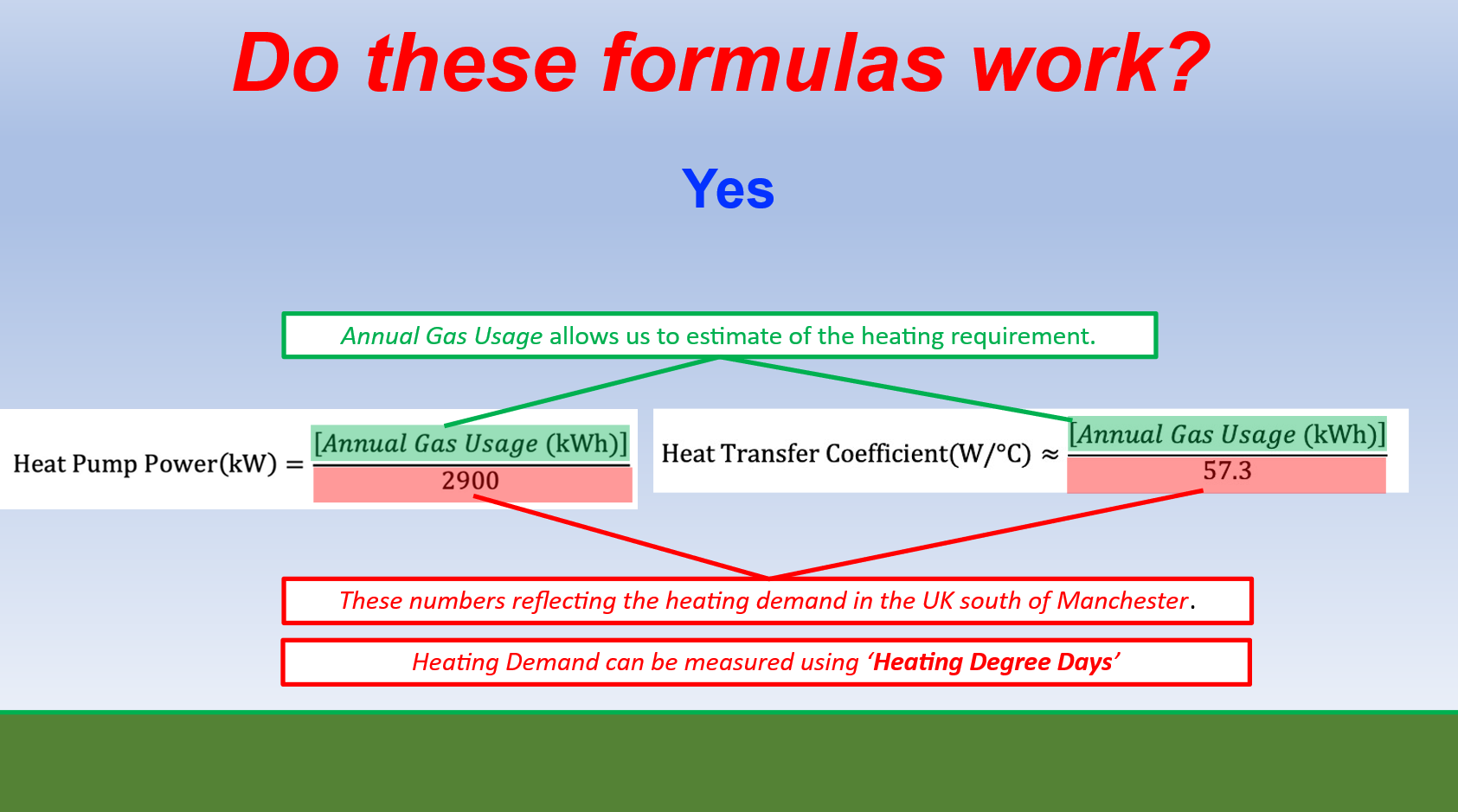
This gives me a suggested Heap Pump Power rating of [6,442/2,900] = 2.2 kW
This seems rather on the small side to me even though this is a new build (2024) small house (83m^2).
Or using the Cardiff [3.34N, 51.4N] Heat Degree Days figure of 2067 = [6,442 / 2,067] = 3.1 kW
That's a significantly different result!?
Fiddling with the HDD figures in a spreadsheet to get an equivalent to 22/23C heat output put the figure just shy of 4.0 kW heat pump...
and a Heat Transfer Coefficient of [6,442/57.3] = 112.43 Watts per degree C.
Therefore to raise the temperature from 0C to 23C would require 23 x 112.43 = 2,585.89 W/hr (2.59 kW/hr)
Therefore for 1 day = 24 x 2,585.89 = 62,061 W/day (62.1 kW/day).
This sounds a LOT! 😲 Daily measurements are clearly needed ... Heading to my Octopus gas data download tomorrow and taking a close look at the daily data! I'm going to be clearly busy over the coming weeks!
This post was modified 3 weeks ago by Majordennisbloodnok
Installed solar [7.44 kWp] and batteries [Sigenstor 3 x 8kWh] and 12 kW inverter in July 2025.

26/10/2026 10:05 pm
@susannasaunders
Indeed, lots to think about there!
Below, I'll try and fill a few gaps.
Re: Radiators: yes if the radiator temperature is 35C, then you get roughly 1/5th the power output for 70C radiator temperature. So 35C radiator temperature needs very large radiators and/or a house with a very low heat loss. Note, with a heat pump running the typical flow minus return temperatures of 5C, then 35C radiator temperature would correspond to 37.5C flow temperature and 32.5C return temperature. The table is for flow minus return of 10C, which allows for lower flow rates suitable for smaller bore pipework while still being able to transfer the required amount of heat. Getting to a maximum flow temperature of 35C is often only possible with underfloor heating.
If you look at the Stelrad radiator information (
) there is a big table of power outputs at DT50 for different sizes of K1 and K2 radiators. If your old radiators do not have convection fins, then these are either type 10 (single panel no convector fins) or type 20 (two panel no convector fins). You should be able to find some details for their power outputs online. K2s have a much higher output for the same basic size, so it is often possible to upgrade by a factor of two in power output without greatly increasing radiator size. There are also K3s with 3 panels which are much thicker and represent a further upgrade at a more significant cost. K3s are not available in as many sizes.
Note, a system would only operate at its maximum design flow temperature when the outside temperature is at the minimum that the design caters for e.g. -3C. The rest of the time, the weather compensation curve used by the heat pump would lower the flow temperature with the aim of matching the radiator output to the heat loss of the house at the current outdoor temperature. Thus the system will hardly ever actually run at the maximum design flow temperature, most of the time it will be lower.
Re: Power output: The compressor in a heat pump can run at some maximum input power. As the gap between outdoor temperature and flow temperature increases, the efficiency of the heat pump reduces due to the higher lift in temperature required. Hence the maximum output power (= input power x efficiency), also decreases. This is why heat pump output reduces at higher flow temperatures.
A decent design with radiators can often get to 45C maximum flow temperature. Note a SCOP of 3.77 is not bad. It may be some way down on 4.13 at 40C maximum flow temperature, but the running cost differences are not that big. Assuming say 9000kWh of heating, that's 2387kWh of electricity input at SCOP of 3.77 and 2179kWh at a SCOP of 4.13, so a saving of 208kWh or about £62 per year at full electricity prices. However, specific heat pump tariffs mean that you may only be paying about half that. Chasing the optimal SCOP isn't necessarily worthwhile. It could notionally take 25-50 years to payback if you need to spend say £1500 extra on new radiators to get there.
This post was modified 3 weeks ago by Majordennisbloodnok

1
26/10/2026 10:44 pm
I'll set this up and start monitoring from tomorrow...
Nice! That is the way to go to get the highest quality estimate you can based on practical data.
The issue with the simple methods based on annual gas consumption is that they make assumptions about what the weather is like during the heating season that may not hold for any given winter. Plotting daily data and a regression line eliminates that issue.
This post was modified 3 weeks ago by Majordennisbloodnok


27/10/2026 8:34 am
@susannasaunders can I just add to @rob-of-york s comment. Before I got my heat pump I monitored half hourly
This gives me a suggested Heap Pump Power rating of [6,442/2,900] = 2.2 kW
This seems rather on the small side to me even though this is a new build (2024) small house (83m^2).
I am not at all surprised by this figure. Modern fairly compact houses can be very low loss.
Can I just add to what @rob-of-york says about the value of monitoring consumption. Im a great fan of this. Its real data which, used intelligently, circumvents many of the uncertainties associated with surveys. It does introduce some uncertainties of its own but its still well worth doing. Its effectively how my heat pump was sized and had I not used this method the sizing would have been way out. My loss measured by monitoring consumption (and subsequently verified using the heat pump) is 7kW, when I used MCS assumptions to calculate loss based on my own survey it came to 10.5kW; two full 'professional' surveys said 16kW. 7kW vs 16kW is a material difference (which I was able to explain).
That said, with a loss of ~2kW it really isnt necessary to determine the value terribly accurately. With an A2W heat pump you are going to end up with a 5-6kW model anyway, and with A2A your capacity will be set by how many outlets you need to cover the rooms.
This post was modified 3 weeks ago by JamesPa
4kW peak of solar PV since 2011; EV and a 1930s house which has been partially renovated to improve its efficiency. 7kW Vaillant heat pump.
2
29/10/2026 12:53 pm
@susannasaunders I agree with @jamespa, I think that your house's actual heat loss figure will be somewhere in the range 2.2 to 3.1kW. A 2024 new build has an excellent level of insulation mandated by building regulations.
In terms of heat pumps, a Vaillant Aerotherm 3.5kW could be a possibility, however, the 5kW is very similar in terms of internals. The 3.5kW is restricted in compressor speed compared to the 5kW, and both modulate down to the same minimum output before cycling. For that reason the 5kW may be a better choice as it will be able to heat a tank of hot water faster, and provides much more headroom for dealing with very low temperatures.
According to the graph from the installation manual that I posted earlier, the 5kW unit has an output of about 4.2kW at -15C and 55C flow temperature. Assuming that your heat loss comes out around 2.8kW at a 24 degree temperature difference (-3C to 21C), that would equate to 4.2kW at a 36 degree temperature difference (-15C to 21C). So an Aerotherm 5kW heat pump would do the job at -15C, which is a really good level of resilience, assuming that your radiators can put out 4.2kW at 55C flow temperature.
These heat pumps avoid short cycling via the control logic that and the minimum water volumes that Vaillant specify for the system, so hopefully that would not be an issue even though the amount of heat that you would need could be below the minimum output of the heat pump a lot of the time. With air-to-water heat pumps that may well be unavoidable given the low level of heat loss for your house.
An alternative would be to keep your gas boiler and fit something like a Daiking Perfera 2.5kW single-split air-to-air heat pump. This would cost roughly £2000 and can be fitted in about half a day with minimal disruption, although current demand means it is unlikely that you could get one fitted before about Feb 2027. SCOP is 5.2, and the output at -10C is 2.4kW. These units can modulate right down to about 0.8kW output (125W input). Air-to-air would have the advantage of providing cooling as well as a redundant heating system that can be run alongside your gas central heating and hot water. You could likely halve your gas usage, while still using gas for hot water, and hence avoid the need to add a new hot water tank. With the gas standing charge being removed at the end of 2027, this approach has a lot going for it if you are comfortable with a pragmatic solution that lowers CO2 emissions without dropping them to zero.
This post was modified 2 weeks ago by Mars
1
29/10/2026 8:13 pm
@rob-of-york Thank you Rob! These are very good suggestions! I very much appreciate the thought gone into your reply! I'll look into the suggested models and learn more about these options.
I like the suggestion of going with the hybrid approach. It would be much cheaper and still provide utility and a reduction in the gas bill. I'm not sure how a hybrid system would function practically though because the two respect thermostats would be switching each other on and off? Effectively competing to heat the house?
How would a hybrid A2A / gas boiler system work practically? You run the A2A at a set temperature and the boiler at a temperature slightly below this set point (say 1 degree lower) so that the boiler kicks in once the heat pump maxes out and is no longer providing the needed heat? Quite what this heat pump does then is a bit confusing though? Presumably, the house temperature rises above the set point for the boiler and then ossilates between them?
If you have any experience of such a hybrid solution, I'd like to hear it! 👍
This post was modified 2 weeks ago by Majordennisbloodnok
Installed solar [7.44 kWp] and batteries [Sigenstor 3 x 8kWh] and 12 kW inverter in July 2025.

29/10/2026 10:44 pm
@susannasaunders
I use the A2A for shoulder periods and if we need an instant heat boost in the lounge, this worked really well in conjunction with calor gas reducing our use substantially. Actually did that this evening as our A2W is set at 20c currently and I could not be bothered lighting our log burner, and we were both feeling chilly!
Having multiple options may be a very useful way to cover oneself if we are heading for wildly varying climate.
If you have any specific questions that I can help with please ask. A brief version of my journey here…
https://renewableheatinghub.co.uk/forums/rules-terms-of-use/say-hello-and-introduce-yourself/paged/114/#post-64655
This post was modified 2 weeks ago by Majordennisbloodnok
1

30/10/2026 8:43 am
If you have any experience of such a hybrid solution, I'd like to hear it!
@susannasaunders For context, our house is a 146 sqm 1970s 4-bed detached with a lot of retrofit insulation. The heat loss is about 6.4kW, annual gas usage of about 14,400 units before installing A2A. Reverse engineering the simple divisor on annual gas usage, this gives 6.4kW = 14,400/2250. So my best guess at the heat loss of your house is 6440/2250 = 2.86kW.
With a heat pump tariff there is a period of cheap rate electricity overnight and often another in the afternoon. For example, British Gas' tariff (open to those with a heat pump, EV, or home battery) has half price electricity from midnight to 7am and from 1pm to 4pm. We have cheap electricity overnight on an Octopus tariff, and also Solar PV and a home battery, which is used during the day. We have Daikin Perfera 3.5kW and 2.5kW A2A units in the living room and main bedroom respectively. For overnight heating, we only use the unit in the living room.
The way we make hybrid heating work with gas CH and A2A is to schedule them to mainly operate separately, which is what I would suggest that you do using the programmable timer-thermostat for the gas CH. Assuming cheap rate electricity in the above time periods, I would suggest the following. Late evening, set the gas CH to go off about 10pm by reducing the set point from normal (22C?) to say 18C. At midnight, the A2A comes on with a set point say +2C over normal 24C, and runs until 7am. At 7am the set point for the gas CH changes to 22C and the gas CH takes over until 1pm then it's set point changes to 18C (off again). At 1pm, the A2A comes on, set point 22C or slightly higher until 4pm. At 4pm the gas CH takes over until 10pm, set point 22C.
You can shift a bit more heating requirement onto the A2A by effectively turning the gas CH off a couple of hours before the A2A is due to come on, and then heating with the A2A to a slightly higher temperature than actually needed. A2A in say your living room won't result in the same consistent temperature throughout the house. The idea is simply to inject some very cheap low carbon heat energy into the house, which reduces your heating bill and CO2 emissions. The gas CH then evens the temperatures out again. You'll need to do some experimentation to find out what works comfortably given the rate at which your house loses heat, and how well the heat from the A2A permeates throughout the house. The biggest win is simply using A2A on cheap electricity to keep your house warm overnight.
If you have both gas CH and A2A on at the same time, it's not a problem. One of them will inevitably have a higher set point than the other. The one with the higher set point will end up taking over the heating, and the other one will not run. The only hazard is gas CH on and A2A switched to cooling! That said, it is preferable not to have the thermostat for gas CH in the same room as the A2A (the thermostat for the A2A is in the wall mounted unit), as a lot of heat in that room will then prevent the gas CH coming on while the rest of the house is below the desired temperature. If you can set the TRVs in the living room, so that room won't overheat just because the gas CH is on and the A2A already put a lot of heat into the room, then it should work quite nicely. Note, I would not let the current siting of the thermostat for your gas CH dictate the A2A location. It is important to have that in the right place, most likely your living room as you are primarily interested in heating with A2A.
This post was modified 2 weeks ago by Majordennisbloodnok
1
30/10/2026 9:09 am
@susannasaunders
When you come to get quotes for A2A, as always get 3 quotes from people who actually visit to see what is required. Let them know that your primary use of the A2A will be for heating as this is a key consideration for where to place the unit and choice of equipment. Also tell them your house's heat loss is a max of 2.8kW or whatever your best estimate is for it.
They will likely suggest the living room for the indoor unit, however they may have good reasons to suggest somewhere else which they should explain.
I think a 2.5kW unit should be enough, but again an installer may suggest a larger 3.5kW unit and explain why. For example, cooling demand can be larger than heating demand and the cost difference is not that much. A 2kW unit may also be enough, however, 2kW units may simply be restricted versions of 2.5kW units for only a few tens of pounds less, better to get the 2.5kW in that case.
Daikin Perfera units are very good (from experience) and are one of the best in modulating down to very low levels (125W input). I've seen this for myself on our solar PV app when the A2A is the only thing running. It does low level heating without cycling very well.
Daikin Comfora may be suggested as a lower priced option and would be perfect if you were only really going to use it for cooling with occasional use for heating. However for a few hundred pounds more, the Perfera is a more robust heavy duty A2A system, better suited to day-in day out use. It has a higher SCOP than Comfora, and will possibly last longer with high usage. I have that one and would recommend it.
Other major Japanese manufacturers also do very good A2A systems, I have no relationship with Daikin other than owning two of their single-split systems.
This post was modified 2 weeks ago by Majordennisbloodnok
30/10/2026 1:32 pm
@rob-of-york Thanks for these additional thoughts Rob! Much appreciated!
In way of background info, we installed 16 solar panels (we did have 18 but 2 had to be removed from the garage roof thanks to our neighbours putting up a trellis that blocked the light along the bottom section of the garage roof that backs onto their garden - we re-orientated the remaining 3 panels on the garage to landscape format but it was annoying!) that gives us 7.44 kWp of solar generation and 3 x 8kWh (24 kWh total) of Sigenstor batteries coupled with a 12 kW inverter.
The batteries are able to provide more power than currently needed [typically we use about 10 to 11 kWh per day). The excess capacity is intended for using a heat pump - once we know what we are going to do and we have the money to implement it! 😆 That's currently the 'rub' I'm here to figure out... We currently run on the Octopus Flux tariff as we fill the batteries between 2-5AM at 16p/kWh and then export anything unused [typically around 12 kWh] at double the cost [30p/kWh] between 4-7PM. It basically means our electricity is free during the Winter and in Summer we make well over £100 a month on export.
I get your point around the TOU and set points for the two systems and I like that approach... How it would work in practice I'm not quite so sure about. But I'm reasonably comfortable that it could be made to work just via managing the set points for each system. The gas central heating (GCH) typically oscillates/cycles between about 21.5 and 23C, which is OK most of the time for us. As I suspect is the case with most wall thermostats, its temperature display reads about 1C higher than the actual room temperature. 🙄 How hard can it be to have a wall thermostat that is actually accurate these days? Tiresome. The GCH thermostat has 0.5C steps, which is kind of a bare minimum granularity as well given the vagaries of hot water system that cycles. Are these kinds of issues (inaccuracies' and lack of granularity) the same on A2W and A2A heating systems?
I've ordered a Switchbot Outdoor Meter Kit with 3 thermometers https://uk.switch-bot.com/products/outdoor-meter-kit?variant=49859900801255 for the purposes of monitoring indoor and outdoor air temperatures over the winter months so that I can calculate the daily air temperature difference vs the gas kWh used per day; with a view to getting a better heat loss figure... I'm still figuring that part of this out but hopefully it will give me some real world data to go on rather than a bunch of vague assumptions and averages. 😏 Hopefully I'll have that setup and running in the next week.
Thanks again for your help and advice! It's sincerely very much appreciated!!!
This post was modified 2 weeks ago by Majordennisbloodnok
Installed solar [7.44 kWp] and batteries [Sigenstor 3 x 8kWh] and 12 kW inverter in July 2025.
30/10/2026 2:22 pm
@watcher Thanks for the input! The option of going with A2A for heating/cooling and keeping the gas boiler for hot water is an appealing one with the daily standing charges being removed next year even tough it means giving up the BUS grant! 🙄 It still leaves a gas boiler that needs annual servicing but I guess that's not too significant in the scheme of things.
We moved into this new build [built 2024] and one of the consequences of buying a new build, aside from the TINY house footprint in square metres of living space is the attendant severe lack of storage! Despite it being one of the worse decisions of my life because of the piss-poor property developers (as an aside, buying a new build is a seriously BAD IDEA these days!), the houses insulation though has been amazing! Anyway, finding space for a 220L water tank is dubious at best but it could go into the loft. As the house is a semi-detached, presumably it could be attached to either the partition wall or the end gable wall. The roof structure is already under strain with the 13 panels [270 kg] of solar panels though, so I'm unsure about putting another 220 Litre water tank up there as well. That's half a tonne of additional weight on the house structure it was probably not designed to take... Given the number of short-cuts and dodgy practices that the property developer [Summerfield Homes] has made that I know about (and there have been a LOT of them), I simply don't trust them AT ALL! But I digress...
An A2A heating system wouldn't be my 'go-to' because of the movement of air causing drafts (rather than radiant heat) but once it's reached equilibrium I guess that becomes less intrusive. The functionality of home cooling though, certainly outweighs that point! As suggested by @jamespa and @rob-of-york above in this thread, a 3kW A2A system would be a good viable option in this case. It's an option that I think I need to get some quotes around and then compare that with the GCH removal option with the BUS grant included... Even with a A2W system, I'm still going to want an A2A system for the summer cooling (I can't handle the heat waves at all above 25C). So the central problem principally resolved around the DHW supply... To my knowledge, no A2A system will supply hot water... 😢 Only an A2W system will provide this for us. Our hot water bill is only about £15 per month though and that's with the daily standing charge! Once that's removed next year, the DHW bill will come down to about half of that! Probably only around £100 per year plus the annual servicing costs. So as much as it pains me, it's getting hard to justify removing the gas boiler completely, despite the government trying it's best to push that upon us. Economically, it doesn't really add up under the current BUS allowances. The allowances would need to be closer to £10k for A2W to offset the DHW issues and radiator replacements.
What are peoples general feelings about the BUS A2W and A2A grant amounts? Are they sufficient or not in your opinion, especially in light of the GCH having to be removed completely?
This post was modified 2 weeks ago by Majordennisbloodnok
Installed solar [7.44 kWp] and batteries [Sigenstor 3 x 8kWh] and 12 kW inverter in July 2025.
SPONSORS

Degrees of Separation

Latest Posts
-

-
RE: Why don't people choose heat pumps?
By the same measure we should be insisting that all gas...
By Batpred , 3 hours ago
-
RE: How quickly would you want/expect heat recovery to take from setback?
True but .. because the room is colder dt rad to room i...
By JamesPa , 3 hours ago
-
Got two or three heat pump quotes that don’t agree? Post them here.
One of the biggest sources of confusion I see on Renewa...
By Mars , 3 hours ago
-
RE: Load Shift and Lifestyle Shift Complete - our journey has ended, for now
I do not disagree with the concept of wanting to live a...
By Batpred , 4 hours ago
-
RE: Buffer tank on a 2 x 14kw Ecodan system
@singlespeed I am going to put a temperature sensor on ...
By fosterl2 , 5 hours ago
-
RE: Grant Aerona - Weather Compensation and Schedules
@taffonthetaff Yes, I have now gotten to the bottom of ...
By bontwoody , 6 hours ago
-
RE: Grant R290 DHW Cycle Interuption
Occasionally our Grant R290 activates all three circuit...
By TaffontheTaff , 6 hours ago
-
RE: Peak Energy Products V therm 16kW unit heat pump not reaching flow temperature
@davec 47kwh for 3 days is very low, compared to what I...
By johnd , 8 hours ago
-
RE: Our 10 year old Grant heat pump failed
As I understand it it was working then stopped. More l...
By JamesPa , 12 hours ago
-
@pipcart, Wattson is back... please go to the homepage ...
By Mars , 12 hours ago
-
Do heat pump defrost cycles impair heat pump efficiency (COP values)?
The short answer is no, as far as I can see from data f...
By cathodeRay , 13 hours ago
-
RE: Are We Sleepwalking Into Another Race to the Bottom?
That is a good approach and an excellent result. For co...
By Judith , 1 day ago


SPONSORS