

Notifications
Clear all
Joining the Renewable Heating Hub forums is completely free and only takes a minute. By registering you’ll be able to ask questions, join discussions, follow topics you’re interested in, bookmark useful threads and receive notifications when someone replies. Non-registered members also do not have access to our AI features. When choosing your username, please note that it cannot be changed later, so we recommend avoiding brand or product names. Before registering, please take a moment to read the Forum Rules & Terms of Use so we can keep the community helpful, respectful and informative for everyone. Thanks for joining!

12/10/2024 4:19 pm
@cathoderay On a general note, I wonder what ball-park figure one might apply to the accuracy tolerance of the data supplied by default measuring equipment rather than by instruments installed for the purpose. My system readings are provided by the default (Daikin) equipment and the stats look very respectable; might I expect to allow perhaps + or - 10% on any given reading perhaps? Regards, Toodles.
Toodles, heats his home with cold draughts and cooks food with magnets.
12/10/2024 5:09 pm
I wonder what ball-park figure one might apply to the accuracy tolerance of the data supplied by default measuring equipment rather than by instruments installed for the purpose
I don't think, for my system, it is too bad, because I have some basic independent monitoring tools, and they broadly agree with the Midea data collected over modbus. For example, I calculate energy out from:
(1) Midea reported flow rate, which I can verify with an analogue flow meter installed in the circuit
(2) LWT/RWT delta t, which I can verify using an IR thermometer/camera
(3) specific heat of the circulating fluid, which is fixed for a given fluid mix
The problem is verification for (1) and (2) is based on spot readings, whereas the modbus/Midea data is continuously recorded at minute intervals. Nonetheless, a short while ago the Midea controller said the flow rate was 1.23 m^3/h (20.5l/min), while the analogue meter showed 20l/min, a ~2.5% difference, but the analogue meter has a very crude scale, maybe it was actually showing 20.5l/min. A few moments later, the delta t on both the Midea controller and the IR measurements was zero (because the heat pump is cycling, and it was in an off phase). A few minutes later, with the on phase underway, the delta t was 4 on both. Since the Midea numbers are integers, they may be a bit out, but not hugely so, and I should add that absolute values for the temps are not the same, the Midea numbers are about 3 degrees below the IR measured values eg Midea number is 38, IR number is 41, but it is not the absolute values we need, rather the difference (delta) value, which is the same. These readings (and others done in the past) are enough to satisfy me that the Midea data based calculated energy out is tolerably close to the real value, say within 5%. At least, that is what I think is the case...
Midea 14kW (for now...) ASHP heating both building and DHW
12/10/2024 5:32 pm
@cathoderay We are back to the person with one watch always knowing the correct time whilst the person with two watches never being quite sure.😉 Toodles.
Toodles, heats his home with cold draughts and cooks food with magnets.
12/10/2024 7:13 pm
@toodles - we are, but back to basic principles: if two independent data sources agree, or are close, then that does generally suggest that both are at least about right for what they purport to measure. There is always the possibility you have stuck the two independent sensors into the wrong orifice, and are not in fact measuring what you think you are measuring, but usually such things can be checked, though I have heard of a doctor who somehow managed to get two anatomically clearly defined orifices mixed up, until the patient, who told me the tale, mentioned to the doctor they might be barking up the wrong tree.
The other thing with the temperature measurements is they don't have to be accurate, as long as they are consistent, because it is the delta t we are after. The real temps might be 40 and 35, the measured ones 37 and 32, but in each case the delta t is the same, 5 degrees. Because I am using the same instrument to take the readings for each source (IR for the independent, whatever Midea use for the Midea data), the chances are each instrument is reasonably consistent, and so it is not unreasonable to assume it gets the delta t right, even if the absolute number is out.
Another thought: I measure the primary flow and return temps as the primary circuit enters and leaves the plate heat exchanger, mainly because it is the least awkward place to take the measurement. But strictly speaking, it they are not the LWT/RWT, which should be (and are, but the Midea sensors) measured at the heat pump. But which is more valid? It's a bit like HP at the flywheel vs HP at the road wheels on a car. Assuming losses in the flow and return pipe, the heat pump may put out X at the heat pump, but only some of X ends up delivered to the house.
I've just taken another set of temp recordings, this time capturing the IR images while noting the Midea values. The latter were LWT 38, RWT 35, and here are the IR images:
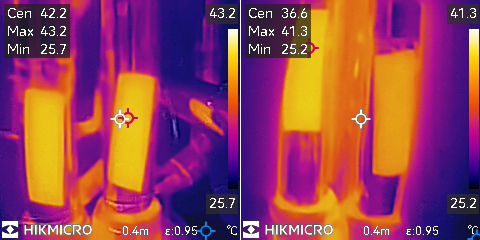
The pipes here are copper, with black insulating tape applied (the warm bars you can see) to get the emissivity at a reasonable level, primary inlet to the plate heat exchanger (and outlet from the secondary circuit) in the left hand image, primary outlet (and secondary inlet) in the right hand image. In each image, the red cross hair is on the hottest point in the image (in both cases the primary pipework), and as you can see, the primary in was 43.2 degrees, the primary out 41.3 (this red cross hair is partially obscured by the readout panel).
This time the Midea delta t was 3 (with the integer reading caveat) , the IR delta t 1.9. They may or may not be correct, but they are at least credible. This time there was a difference between the Midea and IR data, with the former being (as may perhaps be expected, see above) having the higher delta t.
The eagle eyed will also spot something else: on the left hand image, the centre cross hair (white) is very close to the max cross hair (red), yet there is a degree centigrade difference in temperature. I can't account for this, unless, and I am just thinking aloud here, it is an angular effect caused by the curve of the pipework, some of the heat misses the camera. The two red dots you can see are both on the centre of the pipe, ie perpendicular to the tangent of the pipe at that point, the point at which it 'points' most directly towards the camera.
By the way, this IR camera has already paid for itself. Not only is it very useful for heat assessments and loss detection, it is also useful among other things for monitoring things like engines and drive trains. It can probably even tell you when your bun in the oven is ready to come out, but there are probably simpler ways to do that.
Midea 14kW (for now...) ASHP heating both building and DHW

13/10/2024 8:55 am
@cathoderay Your wife or the mid-wife will probably have the best idea!😳 (Sorry) Toodles.
Toodles, heats his home with cold draughts and cooks food with magnets.
Page 12 / 12
Prev

SPONSORS

Degrees of Separation

Latest Posts
-

First you need to know how much thermal energy you'll n...
By bobflux , 10 hours ago
-
RE: How quickly would you want/expect heat recovery to take from setback?
@toodles Ah, that makes sense. Your using the TRV bo...
By Singlespeed , 10 hours ago
-
RE: Renewables & Heat Pumps in the News
Yes, energy seems less of a priority, even if the cost ...
By Batpred , 11 hours ago
-
RE: Renewable Heating Hub Homeowners' Q&A Podcast
Come for the low-carbon homes. Stay for George Clarke’s...
By Mars , 2 days ago
-
RE: Octopus Cosy 12 Heat Pump Regret: Incredibly Loud, Poor Heating & Constant Hum - Help!
@razz, as we head into the heating season, I just wante...
By Mars , 2 days ago
-
RE: How should the Boiler Upgrade Scheme be reformed?
Not quite, regular A2W heat-pumps need a load of extra ...
By Temperature_Gradient , 3 days ago
-
RE: Heat Geek installations: share your experiences
one thing i learnt from reading people’s comments and e...
By Batpred , 3 days ago
-
RE: Cooling/heating with one unit
"The way we use A2A on a cheap overnight EV tariff is t...
By mrkfm , 4 days ago
-
RE: Do I add Air Con or MVHR to existing A2W ASHP?
We have ‘signed on the dotted line’ today for a Panason...
By Toodles , 4 days ago
-
RE: Heat pump branding. Clever, contemporary… or a bit too much?
...or it was there and was lost thanks to laziness and ...
By Majordennisbloodnok , 4 days ago
-
Bufferless design & control of Chinese air to water monoblock hybrid heat pump in Alberta, Canada
This post is about how I successfully configured a buff...
By Tony.Stolz , 4 days ago
-
The installer visited yesterday and suggested the noise...
By JamesChatz , 4 days ago
-
RE: HeatGeek vs Octopus surveys: puzzling disparity - any ideas why?
Your house sounds a lot like mine. 2 surveyors each sp...
By JamesPa , 4 days ago
-
RE: Heat Geek Zero Disrupt: Are We Sleepwalking Into Another Race to the Bottom?
Thats true only if you do the wrong experiment. Done c...
By JamesPa , 4 days ago





SPONSORS