But worse than that for @robs you are using it as a weapon to discredit my valid posts. On several posts since page 14 of this topic you- Rob have systematically denigrated MELCloud and by default inferred my post uses shaky data. You have also denigrated energy claims I’ve made when you haven’t even asked how I had arrived at the values.
You are using hopelessly inaccurate data for your posts and as a result are posting factually inaccurate information. MELCloud is more or less garbage, it's temperature sensors are thermistors with +/- 0.5C accuracy so at a dT of 5C can introduce a +/- 20% inaccuracy (also these are installed by the installer, so the quality of the install could introduce further inaccuracy). It's flow meter is a vortex based Silka unit that is susceptible to turbulence in the water flow (so how accurate this can be is again dependant on the installer) and MELCloud's consumption values are just poor estimates (as my previous example shows). It is literally garbage in = garbage out.
Rob I hope Mitsubishi don’t see your comment here they may well have something to say to you.
I’m not sure what is making you so defensive and hostile about anyone who questions your energy review that you posted. You did after all ask if anyone could let you know if they could see anything that didn’t add up.
The important thing to know is how MELCloud adds energy prediction to account for unknown energy consumption from external/unknown pumps and the continuously active monitoring system. It would appear, RobS you would rather speculate and presume on your invented negative point scoring as you try to defend fairly minor mistakes in your post rather than understand how MELCloud actually works.
I have found MELCloud is consistent and I have a known value to correct it if I ever need it.
MELCloud adds fixed values to the estimated consumption value to account for external pumps, you can configure these fixed values in the installer settings to whatever values you want! I understand how MELCloud works but you don't seem to.
Consistent? In the last few days our MELCloud's energy consumptions figures have varied between 46% and 60% from the accurate figure.
And this "known value to correct it" is what? And how did you derive it?
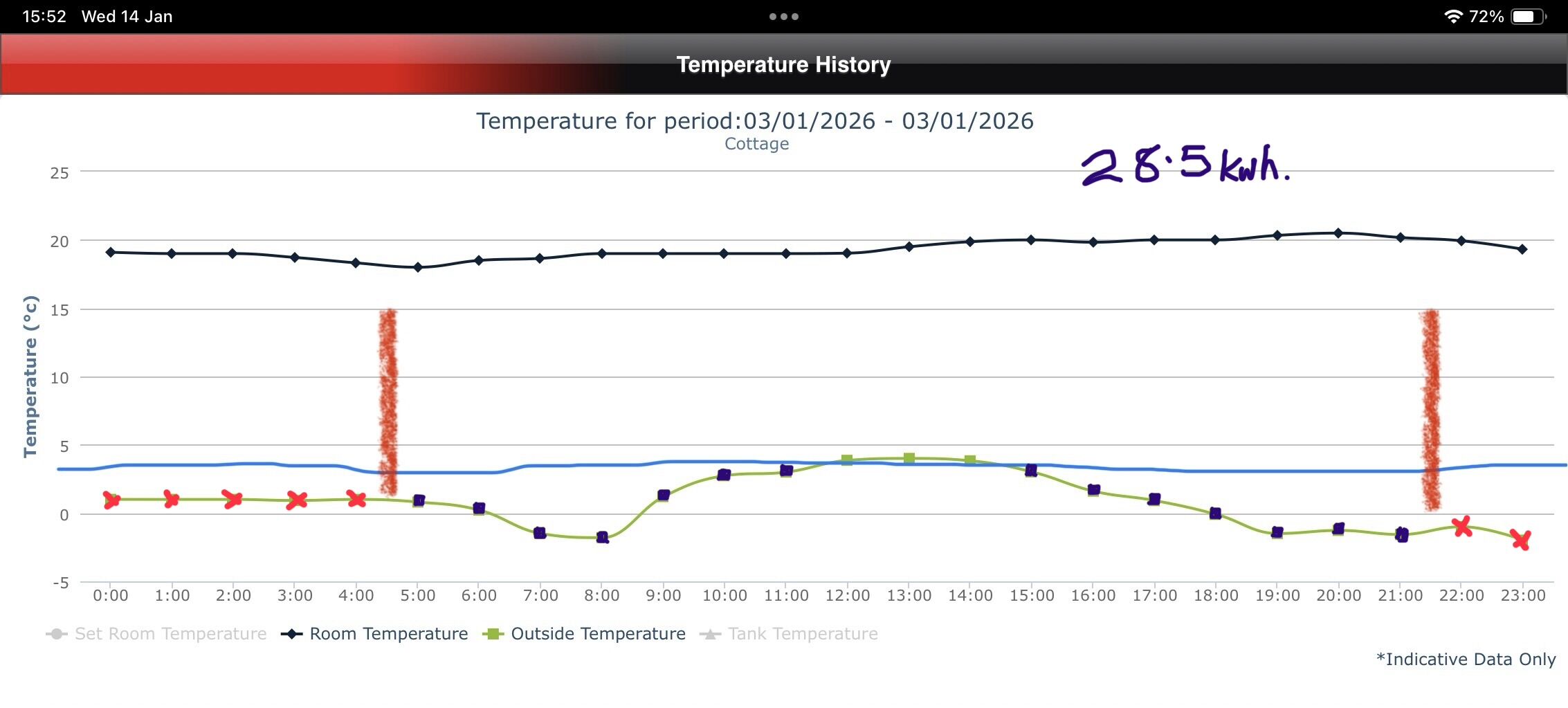
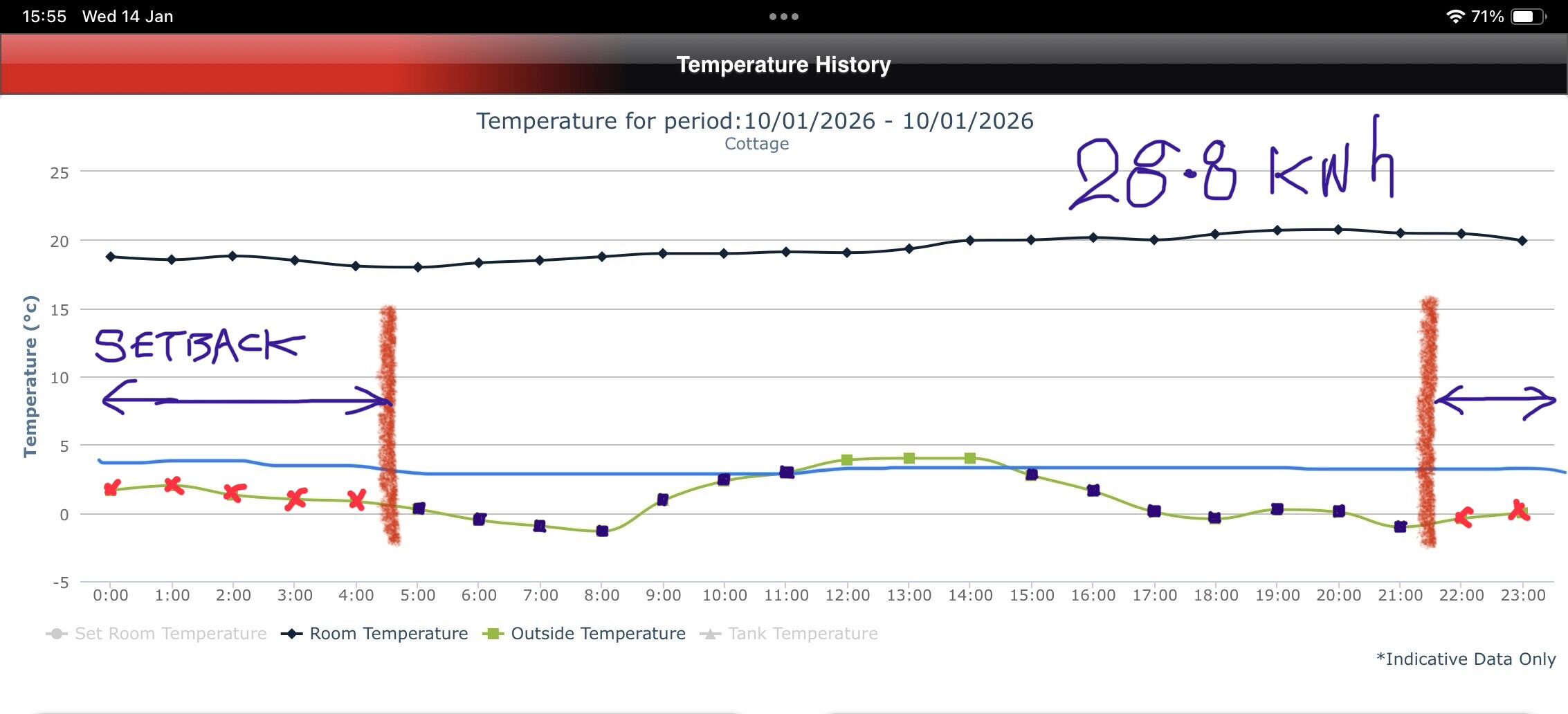
I don’t seem to be having the issues your new R290 system appears to be having. I see reports of startlingly similar outdoor temperatures and the corresponding consumption figures are likewise reassuringly similar. See below two different days. 3rd January 2026 and 10th January 2026
And 10th Jan chart
The problem I see with your annoyance with the MELCloud data reporting system is that you are possibly persuading others to invest in other third party systems which simply add to the cost of the installation yet the system it perfectly programmable without the extra paraphernalia and user monitoring time.
this website should be about helping ordinary people get to grips with their systems without creating doubts and dissatisfaction. People who don’t want to sit in front of a monitor analysing graphs just to get the heating on.
So as you can see there is nothing to hide it’s just the raw data.
OK, that is much clearer: the pie chart is the source of your energy consumed data. But it is not the raw data, the chart is clearly labelled Estimated Energy Usage, ie it is an estimate of the raw data, meaning we need some idea of how the estimate was done, all the more so as @robs has found significant differences between MELCloud estimates and metered values. You have described how you add a manual correction to account for circulating pump and monitoring equipment use, but that still leaves a question over how the rest of the estimate is determined.
I see reports of startlingly similar outdoor temperatures and the corresponding consumption figures are likewise reassuringly similar. See below two different days. 3rd January 2026 and 10th January 2026
The OAT shape may be similar, but the amplitudes are different. The 3rd Jan had more hours, and at lower temps, below zero than the 10th Jan, yet less kWh were used, which is odd. You might be able to do some sort of degree hour type calculation to get a better measure of how similar/dissimilar the OAT 'loads' are.
this website should be about helping ordinary people get to grips with their systems without creating doubts and dissatisfaction
We absolutely don't want to create spurious doubts and confusions, but at the same time we also want to avoid creating a sort of MELCLoud narcosis where everything is sweet when it is not.
Midea 14kW (for now...) ASHP heating both building and DHW
Rob I hope Mitsubishi don’t see your comment here they may well have something to say to you.
Why? Nothing that I've said Mitsubishi don't already know, their sensors are good enough to control a heat pump but are not good enough to measure efficiency (this is common to many/most manufacturers). And they don't install a sensor for electricity usage and just estimate it.
I’m not sure what is making you so defensive and hostile about anyone who questions your energy review that you posted. You did after all ask if anyone could let you know if they could see anything that didn’t add up.
The above has nothing to do with my analysis but has to do with your use of inaccurate data when trying to determine if setbacks save energy/money.
I don’t seem to be having the issues your new R290 system appears to be having. I see reports of startlingly similar outdoor temperatures and the corresponding consumption figures are likewise reassuringly similar. See below two different days. 3rd January 2026 and 10th January 2026
And 10th Jan chart
Great, so you have proven that MELCloud is consistently inaccurate! That doesn't prove in anyway that the estimated values from MELCloud are accurate, you need a third party source of information for that.
The problem I see with your annoyance with the MELCloud data reporting system is that you are possibly persuading others to invest in other third party systems which simply add to the cost of the installation yet the system it perfectly programmable without the extra paraphernalia and user monitoring time.
I haven't advocated buying anything, I have just pointed out the relative (in)accuracies of the sensors/systems and left people to make their own judgement.
this website should be about helping ordinary people get to grips with their systems without creating doubts and dissatisfaction. People who don’t want to sit in front of a monitor analysing graphs just to get the heating on.
It is difficult to help "ordinary people" with inaccurate information, such "help" is sometimes called misinformation.