

Notifications
Clear all
Joining the Renewable Heating Hub forums is completely free and only takes a minute. By registering you’ll be able to ask questions, join discussions, follow topics you’re interested in, bookmark useful threads and receive notifications when someone replies. Non-registered members also do not have access to our AI features. When choosing your username, please note that it cannot be changed later, so we recommend avoiding brand or product names. Before registering, please take a moment to read the Forum Rules & Terms of Use so we can keep the community helpful, respectful and informative for everyone. Thanks for joining!
Air Source Heat Pumps (ASHPs)
11
Posts
3
Users
4
Reactions
1,752
Views

Topic starter
26/05/2025 4:51 pm
I've been going through the motions trying to get things right after a very poor ASHP install.
After a number of corrections, I'm still not convinced the systems working well. I've been struggling with downstairs staying cooler than upstairs (heat loss has been double, and triple checked). However, the radiators downstairs don't seem to heat as evenly, they're noticeably cooler at the bottom, which isn't the case upstairs, I'm wondering if that might be part of the problem.
I've gone through multiple rounds of balancing with the installer (no temp measurement, just guessing), and various other tweaks to the system. All the lock shields upstairs were turned right down to try and encourage more heat to go to the downstairs radiators. The radiators at the end of the loop downstairs are fully open. All the radiators are new and the systems been flushed, so I ruled out any kind of sludge or blockage.
My feeling is that the flow rate is not high enough to deliver the required heat to the radiators downstairs.
In response, the installers have claimed the following:
- Heat rises so downstairs will be cooler than upstairs
- Heat rises so it's normal for the bottom of the radiator to be cooler
- Flow rate through plastic is better than copper as the pipes are "slippier"
- Flow rate reported by the heatpump is good (~ 22 litres per minute), so it's not an issue.
Despite their assurances that there isn't a flow rate issue (along with some very questionable information), I'd already lost trust in their competence and expertise.
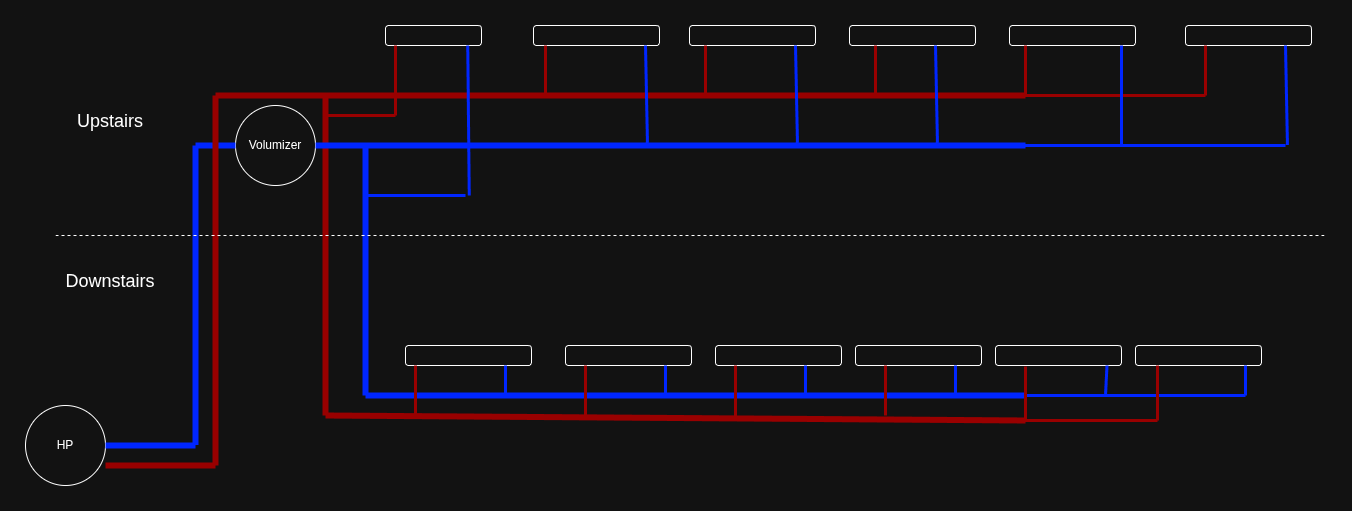
I'm hoping the members of this forum who are much more knowledgeable and experienced than myself, might be able to confirm/reject my assumption, and the rebuttal I've received from the installers. I've attached a rough approximation of the pipework for the central heating (DHW omitted) to try and clarify things.
- Assuming the heat loss is correct, is flow rate a likely cause for the temperature difference?
- What sort of temperatures should I see between the top and bottom of the radiator, I assume it should be less than or equal to the delta T?
- Given that the flow and return T off to serve downstairs, is it possible that the flow rates downstairs will be worse than upstairs? Is the flow rate reported by the heat pump telling the whole story?
The old boiler was downstairs, and I never noticed any issues with temperature between the two floors.

27/05/2025 2:25 pm
Hello Melon, I will give this a go for you as no one has responded yet.
I've gone through multiple rounds of balancing with the installer (no temp measurement, just guessing), and various other tweaks to the system. All the lock shields upstairs were turned right down to try and encourage more heat to go to the downstairs radiators. The radiators at the end of the loop downstairs are fully open. All the radiators are new and the systems been flushed, so I ruled out any kind of sludge or blockage.
You must balance the emitters using balancing equipment such as meters able to read either flow or DT. IR cameras help as well.
My feeling is that the flow rate is not high enough to deliver the required heat to the radiators downstairs.
This could be that the index circuit is suffering if this happens to be the downstairs circuit (your installer will be able to show you some great Math to indicate the index circuit and emitter) The flow rate could be high enough but all being sent round the emitters upstairs, equally it could also be bypassed, stalled or restricted at the branch.
In response, the installers have claimed the following:
- Heat rises so downstairs will be cooler than upstairs
Hmmm, ok but not if you balance the system and reverse this, thats the point of balancing and designing the correct emitters to come with different loads in each room as well as rising heat.
- Heat rises so it's normal for the bottom of the radiator to be cooler
Fractionally yes but maybe a deg, heat convects so eventually the radiator will be hot all over assuming you are running the system at a high enough temp (at least 10 deg over room temp desired.
- Flow rate through plastic is better than copper as the pipes are "slippier"
This may be true by 1% more efficient but this is only if you are comparing straight pipe for long lengths, connecting bends are more restrictive in push fit plastic than soldered copper on equal sizes. This argument would only stand up in comparative circuits and you design to overcome these it is not something we accept, if the pipework is wrong change it to make the emitters downstairs to works then.
- Flow rate reported by the heatpump is good (~ 22 litres per minute), so it's not an issue.
I assume that it is a 7.6kW system running at that rate and that equals your heat loss for the whole house and the heat loss for each and every room has been carefully balanced to match each room?
Despite their assurances that there isn't a flow rate issue (along with some very questionable information), I'd already lost trust in their competence and expertise.
No comment.
I'm hoping the members of this forum who are much more knowledgeable and experienced than myself, might be able to confirm/reject my assumption, and the rebuttal I've received from the installers. I've attached a rough approximation of the pipework for the central heating (DHW omitted) to try and clarify things.
Its quite hard to tell everything from a basic schematic and limited info but there may be a couple of things you can try and with the power of deduction we may be able to help steer you in the right direction. Do you have TRVs on any of the rads? if you do, close of every room apart from the down stairs rads and confirm the flow rate at that point and if the ground floor improved.
- Assuming the heat loss is correct, is flow rate a likely cause for the temperature difference?
We can try some things to rule this in our out
- What sort of temperatures should I see between the top and bottom of the radiator, I assume it should be less than or equal to the delta T?
Half the temp rate left to right but up and down need to be inline so something like this: 45 flow 40 return = Centre of rad 42.5 / 43 Av bottom of rad 45 Av top of rad av rad temp (ultimately they could use a thermal camera and you will see bottom is 43 top is 45 ish) The point is not much of a difference that you could tell with your hand by touch.
- Given that the flow and return T off to serve downstairs, is it possible that the flow rates downstairs will be worse than upstairs? Is the flow rate reported by the heat pump telling the whole story?
No the flow rate on the heat pump is only at one point in the circuit and gives a very good indication only, so you may see that most of the flow can whizz round upstairs starving some of downstairs, watch out for bypasses they do the same thing. A good commissioning team will use DT equipment and iR cameras to check flow to every emitter.
The old boiler was downstairs, and I never noticed any issues with temperature between the two floors.
unfortunately comparing the old boiler to new installation would be misleading, one system was high temp heating and the new is low temp heating they are not designed the same which seems to be the fall down with commissioning.
Can you try the following to rule some things out:
close all of upstairs TRV's if you have them and run the system, see if the downstairs rads improve and check the flow rate at this point and report back to me.
AAC Group Ltd covering the Kent Area for design, supply and installation of ASHP systems, service and maintenance, diagnostics and repairs.
1
Topic starter
27/05/2025 4:54 pm
Hi Bobba, thank you so much for the considered and detailed response.
We have TRVs installed on all the radiators, aside from the bathroom with traditional valves, and a bypass radiator on the landing. So far the TRVs have been left fully open downstairs, and turned down upstairs in the bedrooms to try and keep the rooms cooler.
I will turn all the TRVs off upstairs as advised, set the flow temp to 45 (turning off weather comp), and report back. Fortunately it is a little colder today.
For extra context, we have an 8kW Daikin Monobloc 3, for a 6.3 kW heat loss.
28/05/2025 8:10 am
@melonbuffet Perfect, let me know later the effect, what I am looking for is to see if the flow and heat improve along the ground floor in general. If you get the chance can you also post a picture of your heating configuration in the plant room or airing cupboard?
AAC Group Ltd covering the Kent Area for design, supply and installation of ASHP systems, service and maintenance, diagnostics and repairs.

Topic starter
28/05/2025 4:05 pm
I left the radiators on at a 45 degree flow temp for approximately 12 hours over night, with the thermostat turned up to 25. Everything cold upstairs as expected, aside from the bypass.
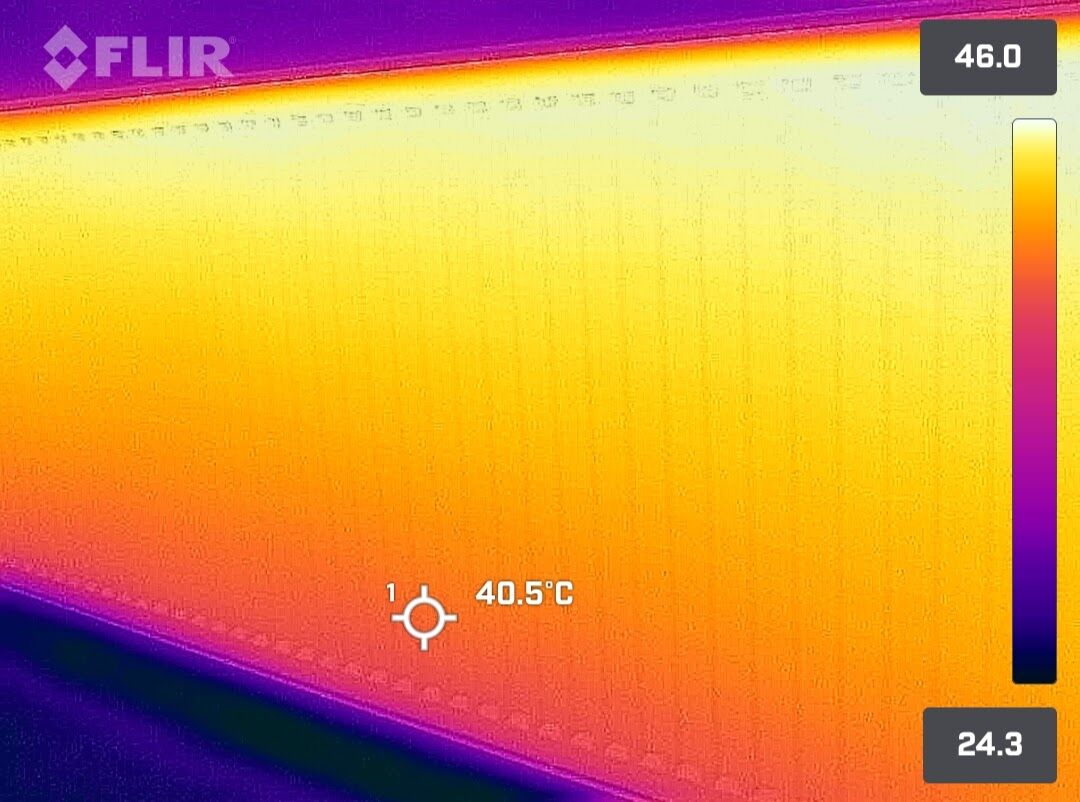
The larger radiators downstairs are behaving the same, I think a bit hotter overall, they are warm at the bottom and hot at the top. This isn't as noticeable on the smaller/medium sized radiators.
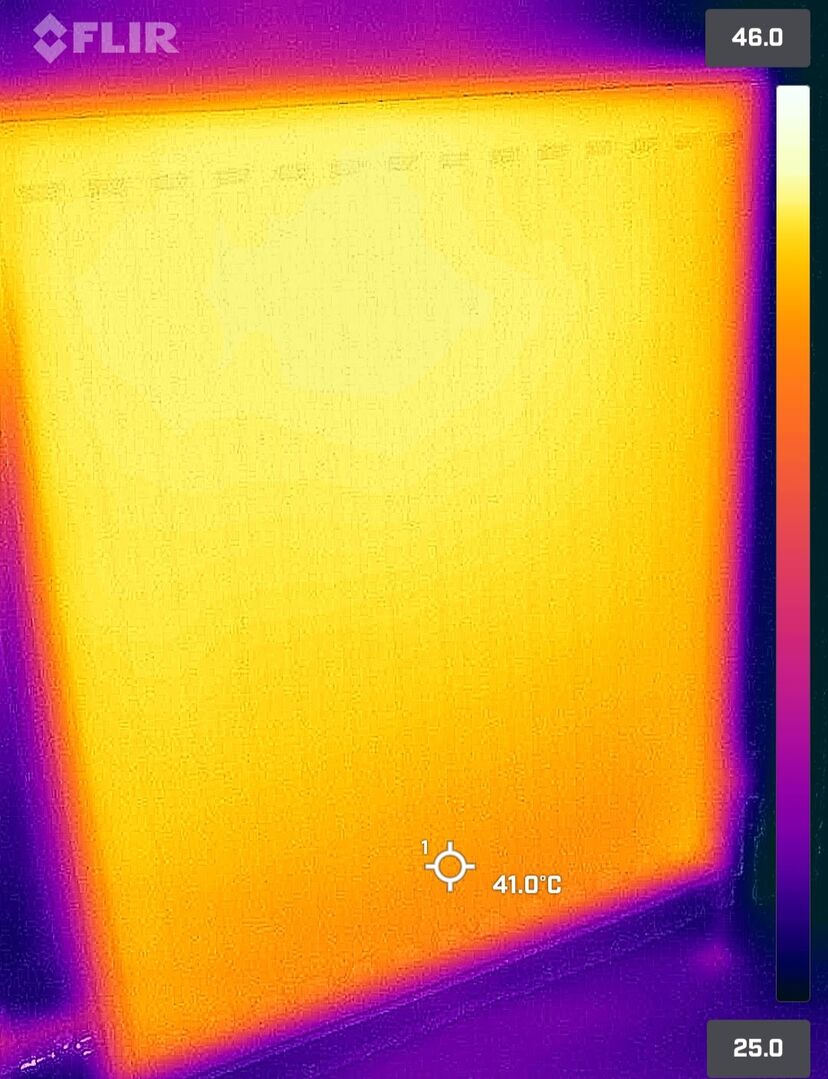
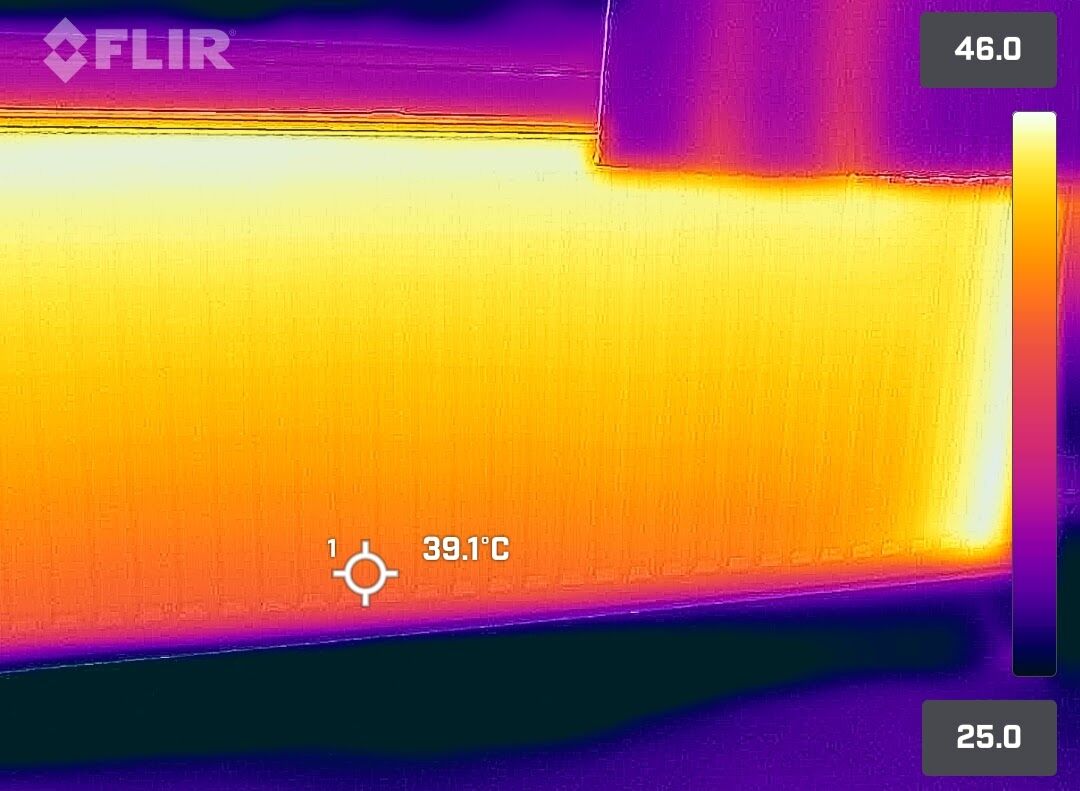
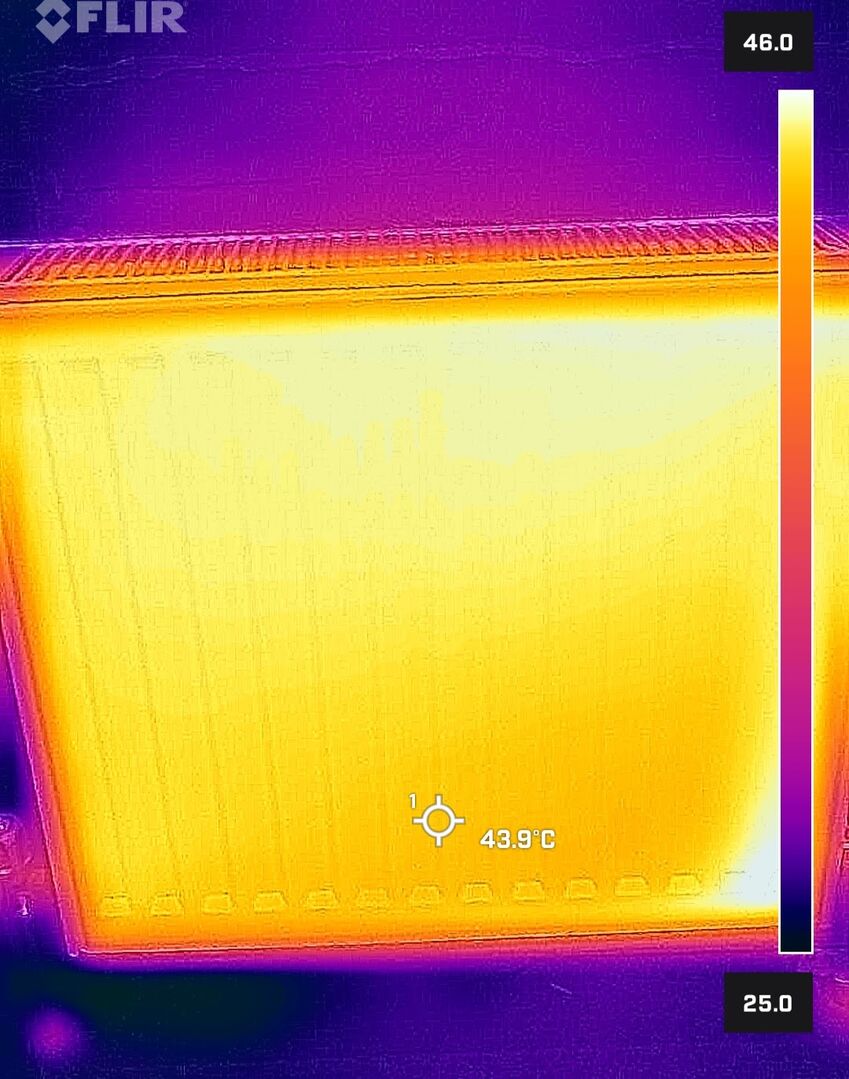
I've taken a few quick pictures with a thermal camera this morning. The large radiators are running at about 44-46 at the top, and dropping to 37-38 at the bottom. Top and bottom on the smaller rads is closer to ~2 degrees difference. It struggles on the copper pipes, but I imagine taking pictures of the flow and return points on the larger radiators may be more useful (I'll need to shift some furniture around).
I'll take a picture of the airing cupboard as well, is there anything else that may be useful?
28/05/2025 4:26 pm
@melonbuffet This is great assuming now the down stairs rads are working better? So it likely the smaller rads have a shorter DT and is closer to correct DT5 over the flow and return. 2.5 deg is better at the same ends high and low point of rad, 5deg is good at opposite ends HH LL or HL (this is roughly).
If you are able can you measure the corner of the bottom of the rads both sides say 50mm in to the rad from the lockshield and TRV and 50mm up from bottom of rad. what we are measuring here is DT across the flow, we are looking for 45 in and 40 out or very near this. Normally this is done from clamping the pipes but we can try with the camera.
AAC Group Ltd covering the Kent Area for design, supply and installation of ASHP systems, service and maintenance, diagnostics and repairs.
Topic starter
30/05/2025 12:15 pm
Thanks for all your help so far @ashp-bobba
With all the radiators still off upstairs, I'm seeing roughly ~5 degrees across the bottom from TRV to lockshield on the two larger rads. This ranges from 1-2 degrees, on the smaller radiators (including the bypass). All of them are around 46/47 on the flow side. The difference in temp, top to bottom in the middle of the larger radiators is still about 8 degrees. If the flow and return are right (45->40), then do I not need to worry that they're cooler in the bottom centre?
Would the next step be to open up the TRVs upstairs? There's quite a few images, that I need to try and organise so they make sense.
I'll look at getting some pipe thermometers, there's quite a bit of variance with the readings using the thermal camera.
30/05/2025 12:34 pm
@melonbuffet Hi, this sounds great is you are getting 5 diff on the bigger rads now, all i need you to do is the same test again with every thing fully open up stairs and measure the same items again using the same camera just to make it a fair test.
What I am looking for is if the DT now widens largely on the bigger rads down stairs.
Dont worry if they are 8 Deg diff from top to bottom if you get 45 in and 40 out its working correctly, if the rads are triple plate double fin they could disperse the heat very efficiently causing a larger top and bottom temp. Let us cover the basic and see if up stairs is using all of the flow and starving down stairs.
AAC Group Ltd covering the Kent Area for design, supply and installation of ASHP systems, service and maintenance, diagnostics and repairs.
1

Topic starter
08/06/2025 5:20 pm
Hi @ASHP-BOBBA, Apologies for the delay in getting an update, and thank you for all your help.
I'm seeing quite a bit of inconsistency in measurements, so have done a few rounds with the camera. I've ordered some pipe thermometers as well, so I can hopefully repeat with more concistent measurements.
Roughly the temperature drop across all the radiators is approximately the same with the TRVs upstairs opened back up. The flow temp did seem to be a couple of degrees lower, it's been left at a fixed 45 degrees.
So initially, aside from a bit of variance, this is looking like everything is correct? Is the DT likely to change/hold up when it gets colder? How critical is it to balance on colder days?

08/06/2025 5:40 pm
@melonbuffet Balancing on colder days makes the job much simpler and probably more consistent and accurate. When colder conditions prevail, the heat pump will be working constantly (or at least, for longer periods at a time) and the effect of the weather (OAT) will provide a far more realistic sample of how your heat loss is cooling your rooms. Setting up in mild weather is very approximate only; usually requiring another round or two of tweaking when the OAT drops for several days. Regards, Toodles.
Toodles, heats his home with cold draughts and cooks food with magnets.
1
08/06/2025 7:03 pm
@melonbuffet Hi Melon, I would just concentrate on balancing as best you cvsn with clip on pipe clamps so its more accurate and then write it on a spread sheet so I can see what they are doing. There is an importance in working out an index circuit and index line as thats the likely set of rads that would suffer if the pump is shy or the circuit is unbalanced.Its worth the wait other wise we may be guessing a bit.
I don't believe in the touch and balance method like they used to in boiler days, i would get an accurate measurement and balance backwards from the index rad.
KR
AAC Group Ltd covering the Kent Area for design, supply and installation of ASHP systems, service and maintenance, diagnostics and repairs.
1
SPONSORS

Degrees of Separation
Latest Posts
-

RE: New Build 3 Phase or 1Phase
£16K (or even £25K!) would go a fair way towards employ...
By Toodles , 1 hour ago
-
-
Mars asked for an update on progress so …. Out HP has...
By DavidB , 3 hours ago
-
RE: How much of your renewable and home setup would still work if the internet went down?
Yes I actually have a copy of a tool that whenever a ce...
By EtchedPixels , 5 hours ago
-
RE: How will removing the standing charge on gas bills benefit heat pumps?
The shoulder months are very difficult to judge COP on ...
By scrchngwsl , 6 hours ago
-
RE: Indevolt Batteries UK Support & Info Thread
@editor Hi, To resolve this, please tap on the A...
By Indevolt Tech , 12 hours ago
-
RE: Double or Triple Glazed Windows?
Posted by: @singlespeed With 9 years repairing windo...
By Rob of York , 1 day ago
-
@transparent we’re still running a secure version of PH...
By Mars , 1 day ago
-
RE: How quickly would you want/expect heat recovery to take from setback?
Much longer than that here. The heating isn't even on. ...
By bobflux , 2 days ago
-
RE: Passiv Smart Thermostat - Help & Forum Support
Obviously the weather is changeable but there's a defin...
By Singlespeed , 2 days ago
-
RE: The Changing Jet Stream Could Challenge UK Air Source Heat Pumps
@rob-of-york I must admit that when we had a Daikin hea...
By Toodles , 2 days ago
-
RE: Forum updates, announcements & issues
Get the Renewable Heating Hub heads-up on WhatsApp. I...
By Mars , 2 days ago
-
RE: Safety study for plug in batteries out to tender - looks like Q3 2027 at best before legal
@editor I pointed out to the one of the Fuse execs that...
By dansus , 2 days ago
-
RE: 15kw pump for 225m2 1990's house - over kill?
@seaviews As well as loft insulation, there are othe...
By Rob of York , 2 days ago


SPONSORS

