

Notifications
Clear all
Joining the Renewable Heating Hub forums is completely free and only takes a minute. By registering you’ll be able to ask questions, join discussions, follow topics you’re interested in, bookmark useful threads and receive notifications when someone replies. Non-registered members also do not have access to our AI features. When choosing your username, please note that it cannot be changed later, so we recommend avoiding brand or product names. Before registering, please take a moment to read the Forum Rules & Terms of Use so we can keep the community helpful, respectful and informative for everyone. Thanks for joining!

26/01/2026 8:54 am
.. You will be shocked at how much power the larger units consume on a cold day. I’ve seen folks using my unit consume approaching 200kwh a day, which gives me indigestion just thinking about it. We are frugal with our heating but at -5C we still chewed through 80kwh. My point being you’d have to have very large capacity batteries to get you through 24 hrs.
200kwh.. Would that be warming an outdoors tent or a castle? 😀 I prefer the image of a castle with cold stone walls..
Now seriously, ASHP in most reasonably well insulated homes with a suitably low flow temperature seem to consume a lot less?
Consumption is determined principally by house loss! 200kWh at a COP of 2, which is very low, means the house loss is 16kW. At a more reasonable COP of 2.5 (Im assuming the 200kWh figure is when its very cold!) its 21 kW. 21kW is either a very, very badly insulated or a very, very large house. Most houses are in the 5-10kW range.
Remember that most of the season heating systems in the UK run at about half design capacity. So if your house is 8kW at design temperature the heating system will be running at around 4kW = 1.5kW consumed most of the time. It might be sensible to consider something in between design loss and this figure, and accept some full price import on the very coldest days!
4kW peak of solar PV since 2011; EV and a 1930s house which has been partially renovated to improve its efficiency. 7kW Vaillant heat pump.

26/01/2026 9:00 am
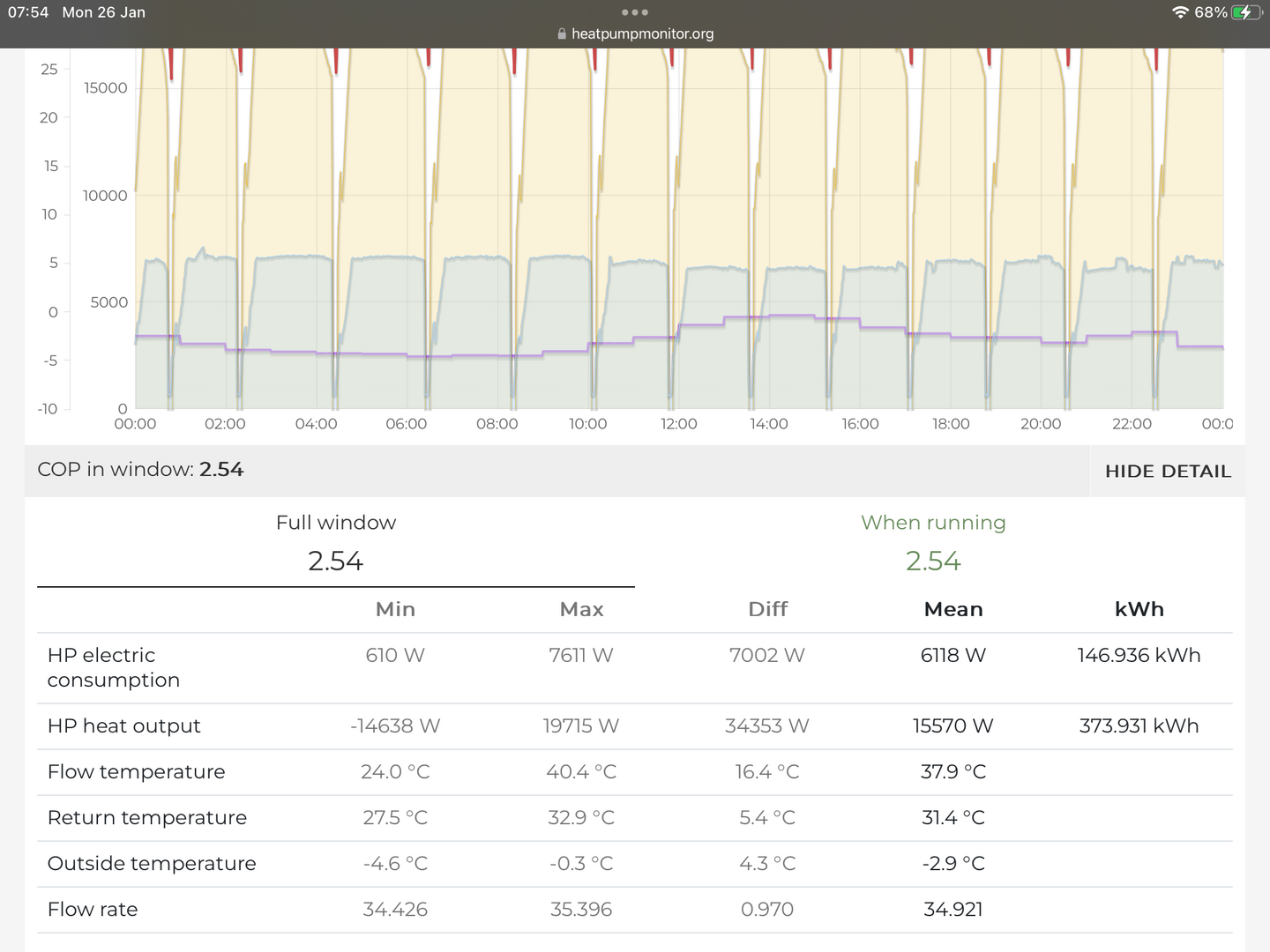
Boiler plate 16kW which has an actual output of about 13kW which is what you would select for a heat loss of about 12kW, in Huddersfield Yorkshire, I picked an early Jan day at random, this had UFH if I remember correctly. On this day was 150kwh, plenty of others similar. I think in this period mine was in the 60-80kWh range, even that seems steep for a tight wad like myself.
26/01/2026 9:02 am
Boiler plate 16kW which has an actual output of about 13kW which is what you would select for a heat loss of about 12kW, in Huddersfield Yorkshire, I picked an early Jan day at random, this had UFH if I remember correctly. On this day was 150kwh, plenty of others similar. I think in this period mine was in the 60-80kWh range, even that seems steep for a tight wad like myself.
26/01/2026 9:30 am
I was comparing and contrasting with this installation because it was the same model of heat pump and we are just the other side of the hills from it and it used the same installer as myself.
But the point I was trying to make is that it is a fallacy to assume you can size house batteries to cover you for 24hrs on the super off peak EV tariff with a larger output unit in cold weather. Unless you have very deep pockets and a 3P supply. We were emptying our batteries in this period even with cycling thrice, having to pay the higher tariff rates, it gets expensive.
This post was modified 9 months ago by Papahuhu

26/01/2026 9:33 am
I was comparing and contrasting with this installation because it was the same model of heat pump and we are just the other side of the hills from it and it used the same installer as myself.
But the point I was trying to make is that it is a fallacy to assume you can size house batteries to cover you for 24hrs on the super off peak EV tariff with a larger output unit in cold weather. Unless you have very deep pockets and a 3P supply.
Agreed. Personally I wouldn't try even for my 7kW house. Thats roughly 50kWh in the high price period which is a lot of battery. The sweet spot for ROI is a capacity much lower than this!
4kW peak of solar PV since 2011; EV and a 1930s house which has been partially renovated to improve its efficiency. 7kW Vaillant heat pump.

26/01/2026 2:46 pm
Remember that most of the season heating systems in the UK run at about half design capacity. So if your house is 8kW at design temperature the heating system will be running at around 4kW = 1.5kW consumed most of the time. It might be sensible to consider something in between design loss and this figure, and accept some full price import on the very coldest days!
Absolutely makes sense to me.
And should a good export allowance and suitable tariff justify more energy storage to "lower the electricity bill", it would be another factor determining the middle point.
8kW Solis S6-EH1P8K-L-PLUS hybrid inverter; G99: 8kW export; 16kWh Seplos Fogstar battery; Ohme Home Pro EV charger; Vaillant Arotherm Pro 7kW; 100Amp head, HA lab on mini PC

Topic starter
23/02/2026 12:49 pm
Hi Guys, apologies the initial request was a little vague, but good general advice received and understood.
To give a little more detail.
The ground floor where the UFH is to be placed is around 100sqm, all rooms are being done, with the kitchen and hall (double height) having a plinth heater (connected into the UFH, just a fan and radiator??).
The UFH is by spreader plates between the joists. Floor is a suspended floor and there is 100mm of "kingspan" under the spreader plates.
The heat pump will be an Ideal Logic Air 10kw (R32). The tank a 300l ish pre plumbed hot water tank.
We have radiators upstairs, although we dont tend to use them much, we always have windows open for fresh air (inc at night).
The house was a 1960's dorma semi which has had single story extension added over the years, so its about 100sqm ground floor and 50/60 sqm upstairs. The rear of the house is south facing and we use the smallest bedroom as a home office. Its too hot to work in at the height of summer so are having aircon fitted for the three bedrooms upstairs, a 2kw for the office, and 2 x 2.5kw for the bedrooms.
We've 11kw (25 panels) on the garage, and are looking to put another 15 on the extension roof - hopefully to power the solar in the summer.
Historically we had "click" flooring on the whole of the ground floor, just a different type in the kitchen and utility.
We are not looking for a replacement, I fancy tiles all through, some wood effect, some other, but just porcelain tiles but her in doors wants some rigid core lvt in all but the bathroom, hall and utility.
My questions are, if anyone can weigh in -
1, What is the best material to put on top of the spreader plates, under the tiles / rigid core lvt? is it standard tg floor boards (the big ones) or some kind of cement board?
2, there are 6 / 7 rooms (its an open plan kitchen / diner) and 10 circuits from the manifold. The rooms at the south side of the house are often warmer than those on the north. I think we would need a buffer tank if we wanted to split the heating into 3 sections, ground floor front and rear plus upstairs and I know there are thoughts about buffering or not.
Whats peoples thoughts?
1
23/02/2026 1:49 pm
2, there are 6 / 7 rooms (its an open plan kitchen / diner) and 10 circuits from the manifold. The rooms at the south side of the house are often warmer than those on the north. I think we would need a buffer tank if we wanted to split the heating into 3 sections, ground floor front and rear plus upstairs and I know there are thoughts about buffering or not.
Whats peoples thoughts?
In a word don't, or at least think VERY hard before doing so. Zoning and buffers are both bad for efficiency and you can adjust the relative amount of heat into different areas by turning up or down the flow control valves to reduce or increase the flow without turning it on and off on thermostats (which are also bad for efficiency, and for comfort!).
How much dynamic (ie time-varying) as opposed to static (ie constant with time) adjustment do you really need and in how many rooms. How likely is it that the house will react in time - if you turn down UFH in response to a signal from room temperature it is almost certainly hours, perhaps even 12-24 hours, before the room reacts, particularly if the UFH is in a slab of concrete. By then the solar conditions will certainly have changed.
My strong advice is to think this through carefully, with the help of those here, and if you can find a way to avoid zoning and buffers do so. Otherwise you risk compromising the system and still being unable to achieve what you want (PS the same comments would apply if the heat source was gas or oil).
Can you describe the problem you are trying to solve more precisely. Are the front rooms more or less always warmer, or do they get warm only when the sun is shining hard through the window? Are they actually too warm, or just comfortably a bit warmer than the lowest you could tolerate. Perhaps you would be better off heating the rooms (how many) that get excessive solar gain to the minimum with UFH, and turning on or off something that will react more quickly - eg a fancoil - to supplement? One way or another the reaction time of the UFH could be a problem if the issue is time varying solar gain, so this may need a bit more thought.
This post was modified 8 months ago 5 times by JamesPa
4kW peak of solar PV since 2011; EV and a 1930s house which has been partially renovated to improve its efficiency. 7kW Vaillant heat pump.

Topic starter
24/02/2026 10:28 am
Thanks James, historically the rooms on the south side have always been warmer when in full sun. To be honest I think we might be worrying about nothing though as we've changed the sizes of the rooms (now open plan) and we've got a lot more insulation in there.
I agree with you, I think we can achieve what we want - switch it on and leave it - setting up with flow.
I understand what you mean about the buffer and zoning and agree with you there too - we'd be better without it. We have radiators upstairs, would that mean we would have one zone downstairs and one upstairs? (we're putting aircon upstairs as well).
We've got a suspended wooden floor with insulation and are going to use spreader plates, what would you put on top of the plates, something line Knauf Brio 18 Dry Screed Panel, NoMorePly TG4 Structural Tile Backer Floor Board 18mm or 20mm Fermacell® 2E11 Dry Screed Overlay Board 1.5m x 500mm
thanks for your advice, love the videos too.
Simon
24/02/2026 1:01 pm
We have radiators upstairs, would that mean we would have one zone downstairs and one upstairs? (we're putting aircon upstairs as well).
Ideally design upstairs and downstairs for the same (low) flow temperature, otherwise you are going to be mixing down for the UFH which is not desirable. Aircon can of course also heat and fancoil radiators/UFH + heat pump can also cool if correctly designed
No idea about spreader plates, hopefully someone else will.
I agree with you, I think we can achieve what we want - switch it on and leave it - setting up with flow.
If you can thats good. If not then you could automate the flow valve, but you would almost certainly need to use the forecast solar intensity 6-12 hours ahead to control it! Probably better just closing the curtains or relying on the fact that very low temperature heating is almost self regulating, because if the room overheats the delta room to UFH reduces.
4kW peak of solar PV since 2011; EV and a 1930s house which has been partially renovated to improve its efficiency. 7kW Vaillant heat pump.
Topic starter
24/02/2026 1:35 pm
Hi, yes, radiator upstairs are now larger so will work at same temps as floor hopefully.
Sounds idle, but thinking of getting some automated blinds for those windows that we can operate via home assistant or manually.
Simon.
24/02/2026 1:58 pm
Sounds idle, but thinking of getting some automated blinds for those windows that we can operate via home assistant or manually.
Good idea IMHO. You just need some appropriate time constants so its not up and down all the time when there is scattered cloud!
4kW peak of solar PV since 2011; EV and a 1930s house which has been partially renovated to improve its efficiency. 7kW Vaillant heat pump.

SPONSORS

Degrees of Separation
Latest Posts
-

At this point, whenever someone mentions our heat pump,...
By Mars , 54 minutes ago
-
RE: Say hello and introduce yourself
@e-a-west as the good Major said, welcome to the forums...
By Mars , 1 hour ago
-
RE: New Build 3 Phase or 1Phase
We are on three phase power because it's an enormous li...
By EtchedPixels , 1 hour ago
-
RE: How much of your renewable and home setup would still work if the internet went down?
Yes I actually have a copy of a tool that whenever a ce...
By EtchedPixels , 10 hours ago
-
RE: How will removing the standing charge on gas bills benefit heat pumps?
The shoulder months are very difficult to judge COP on ...
By scrchngwsl , 11 hours ago
-
RE: Indevolt Batteries UK Support & Info Thread
@editor Hi, To resolve this, please tap on the A...
By Indevolt Tech , 18 hours ago
-
RE: Double or Triple Glazed Windows?
Posted by: @singlespeed With 9 years repairing windo...
By Rob of York , 1 day ago
-
@transparent we’re still running a secure version of PH...
By Mars , 2 days ago
-
RE: How quickly would you want/expect heat recovery to take from setback?
Much longer than that here. The heating isn't even on. ...
By bobflux , 2 days ago
-
RE: Passiv Smart Thermostat - Help & Forum Support
Obviously the weather is changeable but there's a defin...
By Singlespeed , 2 days ago
-
RE: The Changing Jet Stream Could Challenge UK Air Source Heat Pumps
@rob-of-york I must admit that when we had a Daikin hea...
By Toodles , 2 days ago
-
RE: Forum updates, announcements & issues
Get the Renewable Heating Hub heads-up on WhatsApp. I...
By Mars , 2 days ago
-
RE: Safety study for plug in batteries out to tender - looks like Q3 2027 at best before legal
@editor I pointed out to the one of the Fuse execs that...
By dansus , 2 days ago
-
RE: 15kw pump for 225m2 1990's house - over kill?
@seaviews As well as loft insulation, there are othe...
By Rob of York , 2 days ago




SPONSORS