

Notifications
Clear all
Joining the Renewable Heating Hub forums is completely free and only takes a minute. By registering you’ll be able to ask questions, join discussions, follow topics you’re interested in, bookmark useful threads and receive notifications when someone replies. Non-registered members also do not have access to our AI features. When choosing your username, please note that it cannot be changed later, so we recommend avoiding brand or product names. Before registering, please take a moment to read the Forum Rules & Terms of Use so we can keep the community helpful, respectful and informative for everyone. Thanks for joining!


Topic starter
24/12/2021 9:21 am
I've been running the system now on weather compensation only for a few weeks and as I said before, it's working well for us. Some of that time I've had the heating running 24/7 and some off for 5 hours 12-5am. I've messed around a bit with the HW but we use so little at the moment (electric showers and dishwasher) it should make little difference. This is the story so far

Blue is running the ASHP 24 hrs a day, red is 5am to midnight. I removed a couple of early outliers from when I was experimenting. An exponential trend is the best fit. You can see that at the colder end, it makes a difference with the heating off at night; at the warmer end less so. I think this is because when it's cold, having the ASHP off for 5 hours makes a big dent in overall consumption. This is offset a bit by a big peak at 5am to heat the flow from cold but not completely. When it's warmer the overnight consumption is low, so not so much saved and at 5am the ASHP still has to raise the flow from room temperature to its target.
The other thing to bear in mind is that I don't force the house to warm up; it does it as and when with the weather compensation flows. If I were using auto adaptation I think the flow temp would increase until the house warmed up, which would give me a warmer house but lessen any saving from having the 12-5am break. We're happy with this as we don't want the house too warm at night. (We also have TRVs on the bedroom radiators that we can adjust if we want.)
What I'm going to do next is try something I've never done, which is to use a fixed flow temperature of 45C and control the house via the thermostats. This is something a lot of people do with ASHPs and how some suppliers set up new installations. The next week or so looks quite benign for weather so an ideal time. I'm willing to experiment but don't want to bankrupt myself. I'll set both my zones for 21C constantly and I'll leave the heating off 12-5am as I've been doing most recently. I'll put the thermostats where the temperature is most stable, i.e. not in the hall/kitchen. I'll plot the results on the chart above and see what I get.
Any predictions? Mine is that it will cost me more! My average flow temp is about 35C to bumping it to 45C is going to make a difference. What I'm not sure about is the effect of the thermostat switching the ASHP on and off but we'll see.
6

24/12/2021 10:33 am
Any predictions? Mine is that it will cost me more! My average flow temp is about 35C to bumping it to 45C is going to make a difference. What I'm not sure about is the effect of the thermostat switching the ASHP on and off but we'll see.
I did a similar experiment but using a 50ºC flow. That used 930kWh over 30 days vs 855kWh using the compensation curve. Both 30 day periods had an average 6.4ºC ambient outside temp.
2


26/12/2021 4:54 pm
Any predictions? Mine is that it will cost me more!
I would agree. Also, thanks for keeping this thread updated, very useful data.
I wonder what your current weather compensation curve is set to?
Topic starter
06/01/2022 2:20 pm
Here are the results of my experiment to compare (1) Weather compensation only and (2) Constant flow temp and thermostats. Both methods kept the house at c. 21C and switched the heating off 12-5am.
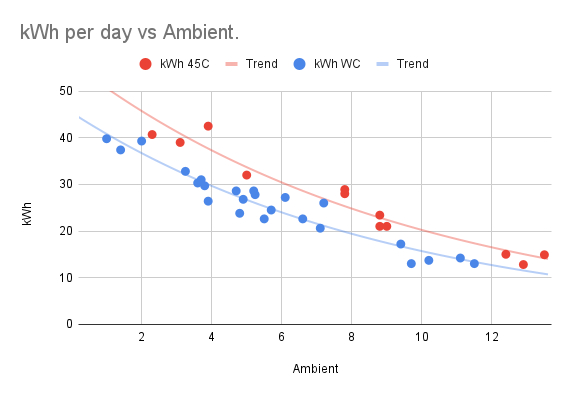
The weather compensation method seems to use less energy. If you look at some detail, you can see why.


The weather compensation energy use is very steady, apart from a blip due to HW. The thermostat energy use is much more variable. The flow is allowed to cool several times and it takes a lot of energy to raise the temperature. 100 on the left scale corresponds to 6kW.
In terms of 'feel'; the thermostat method results in noticeable rises and falls in room temperature with radiators varying between hot and cold whereas with weather compensation the room is more constant and the radiators are always warm.
The house warms up in the morning a little quicker using the thermostats. However, my previous experiment showed that I could leave the weather compensation method running all night at very little increased cost.
In terms of COP, my actual COP is showing as 7.1 (weather comp) and 5.4 (thermostats). I don't believe these numbers (someone is coming today to investigate) but their relative sizes are probably right. If I said 3.55 and 2.7 that might be believable.
Anyway, I'm convinced by weather compensation and I've now gone back.
Any requests for further experiments? 😉 I may try bumping up the weather compensation curve a couple of degrees and letting the thermostats limit the room temperature as a bit of a compromise.
4

Topic starter
22/01/2022 11:31 am

This is the remote room sensor that will (hopefully) allow me to use auto-adaptation. Watch this space!

22/01/2022 11:43 am
I have one of those and still await delivery of the Mitsubishi wireless receiver unit. When i arrives the intention is to swap out the Heatmiser Neostat the installer thought was preferable.
Retrofitted 11.2kw Mitsubishi Ecodan to new radiators commissioned November 2021.
14 x 500w Monocrystalline solar panels.
2 ESS Smile G3 10.1 batteries.
ESS Smile G3 5kw inverter.
Topic starter
22/01/2022 2:08 pm
I thought you were getting the full monty wireless controller. This is just a room thermistor. I have to wire this in to the main FTC6 control box and mount it in the living area. I can then use the wired in controller in the airing cupboard to control the temperature. This is the cheap (£16.99) version!
22/01/2022 2:12 pm
@kev-m you’re correct Kev. My mistake.
Retrofitted 11.2kw Mitsubishi Ecodan to new radiators commissioned November 2021.
14 x 500w Monocrystalline solar panels.
2 ESS Smile G3 10.1 batteries.
ESS Smile G3 5kw inverter.
SPONSORS
Degrees of Separation
Latest Posts
-

RE: New Build 3 Phase or 1Phase
Not so. 1: It's now the case that the Service Fuse wi...
By Transparent , 49 minutes ago
-
RE: How will removing the standing charge on gas bills benefit heat pumps?
I think it has an enormous impact on air/air users. The...
By EtchedPixels , 8 hours ago
-
@editor Ouch, sorry to re start the tick. I had assume...
By DavidB , 1 day ago
-
RE: Say hello and introduce yourself
@e-a-west as the good Major said, welcome to the forums...
By Mars , 1 day ago
-
RE: How much of your renewable and home setup would still work if the internet went down?
Yes I actually have a copy of a tool that whenever a ce...
By EtchedPixels , 1 day ago
-
RE: Indevolt Batteries UK Support & Info Thread
@editor Hi, To resolve this, please tap on the A...
By Indevolt Tech , 2 days ago
-
RE: Double or Triple Glazed Windows?
Posted by: @singlespeed With 9 years repairing windo...
By Rob of York , 2 days ago
-
@transparent we’re still running a secure version of PH...
By Mars , 3 days ago
-
RE: How quickly would you want/expect heat recovery to take from setback?
Much longer than that here. The heating isn't even on. ...
By bobflux , 3 days ago
-
RE: Passiv Smart Thermostat - Help & Forum Support
Obviously the weather is changeable but there's a defin...
By Singlespeed , 3 days ago
-
RE: The Changing Jet Stream Could Challenge UK Air Source Heat Pumps
@rob-of-york I must admit that when we had a Daikin hea...
By Toodles , 3 days ago
-
RE: Forum updates, announcements & issues
Get the Renewable Heating Hub heads-up on WhatsApp. I...
By Mars , 3 days ago
-
RE: Safety study for plug in batteries out to tender - looks like Q3 2027 at best before legal
@editor I pointed out to the one of the Fuse execs that...
By dansus , 3 days ago
-
RE: 15kw pump for 225m2 1990's house - over kill?
@seaviews As well as loft insulation, there are othe...
By Rob of York , 3 days ago





SPONSORS