
Notifications
Clear all
Joining the Renewable Heating Hub forums is completely free and only takes a minute. By registering you’ll be able to ask questions, join discussions, follow topics you’re interested in, bookmark useful threads and receive notifications when someone replies. When choosing your username, please note that it cannot be changed later, so we recommend avoiding brand or product names. Before registering, please take a moment to read the Forum Rules & Terms of Use so we can keep the community helpful, respectful and informative for everyone. Thanks for joining!
Air Source Heat Pumps (ASHPs)
1
Posts
1
Users
1
Reactions
148
Views

Topic starter
19/02/2026 3:42 pm
My heat pump journey began a couple of years ago when I had a survey by a small local company and a quote for a Stiebel Eltron system. I wasn't totally convinced, but it went onto the list of things to do later. Eventually we looked at a Bosch 2000 8kW, which seemed ok, and when Bosch offered a further discount on top of the government grant, it looked even better. So good, in fact, that I asked them to quote for the newer 5800i - more expensive, but quieter and with a higher maximum flow temperature. This, too, came in under my budget, so it was time to move forward.
Naturally I approached other suppliers, including Bosch's "official" distributor in the area (30% higher quote) and my energy supplier Octopus. They declined to quote because my central heating is an older, single-pipe system, and anyway they refused to install the heat pump in the most logical place where I wanted it to go. So it was a green light for the local company.
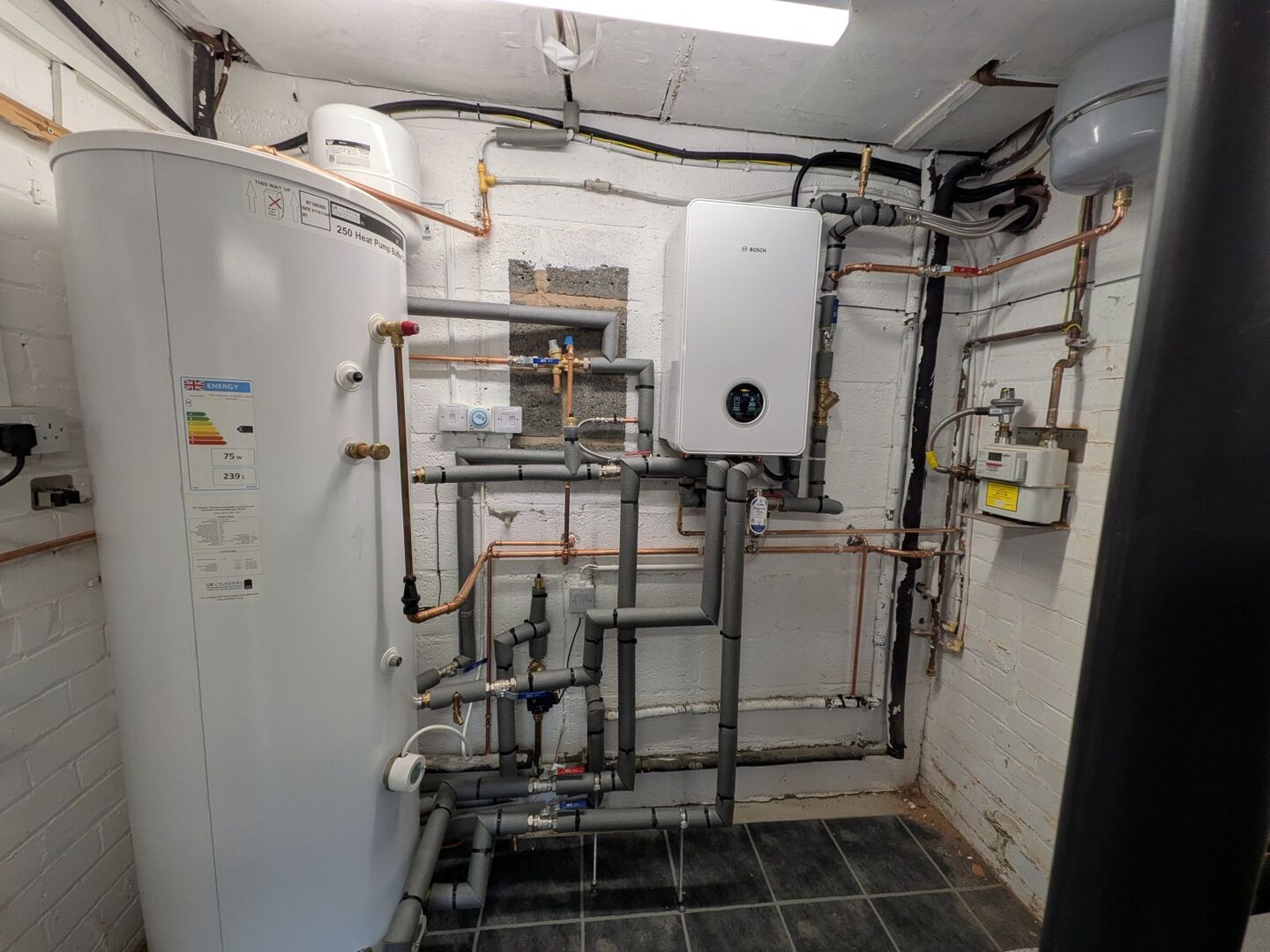
I knew beforehand that I'd need a hot water cylinder (the Greenstar is a combi boiler) and an internal unit (about the same size as the old boiler) but I wasn't expecting the two expansion vessels and the absolute maze of pipework between them all. The internal unit was designed with inputs on the left and outputs on the right - which was a problem, because the external unit was to the right and the cylinder to the left! We could have wished for a choice of handedness there, as it meant some awkward routing of big pipes. (My Bosch dishwasher has a similar problem with its power lead, and I can't help thinking there's some Germanic logic at play here...) Fortunately I had a reasonable amount of space to play with, but you can see the final result here.
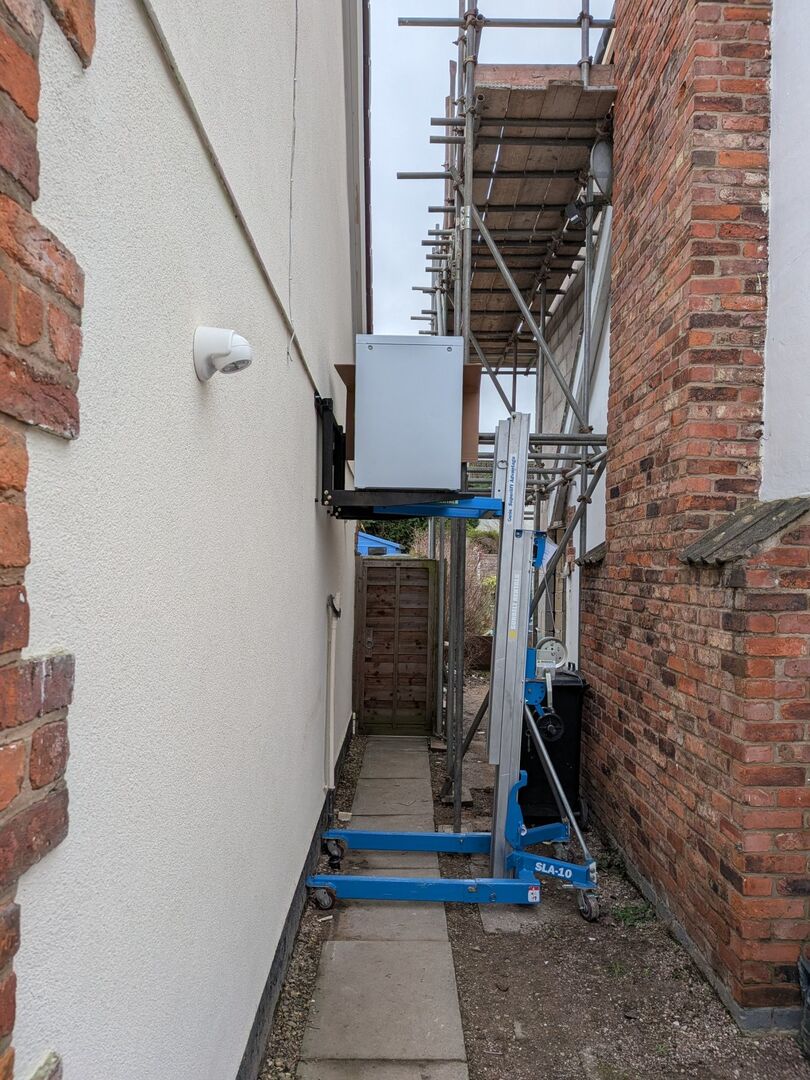
Siting the external unit was a key consideration. With the previous system, the gas supply was on the right hand side of the house next to the garage, with the boiler on the back wall of said garage. For me, the logical place for the 5800i was next to the garage wall. There's a 2m separation between my wall and the next house, a sort of shared alleyway, so there was enough room for the unit and its clearance area. However it was pointed out that my neighbours could, if they wished, put up a fence along the nominal property line, and that wouldn't be good for the pump. So we agreed to put it on the wall, something over 2m off the ground. There are no windows to the side of either house, and although it's a big beast, it's hardly visible from front or back. The unit weighs in at 143kg and is well supported by three wall-mounted struts, which the installers tested by doing pull-ups on each one. And they were big guys... A Genie lift was used to raise the unit to the right level, and the pipework was routed through the old boiler vent, which was another convenient factor.
The 5800i is compatible with Bosch's HomeCom app, which has had some poor reviews but seems to be working fine for me. All the day-to-day settings can be done via the app, as well as remote operation, and there's a control touch panel on the internal unit with access to more settings. Unfortunately there's not enough information about either of these, online or anywhere else, so I've spent some time on the phone with technical support. Connecting the system into the home wifi network was a bit of a pain, as its wifi range isn't good - I had to move the hub closer. Also make sure you've switched off any VPN or ad-blocker apps.
The system went live in the late afternoon and the following day was one of the coldest this year, minus 4 outside. I'd usually light the log-burner on such a day, but even without it the heat pump kept the house cosy and comfortably warm. I was definitely impressed. Since then it's performed pretty well, though I discovered a couple of gotchas along the way. One was the water heating, which I set to eco mode to run for a couple of hours in the early morning. This worked fine, but I noticed the water was getting hotter through the day, because of a default "daily heating" setting - now disabled! The other was the auxiliary heater, which was a little too active because it was set for too high a temperature. I'm going to play with it and see how much - if at all - it's needed. I set the "active" heating zone to start at 4am and setback from 8pm, which works very well. Octopus gives me 6 hours of cheap electricity each night, so it's a balancing act to heat during low-rate times but not use too much energy by starting too soon. We will see.
Overall I'm very happy with the system. It's too early to see how it's working out cost-wise, but I'm expecting it to be somewhat more expensive than gas in very cold weather and somewhat less expensive once we get above 7 or 8 degrees. I'll update this from time to time. All I need now is a gas tariff with a low standing charge, as I'm still, as they say, "cooking with gas!"
1

Latest Posts
-

RE: Octopus Cosy 12 Heat Pump Regret: Incredibly Loud, Poor Heating & Constant Hum - Help!
Balancing is a long process and its possible to mess th...
By JamesPa , 37 minutes ago
-
RE: Daikin Altherma 3 LT compressor longevity question
Up to a point yes. However every heat pump (and every ...
By JamesPa , 2 hours ago
-
Thanks everyone for the help, Havenwise now diasbled. q...
By Boycey , 4 hours ago
-
RE: Advice needed after a successful "leftfield" experiment.....
@pauli Depending on whether you can get an EV tariff, I...
By ChandyKris , 4 hours ago
-
-
RE: New Build ASHP Defects - Looking for Advice, Support & Shared Experiences
Is that a single pair only? If so it may be part if th...
By JamesPa , 6 hours ago
-
RE: Solar Power Output – Let’s Compare Generation Figures
@technogeek I think you are correct, but, it didn’t inf...
By Papahuhu , 6 hours ago
-

@batpred, you’re quite right; it does work well. I don’...
By Majordennisbloodnok , 7 hours ago
-

@Mars at the time of writing heating oil is £1.28 / ltr...
By TechnoGeek , 7 hours ago
-
RE: Ecodan Cylinder Possible Weeping Around Thermostat Port
Update: Mitsubishi sent an engineer around. It was li...
By Gruff2001 , 10 hours ago
-
RE: A Smarter Smart Controller from Homely?
@benson Agreed. I believe the COP gains with homely, i...
By Papahuhu , 10 hours ago
-
RE: Samsung Gen 7 16kW Integrated unit Modbus monitoring
The setup for this is a Samsung Modbus card. Connected ...
By antonical , 12 hours ago
-

RE: Forum updates, announcements & issues
@davidalgarve, if the emails are more than roughly a mo...
By Mars , 12 hours ago
-
How to Find All Your Posts and Topics on the Forum – A Quick Guide
If you’ve ever posted something on the forum and then s...
By Mars , 12 hours ago
-
RE: If a heat pump can only heat DHW to 50C then what? Issue with 18KW Heliotherm heat pump
Sorry to hear that but I'm not surprised TBH. Stratifi...
By JamesPa , 13 hours ago
-
RE: Say hello and introduce yourself
@pt151 welcome to the forums, and looking forward to he...
By Mars , 1 day ago
-
RE: Setback savings - fact or fiction?
The answer was in two parts in my reply, the second par...
By RobS , 1 day ago
-
Samsung Gen 7 16kW Integrated unit Modbus monitoring
Looking for some assistance to get modbus monitoring wo...
By antonical , 1 day ago
-
Ecodan control return to Melpump from Havenwise trial. settings check
Hi, Just got control back after being on the hav...
By Boycey , 1 day ago
-
RE: Refrigerant R32, is it now banned in the EU from 1st Jan 2027 for monobloc ASHPs?
I wonder if heat pump manufacturers will tone these sit...
By JamesPa , 1 day ago
-
RE: Who’s Caved and Switched the Heating On Already?
@editor yesterday we used 12kW of electricity for heat,...
By Judith , 1 day ago
-
RE: Rate the quality of your heat pump design and installation
Loss assessments can be a very serious case of GIGO. I...
By JamesPa , 1 day ago
-
RE: Who's your electricity provider and what's your tariff?
@jamespa Just bizarre. This is our data. I really don't...
By antonical , 2 days ago
-
RE: Mitsubishi Ecodan 11.2kW review
I think you said its an 11.2kW model and your house is ...
By JamesPa , 2 days ago


