

Notifications
Clear all
Joining the Renewable Heating Hub forums is completely free and only takes a minute. By registering you’ll be able to ask questions, join discussions, follow topics you’re interested in, bookmark useful threads and receive notifications when someone replies. Non-registered members also do not have access to our AI features. When choosing your username, please note that it cannot be changed later, so we recommend avoiding brand or product names. Before registering, please take a moment to read the Forum Rules & Terms of Use so we can keep the community helpful, respectful and informative for everyone. Thanks for joining!

Topic starter
13/01/2025 9:38 pm
I have been trying to understand and achieve the best settings for my radiator water temperature on my heat pump.
My setup is , Harnitek 12 kw ashp .with internal 250 tank setup .this is called the Harnitek combo.
1865 farmhouse , shrewsbury, welshpool area , 180m elevation ...130m3 4 on 4 , shwiff system insulated all exterior walls ,270mm loft insulation ,pvc double glazing , with argon , one cavity wall full of poystyrene balls ,6 kw of panels and 4.9 kw battery . new heating radiators and piping to suit heat pump .
I tend to run the hs at 16c most of the time with 15c at night .
My question is , if i set the heat curve at 32c @ 3c ambient , i get one waveform , and if i set it at 31c ,i get a diferent one .and different cycling rates ..
which one is most desirable?
31c ..
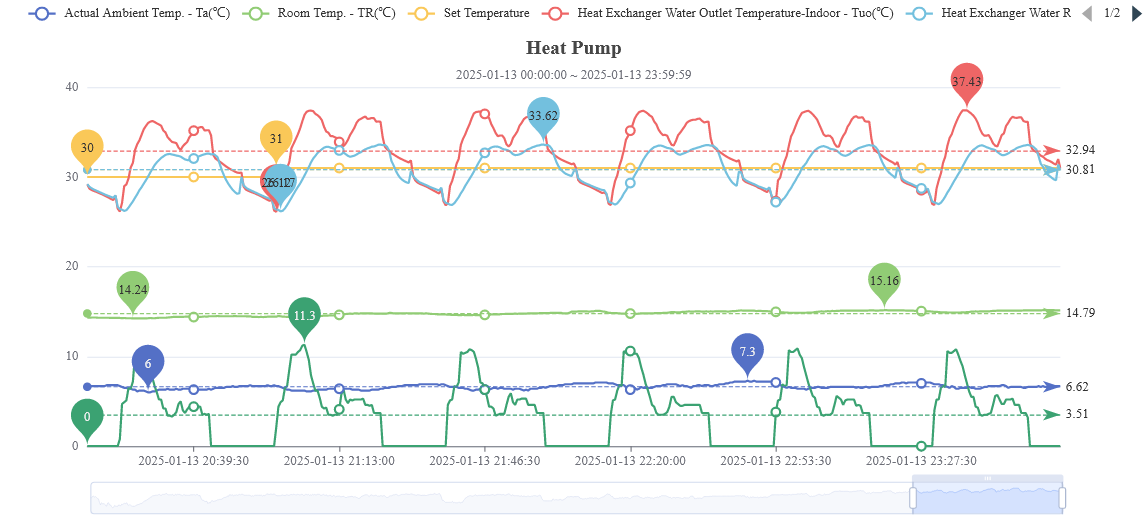
32c
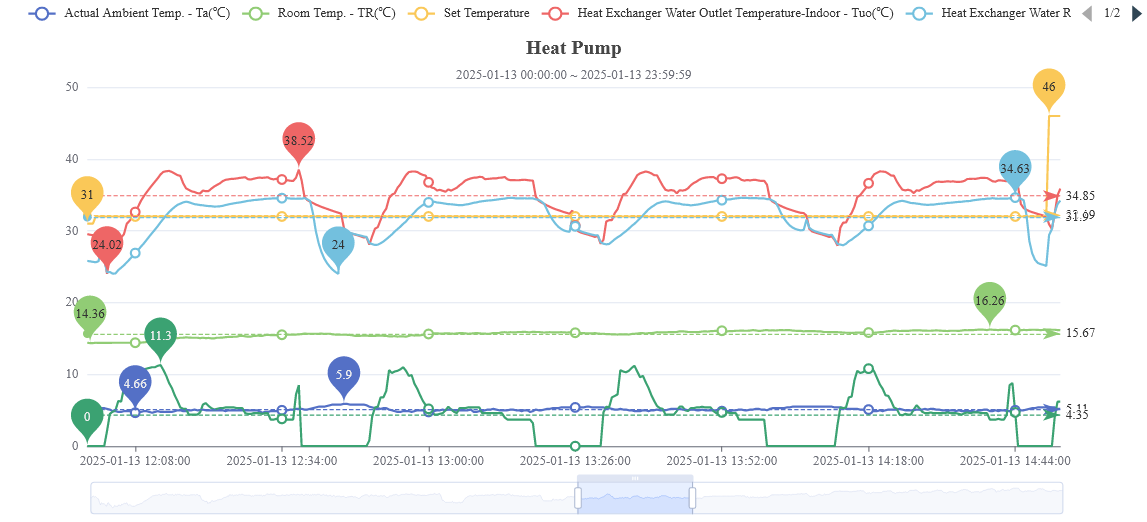
amps in green on the bottom line .
water return temps in pale blue .
its hard to work out which setting uses least power ,but then i am a total newbie.
oh , flow rate is 22l/m.
regards
robert 🙂

13/01/2025 11:49 pm
In general lower FT = higher efficiency.
These are only 1C apart however and with different outdoor temps, but perhaps more importantly both have an indoor temp of ~15. Is that your target indoor temp?
In general (in most cases) start by setting your FT as low as you can (with the heating operated 24x7 and all zone valves/TRVs fully open), consistent with the house being warm enough.
You can tweak starting from that point, but thats the starting point for max efficiency and usually lowest cost, unless you have a heat pump which is well oversized and a strong ToU tarrif.
4kW peak of solar PV since 2011; EV and a 1930s house which has been partially renovated to improve its efficiency. 7kW Vaillant heat pump.

13/01/2025 11:50 pm
The exact waveform does matter too much it’s the average that matters. I can’t read the scale too well but both shapes look reasonable. There’s no need to stress about tiny details.
Do you have a smart meter to compare with?
2kW + Growatt & 4kW +Sunnyboy PV on south-facing roof Solar thermal. 9.5kWh Givenergy battery with AC3. MVHR. Vaillant 7kW ASHP (very pleased with SCOP >4) open system operating on WC

14/01/2025 1:05 am
I find the graphs somewhat hard to reconcile against the references to 31 or 32 @ 3° ambient as in both the flow temperature seems to be targeted at the mid/high 30s and the ambient is a few degrees above 3. Surely the 11.3 noted against the power line can't mean its drawing 11.3kW?
I like the look of the second graph, fewer cycles and more periods of even output, but as JamesPa states the ambient temp (known round these parts as the OAT - Outside Air Temperature) is slightly higher and that alone will be enough to change the operational choices of the pump's software.
I suspect a 12kW sized unit is larger than you need for a medium-sized house that appears to be well insulated, and a target temperature of 15 or 16°C is on the low side requiring less heat to be generated. You may well be operating at the lower end of the capacity range of the pump already.
Mitsubishi EcoDan 8.5 kW ASHP - radiators on a single loop
210l Mitsubishi solar tank
Solar thermal
3.94kW of PV

14/01/2025 9:24 am
My question is , if i set the heat curve at 32c @ 3c ambient , i get one waveform , and if i set it at 31c ,i get a diferent one .and different cycling rates
which one is most desirable?
The second lower one is marginally among purists perhaps more desirable, but as @judith says, you don't need to stress about this.
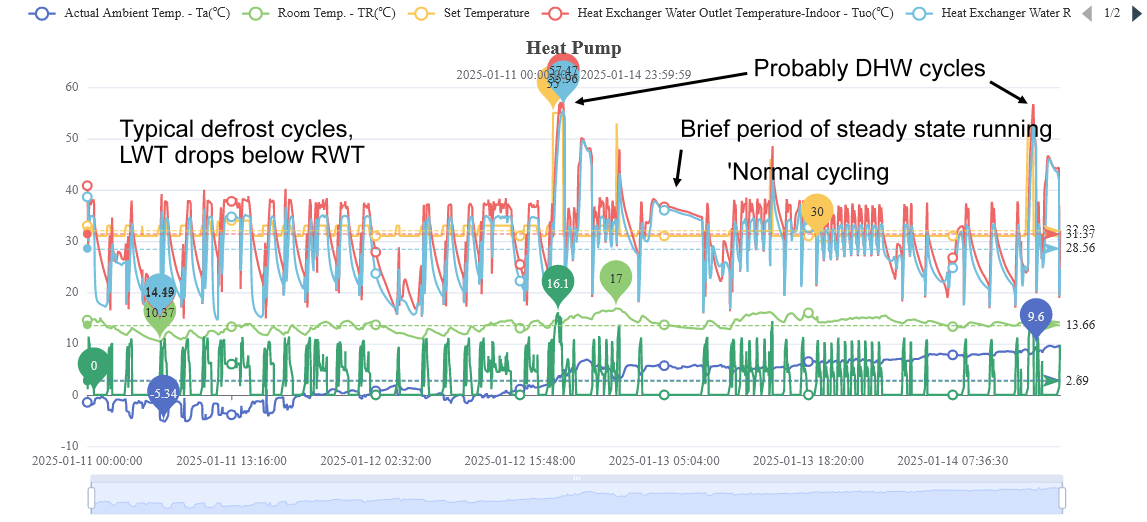
I'm pretty sure the two charts straddle the point at which your heat pump changes from mostly steady state running to cycling. The upper chart (LWT 31 degrees) is at the point where the heat pump has to cycle to modulate, the lower one (LWT 32 degrees is just into the range where it can manage at least some steady state running. Typically, heat pumps have three operations modes depending on LWT/OAT: a mid range where it can modulate parameters enough to achieve steady state, a higher OAT/lower LWT range where it has to cycle to reduce output sufficiently, and a lower OAT/higher LWT range where it uses defrost cycles.
If, as @harriup suggests, tour heat pump output is on the high side for the demand, the you will be more likely to get cycling, because there will be more times when the heat pump can't lower output enough without cycling. In general, the larger the heat pump, the higher it minimum as well as maximum output. This is one of the reasons why it is a good idea to match the heat pump output to the heat loss as closely as possible, just banging in large one makes it much more likely you will get cycling.
The cycling you have is relatively low frequency, maybe every 30 mins in the upper chart. Nil desperandum.
Midea 14kW (for now...) ASHP heating both building and DHW
Topic starter
14/01/2025 9:47 am
Gosh ! thank you for all the replies , i'll quote each one and try to anser the questions in them ..
Topic starter
14/01/2025 9:53 am
In general lower FT = higher efficiency.
These are only 1C apart however and with different outdoor temps, but perhaps more importantly both have an indoor temp of ~15. Is that your target indoor temp?
In general (in most cases) start by setting your FT as low as you can (with the heating operated 24x7 and all zone valves/TRVs fully open), consistent with the house being warm enough.
You can tweak starting from that point, but thats the starting point for max efficiency and usually lowest cost, unless you have a heat pump which is well oversized and a strong ToU tarrif.
Thank you James , 15c is my indoor temp at night, 16c during theday .working outside on the banrs meanswhen i come in that feels quitewarm , then i use my tiny wood burner in the sitting room at tv supper time .
ihave been trying not using the thermostat in the hall , and setting the flow temp to keep the hs at 16 ,but i am concerned about the rapid cycling phenomenon , i can see the ashp is switching on and off more rapidly with the 31c , but from comments i can see here , it appears to be within acceptable parameters, and not about to hit a freqency of operation likely to damage itselt or the ears of the local dog population .
i have a suspicion than my heat pump is oversize .
regards
robert
Topic starter
14/01/2025 9:59 am
The exact waveform does matter too much it’s the average that matters. I can’t read the scale too well but both shapes look reasonable. There’s no need to stress about tiny details.
Do you have a smart meter to compare with?
Thank you Judith ,
i do have a smart meter ,and also the foxcloud and energy stats apps , however i find it a little hard to compare the exact power usage for each setting ,,,must try harder! keeping everything ,ext temp , internal temps, the same ,while varying the flow temps , and trying to compare energy used over a set time , is hard , i can see the amps used seemshigher on average wit hthe higher flow temps, but ,,,its cycling less times an hour too .....
i dont find this stress , just an interesting problem ,which uses less energy for the same hs heat .
regards
robert

Topic starter
14/01/2025 10:11 am
I find the graphs somewhat hard to reconcile against the references to 31 or 32 @ 3° ambient as in both the flow temperature seems to be targeted at the mid/high 30s and the ambient is a few degrees above 3. Surely the 11.3 noted against the power line can't mean its drawing 11.3kW?
I like the look of the second graph, fewer cycles and more periods of even output, but as JamesPa states the ambient temp (known round these parts as the OAT - Outside Air Temperature) is slightly higher and that alone will be enough to change the operational choices of the pump's software.
I suspect a 12kW sized unit is larger than you need for a medium-sized house that appears to be well insulated, and a target temperature of 15 or 16°C is on the low side requiring less heat to be generated. You may well be operating at the lower end of the capacity range of the pump already.
thank you HarriUp ,
I can see what you mean , and my guess is the flow temps are being measured at the pump , and ,by the time its got into the hs its dropped a touch , and then also its creating an average of 31, by exceeding then dropping beloww ,whcih over time creates that average temp .
yes! that is 11.3 kw !! ...scary,and depressing ,i just assumed thats how they all work .
i will admit , going from my old electricity usage , of 6 kw a day , to 20-30kw over the -9c days lately is a hell of a shock , especially at a house temp of 16c
but hey i must remember i am not burning 50-60 litres of heating oil a week .
Re the second graph , that is how i had been running it up to now . i am just starting to get into the system and whether its at its best ,due to the fact i can now data log and graph the design.
with this pump , i can program in 5 ambient temps , and 5 flow temps , so i have good control over the graph of amb/FT.
Yes , i think youre right re lower areas of this pumps capacity , a12 kw may well be too big . at ambient of 10c i can use 28-29 as my flow temps .
regards
robert
Topic starter
14/01/2025 10:23 am
My question is , if i set the heat curve at 32c @ 3c ambient , i get one waveform , and if i set it at 31c ,i get a diferent one .and different cycling rates
which one is most desirable?
The second lower one is marginally among purists perhaps more desirable, but as @judith says, you don't need to stress about this.
I'm pretty sure the two charts straddle the point at which your heat pump changes from mostly steady state running to cycling. The upper chart (LWT 31 degrees) is at the point where the heat pump has to cycle to modulate, the lower one (LWT 32 degrees is just into the range where it can manage at least some steady state running. Typically, heat pumps have three operations modes depending on LWT/OAT: a mid range where it can modulate parameters enough to achieve steady state, a higher OAT/lower LWT range where it has to cycle to reduce output sufficiently, and a lower OAT/higher LWT range where it uses defrost cycles.
If, as @harriup suggests, tour heat pump output is on the high side for the demand, the you will be more likely to get cycling, because there will be more times when the heat pump can't lower output enough without cycling. In general, the larger the heat pump, the higher it minimum as well as maximum output. This is one of the reasons why it is a good idea to match the heat pump output to the heat loss as closely as possible, just banging in large one makes it much more likely you will get cycling.
The cycling you have is relatively low frequency, maybe every 30 mins in the upper chart. Nil desperandum.
Thank you cathodeRay,
It looks like neither flow temp graph is horrific , thats very reassuring , and i think the conversational trend is that my pump is a little on the big size .
I wonder if there's anything i can do to encourage steady state running to use less overall kw , would it be worth me running at say 33 or 34 c FT, and casuing a longer session of steady state , and fewer cycles per hr ?
by the way , i should point out the time scale on the bottom line is 8hrs advanced from uk time .
regards
robert
Topic starter
14/01/2025 10:37 am
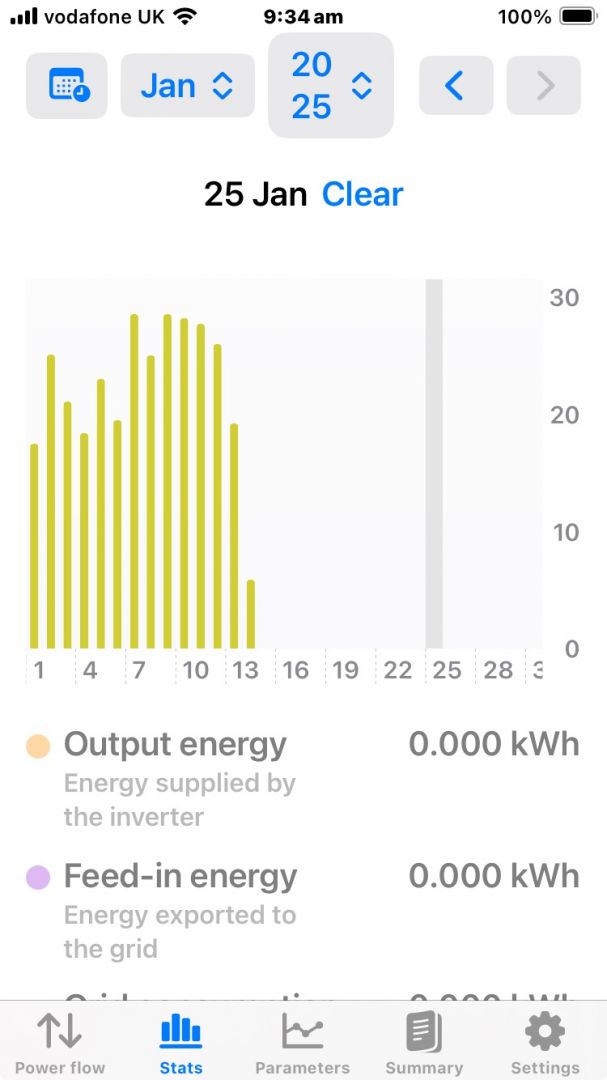
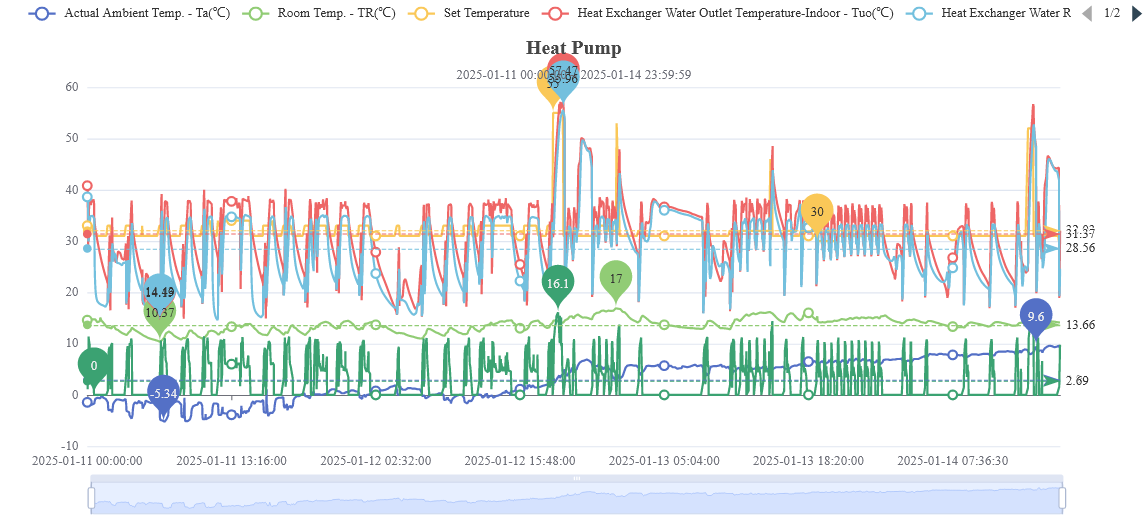
just in case it helps , here is my graph for the last three days on the ashp , and also the energy usage for january day by day to today ..
regards
robert
14/01/2025 11:13 am
@ivanhoew - most if not all of what you need to understand your heat pump's behaviour is on the second chart. Here's an annotated version:
Midea 14kW (for now...) ASHP heating both building and DHW
1
Page 1 / 4
Next
SPONSORS

Degrees of Separation
Latest Posts
-

RE: Jokes and fun posts about heat pumps and renewables
Damn, I pressed the button on my new heat pump too soon...
By ian33a , 5 minutes ago
-
RE: Safety study for plug in batteries out to tender - looks like Q3 2027 at best before legal
I think it may depend how much of the world is on fire ...
By EtchedPixels , 4 hours ago
-
RE: Air-to-Air Heat Pumps & Air Conditioning: UK Heating and Cooling Q&A
I hope it's not the same people who make the awful TV s...
By EtchedPixels , 4 hours ago
-
RE: Why are ASHP installs so expensive?
ECO4 is classic British idiocy, "save" money by requiri...
By EtchedPixels , 4 hours ago
-
RE: Renewables & Heat Pumps in the News
We need more building inspectors anyway and less self-s...
By EtchedPixels , 5 hours ago
-
RE: Does anyone have experience of a smart water meter?
@majordennisbloodnok That is my thinking precisely, I s...
By Toodles , 13 hours ago
-
RE: Replacing Storage Heaters with a Heat Pump in a Stone Cottage
I found some interesting data about the price of heat p...
By Rob of York , 19 hours ago
-
RE: PV and battery long payback - sense check query
Thanks for all the comments. I finally got to the bott...
By DavidB , 21 hours ago
-
RE: Indevolt Batteries UK Support & Info Thread
People following this thread who are hoping that plug i...
By JamesPa , 1 day ago
-
RE: Passiv Smart Thermostat - Help & Forum Support
By Singlespeed , 1 day ago
-
RE: Help me keep the faith with my air source heat pump installation
just had Vaillant over to service the HP and asked abou...
By AdamK , 1 day ago
-
RE: tepeo ZEB UK Support & Info Thread
OK so ZEB is basically a variant on a storage heater, b...
By JamesPa , 3 days ago
-
RE: Heat Geek installations: share your experiences
@editor I suspect that the Heat Geek online quote is a ...
By AndrewJ , 3 days ago
-
RE: Adding additional Solar Panels to a DC coupled battery system
Ah, yes. Thanks for clarifying.
By Transparent , 3 days ago






SPONSORS