

Notifications
Clear all
Joining the Renewable Heating Hub forums is completely free and only takes a minute. By registering you’ll be able to ask questions, join discussions, follow topics you’re interested in, bookmark useful threads and receive notifications when someone replies. Non-registered members also do not have access to our AI features. When choosing your username, please note that it cannot be changed later, so we recommend avoiding brand or product names. Before registering, please take a moment to read the Forum Rules & Terms of Use so we can keep the community helpful, respectful and informative for everyone. Thanks for joining!
Air Source Heat Pumps (ASHPs)
32
Posts
9
Users
6
Reactions
8,804
Views

Topic starter
12/01/2025 10:05 pm
Hello everyone, Just joined the forum and have chipped into a few threads. I thought I'd better write something about what I'm planning to do!
I'm hoping to use an air source heat pump to heat my garage/ workshop and eventually some other buildings in the garden. The garage is 3m x 6m, the workshop is 3m x 3m, both buildings will be well insulated with foil blanket type insulation, I'm aiming for a U value of about 0.2w/m2/K.
I'm estimating a heat load of about 1kW to heat the garage and about 0.5kW to heat the workshop. That's based on a 4kW diesel heater being able to keep the currently uninsulated garage at a reasonable temperature (about 12C with freezing weather outside). It's a bit of a guess really!
I'm aiming for roughly 15C indoor air temperature and 35C water flow temperature to give a 20C delta temperature to drive energy out of the heat emitter. I plan to use a home made fan coil, I dont want radiators cluttering up the walls and I'm not keep in under floor heating (no insulation in the floor slab). Trying to find a 1kW fan coil that operates with a 20C DT is challenging!
I'm considering a 4kW Ecodan or Riello/Midea/Baxi ASHP. The Riello/Midea/Baxi are cheaper and seem easy to set up. Pipework volume would be very small, possibly only 20L, so I would need a buffer tank / volumiser. The Riello manual says 100 to 250L system volume, which is huge for the space I have, not sure how that would fit. Maybe an outside tank?
The expected output power of the heat emitters is 1.5kW which is about 37% of a 4kW heatpump duty, which is below the minimum turndown of the 4kW Riello unit. The tech data sheet states 55% min duty - so the buffer tank is needed to reduce cycling.
The bit that's concerning me at the moment is the large buffer tank is needed to absorb excess duty and provide heat for the defrost cycle. I'm not really sure it's going to be worth the time and cost trying to install a system to heat such a small space. I could get away with electric fan heaters.
Anyway, hopefully I'll flesh out this thread as my thoughts and design evolve.
Regards
Bob
1

13/01/2025 7:56 am
For such a small space wouldn’t A2A be better than A2W and you get cooling in summer.

13/01/2025 11:07 am
For such a small space wouldn’t A2A be better than A2W and you get cooling in summer.
One of the major limitations of A2A is that it can't deal with domestic hot water. Since a garage and workshop don't need that, it sounds like an ideal solution to me (non-expert that I am).
105 m2 bungalow in South East England
Mitsubishi Ecodan 8.5 kW air source heat pump
18 x 360W solar panels
1 x 6 kW GroWatt battery and SPH5000 inverter
1 x Myenergi Zappi
1 x VW ID3
Raised beds for home-grown veg and chickens for eggs
"Semper in excretia; sumus solum profundum variat"

13/01/2025 12:32 pm
Picking up my point from the Hello Topic, I'm assuming that there's no government grant involved, no requirement for MCS accredited installer, and that you'll be doing as much as possible of the work yourself.
Are those assumptions correct?
Insulation.
I have gained experience with several types of insulation, including three different foil-film products.
Building Control in my area does not allow more than 50% of the insulation performance in a habitable dwelling to be provided by multi-foil.
There are good reasons for this, and I have discussed it with one of their experienced surveyors.
As you'll appreciate, multi-layer foil operates by reflecting radiant heat back into the building.
(But it can also conduct heat out of a building if it's crushed during installation, or touches against the surface behind it.)
Over 10 years ago, there was a legal battle between Kingspan and the French manufacturers of Actis multifoil.
Actis Super-9 failed the insulation tests conducted by the National Physical Laboratory.
Kingspan got hold of the test results and used the document in their own advertising.
The problem lies in the way in which the BRE tests were then stipulated.
A box is insulated with the test material and has hot air inside it.
Measurements are taken of the internal temperature drop over time.
That is clearly going to favour insulation which guards against heat-loss by conduction or convection, such as Kingspan's PU rigid boards.
In your case it's not just that you're deciding to use multifoil which is the issue,
... but rather, how you intend to apply it to the existing fabric of the building.
Save energy... recycle electrons!

Topic starter
13/01/2025 9:02 pm
@transparent Hello. This will not be covered on any grant scheme, I'll be paying the full cost from own pocket 😉
The garage / workshop is a stand alone building, it's not attached to the house. There's no need for domestic hot water. It will be a DIY install with a qualified electrician making the main power connection into the house consumer unit.
Thank you for the information about foil type insulation blanked. I plan to install a double layer using 25mm battens to separate it from the internal face of the (single thickness) brick wall. There is a minimum separation distance for the battens and the vendor does re
commend providing an air gap. I will make sure to check the blanket doesn't touch the brickwork.
My primary question at the moment is how much water volume will I need for the defrost cycle? Anyone know how much ice accumulates on a typical 4kW ASHP in a rural UK location?
Regards
Bob
14/01/2025 11:11 am
My primary question at the moment is how much water volume will I need for the defrost cycle?
@majordennisbloodnok was suggesting an A2A heat pump...
... in which case there is no water tank from which to take heat for a defrost cycle.
Check the manufacturer's specifications.
There may be an electric heater element within the unit.
If so, it will take a lot of electricity to operate, and will most likely need to run the main fan.
But that could still cost a lot less than installing an Air-to-Water unit in the first place.
2: Let me point out that the electricity Distribution Network Operators (DNOs) do not yet have a solution for coping with multiple ASHPs entering defrost cycles simultaneously.
The probability of this happening is pretty high.
An area of freezing fog or overnight temperature drop is going to affect the great majority of heat-pumps in the same area.
Diversification on the Low Voltage feeds (LV = 440v/230v) is such that a house is deemed to take far less current than the 100A service fuse.
A new house, built with a heat-pump as standard, isn't likely to be allocated more than 10kw (40A) of the local substation's capacity.
Obviously, those homes with storage batteries configured to run the heat-pump in 'off-grid' mode will be OK,
and will reduce the overall demand on the substation.
But as we progress towards de-carbonisation of heat, there is an increasing likelihood of power outages during sudden frosts, which is concerning.
3: For the sake of others who read this discussion in the future, I ought to point out one further consideration when using multi-foil insulation:
... it is an effective blocker of radio waves!
It will hinder transmissions for TV aerials and Smart Meters.
Even if that doesn't directly affect you, it can be detrimental to your neighbours.
Please check your surroundings and be considerate to others whose line-of-sight to the transmitter mast might pass through your property.
Save energy... recycle electrons!

14/01/2025 4:43 pm
@transparent I spent a King’s ransom on grid chargeable battery storage - but I feel better every time I see you make mention of their implementation assisting the grid @transparent ! 😉 Regards, Toodles.
Toodles, heats his home with cold draughts and cooks food with magnets.

14/01/2025 11:29 pm
Diversification on the Low Voltage feeds (LV = 440v/230v) is such that a house is deemed to take far less current than the 100A service fuse.
A new house, built with a heat-pump as standard, isn't likely to be allocated more than 10kw (40A) of the local substation's capacity.Obviously, those homes with storage batteries configured to run the heat-pump in 'off-grid' mode will be OK,
and will reduce the overall demand on the substation.
My 7kW Vaillant Arotherm+ heat pump has a maximum current of 15A according to the label. It should be sufficient for a very large new house that has been built to modern insulation standards. I think it's inverter controlled and avoids any nasty starting current spikes. I would hope that current production from other manufacturers are similarly equipped.
The biggest power load in my house is the pair of Powerwall batteries recharging. That's 10kW for several hours at this time of year but nothing for the summer half of the year when the solar panels do the reccharging.

15/01/2025 9:52 pm
It's not just current spikes which are the issue @johnr
... nor the switch on surge of the motor(s) as the coils are energised,
... but the compressor itself takes more electricity until the system is up to pressure.
Having a heat-pump turning off/on will significantly reduce the COP.
Are your Powerwall batteries drawing 10kW (42A) because that's what you need them to do in order to have enough energy stored for the next day?
Or do they draw that by default due to their design?
The slower the charge current, the less thermal stress will be adversely affecting the electronics and the cells.
Save energy... recycle electrons!
15/01/2025 11:04 pm
It's not just current spikes which are the issue
... nor the switch on surge of the motor(s) as the coils are energised,
... but the compressor itself takes more electricity until the system is up to pressure.
The Vaillant Arotherm Plus specs refer to "Inrush current (with inrush current limiter)" which, I presume, manages this problem but perhaps other manufacturers don't provide this.
Are your Powerwall batteries drawing 10kW (42A) because that's what you need them to do in order to have enough energy stored for the next day?Or do they draw that by default due to their design?
The slower the charge current, the less thermal stress will be adversely affecting the electronics and the cells.
I think the charging rate reflects limitations in the installer configuration options. If I could, I would reduce the charging rate by about 1/3rd as that would be sufficient to recharge empty batteries within the 5 hours Octopus Go period. Contacting Tesla support to see if they can reduce this rate is on my pending list. I appreciate that slower is better for battery charging. In addition to the charging rate automatically reduces once the charge level reaches 90%, the Powerwall batteries have fairly sophisticated thermal management (both heating and cooling).
1
Topic starter
16/01/2025 10:04 pm
Evening all,
An air to air heat pump system might be a possible solution, but I'm not F-Gas registered so couldn't install one. I'd like to keep costs down so it will be a DIY build.
Please can someone share some data on how much energy their ASHP uses during a defrost cycle? I see lots of trends showing water temperatures and flowrates, that's the data I need. CathodeRay posted some data from 3rd Jan 2025 at 04:15 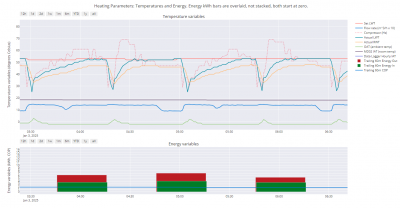
That shows the LWT dropping from 55C to 28C in 7mins with an average flow of 1.5m3/hr. I calculate that to be 175L volume, 25C DT, 18375kJ in 7mins, which is 44kW! That doesn't sound right, my calcs might be wrong. Does anyone have any tabulated data, or maybe a trend over just the defrost cycle?
I also found some data on openenergymonitor.org saying some one had an ASHP that used 1kWh to defrost, for a 10kW unit. I'm estimating that a 4kW system with 100L system volume would take 45mins to go from 10C to 35C flow temp. It would take 15mins to defrost the system assuming 1kWh energy requirement giving an hourly average flow temperature of about 33C. That energy requirement for defrost is going to be a critical number for my design calculations.
Thanks
Bob
17/01/2025 9:45 am
@transparent Further to my comment above, I contacted Tesla who changed the grid code in my Tesla gateway (battery controller) from G99 to G98 and the charging rate has reduced to approx 7.5kW which is still sufficient to recharge the empty batteries within the 5 hour Octopus Go tariff period.
Page 1 / 3
Next

SPONSORS
Degrees of Separation

Latest Posts
-

RE: Jokes and fun posts about heat pumps and renewables
Damn, I pressed the button on my new heat pump too soon...
By ian33a , 1 hour ago
-
RE: Safety study for plug in batteries out to tender - looks like Q3 2027 at best before legal
I think it may depend how much of the world is on fire ...
By EtchedPixels , 5 hours ago
-
RE: Air-to-Air Heat Pumps & Air Conditioning: UK Heating and Cooling Q&A
I hope it's not the same people who make the awful TV s...
By EtchedPixels , 5 hours ago
-
RE: Why are ASHP installs so expensive?
ECO4 is classic British idiocy, "save" money by requiri...
By EtchedPixels , 5 hours ago
-
RE: Renewables & Heat Pumps in the News
We need more building inspectors anyway and less self-s...
By EtchedPixels , 6 hours ago
-
RE: Does anyone have experience of a smart water meter?
@majordennisbloodnok That is my thinking precisely, I s...
By Toodles , 14 hours ago
-
RE: Replacing Storage Heaters with a Heat Pump in a Stone Cottage
I found some interesting data about the price of heat p...
By Rob of York , 20 hours ago
-
RE: PV and battery long payback - sense check query
Thanks for all the comments. I finally got to the bott...
By DavidB , 22 hours ago
-
RE: Indevolt Batteries UK Support & Info Thread
People following this thread who are hoping that plug i...
By JamesPa , 1 day ago
-
RE: Passiv Smart Thermostat - Help & Forum Support
By Singlespeed , 1 day ago
-
RE: Help me keep the faith with my air source heat pump installation
just had Vaillant over to service the HP and asked abou...
By AdamK , 1 day ago
-
RE: tepeo ZEB UK Support & Info Thread
OK so ZEB is basically a variant on a storage heater, b...
By JamesPa , 3 days ago
-
RE: Heat Geek installations: share your experiences
@editor I suspect that the Heat Geek online quote is a ...
By AndrewJ , 3 days ago
-
RE: Adding additional Solar Panels to a DC coupled battery system
Ah, yes. Thanks for clarifying.
By Transparent , 3 days ago


SPONSORS
