

Notifications
Clear all
Joining the Renewable Heating Hub forums is completely free and only takes a minute. By registering you’ll be able to ask questions, join discussions, follow topics you’re interested in, bookmark useful threads and receive notifications when someone replies. Non-registered members also do not have access to our AI features. When choosing your username, please note that it cannot be changed later, so we recommend avoiding brand or product names. Before registering, please take a moment to read the Forum Rules & Terms of Use so we can keep the community helpful, respectful and informative for everyone. Thanks for joining!

13/02/2025 8:49 pm
@cathyem1 - this isn't exactly beginner's level stuff, but it may nonetheless help you get your head around some of this. This is my system running on weather compensation over a recent seven day period as shown on the bottom horizontal axis (I have fairly detailed monitoring that collects this data):
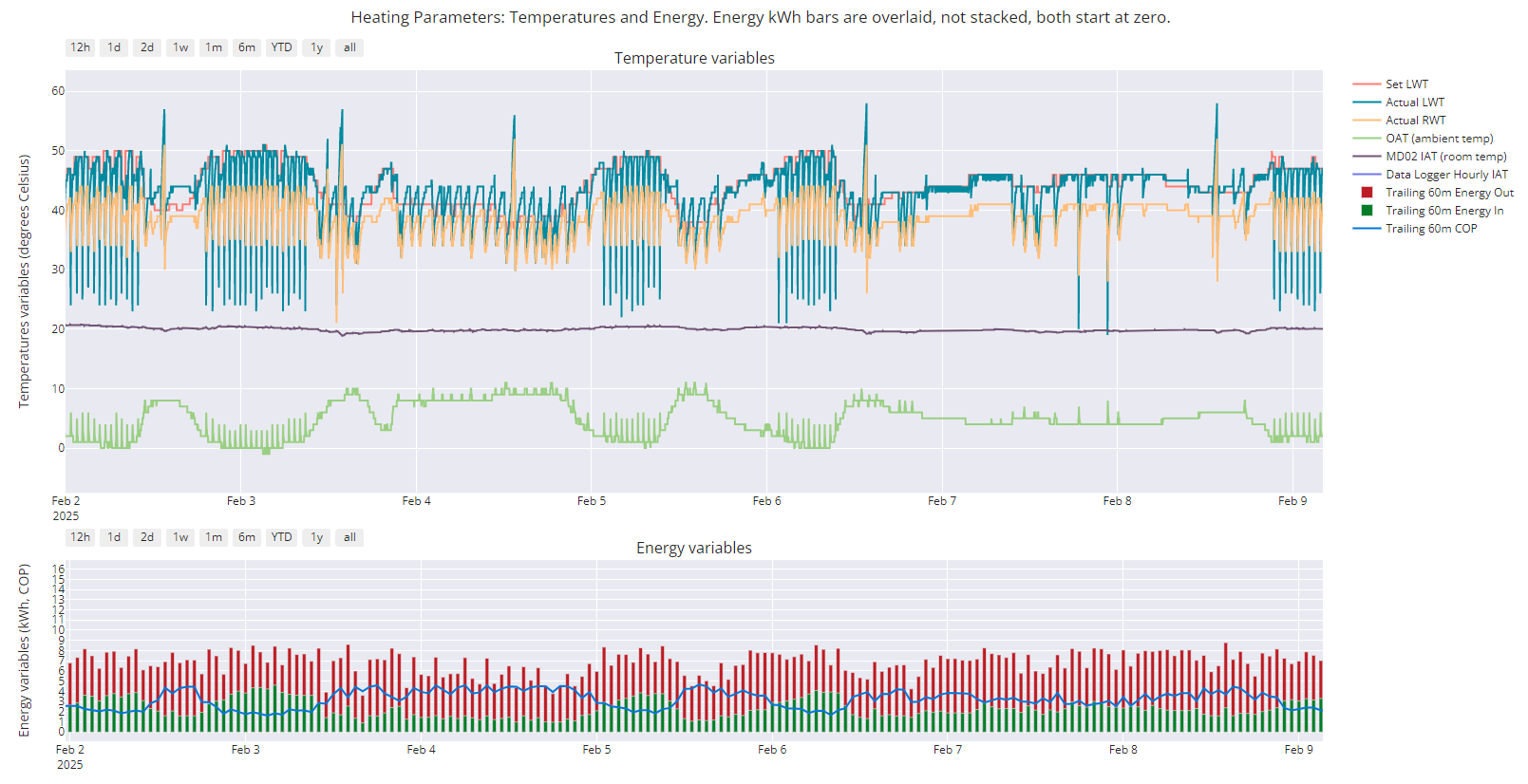
Now at first glance I am sure it makes no sense. However, lets look at certain elements:
In the upper (temperatures) chart
(1) the dark brown purple line stuck on around 20 - that's my room temperature. Fairly steady, weather compensation working as it should.
(2) the green line under the room temperature line - that's the outside air temperature (OAT). Ranges between zero and ten degrees.
(3) the partially obscured red/orange line - that's the SET (target) LWT, as set by the weather compensation curve, not by me). Note how it changes in response to the OAT. When it gets colder outside, the SET LWT goes up, when it's warmer outside, it goes down.
(4) The teal/turquoise line - that's the ACTUAL LWT. For now, just notice how most of the time it is pretty close to the SET LWT. The heat pump is doing its job, without any intervention from me, room stats, timers, magic controllers, woo crystals or anything else (apart from one adjustment control I have which fine tunes the weather compensation curve, but that's another subject for another day for more advanced use). The only thing I did was set the ends points of the weather compensation curve, the heat pump controls did the rest.
Also out of interest in the bottom energy chart note how variable the energy in (used) per hour is (green bars), depending on the OAT, without corresponding large increases in energy out (heat supplied to the house, the red bars). This reflects the extra effort needed in cold weather, the heat pump has to work much harder to produce heat, and as a result its performance (COP, the blue line) falls sharply. They key take away is just how variable the performance is: this is how we know that when it gets milder as spring approaches, our energy use (and bills) will go down.
Edit: I should add that in cold weather there is a double hit: not only does the COP plummet because it is cold, the demand also increases because it is cold. Result: big bills. But equally in mild weather, the COP (performance) increases greatly and the demand is far less. Result: tiny bills. Over a heating season, the two cancel each other out.
Midea 14kW (for now...) ASHP heating both building and DHW

14/02/2025 10:58 am
I'm keen to save some money
Cathy, once you've followed the instructions from @cathoderay to get the WC curve set correctly,
there comes a point where further investigation of System Optimisation is effort being spent with diminishing returns.
Let's look forward in time to see what else you could do to save money:
1: Spent a bit of time to better insulate those pipes, and the attached valves.
We haven't yet seen a photo of the external pipework.
That could be throwing away 20% of your heat energy before it even gets into the house!
2: Reduce the cost of the electricity you're using to run the heat-pump.
Even without having PV Solar Panels, there is still a strong argument in favour of battery storage.
With a Time of Use (ToU) tariff, you could then recharge the battery from the grid during cheap periods.
Better still, the inverter could be wired so as to continue running some equipment during a power cut
- the heat pump
- a kettle
- lights
Only you can decide those priorities.
But I'm suggesting these issues with your husband in mind.
Save energy... recycle electrons!
1

Topic starter
18/02/2025 2:36 pm
@cathoderay I’ve changed both ends of the curve by 1° today and i’ll see how we get on.
Topic starter
18/02/2025 2:41 pm
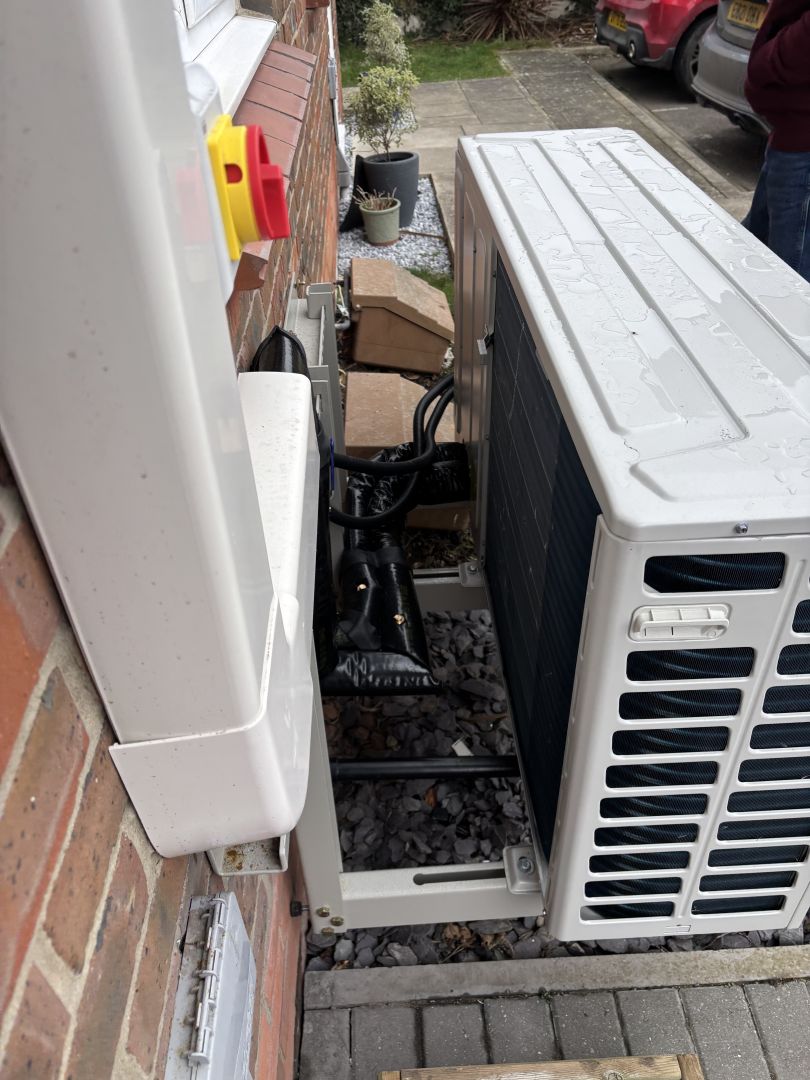
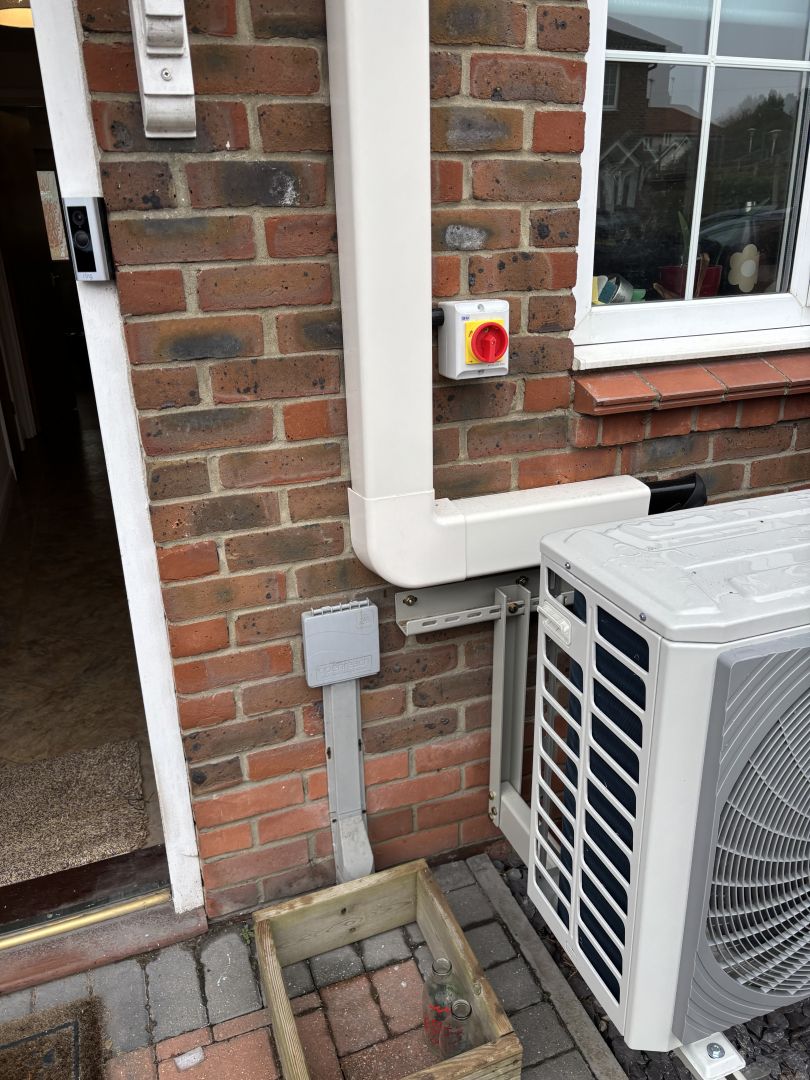
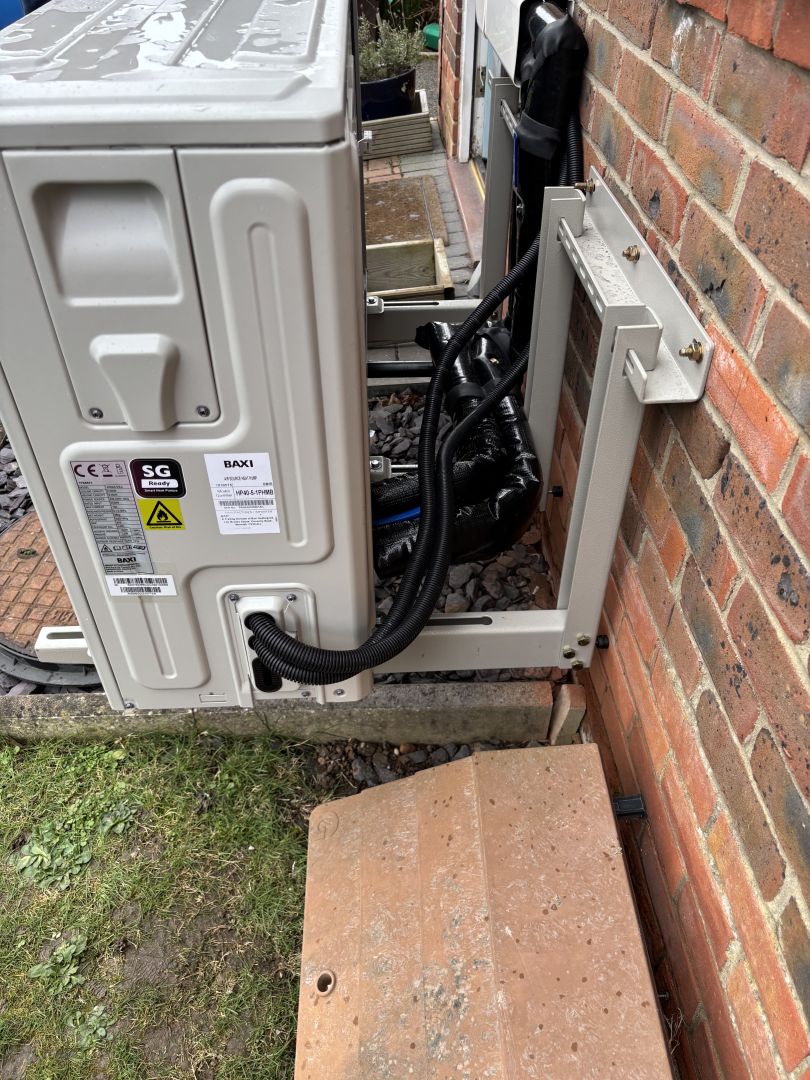
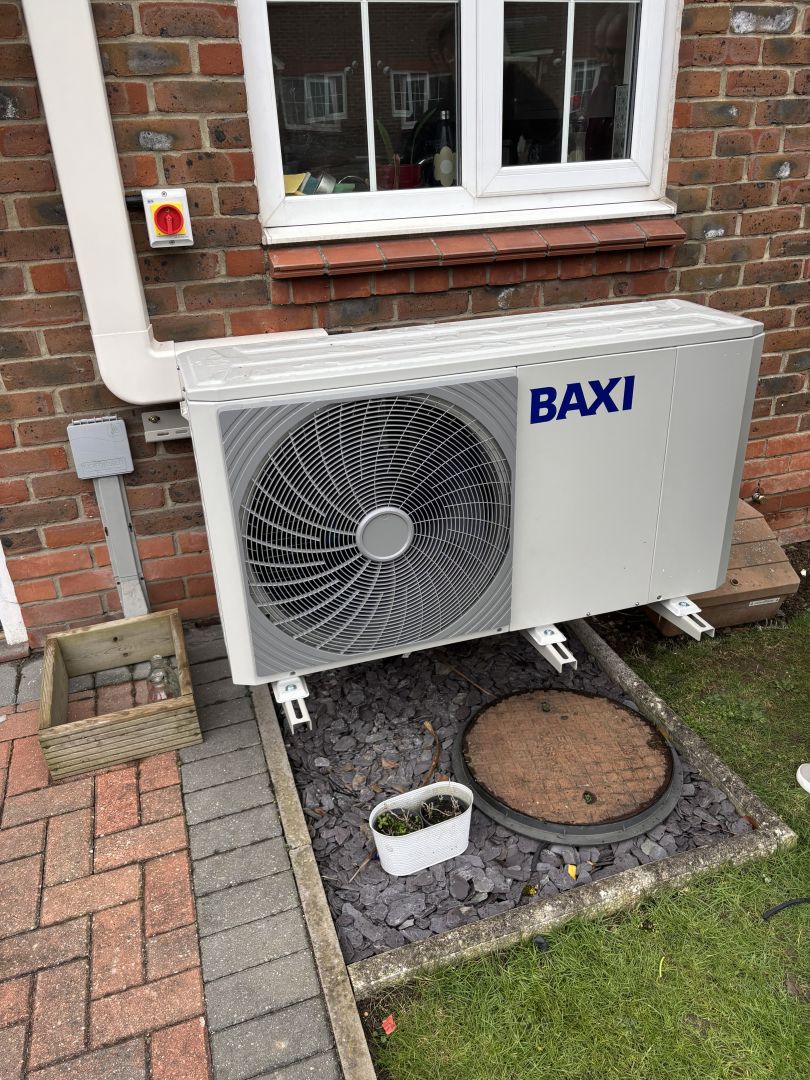

18/02/2025 3:03 pm
Thanks for the photos.
That's in the top 10% of external HP installations which I've seen. 🙂
But it still looks like rain could enter through the gaps in the insulation for the two anti-freeze valves and the isolator with the blue handle above them.
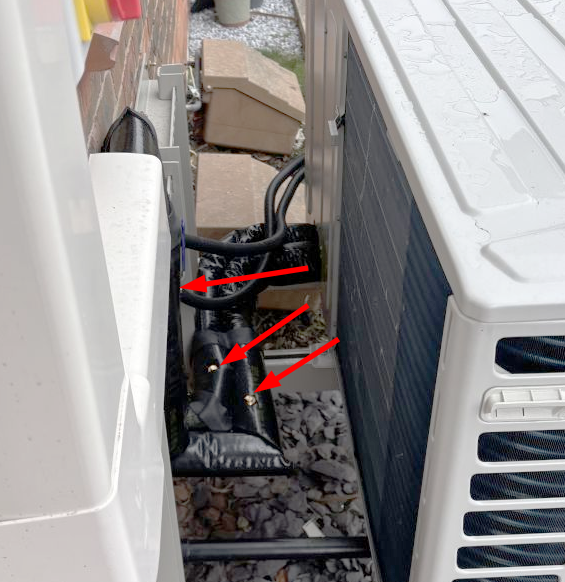
Any rain which goes between the insulation and the pipe will absorb precious heat,
and then dump it on the ground!
I also don't understand why you only appear to have one lever-valve to isolate the external unit.
Save energy... recycle electrons!
1
Topic starter
18/02/2025 3:40 pm
@transparent the installer is returning soon to replenish the glycol and sort out my solar thermal so i’ll mention these points to him then. Thank you again
18/02/2025 6:48 pm
I’ve changed both ends of the curve by 1° today and i’ll see how we get on.
That's the way to go. Over time you will get closer and closer to the ideal setting for your home. Don't be thrown by days when external factors like wind chill (happens to homes as well as people), solar gain (sun's warmth also contributes to warming your home) and human activity eg lots of cooking push the room temp a bit this way or that, just let it happen. There are ways of dealing with these things but for most people they are not necessary. For now, I suggest just concentrate of getting the weather compensation curve right, and of course making progress with @transparent's suggestions.
Midea 14kW (for now...) ASHP heating both building and DHW
18/02/2025 8:22 pm
the installer is returning soon to replenish the glycol
If you are to have glycol added to the system, then I question why have also had (relatively expensive) anti-freeze valves fitted. 🤔
The anti-freeze valve detects when the system fluid is on the point of forming ice, and then opens to empty your pipework into the gravel below the heat-pump.
It should only occur if the software-controlled de-frosting method has failed to remove ice from the compressor circuit and radiator grid of the external unit.
Your heat-pump then stops working (of course) but it does at least avoid damage occuring.
I wouldn't usually expect to see anti-freeze valves on a system with glycol, because they would be dumping that chemical into the soil.

Glycol also has a lower thermal capacity than water.
Adding it to your system will reduce its ability to move heat into the house.
Thus the heat-pump has to work slightly harder and is less efficient.
Everything you're learning about your heat pump is demonstrating that there are balances to be made between alternatives.
It's the role of your installer to explain these rather than just implementing their own personal preference.
Save energy... recycle electrons!
1

Topic starter
18/02/2025 10:09 pm
@transparent The glycol is for the separate solar thermal water heating system not the ashp.
18/02/2025 11:12 pm
mea culpa !
Save energy... recycle electrons!
Topic starter
19/02/2025 10:41 am
@cathoderay I’ve just realised the date on the control panel is now correct but the time isn’t. Could you tell me how to change the time please. I have looked through the user information and cannot find it. Thank you.

SPONSORS
Degrees of Separation
Latest Posts
-

RE: Missing flow temperature in Heat Geek proposal
I cant really comment on what might have happened as I ...
By JamesPa , 20 minutes ago
-
RE: Renewable Heating Hub Homeowners' Q&A Podcast
What a day yesterday! Two podcasts recorded, brilliant ...
By Mars , 4 hours ago
-
Vaillant ecoTEC Plus with sensoCOMFORT and weather compensation
Powering up my new Vaillant which was installed earlier...
By trebor12345 , 4 hours ago
-
RE: Tesla Powerwall (2) Calibration Cycles
@davesoa I’m rather a Luddite, but when I was running I...
By Papahuhu , 5 hours ago
-
RE: Adding additional Solar Panels to a DC coupled battery system
I too use AI when researching online. It's able to co...
By Transparent , 11 hours ago
-
RE: Getting closer to a finished Haier system
Theres comprehensive instalation and service manuals (I...
By Singlespeed , 1 day ago
-
RE: Indevolt Batteries UK Support & Info Thread
There is now a new Secretary of State for Energy Securi...
By Transparent , 1 day ago
-
RE: Do I add Air Con or MVHR to existing A2W ASHP?
@rob-of-york Looks like an impressive bit of kit. Just ...
By Batpred , 1 day ago
-
RE: DIY Heat Pump Installations: Navigating Legal and Regulatory Hurdles
The idealist in me says pioneers in this space should b...
By Batpred , 1 day ago
-
RE: How should the Boiler Upgrade Scheme be reformed?
Ah, that makes sense when a combi is in place. The boil...
By Batpred , 2 days ago
-
RE: Replacing Storage Heaters with a Heat Pump in a Stone Cottage
@bobflux Thanks, that gives me something to check the i...
By Paul1098 , 2 days ago
-
Over the years, due to the non barrier PEX underfloor h...
By bobflux , 3 days ago
-
RE: battery storage without solar
Indeed, current on the grid input = current used for ch...
By bobflux , 4 days ago
-
RE: Who's your electricity provider and what's your tariff?
@papahuhu @papahuhu A lot of tears and sweat went into ...
By Andris , 4 days ago
-
RE: Solar Power Output – Let’s Compare Generation Figures
We have the same problem, 12 mature trees clip the morn...
By Papahuhu , 5 days ago


SPONSORS