
Notifications
Clear all
Air Source Heat Pumps (ASHPs)
34
Posts
7
Users
11
Reactions
448
Views

26/02/2026 8:41 pm
@jancold and @ga3_usr - have checked the Lewden manufacturer's leaflet for their Anti-surge devices, and they do indeed state a 40A MCB in series 'for protection'
I have two observations:
1. What does Lewden think needs protecting?
If the SPD were to blow itself to pieces in a desperate attempt to absorb a massive surge-spike, would I consider that a waste of a good SPD?
Contrarywise, if checked my CU after a lightning strike, and found a nice intact SPD, but all the appliances on my other circuits damaged because the MCB contacts had opened, would I give a sigh of relief that at least I had an anti-surge device which could be moved into a new distribution board? I think not!
The whole point of an anti-surge device is that 'it goes down fighting'!
2: 30 years ago I supplied a pair of Phoenix Contact rapid anti-surge protection units and plug-in bases to a regional electricity board who had won the tender to install wiring in a new secondary school.
They were to be placed in the consumer unit supply to a computer-lab with 32 new PCs.
Halfway through the first term, the school received a lightning strike on the building which housed their local substation transformer.
As you'd expect, any trip which could do so immediately opened its contacts, plunging the entire school into blackout.
On resetting trips, everything powered up OK, except for the new computer suite.
Since the anti-surge devices were pluggable and cost nearly £200 each, the electricity board hadn't installed them inside the distribution board as instructed.
Instead they'd run a 5m long 2.5mm² cable to the adjacent store-room, and placed them high up in a steel box to prevent them being nicked.
That length of cable was carefully protected by a 20A MCB, as per the prevailing regulations.
Every PC in the suite had been 'fried' because the MCB contacts had opened at the first lightning strike.
Consequently the Surge Protectors hadn't been in circuit during the rest of the storm. 🤦
Moral of the story... use common sense when fitting SPDs.
Save energy... recycle electrons!
27/02/2026 10:43 am
@transparent I did not understand why an MCB would be needed so I got down my BS 7671 2018 (now superseded) so With regard to Lewden I imagine the reason for a overcurrent protective device could be to comply with BS7671 534.4.6, for TN systems. It said this is needed in the event of a fault in the SPD
But as I say my copy has been superseded and that may be wrong. Also, If I remember correctly, departures from BS 7671 are allowed in certain circumstances
As you say if the MCB is activated you lose lightening protection and you may not be aware.
I would be most grateful if the latest Bs7671 (why are they so expensive!) could be checked and if I have got it wrong please delete this post I don't want to muddy the waters.
Daikin 6Kw ASHP.
MG4 EV, Solis 8KW inverter, 32KWh battery
1926 Semi with loft and wall cavity insulation, all radiator.

27/02/2026 11:36 am
Like any electrical component, an SPD may fail. They're generally Metal Oxide Varisters (MOV), and over repeated high voltage spikes tend to slowly drift downwards in activation voltage - so that they will eventually pass current when they should not, heat up and fail short circuit. They need some sort of overcurrent protection:
This could be an MCB in series
It may be an internal one way thermal fuse
It may be an integral resettable MCB
I assume the suggestion is an MCB prior to an SPD, with all loads in parallel to this SPD. I expect it can be arranged that the SPD will fail short, within the rating of the upstream MCB. Then if there is a surge that tripped out the MCB, it would trip out the entire CU? It does sound sensible, why isn't this done - it must have been considered.
27/02/2026 11:57 am
I'd agree that Lewden are attempting to comply with BS7671 534.4.6.
There's a discussion about this very point here on the IET's own Forum.
Although one respondent points out that the BS88 Service Fuse is also in line, he's forgotten (or possibly unaware) that lightning-induced surges are 'common mode'. They are being passed along the conductors equally by both Phase and Neutral. If the Service Fuse blows, then it only 'opens' the phase connection.
Yes, there's a level of risk associated with an SPD, in that it might itself exhibit a fault. But that's not going to be diminished by wiring it in series with an MCB which itself usually has a 6kA breakage capacity. In contrast, the majority of SPDs are designed to provide a short-circuit to earth of at least 20kA, and often 40kA.
Which device does the IET think will fail the worst?
Have they and the SPD manufacturers realised that an MCB is also single-pole?
If we're dealing with a lightning strike, then something is likely to get 'fried'.
The whole point is that it should be the SPD!
I buy and fit top-of-the-range Phoenix Contact anti-surge devices on both mains and my renewable generation incomers (solar and wind-turbine tower). I've supplied dozens of these to others. I've only ever known of one unit which blew sacrificially. It went open-circuit.
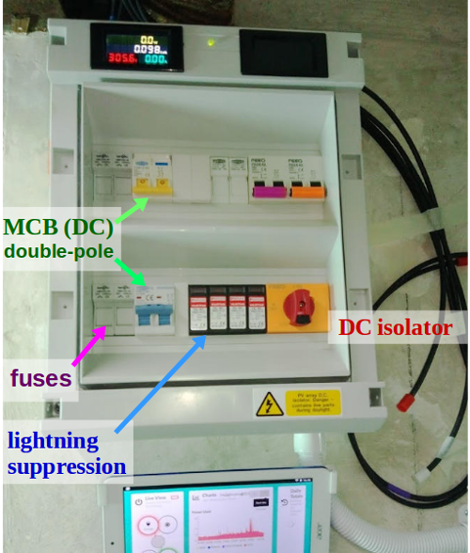
If anyone thinks their SPD might blow short-circuit, and that this will somehow not 'take out' the Service Fuse, then you're probably buying the wrong SPD.
It's an insurance device, and you should feel confident to trust it.
This post was modified 5 days ago by Transparent
Save energy... recycle electrons!
1

27/02/2026 10:28 pm
Your argument makes absolute sense to me. As the latest edition of cu made SPDs mandatory for more sites, it is odd that it did not clarify the way SPD needs to be deployed 🤔
8kW Solis S6-EH1P8K-L-PLUS hybrid inverter; G99: 8kw export; 16kWh Seplos Fogstar battery; Ohme Home Pro EV charger; 100Amp head, HA lab on mini PC
28/02/2026 10:39 am
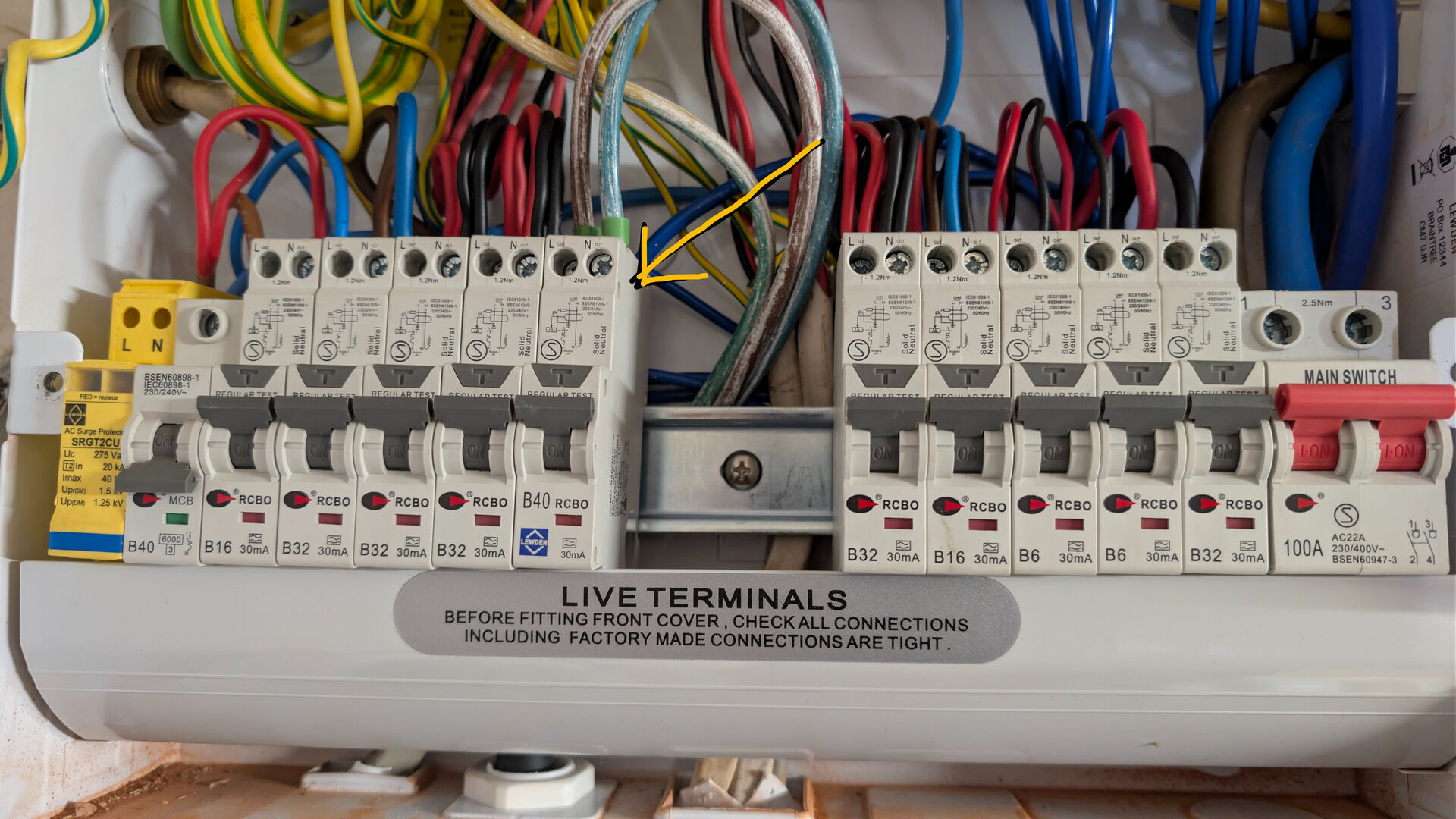
I know this is off topic but I did take the cover off my CU to look at the spd. BUT found the Electrician had not fitted a bi-directional RCBO to the inverter. I have asked for an explanation. note the surge MCB is off, I may have touched it off with the cover, It's on now.
!
This post was modified 4 days ago by Jancold
Daikin 6Kw ASHP.
MG4 EV, Solis 8KW inverter, 32KWh battery
1926 Semi with loft and wall cavity insulation, all radiator.
28/02/2026 11:50 am
Well spotted @jancold - It depends when that RCBO was installed of course.
The Amendment to the 18th Edition of the IET Wiring Regulations isn't retrospective, but I would hope that news spreads to other homeowners, allowing them to voluntarily get their RCBOs changed to bi-directional devices.
This post was modified 3 days ago by Transparent
Save energy... recycle electrons!
1
28/02/2026 12:58 pm
Well spotted @jancold - It depends when that RCBO was installed of course.
The Amendment to the 18th Edition of the IET Wiring Regulations isn't retrospective, but I would hope that news spreads to other homeowners, allowing them to voluntarily get their RCBOs changed to bi-directional devices.
From a compliance perspective, yes it would depend on the time amongst other things.
But if that circuit to the inverter needs to have differential protection, we know that it has been put at risk, @jancold so there is a potential shortcoming and safety issue.
RCBO are expected to be tested (monthly I believe) by pressing the test button.
This post was modified 4 days ago by Batpred
8kW Solis S6-EH1P8K-L-PLUS hybrid inverter; G99: 8kw export; 16kWh Seplos Fogstar battery; Ohme Home Pro EV charger; 100Amp head, HA lab on mini PC
28/02/2026 2:53 pm
@transparent It was fitted just before Christmas 25! So not good.
Daikin 6Kw ASHP.
MG4 EV, Solis 8KW inverter, 32KWh battery
1926 Semi with loft and wall cavity insulation, all radiator.
28/02/2026 3:16 pm
O-oh!
Let's take this as an opportunity to 'pass the word' about bi-directional RCBOs onward to the professional electrician community!
Save energy... recycle electrons!
Page 3 / 3
Prev

Latest Posts
-

RE: Daikin Altherma 3 LT compressor longevity question
This mess is intriguing: I wonder if this represent...
By bobflux , 14 minutes ago
-
RE: Say hello and introduce yourself
Hi. I'm Mike. Thank you for letting me join. My partn...
By Fretless6 , 2 hours ago
-
RE: Connecting Growatt SPH5000 over wired ethernet rather than wireless
The simplest wired option is usually the Growatt Ethern...
By Jonatan , 4 hours ago
-
RE: Peak Energy Products V therm 16kW unit heat pump not reaching flow temperature
ASHPs do have a minimum compressor speed. The minimum h...
By bobflux , 11 hours ago
-
RE: Electricity price predictions
@jamespa And it seems some of the nasty public cloud...
By Batpred , 11 hours ago
-
RE: Tell us about your Solar (PV) setup
Location: near Lyon, France 12kWp on the roof, 2x Sol...
By bobflux , 12 hours ago
-
RE: Jokes and fun posts about heat pumps and renewables
Technology is rapidly advancing. BBC News reported th...
By Transparent , 15 hours ago
-
What matters for flow and pressure drop is internal dia...
By bobflux , 15 hours ago
-

RE: Do Fridges and Freezers have COP ratings?
@editor Thank you all for your replies and submitted in...
By Toodles , 18 hours ago
-
I know and yes. The secondary deltaT wont necessaril...
By JamesPa , 22 hours ago
-
RE: Designing heating system with air to water heat pump in France, near Lyon
Just love the way you put it! 🤣
By Batpred , 2 days ago
-
RE: Safety update; RCBOs supplying inverters or storage batteries
Thank you for sharing. So it seems that your Schneid...
By Batpred , 2 days ago
-

RE: Forum updates, announcements & issues
@upnorthandpersonal thanks for the thoughtful, consider...
By Mars , 2 days ago
-
RE: Solar Power Output – Let’s Compare Generation Figures
@mk4 All 21 panels have their own Enphase IQ7a microinv...
By Toodles , 2 days ago
-
RE: Setback savings - fact or fiction?
Great, so you have proven that MELCloud is consistently...
By RobS , 3 days ago
-
RE: Mitsu PUHZ120Y 'Outdoor Temp 'error?
Thanks David & James It almos...
By DavidAlgarve , 3 days ago
-
RE: Surge protection devices SPDs
@trebor12345 - your original Topic about the right type...
By Transparent , 3 days ago
-
RE: Help needed with Samsung AE120RXYDEG
@tomf I’ve been sent this from a service engineer at Sa...
By Mars , 3 days ago
-
RE: Buying large amp bidirectional RCD and RCBO
Yes... I went through this particular headache and ende...
By bobflux , 4 days ago
-
O-oh! Let's take this as an opportunity to 'pass the ...
By Transparent , 4 days ago
-
RE: Homely setup on daikin heat pump
@craigh I refer to our somewhat elevated temperature of...
By Toodles , 4 days ago
-
RE: Air source heat pump roll call – what heat pump brand and model do you have?
My turn, this describes the future installation, only t...
By bobflux , 4 days ago