

Notifications
Clear all
Joining the Renewable Heating Hub forums is completely free and only takes a minute. By registering you’ll be able to ask questions, join discussions, follow topics you’re interested in, bookmark useful threads and receive notifications when someone replies. Non-registered members also do not have access to our AI features. When choosing your username, please note that it cannot be changed later, so we recommend avoiding brand or product names. Before registering, please take a moment to read the Forum Rules & Terms of Use so we can keep the community helpful, respectful and informative for everyone. Thanks for joining!

Topic starter
16/01/2025 9:27 pm
There's been a bit of discussion e.g. here and here, and very recently here originally, I think, introduced by @transparent about expecting high starting currents on heat pumps as pressures build up to operating pressure.
The interest on the forum in HP starting current particularly relates to correctly sizing an inverter if the HP is running off backup battery storage (though for a grid-tied inverter supplying the HP/house in parallel with grid power, any current beyond the capacity of an inverter is then supplied by the grid)
Looking at the manual for our NIBE F2040 HP, it has a specified maximum operating current of 23A (5.5kW) and a starting current of 5A. So it looks like high starting currents may be characteristic of some HPs but not others.
Out of interest, I took 1-second readings from a current clamp on our HP starting up today, and it does appear to be a well-controlled rise:
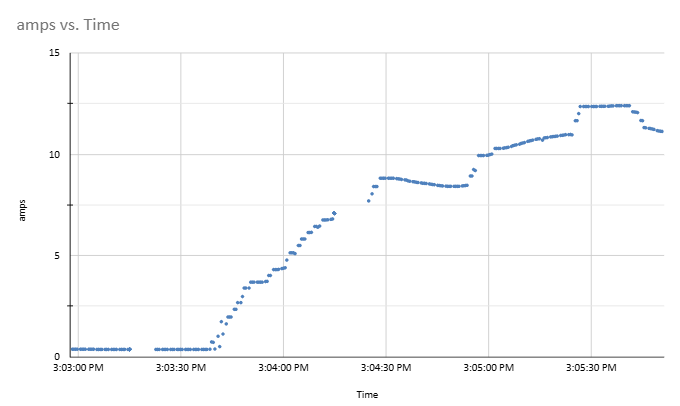
this corresponds with this pressure and flow temperature rise:
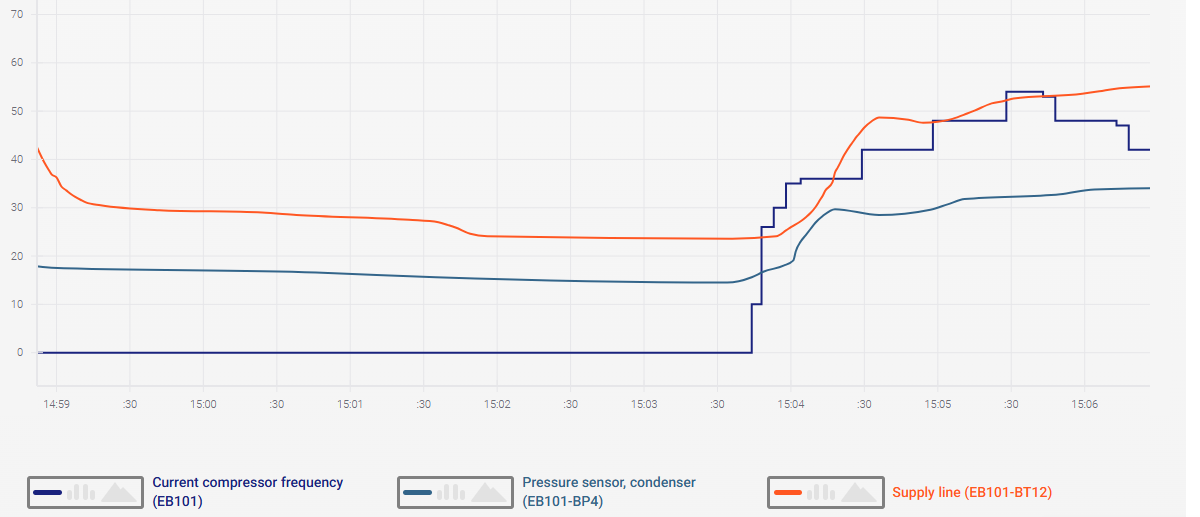
In our discussions over @ivanhoew 's system (Harnitek 12 kw ashp), graphs of operating current are at a useful sample rate (2 per minute) there does not seem to be any sign of turn-on surges, so I'm wondering if I'm either looking at the wrong thing, or there can be very different behaviour between heat pumps, which will need to be understood when considering maximum current handling, particularly for inverters.
Interested to hear what others experience and understanding is ..
End 1980's terrace in Southern England
NIBE 12kW air source heat pump
2 solar water panels
1 x Ohme ePod
1 x VW ID Buzz

17/01/2025 6:56 am
Here’s mine ..
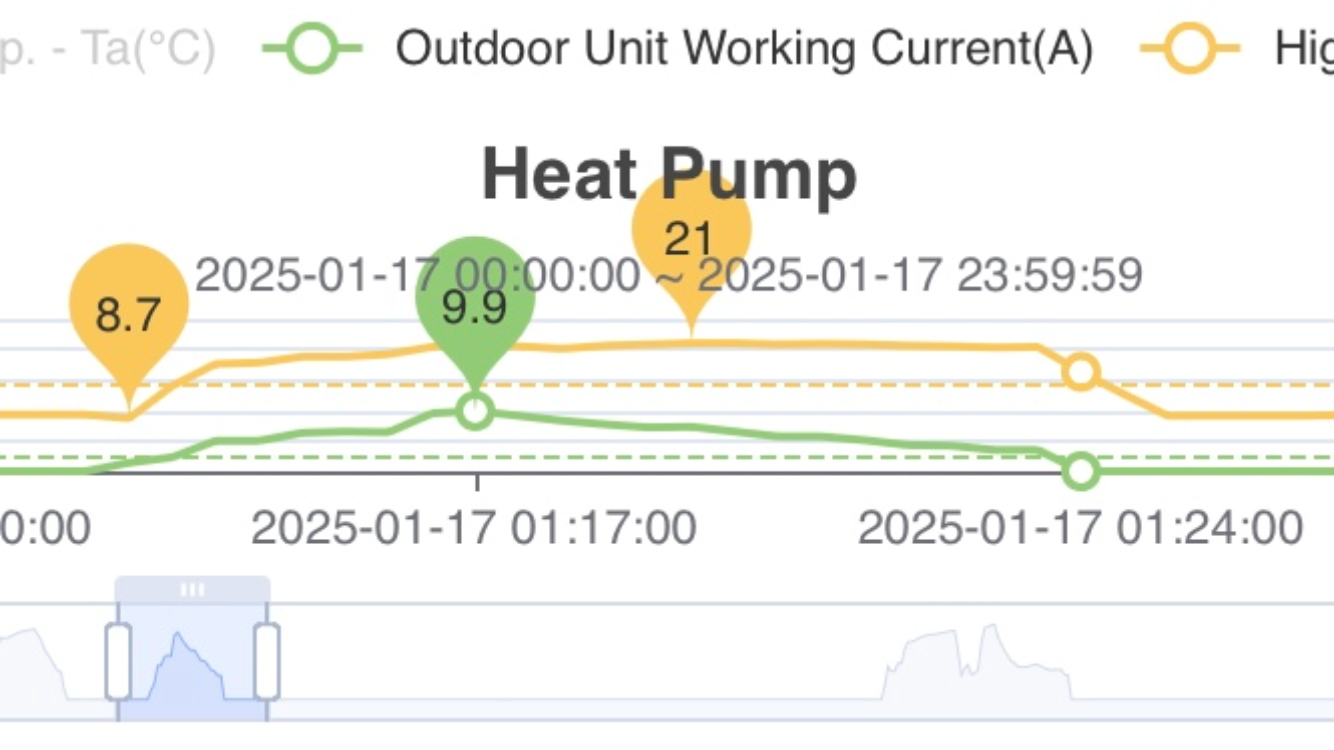
That’s the high pressure line over the amps line.
regards
robert
17/01/2025 8:46 am
Here is the last 24 hours for my heat pump with amps added to the plot. Note that I do not have solar or batteries or inverters, just mains electricity:
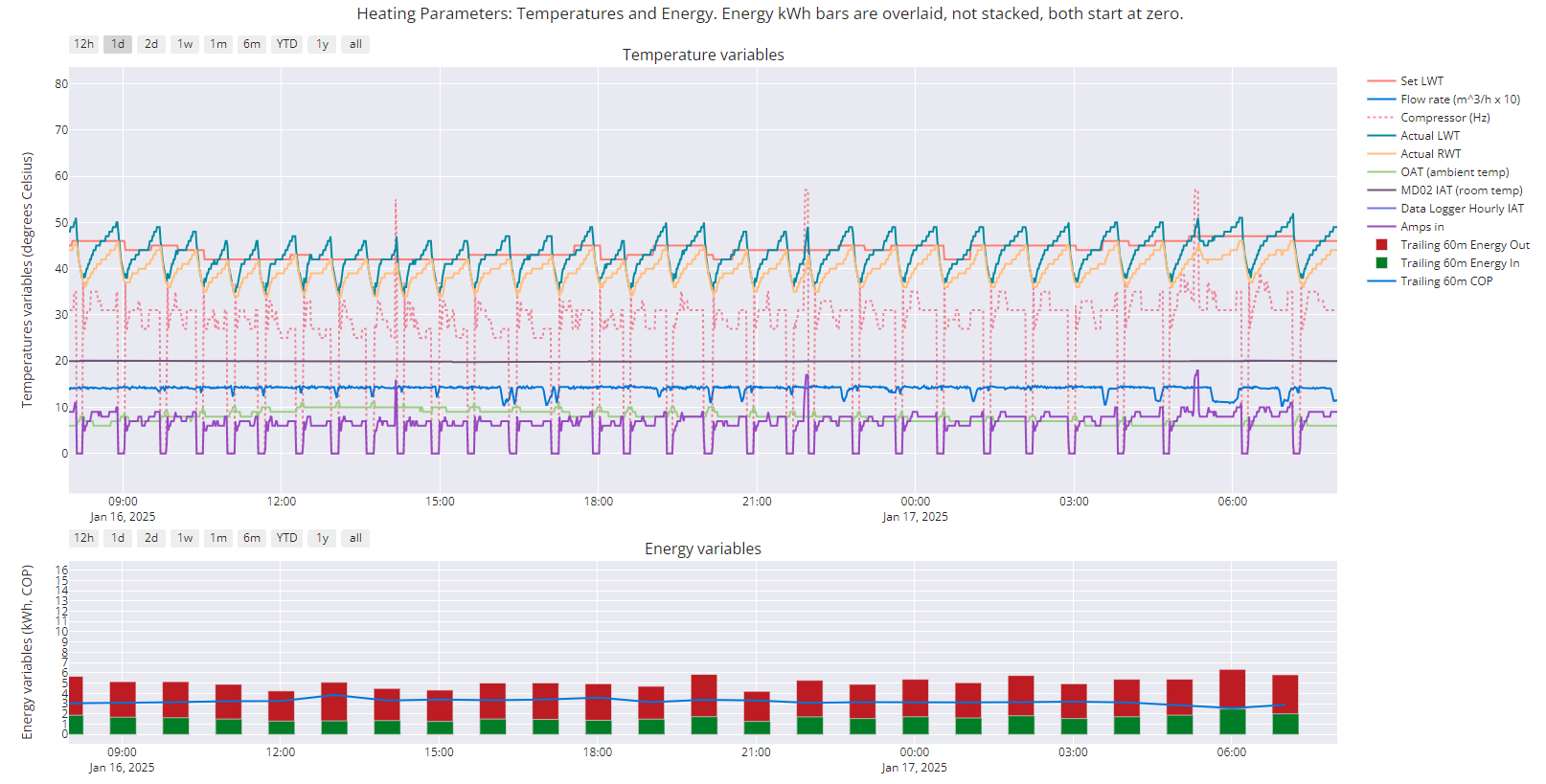
But the steepness is very dependent on zoom level. I can flatten the apparent gradient by zooming in to an hour (either side of the bigger spike just before 2200). The actual gradient is of course the same, but it looks far less:
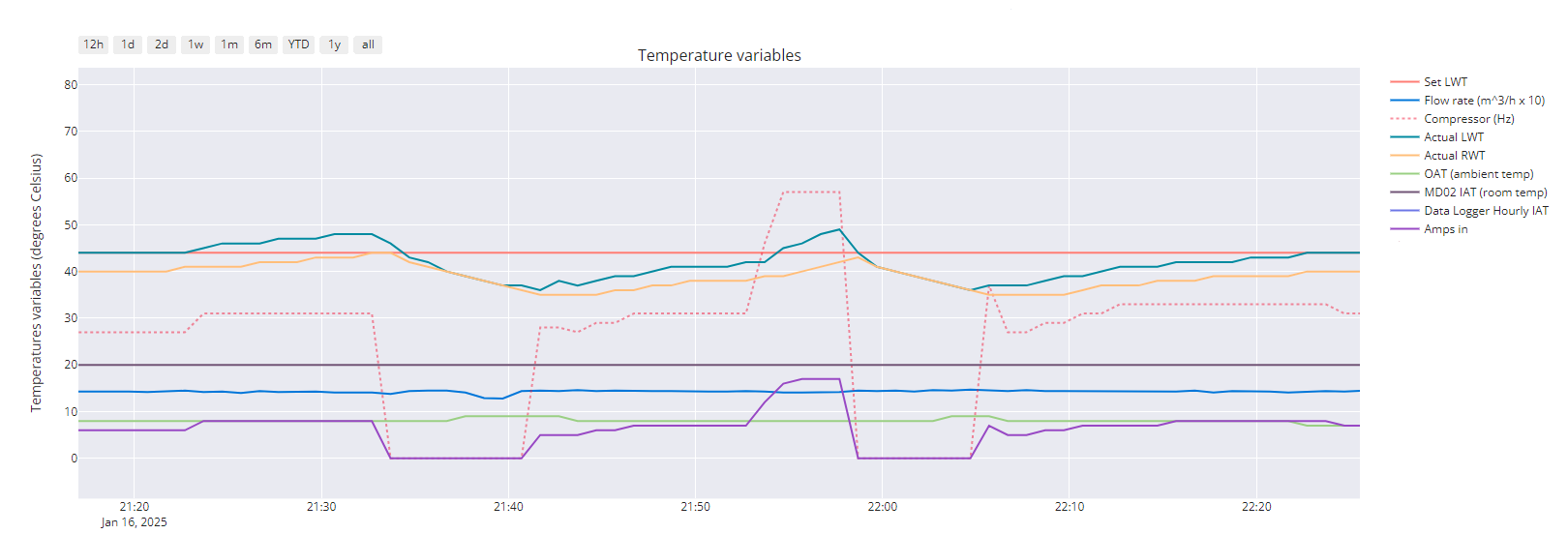
Amps look OK, what is more interesting to me is why, after running in steady state at the start of the hour, it suddenly starts cycling for no obvious reason.
Here's the 11th Jan with -4 degrees OAT in the early hours:
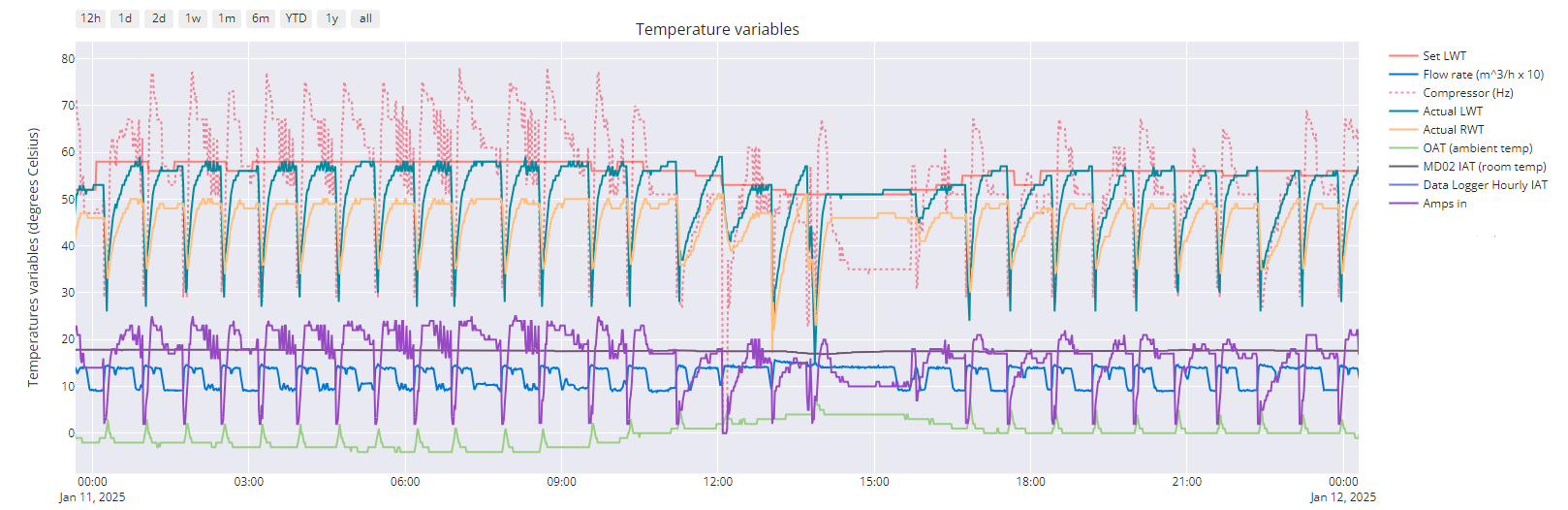
Looks rather alarming, however if I zoom in to one of the worst hours:
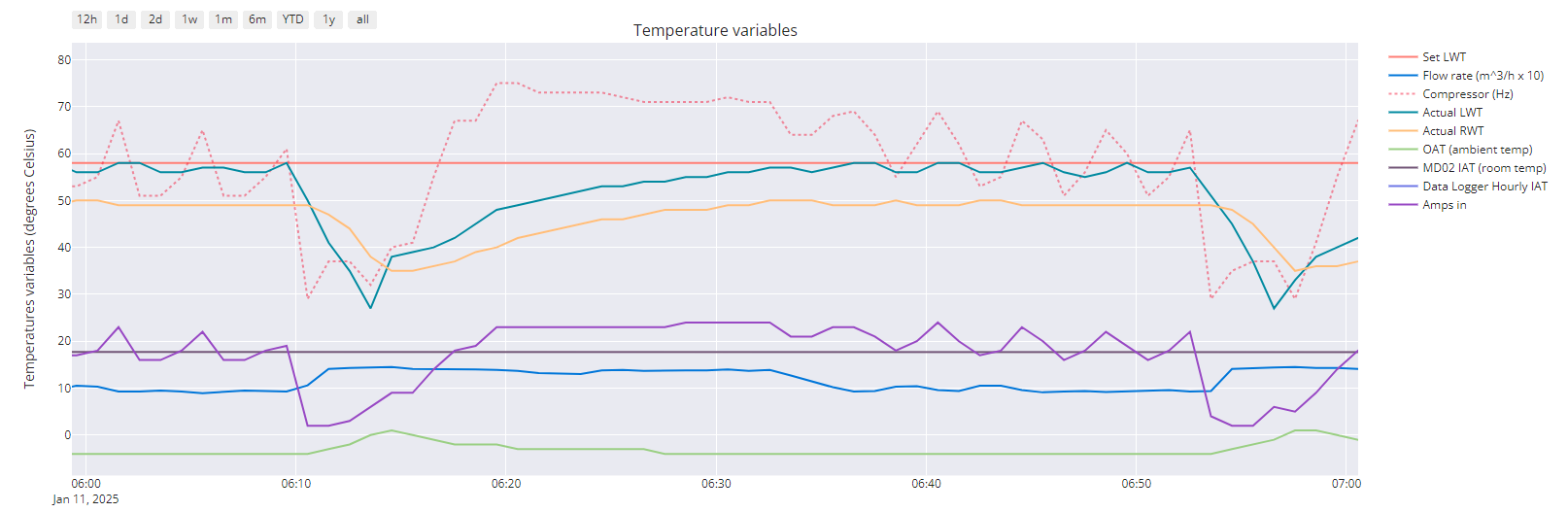
Again, the amps, though high (max 23-24 amps, but it was very cold, COP was terrible, and it needs those amps to get sufficient output), aren't spikey. The cycle starting at 0610 is a defrost cycle, and it interesting to see how long it affects output: 20 minutes. Not so good.
There is absolutely no doubt in my mind that defrost cycles are a major problem. Others have asked the question before, but I don't think I've ever seen an answer: how do our friends in Europe with colder climates deal with this? Have they found a fix, or do they just put up with it?
Midea 14kW (for now...) ASHP heating both building and DHW
17/01/2025 9:13 am
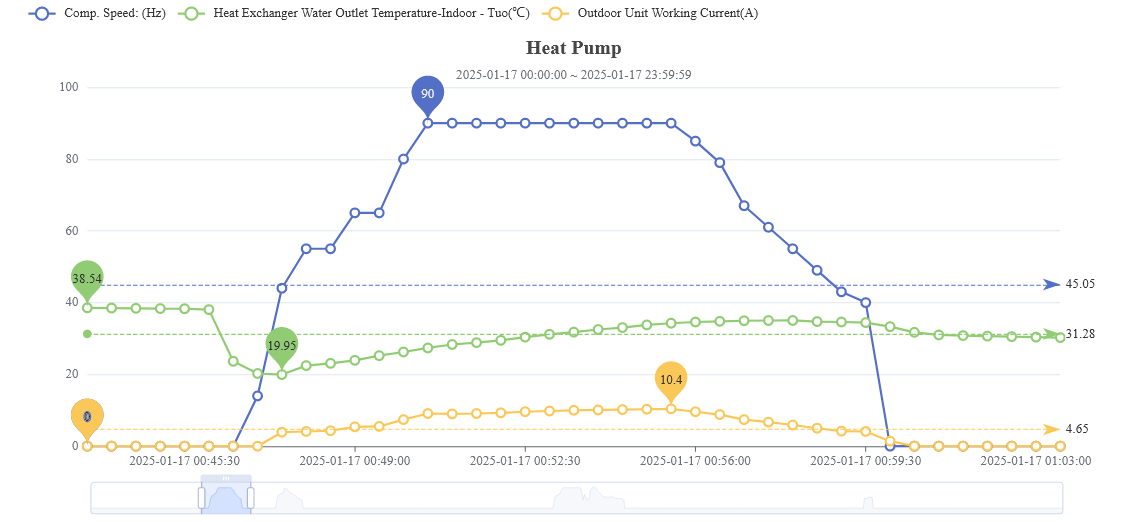
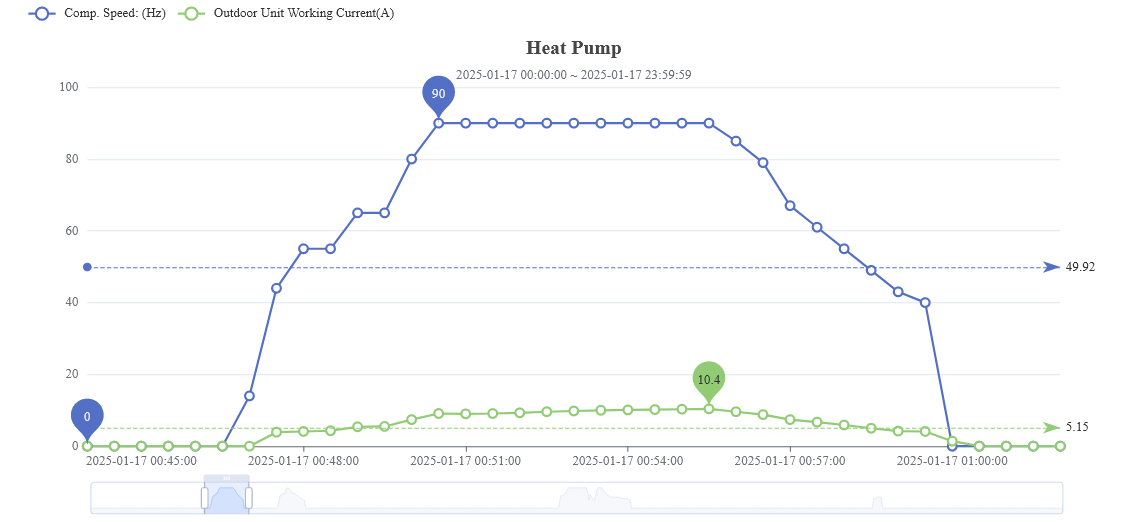
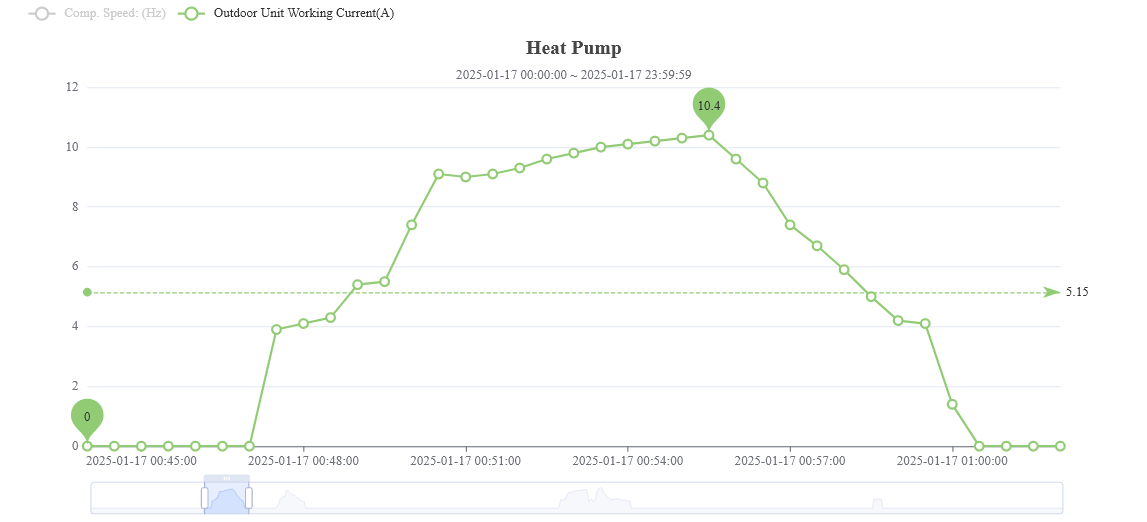
some better resolution graphs for you S gatorator 🙂


17/01/2025 9:43 am
If your talking about inrush current I suspect non of our monitoring systems are capable of capturing the resolution needed for that?
“Anything worth doing, is worth doing right.”
17/01/2025 10:20 am
If your talking about inrush current I suspect non of our monitoring systems are capable of capturing the resolution needed for that?
That is indeed possible, but if there is an inrush it must be very short (and so does it really matter?). I sample every minute, @ivanhoew samples every 30 seconds, and @s_gatorator every second. Also it is surprising that a sample never happens during an inrush (if they do occur, but we always miss them).
What we appear to have here is three different makes of heat pumps, none of which show start up surges in current. I'm not sure that is that surprising, isn't that what modern inverter driven pumps are supposed to do?
Midea 14kW (for now...) ASHP heating both building and DHW
17/01/2025 10:38 am
That is indeed possible, but if there is an inrush it must be very short (and so does it really matter?)
Just because it is short doesn't mean it doesn't matter!
Running on mains it probably doesn't matter, but if your running on an inverter supplied by a battery only maybe it would?
I'm not knowledgeable enough to know either way, I'm just aware we might not be seeing the whole picture.
If these modern heatpump motors don't have any inrush then great 😀 it doesn't matter.
“Anything worth doing, is worth doing right.”
17/01/2025 10:57 am
I'm not knowledgeable enough to know either way, I'm just aware we might not be seeing the whole picture.
I agree, always be sceptical, always question whether what you think you see is what is actually going on. I think another pertinent question here is how exactly does an inrush current do harm? I can see that sustained overloads might do harm, but a short inrush? Isn't that what happens every time internal combustion car starts its engine using a battery?
Edit @transparent may have something to add here.
Midea 14kW (for now...) ASHP heating both building and DHW

17/01/2025 11:37 am
I do try and question everything and have learn't a lot from forums like this by doing that, however I often don't have the knowledge to ask or know to ask the right questions.
A Cars battery is designed for starting a a cars engine, it has a CCA rating in the hundreds of Amps and so can provide that very high current for a short periods.
I believe if your system what ever it is is not capable of providing the current being drawn even for a very short period the consequence is the voltage drops and this can effect if devices start-up cleanly or can negatively effect electrically sensitive devices that are already running.
A quick bit of googling does seem to suggest that modern ASHP have soft starts and so don't have large inrush currents but that is generic info not specific to any makes and models.
“Anything worth doing, is worth doing right.”
17/01/2025 12:28 pm
I do try and question everything and have learn't a lot from forums like this by doing that, however I often don't have the knowledge to ask or know to ask the right questions.
Someone after my own heart. We do try to stick to the 'there is no such thing as a stupid question, the stupid thing is not to ask' way of doing things here.
I agree car batteries have high CCA ratings and so are suited to their tasks. What I am hoping is that @transparent (the source of much light on these matters) can tell us a bit more about the actual damage that occurs from high start up currents. Is there a scrapyard somewhere full of dead ASHPs killed off by high start up currents? Or is it more of a theoretical risk (like for example Legionella)?
I agree most modern heat pumps advertise themselves as being soft start devices. But, as you say, there may be exceptions (and we can be pretty sure they won't advertise the fact!).
Midea 14kW (for now...) ASHP heating both building and DHW

17/01/2025 12:45 pm
What I am hoping is that @transparent (the source of much light on these matters) can tell us a bit more about the actual damage that occurs from high start up currents. Is there a scrapyard somewhere full of dead ASHPs killed off by high start up currents?
🤣
No.
I'm raising the issue due to the problems it creates for the grid...
or for ensuring that an inverter can deliver a sufficiently high current to allow a heat-pump to start.
There's no 'damage' caused to the heat-pump.
It will quite happily take whatever current it needs.
From the viewpoint of the grid, the major headache for DNOs is a demand-surge that occurs when
- they re-energise a sub-station following an outage
- ASHPs in a locality all experience freezing fog and switch on their defrost cycle
How do I know that?
- because a senior DNO engineer told me
- because I can see the switch-on surges when I look at sub-station current data
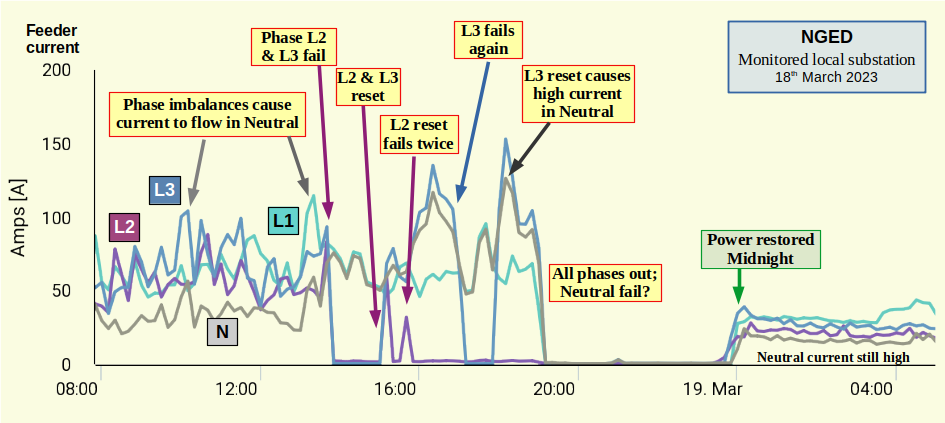
That graph shows averaged data.
The actual switch-on surge is much higher than shown here.
Save energy... recycle electrons!
Topic starter
17/01/2025 9:26 pm
Again, the amps, though high (max 23-24 amps, but it was very cold, COP was terrible, and it needs those amps to get sufficient output), aren't spikey. The cycle starting at 0610 is a defrost cycle, and it interesting to see how long it affects output: 20 minutes. Not so good.
There is absolutely no doubt in my mind that defrost cycles are a major problem. Others have asked the question before, but I don't think I've ever seen an answer: how do our friends in Europe with colder climates deal with this? Have they found a fix, or do they just put up with it?
Hi @cathodeRay , aren't all of the cycles in your chart defrost cycles? The clue I'm seeing is in the OAT graph, which has a small spike just after the compressor stops, presumably due to your outside temperature sensor being near the external unit and it getting some heat from the warm air at the end of the defrost cycle when the fan restarts. I have the same think on ours.
If the temperatures are lower, as in Europe, the moisture freezes out of the air and it looks like frosting does not occur below -7C or above 5C (quick internet search). Otherwise, here, I agree, it's a problem.
End 1980's terrace in Southern England
NIBE 12kW air source heat pump
2 solar water panels
1 x Ohme ePod
1 x VW ID Buzz
1
Page 1 / 4
Next
SPONSORS

Degrees of Separation
Latest Posts
-

RE: Tradespeople on Their Phones: What’s Acceptable When They’re Working in Your Home?
I know most of the folks I use pretty well so I'm fairl...
By EtchedPixels , 3 minutes ago
-
RE: The Changing Jet Stream Could Challenge UK Air Source Heat Pumps
@susannasaunders I'll set this up and start monito...
By Rob of York , 39 minutes ago
-
RE: Electrical works for air to air heat pump
An electrician who signs off work is responsible for it...
By EtchedPixels , 6 hours ago
-
RE: Are there any comparisons of DHW heat stores around?
@sarahemmm I have done things the opposite way round I ...
By Toodles , 6 hours ago
-
RE: 15kw pump for 225m2 1990's house - over kill?
@seaviews I have read you latest response re buffer ...
By JamesPa , 1 day ago
-
RE: How will removing the standing charge on gas bills benefit heat pumps?
The BUS grant funding for 2026/27 will run out at the c...
By Rob of York , 2 days ago
-
-
@editor Ouch, sorry to re start the tick. I had assume...
By DavidB , 3 days ago
-
RE: Say hello and introduce yourself
@e-a-west as the good Major said, welcome to the forums...
By Mars , 3 days ago
-
RE: How much of your renewable and home setup would still work if the internet went down?
Yes I actually have a copy of a tool that whenever a ce...
By EtchedPixels , 4 days ago
-
RE: Indevolt Batteries UK Support & Info Thread
@editor Hi, To resolve this, please tap on the A...
By Indevolt Tech , 4 days ago
-
RE: Double or Triple Glazed Windows?
Posted by: @singlespeed With 9 years repairing windo...
By Rob of York , 4 days ago
-
@transparent we’re still running a secure version of PH...
By Mars , 5 days ago
-
RE: How quickly would you want/expect heat recovery to take from setback?
Much longer than that here. The heating isn't even on. ...
By bobflux , 5 days ago





SPONSORS

