

Notifications
Clear all
Joining the Renewable Heating Hub forums is completely free and only takes a minute. By registering you’ll be able to ask questions, join discussions, follow topics you’re interested in, bookmark useful threads and receive notifications when someone replies. Non-registered members also do not have access to our AI features. When choosing your username, please note that it cannot be changed later, so we recommend avoiding brand or product names. Before registering, please take a moment to read the Forum Rules & Terms of Use so we can keep the community helpful, respectful and informative for everyone. Thanks for joining!
Air Source Heat Pumps (ASHPs)
212
Posts
31
Users
75
Reactions
84.5 K
Views

Topic starter
03/06/2023 8:14 am
I'm about to have a 17kW Grant Aerona installed to run underfloor heating plus some upstairs bedroom radiators in a new build house.
I've read hear that the controller is (or can be) the thermostat for the system but when I spoke to the installer I was told that it wasn't.
It looks like there are going to be multiple room thermostats in the setup and I'm feeling a bit confused about what is right
Csn anyone with a Grant clarify for me?

04/06/2023 1:26 pm
On most installations the Grant controller is just used to configure the system and external controls are fitted to demand heating and hot water.
This is the way that Grant want things and the installers fall in line because then they are then fairly simple to throw in as a replacement for a boiler and everyone likes the smart thermostats nowadays with the obligatory app.
The system is actually made by Chofu and while the controller is a little bit clunky it can handle both the heating and hot water demand and more (it can do cooling but Grant won't tell you that!).
I have the 17kW Grant model wired in with a Google Nest (as it was installed), I had it timed to heat to a certain temperature at different times of the day as that was what the installers said to do. It was very power hungry even in late spring/summer.
Very quickly I learned to enable weather compensation and after reading comments from a lady on here (maybe twitter), where she advised to bypass the Nest altogether, I just turned up the temperature demand on the Nest to a value the house would never reach thus the Grant was constantly in demand for heat (unless it was doing a hot water run).
This dropped the electricity usage dramatically and I started to get longer heating runs from the Grant rather than it stop/starting multiple times an hour.
As for the multiple room thermostats, this very much depends on your circumstances. Personally I use weather compensation and run the heat pump 24/7 (by always calling for demand from the Nest). I have removed every TRV head from the upstairs radiators and the ground floor radiators are all on max - I want as open a circuit as possible to allow water to flow everywhere and heat to dissipate. I trust the weather compensation to put enough heat into the house as what is leaking out the house to keep the house constantly warm during the heating season.
If radiators start to close then the amount of water in the circuit for use effectively reduces, making the heat pump work less efficiently.
I used to have Honeywell Evohome and have every room a separate zone, either great on a gas combi but I wouldn't do this with a heat pump.
Just my opinion!
1
Topic starter
05/06/2023 12:57 pm
Thanks aceshigh,
That sounds like a reasonable way to go. If my system has actuators rather than TRVs I'm not sure if I can crank up the room stats and get the same end result?

09/06/2023 2:57 pm
My Grant system was installed 6 years ago (I'm now in the last year of the RHI payments). We have UFH on both ground and first floors and separate room thermostats in each room.
The Grant remote controller has a timer function built-in but its only accessible via the service engineer menu, not the parts of the menu to which the customer is supposedly restricted (the engineers menu is easy to access). Our installation also has a separate Honeywell timer (like you find on many gas boiler systems) and it's this that controls the UFH and HW (why a separate timer I don't know). This is set so that only the water or the heating is on at any one time. But when the heating is off the room thermostats are also off so they never show the correct time. The system is on weather compensation so the room thermostats are somewhat superfluous (why install them?). They are actually set to 20 deg downstairs and only 16 deg upstairs. The house is quite open plan and in practice I've found that upstairs generally settles to a higher temperature anyway so they do very little.
I'm sure the system was not installed (by an MCS registered firm - but we know that is a low bar))optimally (ASHP uses crazy amounts of electricity as the outside temperature drops to Zero and below). But I've given up spending money on heating engineers who should know what they are doing and never achieve any improvement. I'll live with it as is until it's time to replace the ASHP. The ASHP is not separately metered but allowing for other background use (calculated by switching the ASHP off completely for a few days while away) of about 8kWh per day (fridges, freezers and Klargester), usage for UFH and HW over the year is about 7,000 kWh, or 46kWh /sqm/year. I've no idea if this is good, bad or indifferent as I have nothing to compare it with. But comparing this year to date (I take daily electricity readings), with last year it is operating at pretty much the same level. This is a vast improvement over 2021 when we had a problem, now fixed, and used 12,000 kWh or about 80 kWh /sqm/year.
Outside air temperature is the dominant variable affecting usage. Short but very cold (-6 deg) spells in January and last December sent usage off the scale. If we avoid a repeat this December, usage will be below last year. June, July and August combined use less electricity than either January or December. This winter, if it gets very cold, I'm going to try an experiment and switch the WH off but use the immersion heater instead to see if this is in fact more economical than the ASHP.
Mike
Grant Aerona HPID10 10kWh ASHP


12/06/2023 1:26 pm
@dodgyknee - yes, Grant controller is a CH and HW thermostat. Not a very user friendly one, and very complicated to work. It's capable, with features such as quiet mode and economy, etc. Grant fit separate Central Heating and Hot Water thermostat controls on their systems, essentially over-riding the Chofu controller. NEST and HIVE and other digital on/off so-called smart thermostats are not good at controlling ASHPs. They will cycle the ASHP on and off far too often, because they have an on/off switching differential [hysteresis] as low as 0.1degC. This gets very power hungry and adds to wear and tear of the ASHP over time. There's easy ways to avoid that with Grant:
* Use a smart thermostat simply as a heating system on/off switch. It pairs with an app, so you're able to quickly turn the system on and off if away from the property. Set the thermostat high, 24 or 25degC, so it calls for heat all the time the heating is set to be on. Set the heating to be on all day from early morning, to bedtime. You can run it 24/7, but most people prefer to knock it off at night, for a slightly cooler night time, and doing this for 6-7hrs a day is generally more economical. The first two hours or so of pre-heat early morning are power hungry, but you still consume less electricity.
* Use TRVs, either thermostat or smart ones, as room overheat limiters. Set them one number higher than you want the room, simply to avoid the room getting too hot. Smart TEVs are good, as you can use your app to knock off heating to spare rooms, or set it back, but generally, for ASHP, you want flow to most rads most of the time. Turn too many rads off and the system volume can get rather low, and there may not be enough heat emitter capacity to meet your temperature requirements.
* Enable weather compensation, and learn how to set and adjust it at the Chofu controller. The default settings in the Chofu are a good start point. Try them for a week or two then tweak as you need. The lower the max system leaving water temperature [LWT] the better. You really don't want the system design max LWT above 45degC, else at current energy prices your ASHP will likely cost you more to run than an equivalent gas condensing boiler. (If you're still at the design stage, get your designer to offer as low a design LWT as possible, ideally 40degC or less. Big rads upstairs if you have UFH downstairs and wet rads upstairs)
* Hot water cylinder charge. Once a day in the middle of the day, to benefit from a maximum daytime outdoor temperature and to minimise impact on space heating. Default mindset is to do this in the early hours before you wake up, but from an ASHP perspective, that's the least efficient time, as the outdoor temperature, from which the ASHP harvests heat, is lowest. 50degC is a plentiful water storage temperature, adequate for home needs, boosted once a week to 60degC+ for anti-Legionella.
@aceshigh - my experience exactly with my Grant install. As left 'commissioned' by Grant, the weather compensation was not enabled, system design flow temperature set to 50degC, the heating was on for two short periods a day, like a gas boiler, and it was cycling on/off on the room thermostat costing a small fortune. System design max LWT now 45degC which is plenty, WC enabled, heating on from 5am-9pm every day, and it all works very efficiently. I love having the house heated all day every day, I would never have done that with the old oil boiler.
2
Topic starter
12/06/2023 4:14 pm
Thanks for the info, that's very useful. I did request that the controller wasn't placed in the plant room but, if the addition of thermostats disables the controller's own temperature measurements, then maybe that wasn't an issue after all.
I think I'm going to have many hours of tinkering to get it right.

16/10/2023 12:58 pm
On most installations the Grant controller is just used to configure the system and external controls are fitted to demand heating and hot water.
This is the way that Grant want things and the installers fall in line because then they are then fairly simple to throw in as a replacement for a boiler and everyone likes the smart thermostats nowadays with the obligatory app.
The system is actually made by Chofu and while the controller is a little bit clunky it can handle both the heating and hot water demand and more (it can do cooling but Grant won't tell you that!).
I have the 17kW Grant model wired in with a Google Nest (as it was installed), I had it timed to heat to a certain temperature at different times of the day as that was what the installers said to do. It was very power hungry even in late spring/summer.
Very quickly I learned to enable weather compensation and after reading comments from a lady on here (maybe twitter), where she advised to bypass the Nest altogether, I just turned up the temperature demand on the Nest to a value the house would never reach thus the Grant was constantly in demand for heat (unless it was doing a hot water run).
This dropped the electricity usage dramatically and I started to get longer heating runs from the Grant rather than it stop/starting multiple times an hour.
As for the multiple room thermostats, this very much depends on your circumstances. Personally I use weather compensation and run the heat pump 24/7 (by always calling for demand from the Nest). I have removed every TRV head from the upstairs radiators and the ground floor radiators are all on max - I want as open a circuit as possible to allow water to flow everywhere and heat to dissipate. I trust the weather compensation to put enough heat into the house as what is leaking out the house to keep the house constantly warm during the heating season.
If radiators start to close then the amount of water in the circuit for use effectively reduces, making the heat pump work less efficiently.
I used to have Honeywell Evohome and have every room a separate zone, either great on a gas combi but I wouldn't do this with a heat pump.
Just my opinion!
16/10/2023 1:23 pm
I was interested to see your thorough response, I have been a Grant ASHP owner for a year now.
As we go into another winter,the problems I had last year have still to be resolved.
For a few days last year we had temps of >-11degs,the compressor coils were frozen and it seemed to always take an age for the defrost to function.And of course the CH lost efficiency.
I would be very interested to know how to enable the weather compensation mode, this could be the solution to my problem. I was thinking that the temp bulb at the rear of the ASHP was faulty.
Owning an ASHP is a bigger learning curve than I thought. Any advice appreciated . Cheers

16/10/2023 4:20 pm
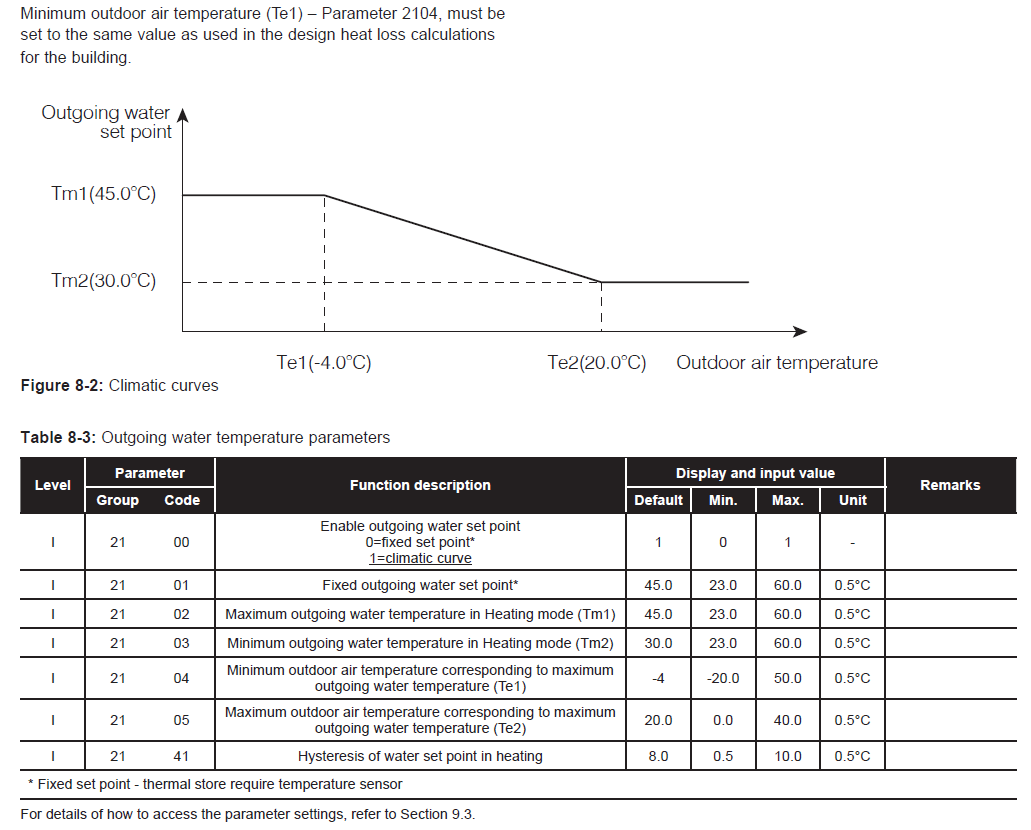
@daveb Hi Dave, weather compensation is a must - and Grant should be enabling it on every MCS install. There's evidence from multiple Grant ASHP users this isn't the case. Here's the Grant installer literature for the Aerona3 ASHP, which you can easily download.
It's a reduced version of Chofu's own manual, without the sections on cooling as that's not used in the UK, and so it is rather disjointed and awkward to follow as a result. The settings below in section 8.2.2 are what you need to check and adjust. There's only 5 4-digit parameters required to check.
You need to access INSTALLER LEVEL on the controller to set up weather compensation. Press and hold the 3 buttons highlighted below for 3 seconds:
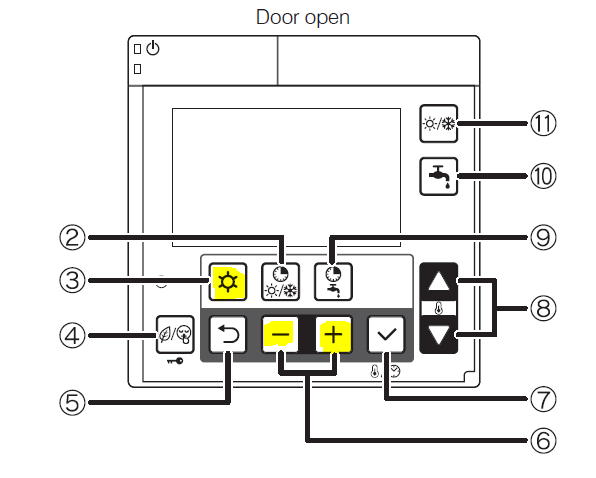
Then you'll see the screen clear and: 'INST ----' appear. You're now able to use the - and + buttons as left and right and up/down arrow buttons to enter a 4 digit parameter. First one 2100 (enter 21 on the left, use the + move to the right, enter 00) press the tick and you'll see either a 0 or 1 display. If weather compensation is off you'll see a 0. Use the up/down arrow keys to change the value to 1 and press tick again.
You need to set these parameters to enable weather compensation:
2100 to 1
2102 to your maximum outgoing water temperature, say, 45degC (the higher you set this, the more energy you'll use, every 1degC increase is about a 2.5% increase in electrical input power. You want it as low as possible)
2103 to the minimum outgoing water temperature, 30degC
2104 to the minimum outdoor air temperature corresponding to the maximum outgoing water temperature, I would use 0degC rather than the -4degC default.
2105 to the maximum outdoor ait temperature corresponding to the minimum* outgoing water temperature, 20degC (*typo in Grant literature, they state maximum, this is incorrect)
Once all is set, scroll through them all to double check, then press and hold the 3 highlighted buttons simultaneously again for 3 seconds to return you to the home screen. You can tweak the weather compensation to your heart's content. If you find the house overheats, lower the minimum outgoing water temperature. If you find it's not getting warm enough, raise the maximum outgoing temperature or the corresponding minimum outdoor ambient temperature at which this is delivered. It's a process of trial and error as every house & heating system responds differently.
1
16/10/2023 4:39 pm
For a few days last year we had temps of >-11degs,the compressor coils were frozen and it seemed to always take an age for the defrost to function. And of course the CH lost efficiency.
This is a common problem, and the Chofu/Grant ASHP unit seems to frost up very quickly. I have my thoughts why, and that's simply because it's not designed for the UK climate. We have quite mild but damp winters where there's high humidity at lower temperatures. The coil has be colder the the air passing through it to absorb heat, and that means the moisture vapour present in the air freezes. The fins are very fine - just a millimetre or so apart, you only need a little ice build up and soon the coil is blocked solid and needing to defrost. The very fine fins make for a very compact unit, and permitted development for ASHPs requires the outdoor box to be no bigger than 0.6m3 volume. A bigger coil with wider fin spacing would not freeze up as fast and require defrosting less often, but on Grant's larger units would probably mean non-compliance with the 0.6m3 'rule'.
Grant and Chofu are by no means alone with this problem, it's common to a lot of imported ASHPs. If you consider Norway, a country often seen as a renewable heating leader... It's colder in winter, maybe -10 or -15degC regularly (I work in Oslo periodically) but the air is drier. There's less moisture vapour, so even though it's colder, heat pump outdoor coils don't freeze up nearly as quickly. Defrost really impacts the unit performance, I've noticed that in my 1 year of ownership. The way the unit defrosts is also questionable, and that stems from the Chofu unit being designed as a heating and cooling unit for the Japanese market. I'll not bore you on that one! There are other ways to defrost ASHPs that would not be so detrimental to the heating performance in your house.
This winter, if we get really cold damp freezing fog weather, I'll probably switch the ASHP off and light the wood stove instead, and use a small oil filled rad in the office where I work. It's cheaper even though I have a variable time of use electricity tariff and battery storage to import and store cheap rate electricity. Put bluntly, the Grant Aerona unit doesn't really work effectively in freezing fog or very damp cold weather. On the plus side, we get very few days like that a year, and for the rest of the heating season, like now as I type this, it's heating the whole house to 21degC with 11degC outdoors and consuming 1kW 🙂
17/10/2023 9:47 am
Thanks so much for the info,good to know my problem is shared by others. 🙂 I'm thinking about introducing a heat source to the coil maybe.
17/10/2023 9:56 am
Thank you so much for all the info,i'll be on it as soon as possible.Cheers.
Page 1 / 18
Next

SPONSORS

Degrees of Separation

Latest Posts
-

RE: Heat pump branding. Clever, contemporary… or a bit too much?
I think Heat Geek have done an amazing job on their bra...
By Tomtheheatingengineer , 7 hours ago
-
RE: HeatGeek vs Octopus surveys: puzzling disparity - any ideas why?
I have just had 3 heat loss surveys, one by heat geek o...
By David , 7 hours ago
-
RE: Heat Geek Zero Disrupt: Are We Sleepwalking Into Another Race to the Bottom?
I think that's the key question. After all inverter uni...
By Prunus , 9 hours ago
-
RE: battery storage without solar
As of October 1st they need specific qualifications to ...
By EtchedPixels , 10 hours ago
-
RE: How should the Boiler Upgrade Scheme be reformed?
A unit which uses water to transfer the heat/chill from...
By Temperature_Gradient , 10 hours ago
-
RE: Renewables & Heat Pumps in the News
With regards to the BUS grant raid, I gave it more thou...
By ASHP-BOBBA , 10 hours ago
-
RE: Why are ASHP installs so expensive?
The whole system seems to work on the basis of...
By ian33a , 11 hours ago
-
RE: Missing flow temperature in Heat Geek proposal
Good plan. If you can get half hourly meter readings a...
By JamesPa , 16 hours ago
-
RE: Heat Pumps Without Grants: Would You Have Installed One & Will You Now?
@editor Most certainly. The heat pump was an ideal s...
By Abernyte , 16 hours ago
-
Although regulations may well vary from country to coun...
By Majordennisbloodnok , 17 hours ago
-
RE: Does anyone have experience of a smart water meter?
Yep I caught our slow leak from a £100 bill rise 8)
By EtchedPixels , 17 hours ago
-
RE: Do You Need a Buffer Tank or Low Loss Header for Underfloor Heating in a Large Property?
@jamespa in some cases, failing the Turing test might b...
By GrahamF , 20 hours ago
-
RE: Passiv Smart Thermostat - Help & Forum Support
@energystoragetech The heat capacity of some...
By JamesPa , 21 hours ago
-
RE: tepeo ZEB UK Support & Info Thread
Sorry you are correct, I was remembering figures from t...
By JamesPa , 1 day ago




SPONSORS
