
Notifications
Clear all

Topic starter
05/01/2026 10:29 am
This is a (maybe crazy) thought experiment more than anything, and would like to know if anyone has done this.
I already have 300mm (original 100mm fibreglass + 200mm rock wool) and boards in my loft, the roof is pitched tiles with felt underneath. I have a heated PIV blowing in from the loft and my DHW tank (4 years old) is up there as well as my ASHP plant (pipes lagged as much as possible), inverter and batteries.
I wonder whether it's worth adding kingspan boards underneath the felt and tiles to give a bit more insulation, the PIV heater wouldn't need to be on a much maybe and it wouldn't hurt everything else for heat retention.
Would I then need mechanical ventilation into the loft space from outside? What about in summer when it's really hot?
Mitsubishi Ecodan 8.5kW
4.4kW Solar PV
5.2 kWh Battery Storage
1983 build, 300mm loft insulation, cavity wall insulation (beads)

05/01/2026 11:16 am
As you have maximum floor insulation, there will be little heat coming into the loft area from below, and in summer there will be a large solar gain from the uninsulated roof.
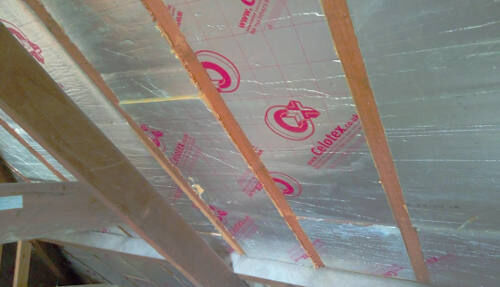
I decided to put Kingspan between my rafters on my pitch roof for following reasons.
I am an Engineer so tackled the problem using thermodynamics.
The pitch roof has a thermal transfer, or heat loss/gain value.
I measured my loft temperature, winter 4C, summer 40C.
The insulation has an R rating, this gives you the rate of thermal transfer. Having a loft at 4C and the room below at 20C, there will be a heat transfer pressure of 16C.
Insulation in the rafters will slow down the heat transfer loss/gain from the loft, and reduce the temperature swings, in my case the summer high was reduced dramatically but the winter low remained the same.
Thermodynamics are hard to comprehend but if you think about 3 rooms in line. Room 1 is heated to 20C, room 2 next door 19C, Room 3 (the loft) is 4C.
The thermal gradient between the rooms is 20/19 and 19/4.
with no insulation, ie an open door, both rooms attain similar temperatures, ignoring thermal gain from a south facing window, with the door closed, the heat required in room 1 will be less. If room 2 is now a cold draughty loft, room 1 will transfer heat faster into room 2.
you said your DHW is in the loft, it will benefit from a better insulated loft.
1

05/01/2026 6:09 pm
One thing to be aware is to ensure the eaves are not blocked, to avoid mould, etc. Better, check how your roof design ensures ventilation.
8kW Solis S6-EH1P8K-L-PLUS hybrid inverter; G99: 8kw export; 16kWh Seplos Fogstar battery; Ohme Home Pro EV charger; 100Amp head, HA lab on mini PC

05/01/2026 6:12 pm
One thing to be aware is to ensure the eaves are not blocked, to avoid mould, etc. Better, check how your roof design ensures ventilation.
I suspect @agentgeorge is already aware of that, @batpred, but it's a sensible observation to make nonetheless, particularly for anyone else who may happen across this thread.
105 m2 bungalow in South East England
Mitsubishi Ecodan 8.5 kW air source heat pump
18 x 360W solar panels
1 x 6 kW GroWatt battery and SPH5000 inverter
1 x Myenergi Zappi
1 x VW ID3
Raised beds for home-grown veg and chickens for eggs
"Semper in excretia; sumus solum profundum variat"
2
05/01/2026 6:48 pm
Yes, the builder reminded me to allow a good air gap, have 50mm gap up to the top of roof pitch.
always good to state the obvious incase some newbies read the thread.
1

05/01/2026 8:11 pm
Like @agentgeorge I too have a warm-roof construction.
It's retrofitted onto a 1930's farmhouse for which I was extending the roof in any case.
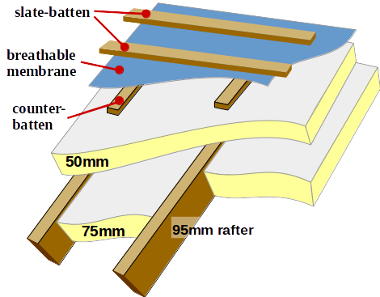
I have 75mm PIR insulation board between the rafters, and 50mm outside of that, running on top of the rafters.
The outer 50mm layer is then counter-battened (vertically), followed by a breathable membrane held in place by the horizontal slate battens.
I wonder whether it's worth adding kingspan boards underneath the felt and tiles to give a bit more insulation
I'm slightly more concerned about that strategy.
It's not a warm-roof construction because the external top-side of each rafter isn't covered by a final outer layer of insulation.
There will be a temperature gradient across the rafter, making its inside face 'colder' than the adjacent PIR insulation board.
I wonder whether condensation will accumulate in winter, making the rafters susceptible to rot or fungal growth.
If so, then installing mechanical ventilation (with heat recovery) into the loft-space would most likely solve the problem.
One thing to be aware is to ensure the eaves are not blocked, to avoid mould, etc.
Well, that's the tricky issue, isn't it?
For a warm-roof construction the air-flow is between the counter-battens - on the outside of the upper insulation board and beneath the breathable membrane.
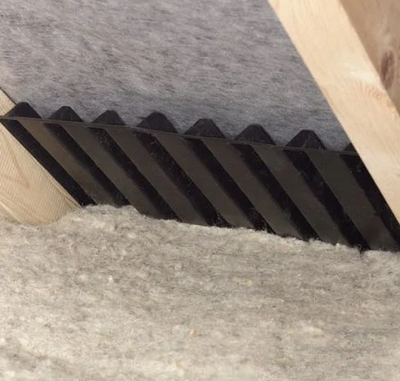
But if it's a cold-roof construction then you must have airflow from the eaves into the main loft space.
Typically that will use ventilation trays to hold the ceiling-level insulation away from the sloping roof above it.
This post was modified 2 months ago 2 times by Transparent
Save energy... recycle electrons!
1
05/01/2026 8:33 pm
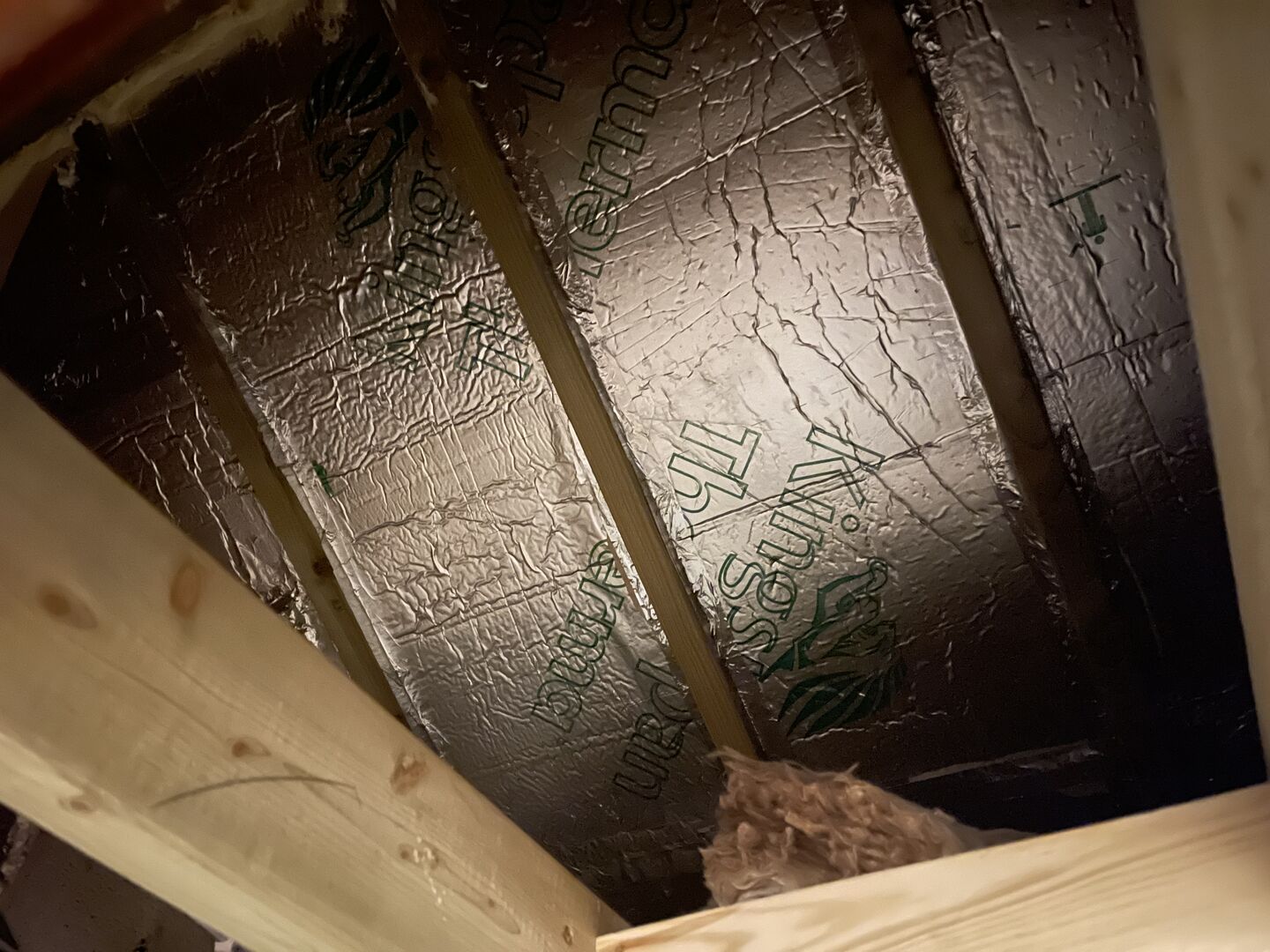
The warm deck roof 150mm thick, eventually a second layer of wool insulation will go up with the ceiling boards
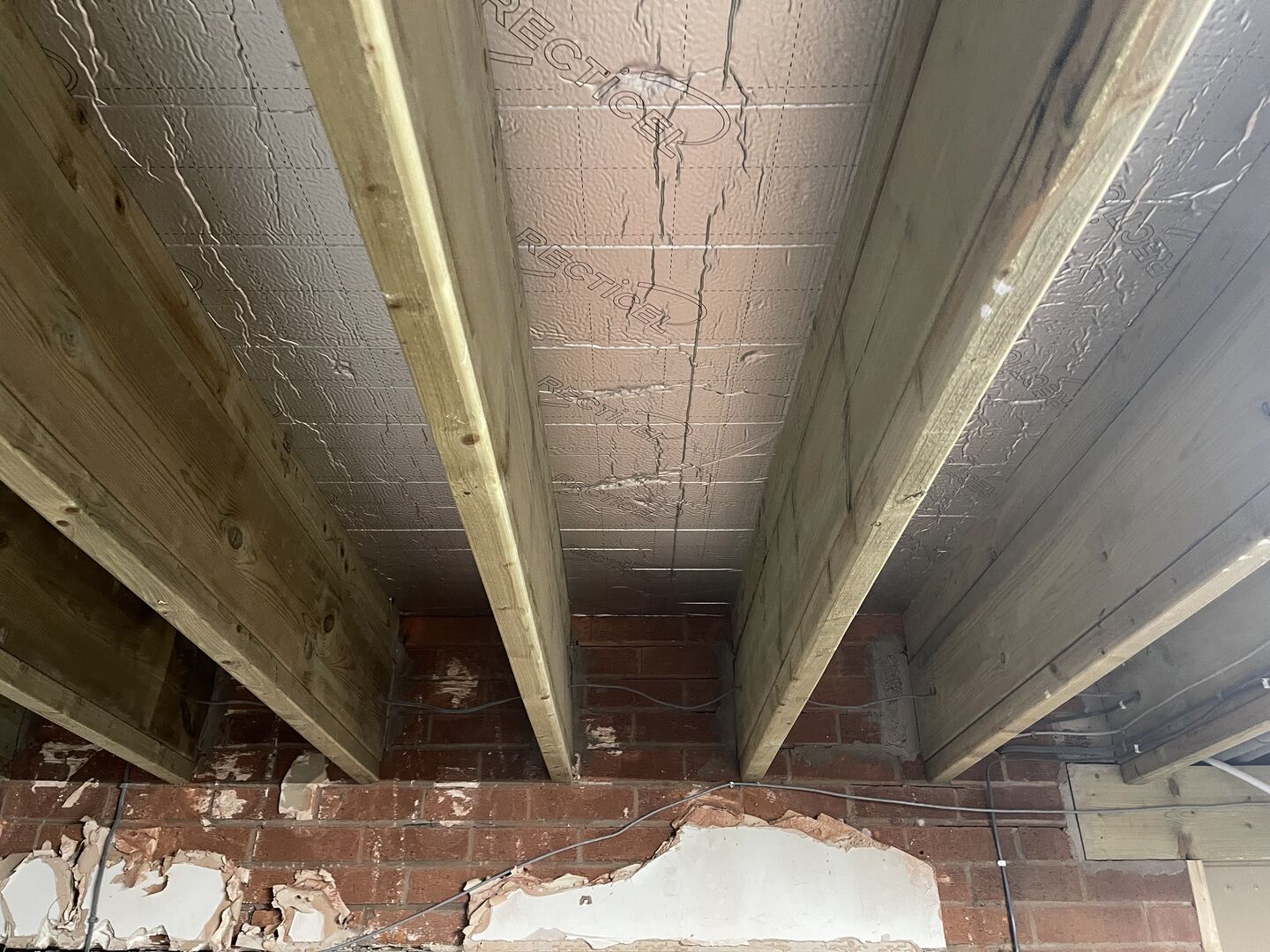
The front extension has kingspan between the rafters and wool insulation above the ceiling, i am still finishing the lighting for this area so have 2 access panels still open
1
Topic starter
05/01/2026 8:43 pm
Thank you everyone for all of the information, it looks like something best done if replacing the roof perhaps given the complexity.
Mitsubishi Ecodan 8.5kW
4.4kW Solar PV
5.2 kWh Battery Storage
1983 build, 300mm loft insulation, cavity wall insulation (beads)
1

Latest Posts
-

RE: Daikin Altherma 3 LT compressor longevity question
This mess is intriguing: I wonder if this represent...
By bobflux , 21 minutes ago
-
RE: Say hello and introduce yourself
Hi. I'm Mike. Thank you for letting me join. My partn...
By Fretless6 , 2 hours ago
-
RE: Connecting Growatt SPH5000 over wired ethernet rather than wireless
The simplest wired option is usually the Growatt Ethern...
By Jonatan , 5 hours ago
-
RE: Peak Energy Products V therm 16kW unit heat pump not reaching flow temperature
ASHPs do have a minimum compressor speed. The minimum h...
By bobflux , 12 hours ago
-
RE: Electricity price predictions
@jamespa And it seems some of the nasty public cloud...
By Batpred , 12 hours ago
-
RE: Tell us about your Solar (PV) setup
Location: near Lyon, France 12kWp on the roof, 2x Sol...
By bobflux , 12 hours ago
-
RE: Jokes and fun posts about heat pumps and renewables
Technology is rapidly advancing. BBC News reported th...
By Transparent , 15 hours ago
-
What matters for flow and pressure drop is internal dia...
By bobflux , 16 hours ago
-

RE: Do Fridges and Freezers have COP ratings?
@editor Thank you all for your replies and submitted in...
By Toodles , 18 hours ago
-

I know and yes. The secondary deltaT wont necessaril...
By JamesPa , 22 hours ago
-
RE: Designing heating system with air to water heat pump in France, near Lyon
Just love the way you put it! 🤣
By Batpred , 2 days ago
-
RE: Safety update; RCBOs supplying inverters or storage batteries
Thank you for sharing. So it seems that your Schneid...
By Batpred , 2 days ago
-

RE: Forum updates, announcements & issues
@upnorthandpersonal thanks for the thoughtful, consider...
By Mars , 2 days ago
-
RE: Solar Power Output – Let’s Compare Generation Figures
@mk4 All 21 panels have their own Enphase IQ7a microinv...
By Toodles , 2 days ago
-
RE: Setback savings - fact or fiction?
Great, so you have proven that MELCloud is consistently...
By RobS , 3 days ago
-
RE: Mitsu PUHZ120Y 'Outdoor Temp 'error?
Thanks David & James It almos...
By DavidAlgarve , 3 days ago
-
RE: Surge protection devices SPDs
@trebor12345 - your original Topic about the right type...
By Transparent , 3 days ago
-
RE: Help needed with Samsung AE120RXYDEG
@tomf I’ve been sent this from a service engineer at Sa...
By Mars , 3 days ago
-
RE: Buying large amp bidirectional RCD and RCBO
Yes... I went through this particular headache and ende...
By bobflux , 4 days ago
-
O-oh! Let's take this as an opportunity to 'pass the ...
By Transparent , 4 days ago
-
RE: Homely setup on daikin heat pump
@craigh I refer to our somewhat elevated temperature of...
By Toodles , 4 days ago
-
RE: Air source heat pump roll call – what heat pump brand and model do you have?
My turn, this describes the future installation, only t...
By bobflux , 4 days ago