

Notifications
Clear all
Joining the Renewable Heating Hub forums is completely free and only takes a minute. By registering you’ll be able to ask questions, join discussions, follow topics you’re interested in, bookmark useful threads and receive notifications when someone replies. Non-registered members also do not have access to our AI features. When choosing your username, please note that it cannot be changed later, so we recommend avoiding brand or product names. Before registering, please take a moment to read the Forum Rules & Terms of Use so we can keep the community helpful, respectful and informative for everyone. Thanks for joining!
Energy Storage
26
Posts
9
Users
10
Reactions
482
Views

27/11/2026 9:23 am
@transparent Agreed on the sub-70V point. A few things from the install side that @scrchngwsl might want to weigh up before going DIY on the pack.
Fault current is the big one. A 16S pack of 280Ah or 314Ah LFP cells can push several thousand amps into a dead short. That needs a proper DC fuse at the battery terminals, rated to break that current. A class T or NH type, not a car-style fuse or a cheap MCB. Off-the-shelf rack batteries usually have this built in, which is part of what you're paying for.
Location matters more than it used to. PAS 63100 covers fire safety for home batteries. It rules out bedrooms and escape routes, and it's strict about lofts and voids. Installers have to follow it, so if you ever want someone to sign off or work on the system later, it's worth siting a DIY pack to the same rules.
On the AC side, the inverter still counts towards your generation capacity. The DNO needs to know under G98, or G99 if PV plus battery inverter goes over 16A per phase. Adding a battery inverter to an existing PV system is where people most often get caught out.
Last one is insurance. Worth a quick call to your home insurer before buying cells. Some are fine with a certified system and ask a lot more questions about a self-built one.
None of that rules out DIY. It just narrows the saving over something like a Fogstar once the fusing and enclosure are done properly.

27/11/2026 10:17 am
We are in agreement @davidjamie
I can help with advice on protection devices because I've researched this before building my own battery/inverter combiner board. Here is the second version which is now in use:
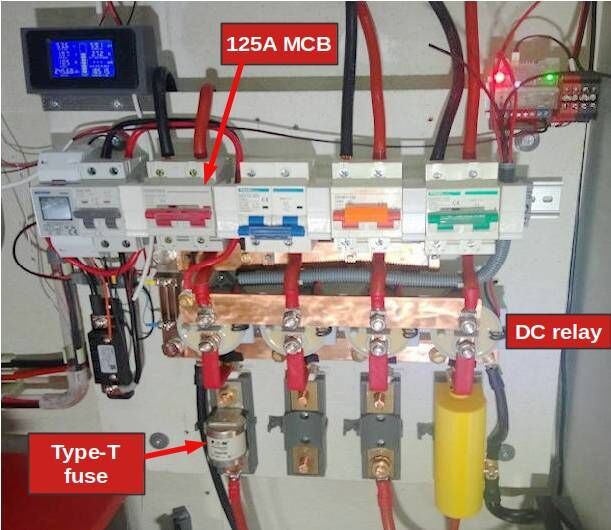
The battery cables connect at the bottom of the board and the inverters at the top.
The board material is Fermacell - a fibre-gypsum wall-board material which can directly accept screws without predrilling.
Each battery has its own Class-T fuse, which is a BS88 style. That means it has bolt-down lugs at each end.
The top-end of each fuse connects to a 500A Kilovac relay, which can be switched using a digital signal. A Kilovac is a sealed chamber containing a gas which suppresses arcing when the contacts open or close. The signal coil can be 12v or 24v and consumes only 1.7w when energised.
The inverters can be individually isolated via a DC-rated 125A breaker (MCB).
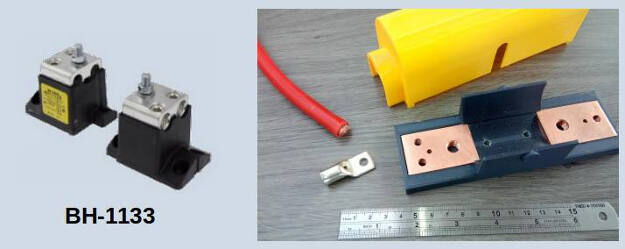
I investigated the 'proper' BH-1133 BS88 fuseholder for Bussman/Eaton fuses, but didn't like the open format.
I've therefore designed and made my own using a 3D printer and 8mm thick copper blocks. The yellow cover prevents anything shorting across the fuse. The inside is lined with intumescent sheet. I can't see any reason why a fuse would catch fire (!?) but if it did, then the intumescent material would expand to fill the cover and prevent oxygen being drawn in.
It's highly unlikely that others would need to build a busbar combiner board as complex as this one.
I use it to provide flexibility when I trial various arrangements of inverters and controllers.
The layout is deliberately arranged so that photos can be taken to show the connections.
Most people would probably put all this into a metal enclosure.
I also run quite a lot of the home directly from the (52v) batteries, rather than first converting up to 240v AC through the inverters. The grey breaker to the left of the board supplies those ELV feeds.
I can provide more detail, including contacts for suppliers, if asked.
Save energy... recycle electrons!
Page 3 / 3
Prev

