

Notifications
Clear all
Joining the Renewable Heating Hub forums is completely free and only takes a minute. By registering you’ll be able to ask questions, join discussions, follow topics you’re interested in, bookmark useful threads and receive notifications when someone replies. Non-registered members also do not have access to our AI features. When choosing your username, please note that it cannot be changed later, so we recommend avoiding brand or product names. Before registering, please take a moment to read the Forum Rules & Terms of Use so we can keep the community helpful, respectful and informative for everyone. Thanks for joining!
Energy Storage
233
Posts
20
Users
170
Reactions
127.9 K
Views

18/09/2022 10:53 am
I wonder if I should change my advice on top-balancing.
Should I recommend connecting the cells to the power-supply via an external/visible fuse?
To keep resistance low it would need to be a fuse in a holder with relatively large connection posts. And preferably the fuse itself should be bolted in place - not merely clipped into the holder.
Save energy... recycle electrons!

Topic starter
18/09/2022 11:00 am
I don't think it matters too much. As long as they can charge it doesn't really matter. I'm not sure who is in a major rush. I just wasn't thinking when I connected the wires.
Topic starter
19/09/2022 10:13 am
@transparent still going at 4 and a bit amps. So tiny amounts of power trickling in
19/09/2022 10:32 am
1. Is the power supply genuinely capable of delivering 10A? Or is it possibly a broad allusion to 10A, based on the rating of the components used inside?
2.Is the current measurement accurate? Check with an external multimeter,
3. I must emphasise - the quality of connections is extremely important. All wires need to be tightened onto terminals. Thus if you were to use crocodile clips to attach the power supply to the battery busbars, then you see a dramatic reduction in current. Tarnished copper also presents a higher resistance - ensure it's clean!
Save energy... recycle electrons!


19/09/2022 1:28 pm
On power supply units it is often possible to limit the output current. What make is it and what control knobs are on the unit?
Topic starter
19/09/2022 3:03 pm
Annoyingly I can't measure the current. I have two multimeters, one only measures AC current and the other measures DC but only on mA and doesn't have a suitable setting for that measurement. It does have a current adjustment, but I don't think I can use it as it's voltage controlled Vs current controlled. It's still charging and the voltage on the cells is increasing, it's just a slow game at the moment. My case isn't here, so no rush (yet)
Topic starter
19/09/2022 4:37 pm
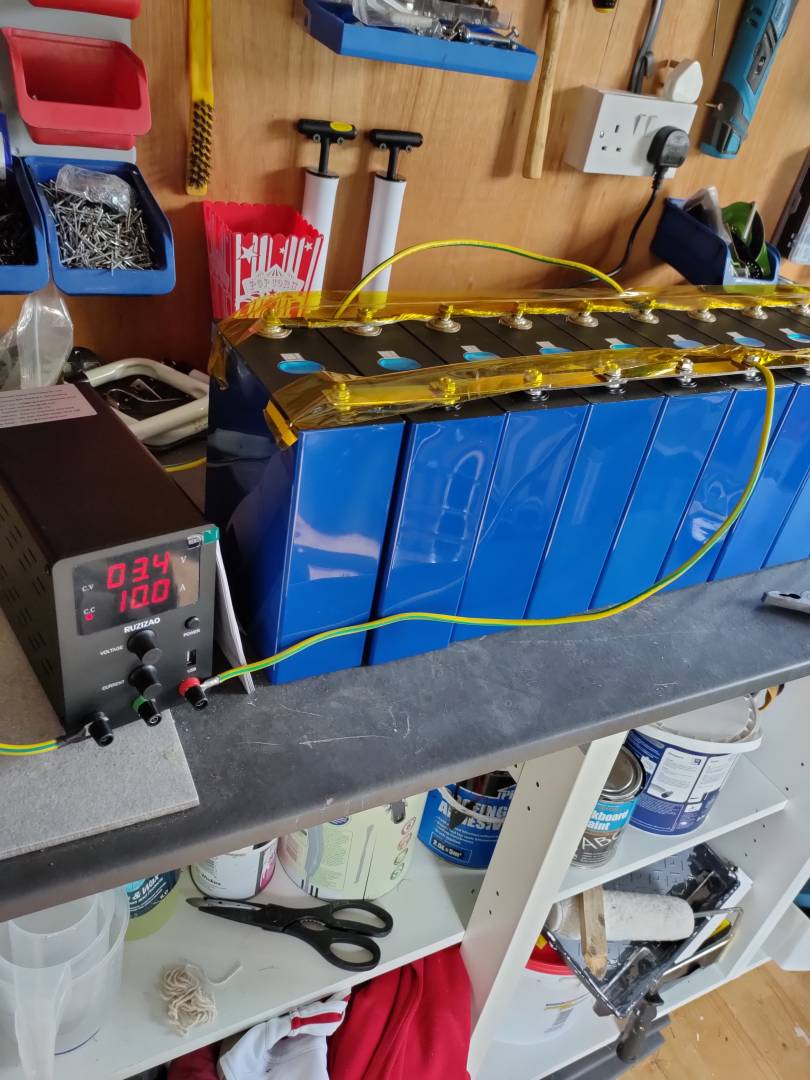
Made some new connectors using left over wire connectors and some very thick cable. Now charging at 10a continuous current, aiming for 3.6v
Let's see how we get on!
Topic starter
20/09/2022 9:18 am
@transparent by my calcs I have roughly another 29 hours of charging left to top balance.
Cells are currently at 3.36v, so 16 cells x 280ah = 15,053w of power stored currently
Desired state is 3.6v so that is 16,128w target
Its charging at 3.6v and 10amps = 36 watts per hour
(16128 - 15053) / 36 = 29.87 hours

20/09/2022 10:11 am
Do I assume that you're reading that 3.36v from the meter on front of the psu?
That's not the cell voltage. The PSU voltage reading is defined such that it causes 10A to flow into the cells.
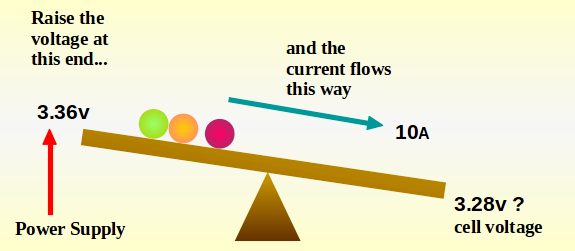
Based on the approximate State of Charge (SoC) of the EVE cells I've received from China this year, I'll predict the time taken for your cells to reach 3.6v is more like 15-18 days. 🙂
Background information for others who come across this topic later:
Lithium cells are not charged by the manufacturer before sale.
A typical post-assembly electrical test in the factory would include measurement of the internal resistance and the ability of each cell to receive a charge current of around 2C for about a minute. C is the Ah rating of the cell. So a 280Ah cell would be tested at 2 x 280 = 560A
The voltage of the cell is dictated by its chemistry, according to the universal electro-chemical series:
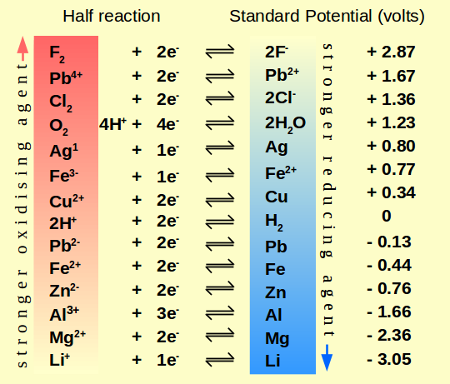
In our case, the Lithium Ferrous Phosphate (LiFePO4) is the cathode, whilst the anode is graphite (carbon) with a metallic backing. If you put those two materials together as thin films on a laboratory bench with an electrolyte liquid between them, electrons will flow, and you can measure a potential difference of 3.2v - which tells you nothing about the amount of charge held by those two plates.
A manufacturer will develop a method of assembly which gives them a predictable cell capacity. Thus EVE have designed a manufacturing process which yields cells of around 280-290Ah capacity. They then offer those for sale with a 280Ah specification.
The only way to find out the actual capacity of a cell you've bought is to charge it fully (to around 3.65v) and then discharge it at a current less than C to about 2.8v. (Outside those voltages risks damaging the cell).
You then verify that capacity by charging it back up again, which will obviously take a slightly greater amount of electricity due to internal losses.
If you intend doing capacity tests on cells more than a couple of times, then consider investing in a proper Capacity Load-tester. This takes a constant-current through a heating element whilst measuring the discharge characteristics. The data is streamed to a PC via a USB lead, enabling you to see the resulting graph.
Save energy... recycle electrons!
Topic starter
20/09/2022 10:33 am
@transparent no that's the reading on the cells from my multimeter
20/09/2022 11:05 am
So are you measuring that voltage with the cells still charging?
Even if the PSU is disconnected, you will need to allow the cells to 'rest' for about 20 mins, and then connect a small load. You need something drawing between 1-10A. That will then allow you to obtain a reasonable measurement of the real cell voltage.
Save energy... recycle electrons!
Topic starter
21/09/2022 8:57 pm
@transparent still charging lol. No idea how long it's going to take

SPONSORS

Degrees of Separation

Latest Posts
-

RE: 15kw pump for 225m2 1990's house - over kill?
@editor sorry should have been clearer - the whole hous...
By Carpenterstation , 2 hours ago
-
RE: Safety study for plug in batteries out to tender - looks like Q3 2027 at best before legal
Maybe this is why Octopus and Fuse are hell bent on plu...
By dansus , 3 hours ago
-
RE: Indevolt Batteries UK Support & Info Thread
@editor Manually setting the charging times and rates o...
By dansus , 4 hours ago
-
RE: How much of your renewable and home setup would still work if the internet went down?
Ours is similar to James, but with a few optional tweak...
By Batpred , 6 hours ago
-
RE: Renewables & Heat Pumps in the News
Yes, this is a swiss and german standard I believe, Vai...
By Batpred , 6 hours ago
-
RE: BT cuts you off, Plusnet blames Openreach... welcome to “seamless” broadband switching
My Vodafone FTTP broadband was down for a month when I ...
By JamesPa , 10 hours ago
-
RE: Octopus Cosy 12 Heat Pump Regret: Incredibly Loud, Poor Heating & Constant Hum - Help!
@editor FWIW my problem was resolved, eventually, after...
By BigFish , 13 hours ago
-
My heating has been off and DHW on throughout the summe...
By DavidAlgarve , 16 hours ago
-
RE: Anyone concerned about GivEnergy?
The GivE forum seemed to have survived the collapse of ...
By downfield , 17 hours ago
-
RE: How quickly would you want/expect heat recovery to take from setback?
@singlespeed I had better explain how my radiators are ...
By Toodles , 17 hours ago
-
RE: Cooling/heating with one unit
@mrkfm The Solo has a small capacity and only suitable ...
By dgclimatecontrol , 17 hours ago
-
First you need to know how much thermal energy you'll n...
By bobflux , 1 day ago
-
RE: Renewable Heating Hub Homeowners' Q&A Podcast
Come for the low-carbon homes. Stay for George Clarke’s...
By Mars , 2 days ago
-
RE: How should the Boiler Upgrade Scheme be reformed?
Not quite, regular A2W heat-pumps need a load of extra ...
By Temperature_Gradient , 4 days ago
-
RE: Heat Geek installations: share your experiences
one thing i learnt from reading people’s comments and e...
By Batpred , 4 days ago






SPONSORS

