
Notifications
Clear all

08/01/2026 12:07 am
As electricity prices continue to rise and specialist heat pump tariffs disappear, many homeowners are discovering that heat pump efficiency isn’t optional… it’s survival.
In this video, I break down:
- Why bad heat pump systems are being financially exposed
- Why Time-of-Use tariffs aren’t a safety net
- What happens when an energy company kills a tariff overnight
- And what homeowners must demand before installing a heat pump
Great point, one of the key ones in my chat with Octopus following my ASHP enquiry before Christmas. Tariffs are a concern.
8kW Solis S6-EH1P8K-L-PLUS hybrid inverter; G99: 8kw export; 16kWh Seplos Fogstar battery; Ohme Home Pro EV charger; 100Amp head, HA lab on mini PC

22/01/2026 9:27 am
There is one often repeated point made that the video doesn't necessarily address. We're regularly quoting the rule of thumb that electricity is about three times more expensive than gas and so a SCoP of 3.5 outstrips the energy price difference.
I decided to put that to the test, and I used historical price data downloaded from https://agilebuddy.uk. I compared the gas kWh price with the Octopus Flexible price, both for my region which is the South East of England. Here are the results.
Chart of daily prices
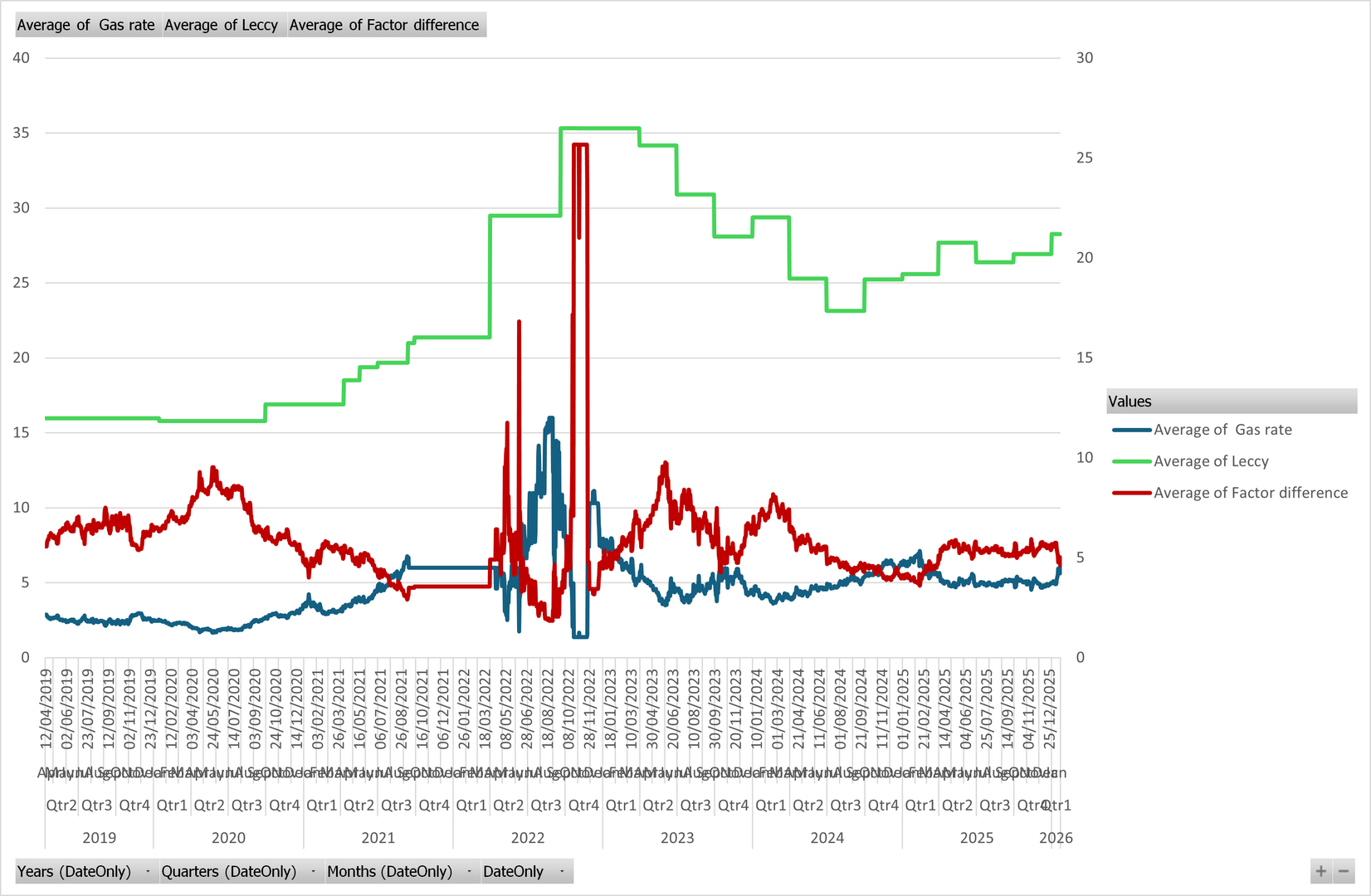
Chart averaging over months
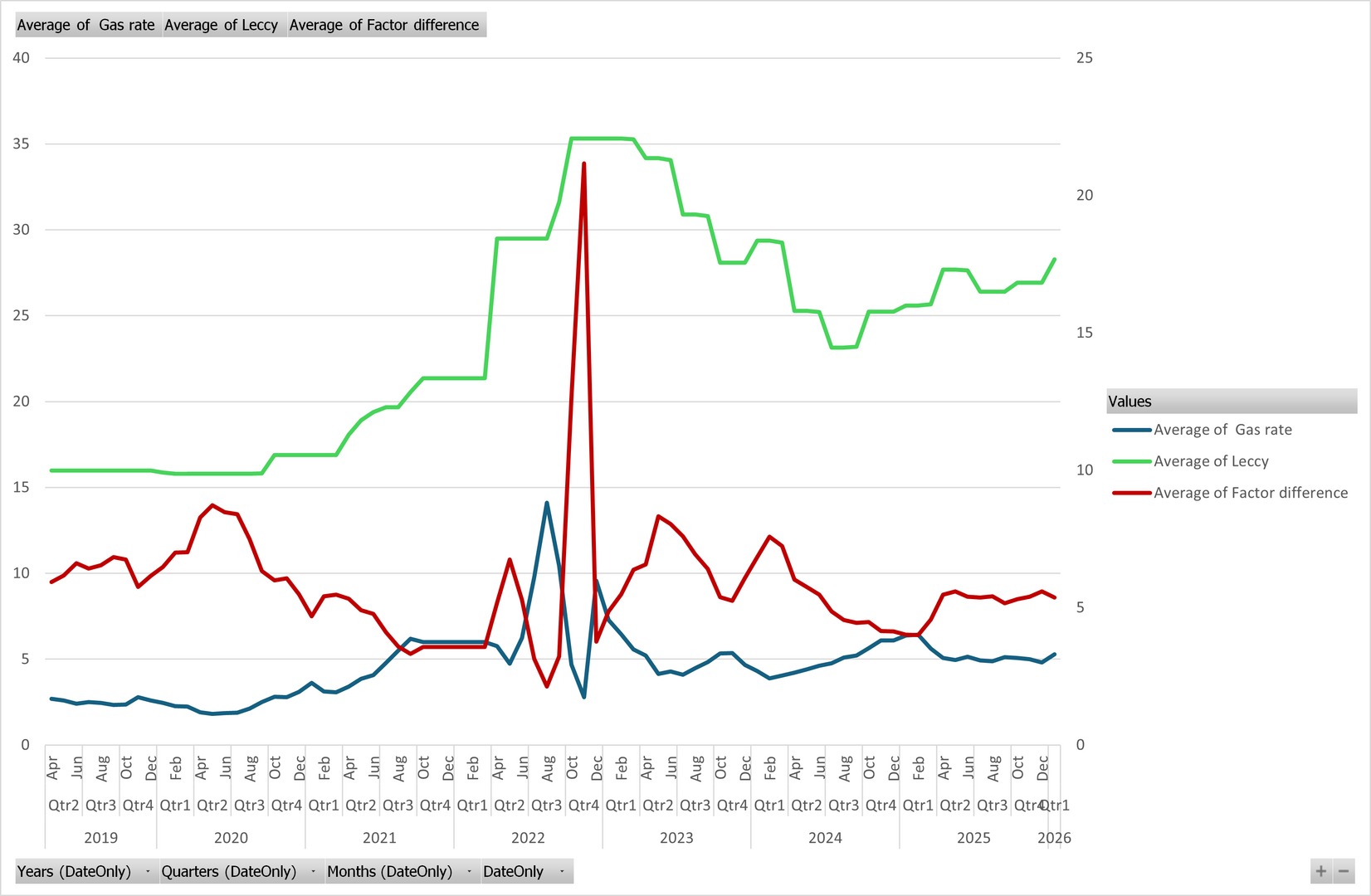
Chart averaging over quarters
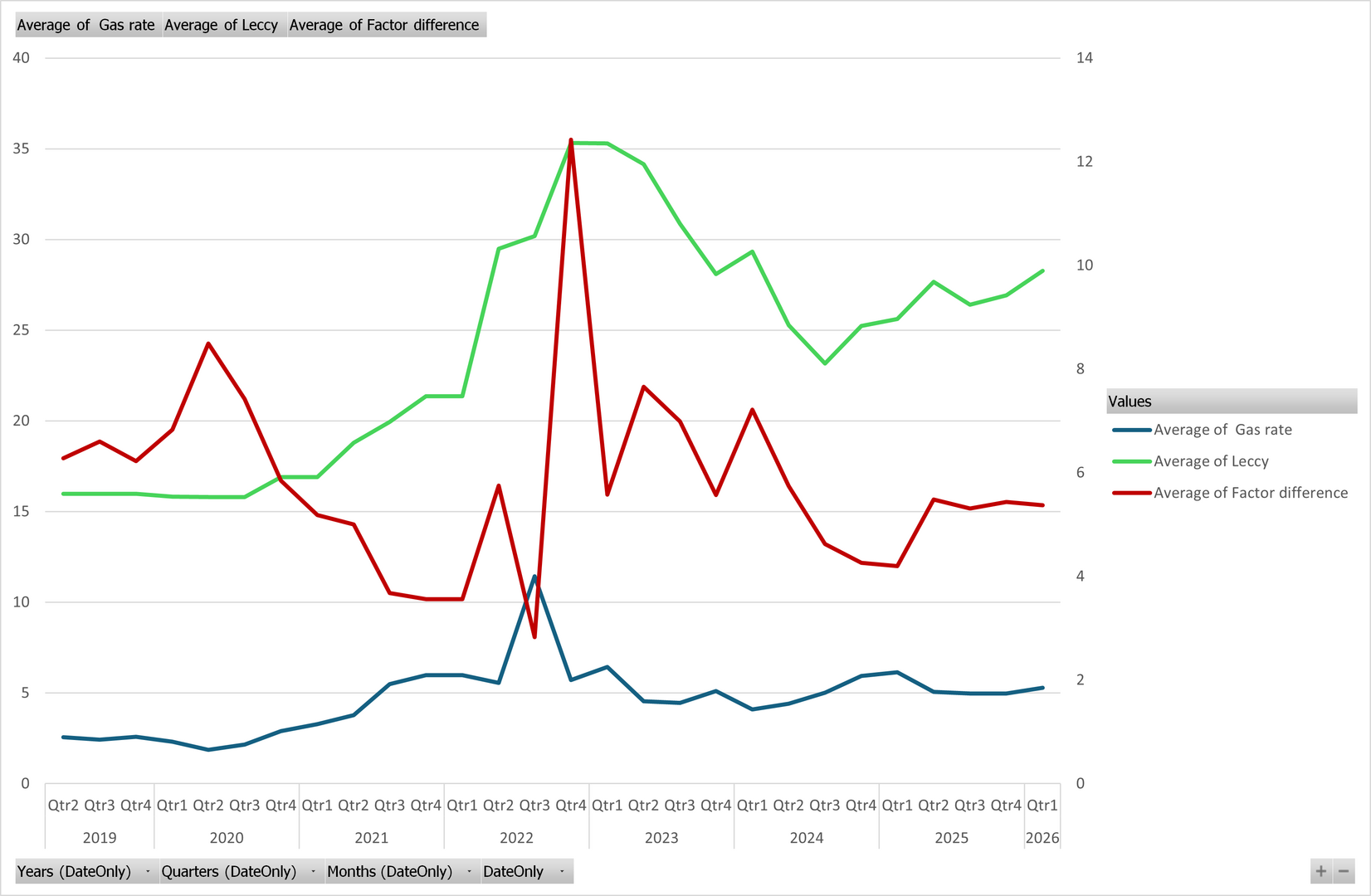
Chart averaging over years
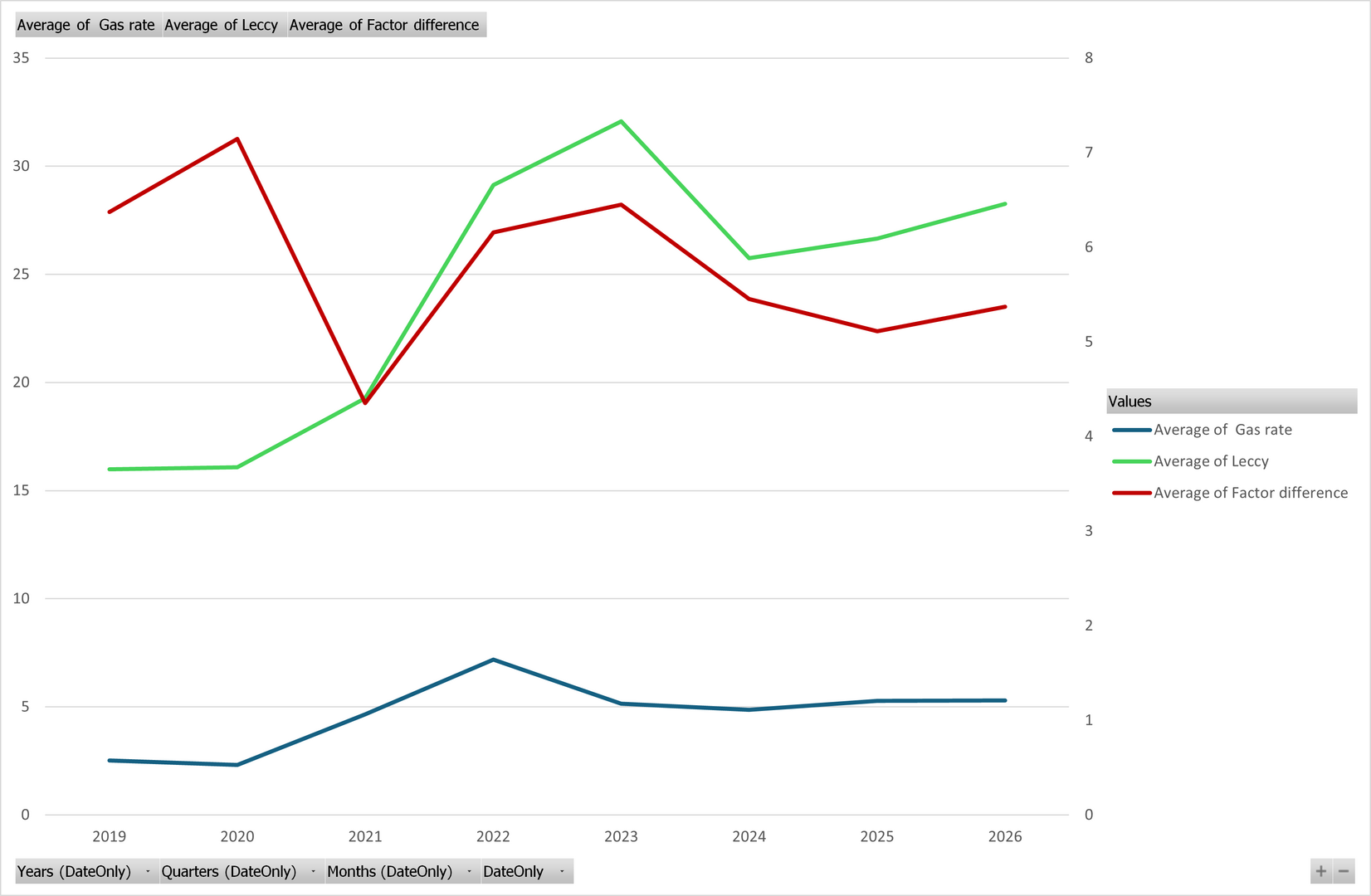
The important line to note is the red one which is how many times more expensive the leccy rate is than the gas rate (both per kWh), and the scale for that red line is the one on the right hand side of the chart. Obviously, the daily data shows some pretty big swings since leccy and gas prices don't necessarily change on the same day. However, once you look at monthly, quarterly or yearly averages it becomes clear that our rule of thumb is pretty wildly out. Electricity prices aren't around three times more expensive than gas; they're around 5.5 times more expensive.
We've been banging on for quite a long time on the forum - and lobbied to the Government as well - about the need to break that dependency of electricity prices on the prevailing gas price, and this is a pretty stark demonstration of why. The fact many heat pump installations still remain financially viable even with a five times energy price differential is testament to the good sense behind a well designed, installed and commissioned heat pump system, but that's a hell of a handicap for them to have to compete with.
105 m2 bungalow in South East England
Mitsubishi Ecodan 8.5 kW air source heat pump
18 x 360W solar panels
1 x 6 kW GroWatt battery and SPH5000 inverter
1 x Myenergi Zappi
1 x VW ID3
Raised beds for home-grown veg and chickens for eggs
"Semper in excretia; sumus solum profundum variat"
3

22/01/2026 10:06 am
Solar PV is the way to collapse that spark gap, my solar install LCOE is 8p/kWh and the heat pump is using a lot of that. I haven't enough data to annualise it yet but it probably gets my electric rate to an average of 16-18p.
The synergies of heat pumps and other green tech are hard to ignore. It should be an important part of talking to people about heat pumps. There simply wasn't an option for me to produce my own methane (well not in sufficient quantities 😆).
This post was modified 1 month ago by Scalextrix
2

22/01/2026 10:15 am
@scalextrix Yes, there is a lot of noise about producing our own methane😉
Toodles, heats his home with cold draughts and cooks food with magnets.
22/01/2026 10:15 am
Totally agree, @scalextrix, but it's also hard to ignore the fact that few people can afford to jump straight from simple fossil fuel boiler setup to full-on heatpump/solar PV/home battery/export tariff/smart home management system all in one go. Many people have to make the decision to just do the boiler --> heat pump swap now and wait for a while before being able to do the next step in their grand plan. The metaphorical playing field ought to be a lot more level than that.
Nor is it easy to ignore that part of the way heat pump owners currently close the gap is by ensuring that a new heat pump system also fixes how the heating is controlled - replacing a high fixed flow temperature fossil fuel boiler with a weather compensated variable flow temperature heat pump is far easier to justify financially than if the boiler were already running with weather compensation.
105 m2 bungalow in South East England
Mitsubishi Ecodan 8.5 kW air source heat pump
18 x 360W solar panels
1 x 6 kW GroWatt battery and SPH5000 inverter
1 x Myenergi Zappi
1 x VW ID3
Raised beds for home-grown veg and chickens for eggs
"Semper in excretia; sumus solum profundum variat"
1
22/01/2026 10:19 am
@majordennisbloodnok I agree, for me the calculation is simple; solar PV is cheap, reliable, and guarantees a payback - it's the gateway drug of the energy transition.
Get people hooked on producing their own energy, then get them hooked on using it all later 😉
1
22/01/2026 10:29 am
The synergies of heat pumps and other green tech are hard to ignore. It should be an important part of talking to people about heat pumps. There simply wasn't an option for me to produce my own methane (well not in sufficient quantities
).
That's also an interesting point. There's a startup that's been around for several years now that attempts to do exactly that. It's called a Heru and they STILL haven't managed to get a commercial product released, although there are some big names amongst the early adopters and the technology does appear to be both sound and effective.
105 m2 bungalow in South East England
Mitsubishi Ecodan 8.5 kW air source heat pump
18 x 360W solar panels
1 x 6 kW GroWatt battery and SPH5000 inverter
1 x Myenergi Zappi
1 x VW ID3
Raised beds for home-grown veg and chickens for eggs
"Semper in excretia; sumus solum profundum variat"
22/01/2026 10:56 am
I still think that biomass cannot go that far. At large scale, many technologies can work, but then our planning and reg challenges may get in the way.
The beauty of batteries is that they can also be deployed at small scale and allow more use of green electricity. Unfortunately what I managed to achieve with self learning and time (and pushing the cost down) is not within reach for the majority.
PV can help the UK, but it does not tackle the concept of self sufficiency during the months of Jan and Feb, when heat pumps work harder and the wind does not blow very strong.. Perhaps more hydro storage is needed?
Maybe then cheap overnight electricity would be sustainable..
8kW Solis S6-EH1P8K-L-PLUS hybrid inverter; G99: 8kw export; 16kWh Seplos Fogstar battery; Ohme Home Pro EV charger; 100Amp head, HA lab on mini PC
22/01/2026 11:09 am
Please don't misunderstand, @batpred. I like the concept of the Heru (turning waste into useable energy) but I don't see it as a long term solution. In my eyes, it's a stopgap at best and the fact they were "almost" at the production stage when my wife and I first stumbled across them about 5 years ago and still haven't actually sold any production units rather suggests they're going to be overtaken by the wider technology advances anyway.
I tend to use it more as an example that offsetting the costs of any home heating is easier if you can produce some of your own energy, and the Heru is the only exception I can find to domestic energy production being limited to electricity. In other words, I use it as part of a confirmation that if you stay with fossil fuels then you're dependent on someone else supplying all your energy and so dependent on what price they want to set.
105 m2 bungalow in South East England
Mitsubishi Ecodan 8.5 kW air source heat pump
18 x 360W solar panels
1 x 6 kW GroWatt battery and SPH5000 inverter
1 x Myenergi Zappi
1 x VW ID3
Raised beds for home-grown veg and chickens for eggs
"Semper in excretia; sumus solum profundum variat"
22/01/2026 11:54 am
...
PV can help the UK, but it does not tackle the concept of self sufficiency during the months of Jan and Feb, when heat pumps work harder and the wind does not blow very strong.. Perhaps more hydro storage is needed?
...
I'm not entirely sure about hydro storage in particular but I think you're absolutely correct that it's storage rather than energy production that is the key. I'm still, for instance, slightly surprised that there's very little chatter about large seawater battery arrays potentially being installed next to offshore wind farms despite the fact energy density and overall battery weight in those situations are largely irrelevant and there's an abundant supply of said seawater.
105 m2 bungalow in South East England
Mitsubishi Ecodan 8.5 kW air source heat pump
18 x 360W solar panels
1 x 6 kW GroWatt battery and SPH5000 inverter
1 x Myenergi Zappi
1 x VW ID3
Raised beds for home-grown veg and chickens for eggs
"Semper in excretia; sumus solum profundum variat"
1
22/01/2026 12:04 pm
Solar PV is the way to collapse that spark gap, my solar install LCOE is 8p/kWh and the heat pump is using a lot of that. I haven't enough data to annualise it yet but it probably gets my electric rate to an average of 16-18p.
That makes sense.
What I was pleased to find is that fitting a simple battery and inverter able to export can deliver ROI in the short term, with the current tariffs. If anyone prefers to rely on fossil fuel for heating for a few years, they can take a first step with a battery, etc. And then, if the roof is suited to PV, they can even take that step before going for a heatpump.
8kW Solis S6-EH1P8K-L-PLUS hybrid inverter; G99: 8kw export; 16kWh Seplos Fogstar battery; Ohme Home Pro EV charger; 100Amp head, HA lab on mini PC
22/01/2026 12:12 pm
I'm not entirely sure about hydro storage in particular but I think you're absolutely correct that it's storage rather than energy production that is the key. I'm still, for instance, slightly surprised that there's very little chatter about large seawater battery arrays potentially being installed next to offshore wind farms despite the fact energy density and overall battery weight in those situations are largely irrelevant and there's an abundant supply of said seawater.
I just mentioned hydro based storage since it is a proven technology. At the moment, I think the UK still reserves it for emergency last resort.
But I am curious about the seawater battery arrays, could you share a source?
8kW Solis S6-EH1P8K-L-PLUS hybrid inverter; G99: 8kw export; 16kWh Seplos Fogstar battery; Ohme Home Pro EV charger; 100Amp head, HA lab on mini PC

Latest Posts
-

RE: Daikin Altherma 3 LT compressor longevity question
This mess is intriguing: I wonder if this represent...
By bobflux , 42 minutes ago
-
RE: Say hello and introduce yourself
Hi. I'm Mike. Thank you for letting me join. My partn...
By Fretless6 , 2 hours ago
-
RE: Connecting Growatt SPH5000 over wired ethernet rather than wireless
The simplest wired option is usually the Growatt Ethern...
By Jonatan , 5 hours ago
-
RE: Peak Energy Products V therm 16kW unit heat pump not reaching flow temperature
ASHPs do have a minimum compressor speed. The minimum h...
By bobflux , 12 hours ago
-
RE: Electricity price predictions
@jamespa And it seems some of the nasty public cloud...
By Batpred , 12 hours ago
-
RE: Tell us about your Solar (PV) setup
Location: near Lyon, France 12kWp on the roof, 2x Sol...
By bobflux , 13 hours ago
-

RE: Jokes and fun posts about heat pumps and renewables
Technology is rapidly advancing. BBC News reported th...
By Transparent , 15 hours ago
-
What matters for flow and pressure drop is internal dia...
By bobflux , 16 hours ago
-
RE: Do Fridges and Freezers have COP ratings?
@editor Thank you all for your replies and submitted in...
By Toodles , 18 hours ago
-

I know and yes. The secondary deltaT wont necessaril...
By JamesPa , 22 hours ago
-
RE: Designing heating system with air to water heat pump in France, near Lyon
Just love the way you put it! 🤣
By Batpred , 2 days ago
-
RE: Safety update; RCBOs supplying inverters or storage batteries
Thank you for sharing. So it seems that your Schneid...
By Batpred , 2 days ago
-

RE: Forum updates, announcements & issues
@upnorthandpersonal thanks for the thoughtful, consider...
By Mars , 2 days ago
-
RE: Solar Power Output – Let’s Compare Generation Figures
@mk4 All 21 panels have their own Enphase IQ7a microinv...
By Toodles , 2 days ago
-
RE: Setback savings - fact or fiction?
Great, so you have proven that MELCloud is consistently...
By RobS , 3 days ago
-
RE: Mitsu PUHZ120Y 'Outdoor Temp 'error?
Thanks David & James It almos...
By DavidAlgarve , 3 days ago
-
RE: Surge protection devices SPDs
@trebor12345 - your original Topic about the right type...
By Transparent , 3 days ago
-
RE: Help needed with Samsung AE120RXYDEG
@tomf I’ve been sent this from a service engineer at Sa...
By Mars , 3 days ago
-
RE: Buying large amp bidirectional RCD and RCBO
Yes... I went through this particular headache and ende...
By bobflux , 4 days ago
-
O-oh! Let's take this as an opportunity to 'pass the ...
By Transparent , 4 days ago
-
RE: Homely setup on daikin heat pump
@craigh I refer to our somewhat elevated temperature of...
By Toodles , 4 days ago
-
RE: Air source heat pump roll call – what heat pump brand and model do you have?
My turn, this describes the future installation, only t...
By bobflux , 4 days ago