

Notifications
Clear all
Joining the Renewable Heating Hub forums is completely free and only takes a minute. By registering you’ll be able to ask questions, join discussions, follow topics you’re interested in, bookmark useful threads and receive notifications when someone replies. Non-registered members also do not have access to our AI features. When choosing your username, please note that it cannot be changed later, so we recommend avoiding brand or product names. Before registering, please take a moment to read the Forum Rules & Terms of Use so we can keep the community helpful, respectful and informative for everyone. Thanks for joining!

05/09/2022 10:23 am
Just looked briefly at the OFGEM tariffs for Oct to Dec. What’s happened to the direct debit? It’s just other payment, standard credit and prepayment.
Direct Debit is the mechanism by which most of us pay a 'Standard Credit' tariff.
I'm amazed you only managed to 'look briefly' at the Ofgem tariffs. I've spent several hours pouring over them and trying to understand the categories under which they do the calculations.
For example the Standing Charge isn't called that. You have to look for data about a home with consumption of nil.
There are 11 components which can contribute to the Standing Charge, of which two are marked 'wholesale' and are null fields. The other 9 fields are given obscure titles, such as Policy Charge. Is this the 'Environmental and Social Obligation' we often hear about? Is this where the free-insulation offers get funding?
No wonder the general public can't challenge the 100%-ish rises in the Standing Charge.
I've been trying to look at the historical Standing Charge data in order to verify the table which the BBC published in April, which I'll post here again to save you looking for it.
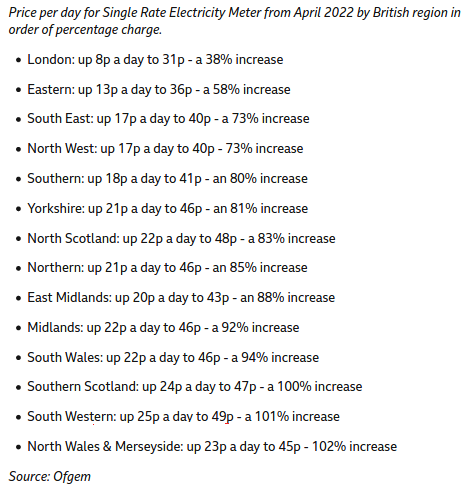
As yet I've been unable to verify the BBC's figures. There are too many unknowns:
- Are these percentage rises based on the previous 6-month period, or is it an annual rate?
- Although it's marked 'single rate' (no Economy-7) is it an average across all three payment methods?
- Is this for electricity-only customers, or dual fuel?
- Does it include or exclude the 5% VAT?
I've re-worked my spreadsheet to use only those figures published in Ofgem's tables at the end of August, ie excluding BBC data.
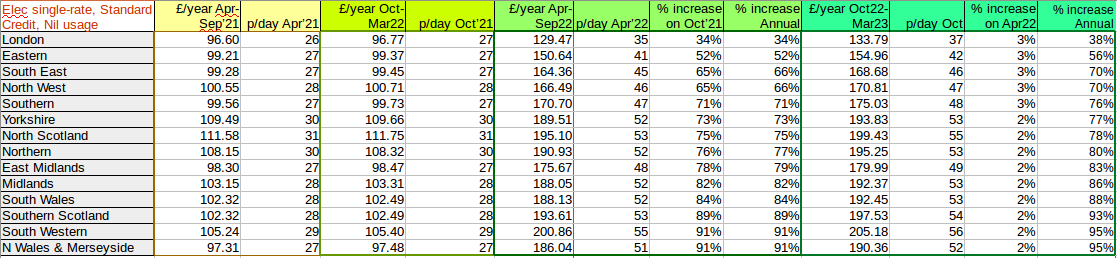
If anyone else wants to use this as a basis of a complaint via your MP, then I suggest you include the list of unknowns I've stated.
The percentage rises would, of course, be higher if I'd analysed pre-payment meters, which are more typically used by households already in fuel-poverty.
Save energy... recycle electrons!
2


08/09/2022 8:38 am
It’ll be interesting to see what Liz Truss’ plan to curb the energy crisis will be later today.
She’s opposed to it, but what’s the general consensus on the windfall tax?
🔥 Britain’s Heat Pump Shitshow
How Installing a Heating System Became a National Nervous Breakdown
Free UK shipping.
📗 Heat Pumps Explained
A Jargon-Free Guide for Homeowners
Rewritten and updated for 2027
📘 From Zero to Heat Pump Hero
🛠️ Bodge Buster
New to heat pumps?
Take the Heat Pump Fundamentals course and use INTRO50 at checkout for 50% off.

08/09/2022 11:09 am
It’ll be interesting to see what Liz Truss’ plan to curb the energy crisis will be later today.
She’s opposed to it, but what’s the general consensus on the windfall tax?
Whilst I think that it is quite disgusting that countries and companies are making obscene profits during the present situation, the major problem is the manipulation of the markets by the likes of Russia and Saudi Arabia. I don't know if it is feasible, but governments, companies and traders should be trying to force down the wholesale price of all these commodities to help diminish Russia's ability to wage war.
In the longer term there needs to be a major overhaul of the market system, to prevent energy from being used as a weapon of war.
I forgot to add that I am in favour of windfall taxes on excessive profits during this energy crises, which should be used to help reduce the prices charged to consumers and also to help fund energy efficiency efforts throughout the country. Reducing our energy demand can only be good for both lowering costs and also for the environment.
1
08/09/2022 12:20 pm
I have just been reading an article on the BBC News website, which was stating that the EU are indeed discussing capping the price of both Russian Oil and Gas. They are also keen that the UK should be involved. I wonder if Liz Truss would be agreeable, or find that it might upset the sensibilities of the Brexit mob?
1

08/09/2022 12:21 pm
I have some background information which may help us to understand what's happening. I'm going to try and report essential facts about the Government position without commenting on the politics, which would fall foul of this Forum's code. I will re-edit over the next few hours this if anyone raises objections of course.
Liz Truss' sponsor for her leadership bid was Kwasi Kwarteng MP, who was then Secretary of State for BEIS. Let's remember that the 'E' stands for Energy.
As the energy crisis hit in the Spring, Kwarteng's focus was on the energy supply contracts for those companies who supply the gas and electricity grids. The terms of those contracts allowed companies to receive income based on their output commodity (electricity) even if their input was unrelated to the rise in price of Russian gas. For example, the eight nuclear plants operated by EDF had no change in their inputs, whilst their profits soared due to the price of electricity on ExSpot. Note that EDF is Électricité de France, which is 85% owned by the French government.
The Minister assisting him in these negotiations was Jacob Rees-Mogg MP, Minister of State for Brexit Opportunities and Government Efficiency. That role was renamed by Boris Johnson PM, and had originally been a Ministerial position in the Treasury.
We can imagine that legal advice was sought... most probably from the then Attorney General, Suella Braverman MP. I have little doubt that the weight of legal opinion was heavily in favour of the existing supply contracts, leaving Kwarteng and Rees-Mogg in a particularly weak position.
Nevertheless both Ministers were supporters of Truss during the leadership campaign, and she would therefore be much more aware of the energy-crisis arguments than her rivals.
It still puzzles me that BEIS didn't intervene with the DNO's ongoing future spending review by Ofgem. Why wasn't Kwarteng alerted by BEIS staff that the Energy Regulator was simultaneously considering an enormous rise in the standing charge?
The DNO's Business Plans to meet their forthcoming RIIO-ED2 contracts were published in December 2021, a month before Russia invaded Ukraine. These plans for massive spending on infrastructure are completely independent of wholesale energy prices. So why was Ofgem allowed to implement the standing-charge hikes in April 2022 for DNOs whose RIIO-ED2 contracts don't even start until April 2023?!
Ofgem didn't approve as large a rise in standing charges as DNOs had requested, but they should have known that the increases would most affect households which would already be reeling from increased costs of the electricity and gas itself - a perfect storm.
Some DNO's are still unhappy that their Business Plans have been scaled back by any amount, citing slower progress towards the Government target of Nett Zero by 2050. I will be attending a half-day conference by Western Power next week to hear what they have to say about 'only' being allowed £16.7b 😢
Readers here will notice that Liz Truss PM has now promoted Kwarteng to Chancellor and Rees-Mogg to BEIS. Both are very well informed of the true background to the energy-crisis, having already been working on the subject for the previous eight months. Without doubt, they must be the ministers who arrived in those positions most prepared to tackle their portfolios after a cabinet reshuffle!
We here should also note that Jacob Rees-Mogg likes to undertake extensive research on technical issues. I recall his amazing grasp of mutations in mitochondrial RNA when he advised Parliament during the second stage of the Human Embryology Bill a decade ago!
This forum should endeavour to provide and discuss energy issues, based on the best evidence available. You never know when a civil servant in BEIS might get instructed to undertake background research for the Minister and arrive here on these pages.
Save energy... recycle electrons!
2
08/09/2022 12:52 pm
I fully agree that the massive increase in the standing charges is unfair, particularly for those less able to pay their energy bills. It is also not a very good example when it comes to encouraging consumers to use less energy.
I did some recent calculations on the proposed standing charges, and moving the standing charge onto the unit cost would increase this by approximately 6p. This is based on the average usage figures from which Ofgem base their predictions.
When it comes to the additional infrastructure changes that National Grid and the DNO's wish consumers to fund, I would question if they are all necessary. As you have repeatedly pointed out, poor planning in the siting of renewable assets, has led to unnecessary imbalance within the electricity supply system, which now requires extensive upgrades to resolve. As I have repeatedly pointed out, better energy efficiency would require less generation and transmission in the first place, meaning less fossil fuel use, since a greater percentage would be from renewable's. This would have the knock on effect of requiring less renewable's to be constructed to meet our energy needs, bringing us quicker to net zero.
If anyone from BEIS is reading this then please let's have some common sense, grown up thinking for a change.
2

Topic starter
08/09/2022 4:17 pm
Any views on new unit costs given the cap will be artificially held at 2.5k for average consumption for two years.
08/09/2022 4:36 pm
Any views on new unit costs given the cap will be artificially held at 2.5k for average consumption for two years.
That will be difficult, since it depends how they price electricity and gas, and also what they do with standing charges.
08/09/2022 4:53 pm
Any views on new unit costs given the cap will be artificially held at 2.5k for average consumption for two years.
Here is an educated guess.
Electricity approximately 35p unit charge with a daily standing charge of 50p.
Gas approximately 10p unit charge with a daily standing charge of 25p.
Don't shoot the messenger if I am wrong.
Topic starter
08/09/2022 4:56 pm
The standing charge didn’t alter that much in the last price cap so I imagine they keep as is.
My guess is 10p for gas and 36p for elec

08/09/2022 9:48 pm
I’ve been out all day so not had a chance to look at the new plan. Does the new cap cap the per kWh tariff if you’re on flexible tariff? This week the news channels have been throwing around arbitrary average house expenditure numbers which I’ve not found particularly helpful.
The good news is that users on fixed rate tariffs will be able to switch to a variable rate. Now I just need to confirm whether that’s the current rate we’re on.
🔥 Britain’s Heat Pump Shitshow
How Installing a Heating System Became a National Nervous Breakdown
Free UK shipping.
📗 Heat Pumps Explained
A Jargon-Free Guide for Homeowners
Rewritten and updated for 2027
📘 From Zero to Heat Pump Hero
🛠️ Bodge Buster
New to heat pumps?
Take the Heat Pump Fundamentals course and use INTRO50 at checkout for 50% off.

SPONSORS
Degrees of Separation
Latest Posts
-

RE: New Build 3 Phase or 1Phase
£16K (or even £25K!) would go a fair way towards employ...
By Toodles , 60 minutes ago
-
-
Mars asked for an update on progress so …. Out HP has...
By DavidB , 3 hours ago
-
RE: How much of your renewable and home setup would still work if the internet went down?
Yes I actually have a copy of a tool that whenever a ce...
By EtchedPixels , 5 hours ago
-
RE: How will removing the standing charge on gas bills benefit heat pumps?
The shoulder months are very difficult to judge COP on ...
By scrchngwsl , 6 hours ago
-
RE: Indevolt Batteries UK Support & Info Thread
@editor Hi, To resolve this, please tap on the A...
By Indevolt Tech , 12 hours ago
-
RE: Double or Triple Glazed Windows?
Posted by: @singlespeed With 9 years repairing windo...
By Rob of York , 1 day ago
-
@transparent we’re still running a secure version of PH...
By Mars , 1 day ago
-
RE: How quickly would you want/expect heat recovery to take from setback?
Much longer than that here. The heating isn't even on. ...
By bobflux , 2 days ago
-
RE: Passiv Smart Thermostat - Help & Forum Support
Obviously the weather is changeable but there's a defin...
By Singlespeed , 2 days ago
-
RE: The Changing Jet Stream Could Challenge UK Air Source Heat Pumps
@rob-of-york I must admit that when we had a Daikin hea...
By Toodles , 2 days ago
-
RE: Forum updates, announcements & issues
Get the Renewable Heating Hub heads-up on WhatsApp. I...
By Mars , 2 days ago
-
RE: Safety study for plug in batteries out to tender - looks like Q3 2027 at best before legal
@editor I pointed out to the one of the Fuse execs that...
By dansus , 2 days ago
-
RE: 15kw pump for 225m2 1990's house - over kill?
@seaviews As well as loft insulation, there are othe...
By Rob of York , 2 days ago



SPONSORS

