

Notifications
Clear all
Joining the Renewable Heating Hub forums is completely free and only takes a minute. By registering you’ll be able to ask questions, join discussions, follow topics you’re interested in, bookmark useful threads and receive notifications when someone replies. Non-registered members also do not have access to our AI features. When choosing your username, please note that it cannot be changed later, so we recommend avoiding brand or product names. Before registering, please take a moment to read the Forum Rules & Terms of Use so we can keep the community helpful, respectful and informative for everyone. Thanks for joining!

Topic starter
08/04/2026 9:52 am
My legionella cycle has never worked, and I'm trying to work out why
I have a Grant Aerona3 13kW and I've wired it so the ASHP controls the legionella cycle (disconnecting the spurious Grant timer box they install). The way this works is the ASHP runs up the hot water to the maximum temperature it can manage, then hands over to the immersion heater for the last few degrees to get it to 60C. On the standard setup it has 2 hours to do that - there's a service manual parameter to extend it to 3 hours, which I've done. After 3 hours the water is only at 50C and the ASHP flashes 'LC' meaning legionella cycle failed. Next week comes around and it does legionella again and the same happens... every week.
To cut a long story short of pondering various control system things (eg what if the pump is running during the immersion cycle, won't that be using the DHW coil to cool the cylinder?), I turned off the ASHP completely and just manually powered the immersion (it goes via a contactor which I can enable independently). I have a power meter on it so I can see the current. And this is what I see:
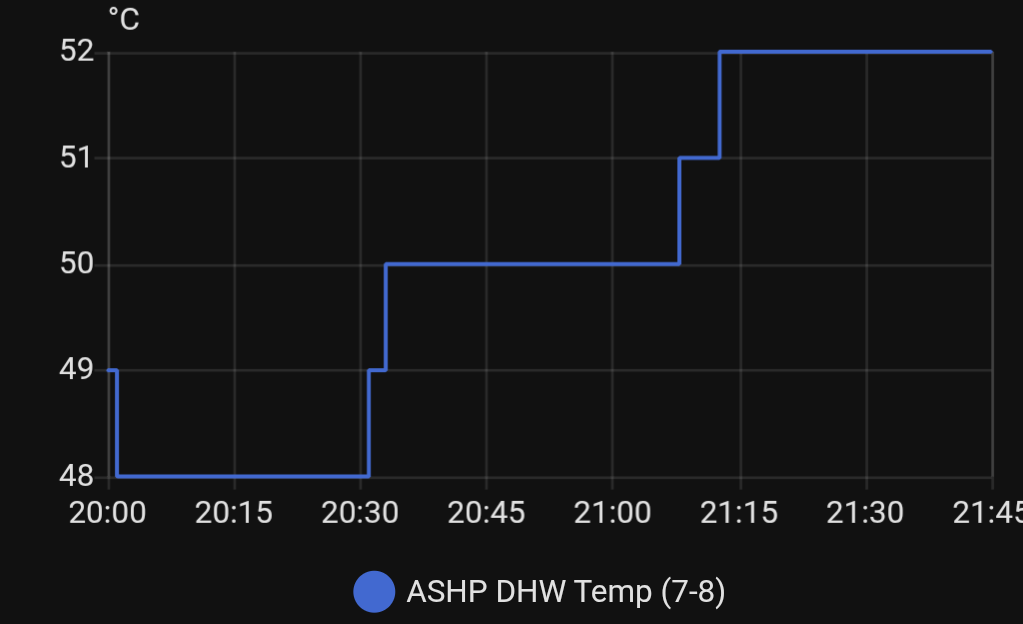
It seems the hot water temperature is plateauing at 52C. I confirmed this with two thermometers in the drawn water. I could also see that the current had dropped away, ie the immersion had cut out even though the contactor was still enabled. I took off the back of the immersion (Thermowatt 340160900000 aka 3401609) and I saw this:
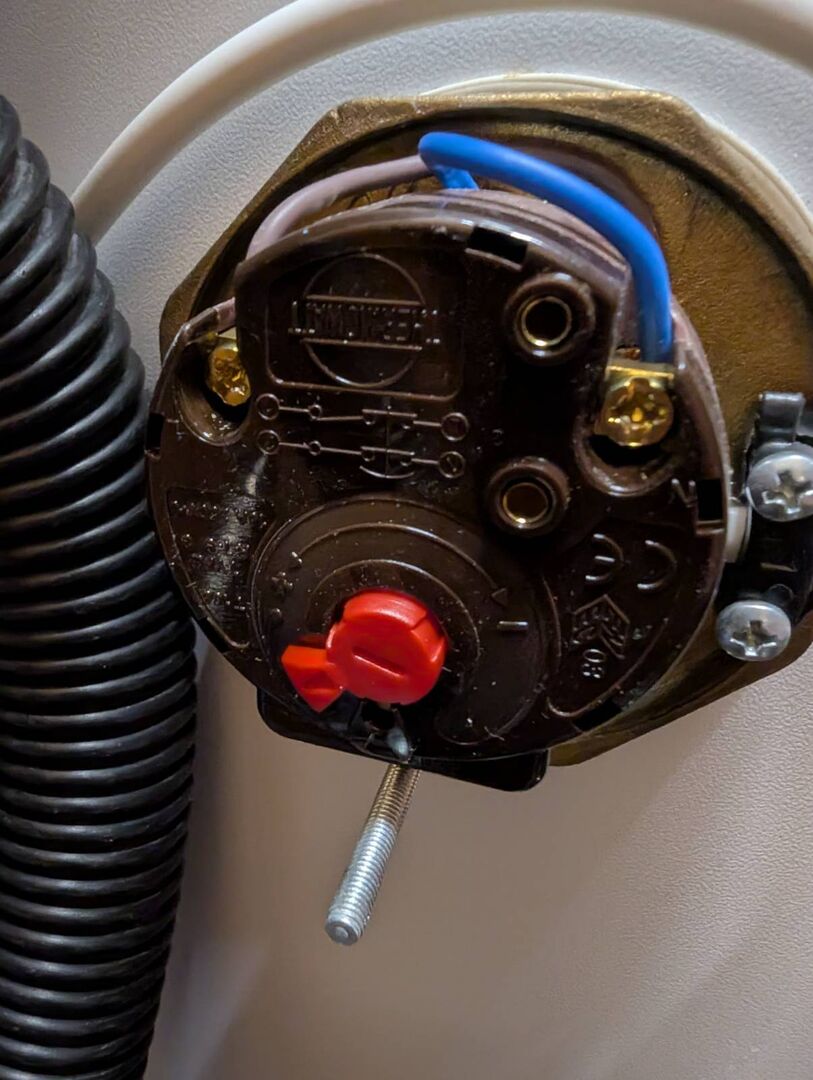
A bit hard to see but the dial was about 90% of the way anticlockwise towards the + symbol. I turned it anticlockwise all the way:
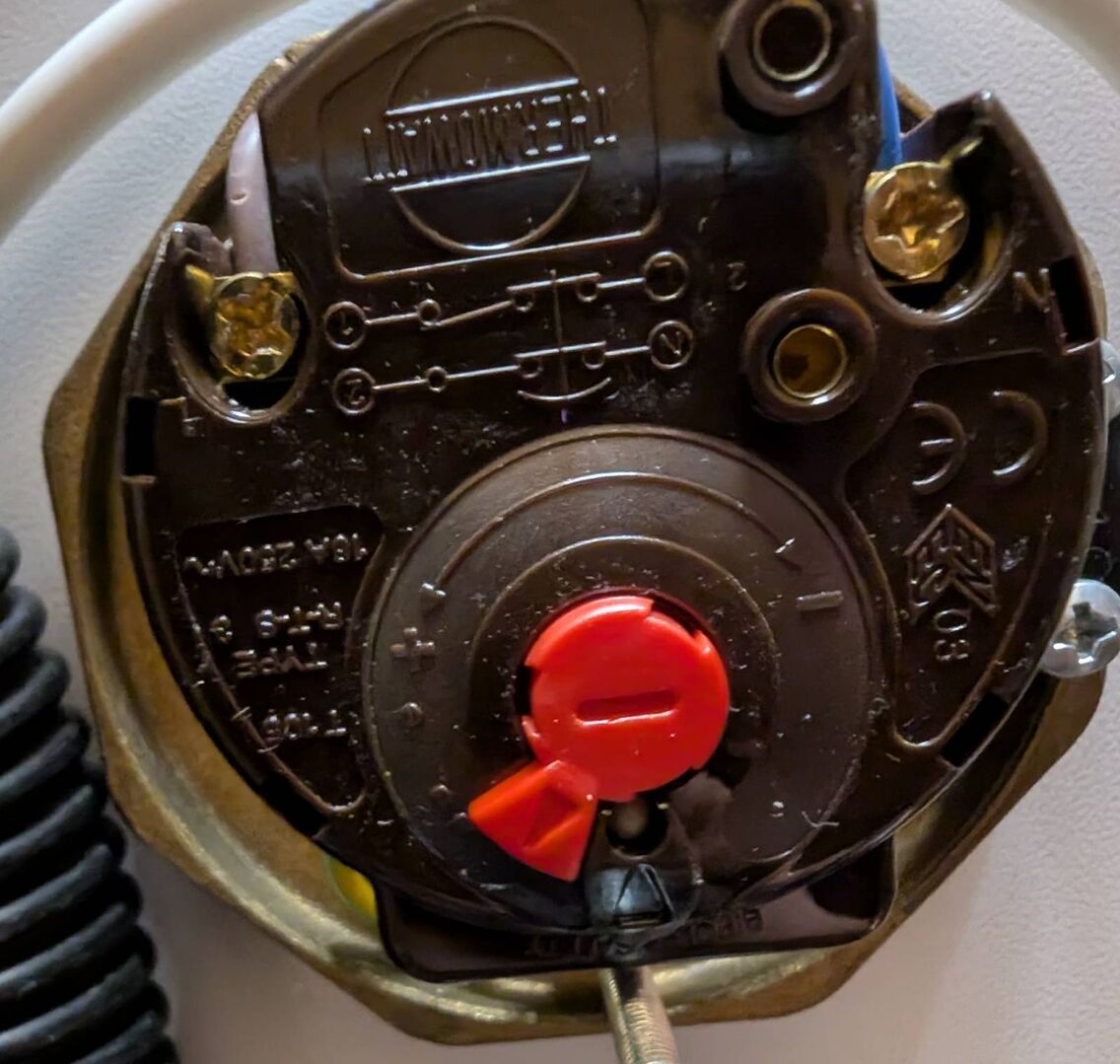
then restarted the immersion and I got:
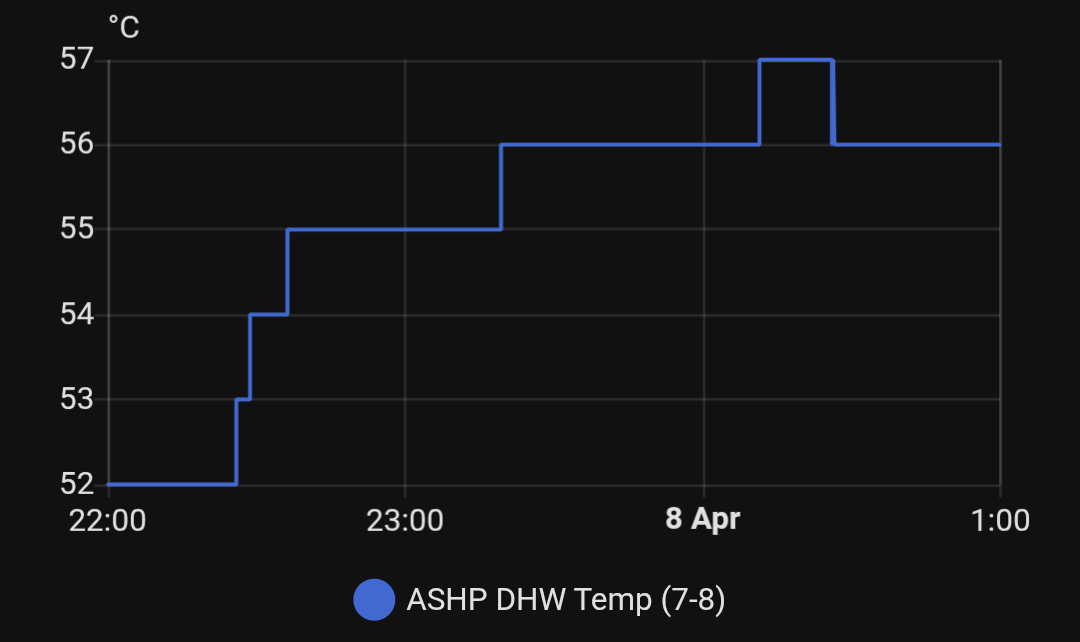
so 57C is the max it will go. According to some calculations, 3kW (confirmed on the meter) into a 200 litre cylinder should cause a rise of 12.9degC per hour, or roughly a degree per 5 minutes. The immersion is at the bottom of the cylinder as you'd expect and the pocket with the thermistor that the ASHP is reading is halfway up (the immersion is not being externally controlled here, just using its own thermostat). The hot water is being drawn off the top of the cylinder.
I can't find any manual for this immersion, but the only downloadable manuals on the Thermowatt website say the factory set should be 65C or 75C for various models. That's also what the label seems to imply:
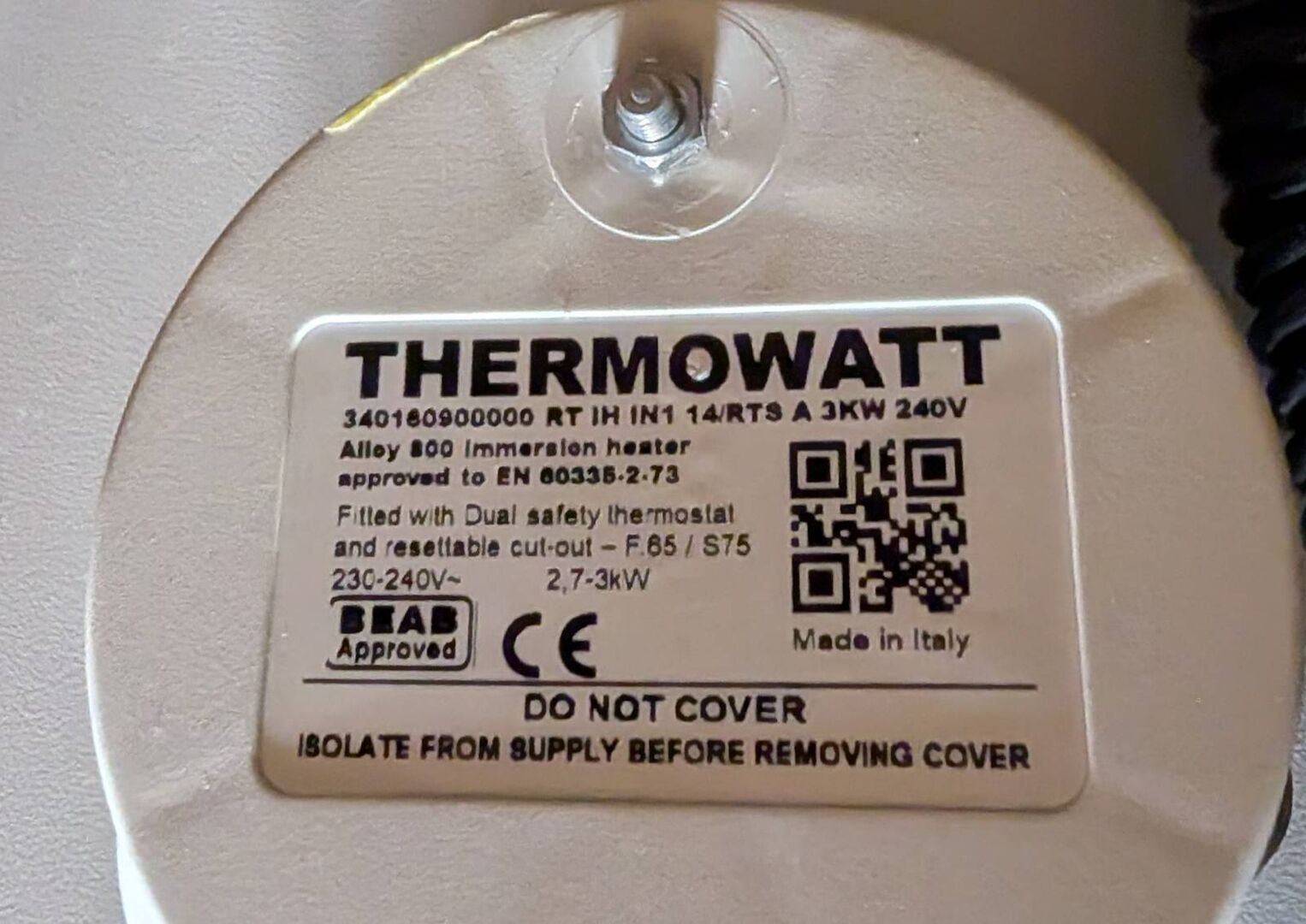
It seems to be really struggling to heat the water. I think this points to a faulty thermostat on the immersion, but before I go draining everything down to change it did I perhaps miss something?
This topic was modified 7 months ago by Prunus
Topic starter
08/04/2026 10:33 am
Also to add, on the original Grant wiring there was a separate tank stat which is in the pocket at the top of the cylinder. I have disconnected this and am just relying on the thermostat inside the immersion heater. Was that a mistake?

08/04/2026 10:44 am
Also to add, on the original Grant wiring there was a separate tank stat which is in the pocket at the top of the cylinder. I have disconnected this and am just relying on the thermostat inside the immersion heater. Was that a mistake?
Not sure which sensor you are referring to.
When the heat pump heats the DHW (ie normal DHW heating not the legionella cycle) it relies on the tank sensor (NOT the one associated with the immersion) to tell it what the temperature of the water is. This is normally in a pocket about half way down and must not be removed.
This post was modified 7 months ago by JamesPa
4kW peak of solar PV since 2011; EV and a 1930s house which has been partially renovated to improve its efficiency. 7kW Vaillant heat pump.
Topic starter
08/04/2026 12:15 pm
Here is the full setup (I really should tidy that wiring...):
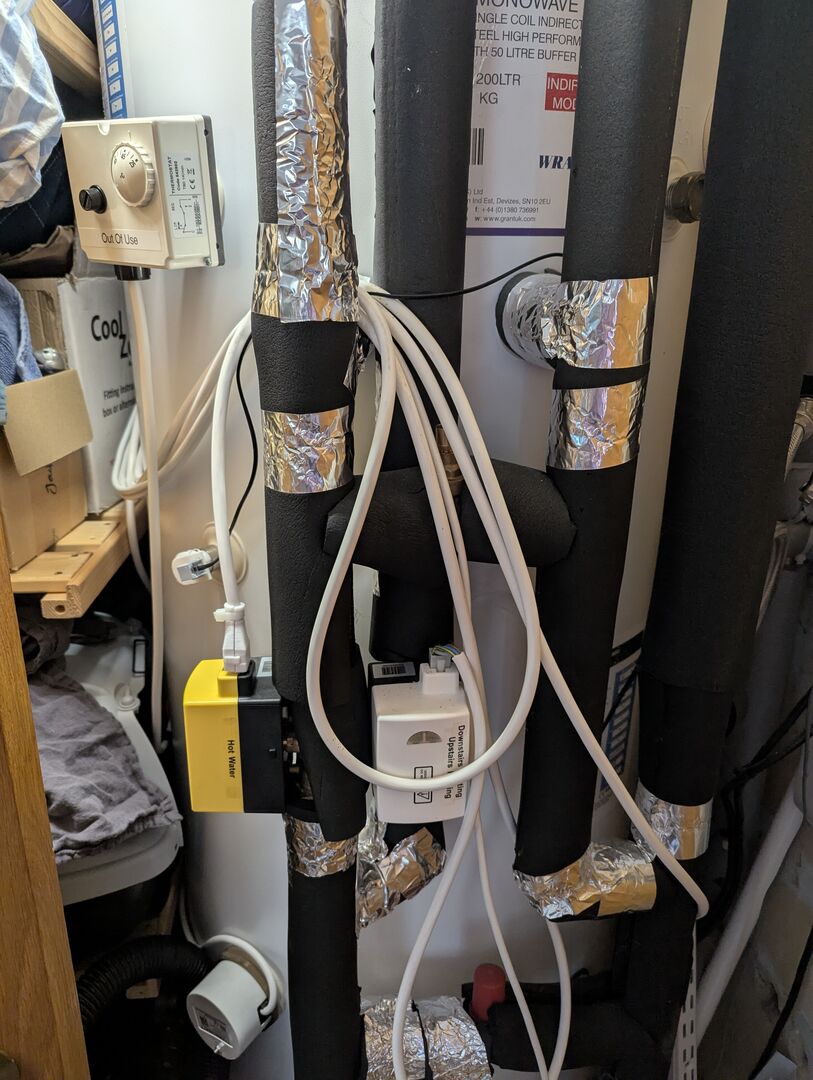
Disconnected tank stat at the top pocket, thermistor going to the ASHP in the middle pocket, immersion in the bottom pocket. The buffer is below that out of shot.
Tank stat:
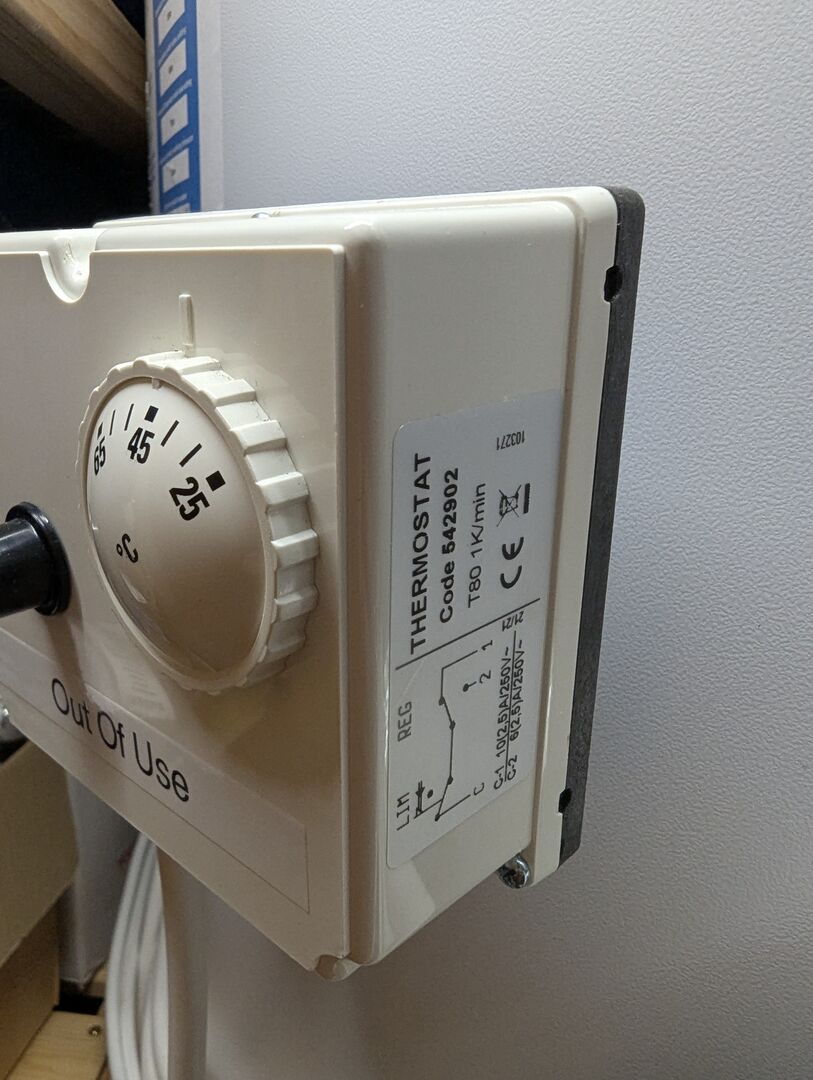
Grant's wiring for this is as if it was a classic gas boiler: boiler programmer -> tank stat -> immersion. There is additionally a single DIN timer and contactor for immersion boost. AIUI the tank stat is used for setting the normal ASHP target DHW temperature (eg 45 as it's currently showing) where the Grant wiring centre then shuts off hot water mode once the tank stat opens. I believe the boost timer overrides the tank stat and heats the hot water using only the thermostat in the immersion, to get it up to 60+C for legionella. Because this immersion timer has no temperature sensing the whole legionella cycle is done open-loop by immersion alone (ie it's just run for a fixed time, without preheating by ASHP and just hoping nobody ran a bath in the middle).
I have disconnected the whole Grant wiring centre and replaced it with controls from the ASHP, ie the ASHP does it's own legionella cycle and then it's own DHW boost output kicks in the immersion once it has achieved maximum temperature, according to the thermistor. That means the ASHP just powers the immersion until 60C is sensed. The thermostat on the immersion wants to be set higher (say 65) so it will reach 60C and be shut off by the ASHP before the immersion shuts itself off.
But perhaps I misunderstood something about this particular immersion? The instructions for those Thermowatts I can find are clear as mud.

08/04/2026 12:56 pm
Grant's wiring for this...
like almost everything else in Grant's original wiring schemes, should be ignored - as you have
I have disconnected the whole Grant wiring centre and replaced it with controls from the ASHP, ie the ASHP does it's own legionella cycle and then it's own DHW boost output kicks in the immersion once it has achieved maximum temperature, according to the thermistor. That means the ASHP just powers the immersion until 60C is sensed. The thermostat on the immersion wants to be set higher (say 65) so it will reach 60C and be shut off by the ASHP before the immersion shuts itself off.
Very sensible!
But perhaps I misunderstood something about this particular immersion? The instructions for those Thermowatts I can find are clear as mud.
Do you know what the 'tank stat' did before you disconnected it?
I have a Grant Aerona3 13kW and I've wired it so the ASHP controls the legionella cycle (disconnecting the spurious Grant timer box they install). The way this works is the ASHP runs up the hot water to the maximum temperature it can manage, then hands over to the immersion heater for the last few degrees to get it to 60C. On the standard setup it has 2 hours to do that - there's a service manual parameter to extend it to 3 hours, which I've done. After 3 hours the water is only at 50C and the ASHP flashes 'LC' meaning legionella cycle failed. Next week comes around and it does legionella again and the same happens... every week.
Does it actually ever enable the immersion. If not it may be that 'backup heater' has not been enabled in the installer menu, or if it has its parameters set up wrongly.
Alternatively it may be that the immersion simply doesn't go far enough down the tank so it heats the top third (above the Grant temperature sensor) then turns itself off before the the bit down to the Grant sensor gets heated. This may conceivably be worse than not running legionella at all! My Vaillant tank is like that, the immersion heater really only heats the top bit of the tank and the sensor barely notices it. In this case however its doesn't matter much because the Vaillant does the legionella cycle natively without invoking the immersion heater, and gets it to 69C.
4kW peak of solar PV since 2011; EV and a 1930s house which has been partially renovated to improve its efficiency. 7kW Vaillant heat pump.
Topic starter
08/04/2026 1:47 pm
I think we're talking at cross purposes here. The above test is with the ASHP completely turned off. The setup is mains -> power meter -> contactor -> immersion, and the contactor is turned on. ie the immersion is just constantly across the mains and yet it can only achieve 57C at its maximum setting. There is no thermostat in circuit beyond the thermostat integrated into the immersion.
The immersion is at the bottom of the cylinder but that should mean that the sensor in the middle of the cylinder and the water drawn off should be hotter than 57. In the draw-off after running the hot tap for a minute or two the highest I could get on my coffee and jam thermometers was about 55-56, which is probably within measurement error. (Hot side of kitchen mixer tap, not anything fancy like a thermostatic mixer)
So either the immersion is faulty or I misunderstood its settings. I can't think of anything else it could be, unless I misunderstood something about how this immersion operates?
(also to note that supposedly the safety cutout reset is a button on the immersion but seemingly that is pushed in on the pictures above, suggesting the cutout hasn't activated)
This post was modified 7 months ago 4 times by Prunus
08/04/2026 3:13 pm
I think we're talking at cross purposes here. The above test is with the ASHP completely turned off. The setup is mains -> power meter -> contactor -> immersion, and the contactor is turned on. ie the immersion is just constantly across the mains and yet it can only achieve 57C at its maximum setting. There is no thermostat in circuit beyond the thermostat integrated into the immersion.
The immersion is at the bottom of the cylinder but that should mean that the sensor in the middle of the cylinder and the water drawn off should be hotter than 57. In the draw-off after running the hot tap for a minute or two the highest I could get on my coffee and jam thermometers was about 55-56, which is probably within measurement error. (Hot side of kitchen mixer tap, not anything fancy like a thermostatic mixer)
So either the immersion is faulty or I misunderstood its settings. I can't think of anything else it could be, unless I misunderstood something about how this immersion operates?
(also to note that supposedly the safety cutout reset is a button on the immersion but seemingly that is pushed in on the pictures above, suggesting the cutout hasn't activated)
Ah. Ok with immersion at bottom then the whole cylinder should eventually heat. The hottest point will still be by the element, but you would expect everything above that to rise eventually to whatever the thermostat setting is on the immersion or perhaps a tiny bit below if the currents local to the immersion stat cause local hot spots.
Im wondering if there is actually a fault, or whether 57 is the temperature at which the immersion thermostat (possibly nominally set to 60) cuts out. Obviously at this point it would cease drawing power which you would detect. I cant see how it can continue to draw power without the tank continuing to heat, unless there is a heat sink! Otherwise it hat would be violating the laws of thermodynamics.
4kW peak of solar PV since 2011; EV and a 1930s house which has been partially renovated to improve its efficiency. 7kW Vaillant heat pump.
Topic starter
08/04/2026 3:41 pm
I suppose it could be that 57C is the maximum achievable temperature by the immersion heater, but I thought the point of the adjustment is you could set them higher than that? eg the manual for the 420011210800 "Thermowatt RT 1” ½ IP65 with RTS thermostat - Bipolar double safety disconnection" says:
The immersion heater is supplied with a RTS/RTS PLUS thermostat. Functional temperature
is factory set to 75°C, with adjustable temperature.
To maintain safety, any replacement thermostat must be of the same type.
RECOMMENDATION: low water temperature is recommended to reduce limestone deposit
(Not lower than 60°C).
and that has a picture that looks like the same as the back of mine. But nowhere, either on the product page or in the zipped PDF, does it state minimum/maximum thermostat temperatures.
As you say, if it's powered either the heat has to go somewhere or it's shut itself off - the power meter indicates it's shut itself off, which points to the internal thermostat. Moving the setting on the internal stat does seem to improve the shutoff temperature slightly. But could it be so out of calibration?

08/04/2026 3:43 pm
I suppose it could be that 57C is the maximum achievable temperature by the immersion heater, but I thought the point of the adjustment is you could set them higher than that? eg the manual for the 420011210800 "Thermowatt RT 1” ½ IP65 with RTS thermostat - Bipolar double safety disconnection" says:
The immersion heater is supplied with a RTS/RTS PLUS thermostat. Functional temperature
is factory set to 75°C, with adjustable temperature.
To maintain safety, any replacement thermostat must be of the same type.
RECOMMENDATION: low water temperature is recommended to reduce limestone deposit
(Not lower than 60°C).
and that has a picture that looks like the same as the back of mine. But nowhere, either on the product page or in the zipped PDF, does it state minimum/maximum thermostat temperatures.
As you say, if it's powered either the heat has to go somewhere or it's shut itself off - the power meter indicates it's shut itself off, which points to the internal thermostat. Moving the setting on the internal stat does seem to improve the shutoff temperature slightly. But could it be so out of calibration?
If the cut out is at 65 I would guess the max design temp is 60, so actual of 57 is plausible albeit at the margins. Bear in mind these are generally bimetallic strip thermostats so yes it could be that far out of calibration (if they even bother calibrating them, which frankly I doubt).
4kW peak of solar PV since 2011; EV and a 1930s house which has been partially renovated to improve its efficiency. 7kW Vaillant heat pump.
Topic starter
08/04/2026 3:58 pm
Well, if that's the right PDF the factory set is supposed to be 75 so in theory it should go up at least that far when cranked up to the max. A bit poor that it could be 18C off, especially where legionella might be a risk. I suppose I'll have to replace it with something better - any recommendations?
Edit: ah, does F.65/S.75 on the label mean 'max functional temp 65C, safety cutout temp 75C'? So it's not possible to set it above 65 +/- lots?
This post was modified 7 months ago by Prunus
08/04/2026 6:34 pm
@prunus Hmm
57 vs 65 does seem a way off, but perhaps not impossible. Given the purpose, one might argue that its not fit for purpose!
I cant advise on immersion heaters TBH, my guess a fair proportion are made in the same factory in China then just branded differently. They arent expensive, but of course you will need to drain the tank.
4kW peak of solar PV since 2011; EV and a 1930s house which has been partially renovated to improve its efficiency. 7kW Vaillant heat pump.
Topic starter
17/05/2026 2:59 pm
To conclude this story, I hadn't realised that immersion thermostats are a separate replaceable item to the immersion heater itself. I ordered a Cotherm TSE00187 which claims to go up to 70C, and is a replacement for the Thermowatt RTS3 installed on my immersion. Until now it's been sitting in my in-queue waiting to be fitted, and I finally got around to it.
It's a straight swap - undo L and N wires from old thermostat, pull to remove. Push on new thermostat ensuring alignment with spade connectors on the immersion coil, connect up wires. Took 5 minutes.
Now it doesn't actually manage 70C, it only gets to 66, but that's enough for the ASHP to be happy. It's also rather hot - I never worried about having separate taps instead of mixers until now! I'll probably back it off a bit, but for now seems to be much improvement - £23.25 well spent!
1

Page 1 / 2
Next
SPONSORS

Degrees of Separation
Latest Posts
-

RE: How will removing the standing charge on gas bills benefit heat pumps?
I'm not sure it makes much of a difference to heat-pump...
By Temperature_Gradient , 5 hours ago
-
@editor Ouch, sorry to re start the tick. I had assume...
By DavidB , 5 hours ago
-
RE: Say hello and introduce yourself
@e-a-west as the good Major said, welcome to the forums...
By Mars , 7 hours ago
-
RE: New Build 3 Phase or 1Phase
We are on three phase power because it's an enormous li...
By EtchedPixels , 7 hours ago
-
RE: How much of your renewable and home setup would still work if the internet went down?
Yes I actually have a copy of a tool that whenever a ce...
By EtchedPixels , 16 hours ago
-
RE: Indevolt Batteries UK Support & Info Thread
@editor Hi, To resolve this, please tap on the A...
By Indevolt Tech , 23 hours ago
-
RE: Double or Triple Glazed Windows?
Posted by: @singlespeed With 9 years repairing windo...
By Rob of York , 2 days ago
-
@transparent we’re still running a secure version of PH...
By Mars , 2 days ago
-
RE: How quickly would you want/expect heat recovery to take from setback?
Much longer than that here. The heating isn't even on. ...
By bobflux , 2 days ago
-
RE: Passiv Smart Thermostat - Help & Forum Support
Obviously the weather is changeable but there's a defin...
By Singlespeed , 2 days ago
-
RE: The Changing Jet Stream Could Challenge UK Air Source Heat Pumps
@rob-of-york I must admit that when we had a Daikin hea...
By Toodles , 2 days ago
-
RE: Forum updates, announcements & issues
Get the Renewable Heating Hub heads-up on WhatsApp. I...
By Mars , 3 days ago
-
RE: Safety study for plug in batteries out to tender - looks like Q3 2027 at best before legal
@editor I pointed out to the one of the Fuse execs that...
By dansus , 3 days ago
-
RE: 15kw pump for 225m2 1990's house - over kill?
@seaviews As well as loft insulation, there are othe...
By Rob of York , 3 days ago




SPONSORS
