

Notifications
Clear all
Joining the Renewable Heating Hub forums is completely free and only takes a minute. By registering you’ll be able to ask questions, join discussions, follow topics you’re interested in, bookmark useful threads and receive notifications when someone replies. Non-registered members also do not have access to our AI features. When choosing your username, please note that it cannot be changed later, so we recommend avoiding brand or product names. Before registering, please take a moment to read the Forum Rules & Terms of Use so we can keep the community helpful, respectful and informative for everyone. Thanks for joining!

Topic starter
08/06/2022 5:27 pm
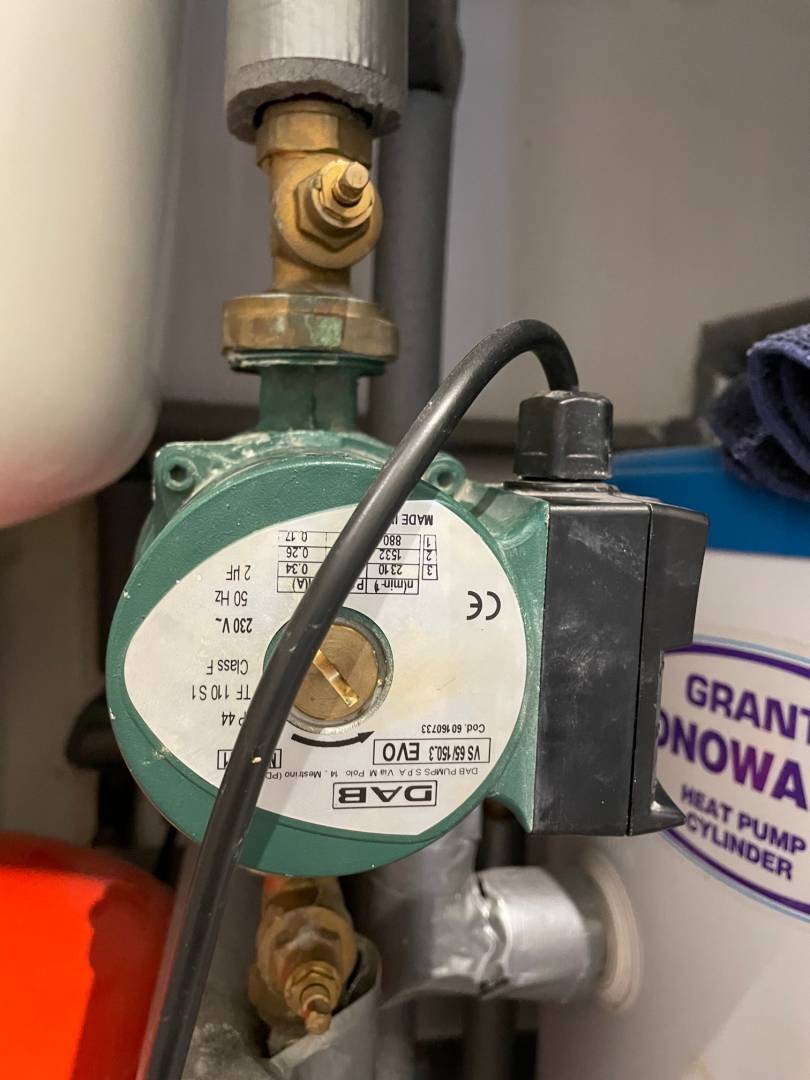
A few days ago the joint above this pump on our heating system started to leak. I was alerted to it by the RCD tripping in the fusebox due to the water ingress into the pump's electrical supply. A plumber (turned out to be the same guy who had replaced a faulty main PCB on our Grant heat pump 2 years ago) soon fixed the leak by replacing a seal inside the joint.
It was then that he said this is the auxiliary pump which just speeds up delivery of hot water. It's optional, you don't have to have one. You can turn it off and save electricity if you don't mind waiting longer for the taps or shower to deliver.
If he's right then I think it was installed incorrectly. It is wired into the Honeywell timer which is set to switch space heating off when the water is being heated and vice-versa. The pump can only come on when the timer is set for the heat pump to heat the water. When space heating is on (ie most of the time) then the pump is off. So, it can't be speeding up the supply of hot water when a tap is turned on.
It appears to me me that, as wired, this pump (a £200 componenet) serves no useful purpose. Could I be right?
Mike
Grant Aerona HPID10 10kWh ASHP

09/06/2022 8:49 am
I'm guessing the pump is there to boost the flow of the water, in a low pressure DHW system? Try turning it off somehow, or turning it down, see if you can tell the difference!
Alternatively, in larger houses and hotels, it's common to have a hot water return line, so the hot water is circulated back to a tank either on demand (eg when the bathroom light is turned on) or constantly. This means that when you turn on a hot tap, it's much quicker to give hot water. They obviously waste a lot of elec and heat. A better solution in a home is likely to use smaller bore pipes direct to the tap - the flow speed will be a lot higher, so there will be less wasted water before it gets hot, and less wasted heat afterwards.

SPONSORS

Degrees of Separation
Latest Posts
-

RE: How will removing the standing charge on gas bills benefit heat pumps?
I'm not sure it makes much of a difference to heat-pump...
By Temperature_Gradient , 1 hour ago
-
@editor Ouch, sorry to re start the tick. I had assume...
By DavidB , 2 hours ago
-
RE: Say hello and introduce yourself
@e-a-west as the good Major said, welcome to the forums...
By Mars , 3 hours ago
-
RE: New Build 3 Phase or 1Phase
We are on three phase power because it's an enormous li...
By EtchedPixels , 4 hours ago
-
RE: How much of your renewable and home setup would still work if the internet went down?
Yes I actually have a copy of a tool that whenever a ce...
By EtchedPixels , 13 hours ago
-
RE: Indevolt Batteries UK Support & Info Thread
@editor Hi, To resolve this, please tap on the A...
By Indevolt Tech , 20 hours ago
-
RE: Double or Triple Glazed Windows?
Posted by: @singlespeed With 9 years repairing windo...
By Rob of York , 1 day ago
-
@transparent we’re still running a secure version of PH...
By Mars , 2 days ago
-
RE: How quickly would you want/expect heat recovery to take from setback?
Much longer than that here. The heating isn't even on. ...
By bobflux , 2 days ago
-
RE: Passiv Smart Thermostat - Help & Forum Support
Obviously the weather is changeable but there's a defin...
By Singlespeed , 2 days ago
-
RE: The Changing Jet Stream Could Challenge UK Air Source Heat Pumps
@rob-of-york I must admit that when we had a Daikin hea...
By Toodles , 2 days ago
-
RE: Forum updates, announcements & issues
Get the Renewable Heating Hub heads-up on WhatsApp. I...
By Mars , 2 days ago
-
RE: Safety study for plug in batteries out to tender - looks like Q3 2027 at best before legal
@editor I pointed out to the one of the Fuse execs that...
By dansus , 2 days ago
-
RE: 15kw pump for 225m2 1990's house - over kill?
@seaviews As well as loft insulation, there are othe...
By Rob of York , 2 days ago




SPONSORS
