
Notifications
Clear all

01/02/2026 10:47 am
New Year, But Not the Best January Production.
The trend of increasing monthly production year by year has gone downhill I’m afraid. Oh well, perhaps February will do better!


Regards (Regrets maybe?) Toodles.
Toodles, heats his home with cold draughts and cooks food with magnets.

01/02/2026 11:03 am
Sun path critical for us, needs to get over a hill to hit the roof, currently lightly touching our lower smaller array but not the main roof yet. Back end of Jan starting to perk up even with daily rain and cloud.

This post was modified 1 month ago by Papahuhu

01/02/2026 12:42 pm
We've had solar for the past three Januaries. These were our monthly yields: -
Jan 2024: - 320kWh
Jan 2025: - 256kWh
Jan 2026: - 309kWh
Full years so far: -
2024: - 7588kWh
2025: - 8723kWh, including increased battery capacity which greatly improved (reduced) inverter clipping during solar peaks.
Mitsubishi Ecodan 11.2kW R32 ASHP; Ecodan DHW cylinder; UFH+rads
20x430W Jinko TOPCON Tiger Neo solar; Luxpower 6+4kW hybrid inverter; 20kWh Hanchu ESS LFP battery storage
PHEV; Zappi charger
1997 stone detached house with updated insulation. 140sqm, maintained at 20-22degC 24/7
1

02/02/2026 4:24 pm
2025 yield was 9MWh, 7x565Wp facing SE + 7x565Wp facing NW (almost 8kwp installed power). Sun disappearing rather too soon behind a hill in our location.
The production numbers I read in this thread have impressed me as I always thought of UK as a rainy, ever overcast place. But then I realized that compared to Greece a) daylight lasts longer in the summer b) summers are cooler and this helps the panels plus c) climate change is here
Since Heathrow was mentioned in an earlier post, Athens International Airport (1/3 of Heathrow in annual passenger volume) runs completely on PV in-situ generated power as of January 2026. Installed capacity is 51MWp plus 82MWh batteries. If you go in Google Maps you can see the panel farm installed along the runway. I would assume they have backup connections to the grid also. I thought I’d mention it to boost our faith in technology… 🙂

1
02/02/2026 4:38 pm
@mk4 Coo! That’s a tidy bit of solar produced power!!! Toodles.
Toodles, heats his home with cold draughts and cooks food with magnets.
1
02/02/2026 6:23 pm
@mk4 For many of us, whom live in the less sunny parts of the country, we overcome poor per panel production by installing oversized systems. With cheap but good Chinese panels it becomes an economically viable option to do this, whereas it never used to be.
Does Greece offer viable export rates for your excess production, or do you run aircon to use up that 9mWh instead?
This post was modified 4 weeks ago by Papahuhu
02/02/2026 8:13 pm
We have a netmetering contract. The unconsumed energy flows into the grid, we draw from the grid what we need (when PV production and/or battery energy cannot cover our needs) and there is a clearance every 3 years. If we source more than we gave to the grid, we pay for the extra energy. If we gave more than we sourced, we get nothing.We have no aircon units (we live in a relatively cool area), so today all the excess flows into the grid.
We pay of course network usage charges for every KWh we source from the grid (circa 5 cents).
This type of contract is no longer available. Nowadays the clearance is done on a billing level i.e. How much was the cost of the KWhs when you sourced energy minus how much was the cost when you gave to the network. Energy providers had a problem with netmetering, because everybody was producing in the summer (when sometimes energy cost is 0 in the country energy exchange due to mass PV and wind production) and sourcing in winter when energy is always more expensive.
The sizing of the PV panels was done with the ASHP in mind. Since we just installed it, I guess we will know in circa 15 months where we stand.
02/02/2026 8:39 pm
@mk4 Nett metering is great. The VPP I’m on works by charging the same for import and export, they then issue debit or credit each month to the account. We are doubly lucky because at the high solar months we can switch back to a tariff that favours nett import and can switch back again in the spring. I don’t know how long they will allow this to happen as I had a nett export of about 9mWh, so several thousand pounds, but it’s clearly not sustainable for any supply business to carry on doing this. My assumption is that the regulator will have to start to limit the array sizes or put a lower cap on export. It feels a bit ethically irresponsible, but us petite bourgeoise are too small minded to let that get in the way of making a little profit.
1
01/03/2026 10:24 am
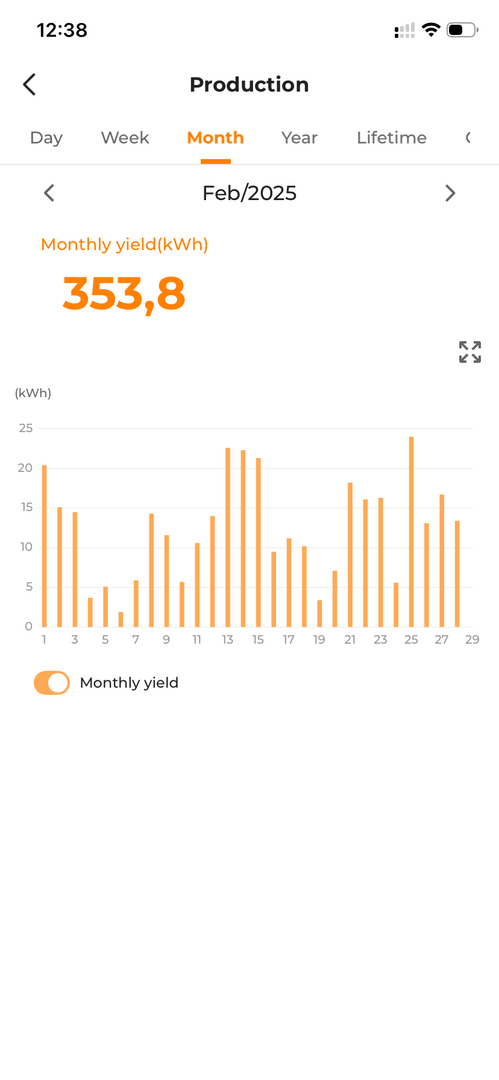
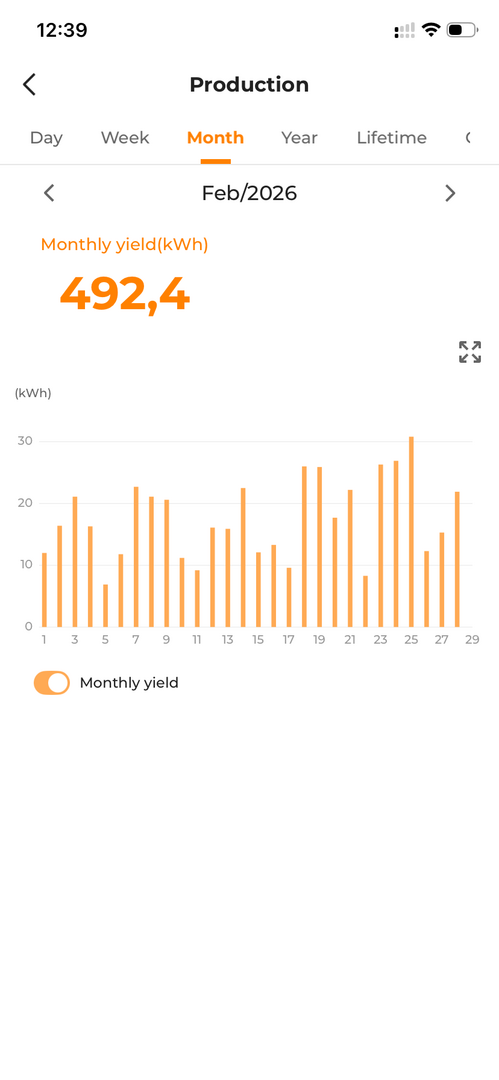
@papahuhuahuhu Here we are again - summing up Feb. 2026 solar production … In Mar’s words, Not So Great this year! Hoping for a bumper March (can but hope!)
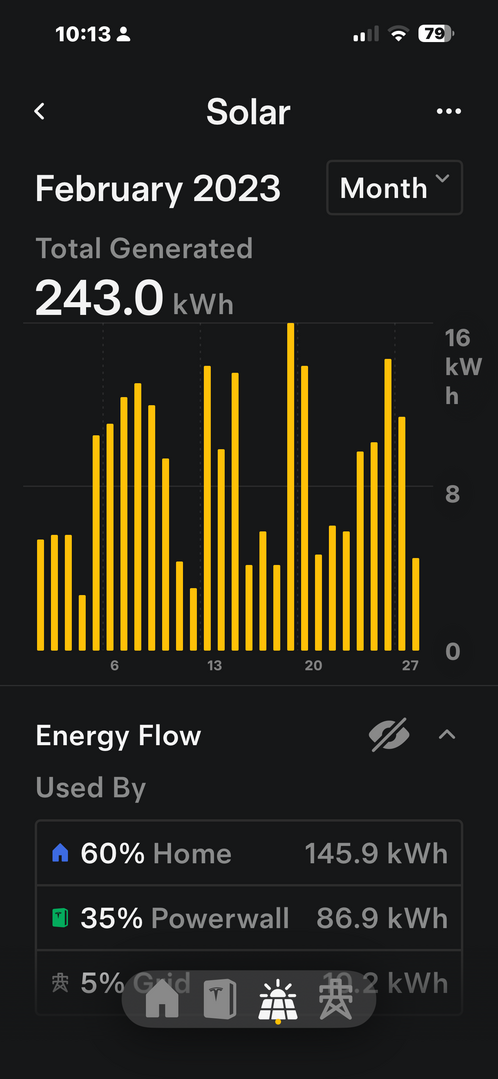
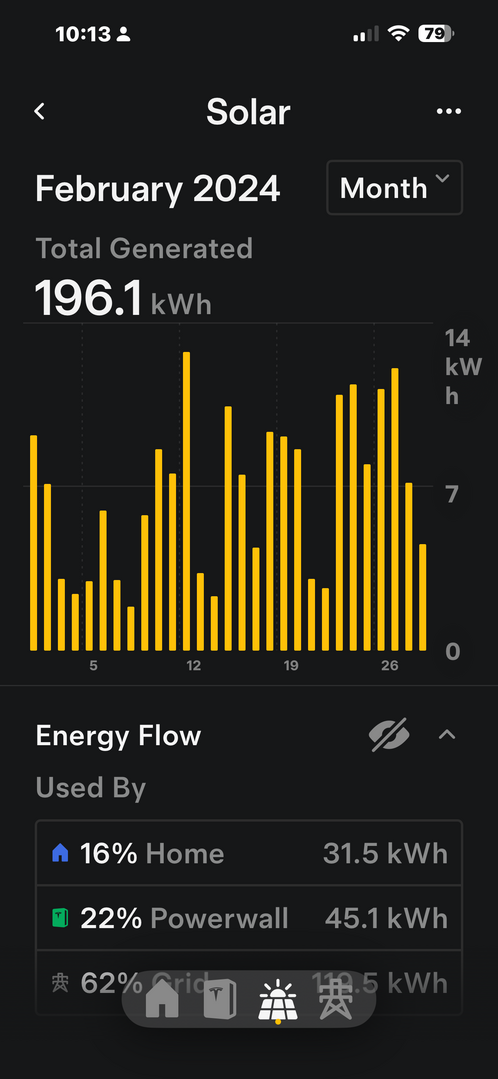
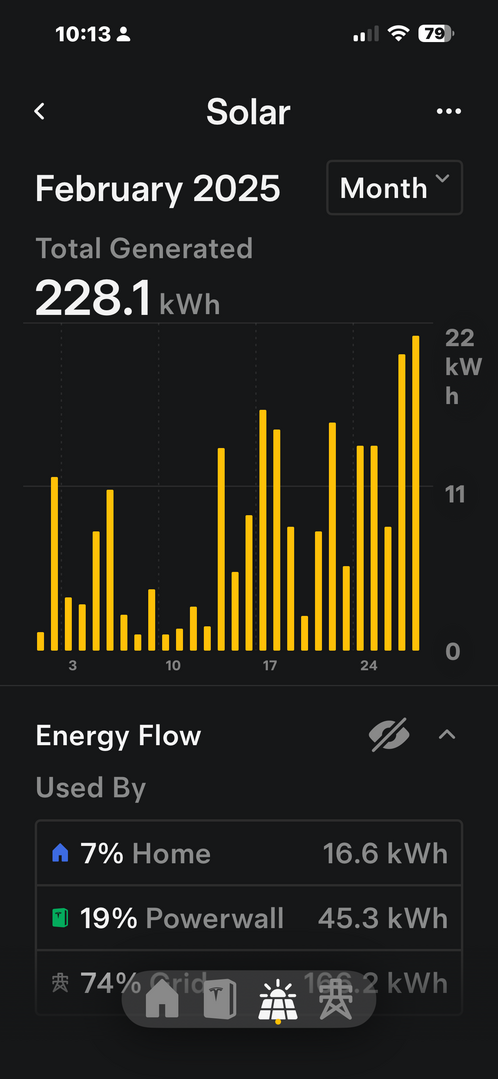
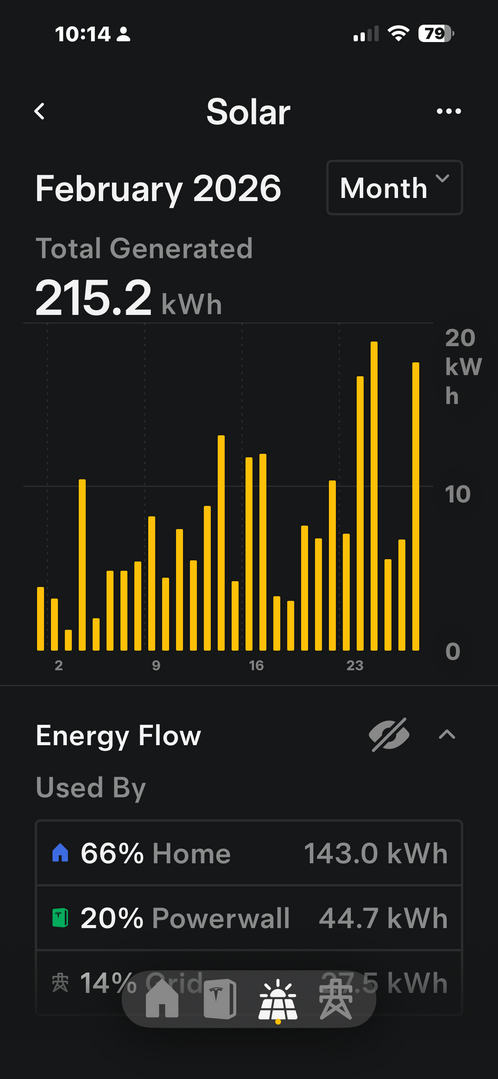
Regards and Hopes, Toodles.
This post was modified 3 days ago by Toodles
Toodles, heats his home with cold draughts and cooks food with magnets.
01/03/2026 10:55 am
Despite the increased precipitation events we experienced this February (thankfully), yield has been much higher than last year’s one.
01/03/2026 11:00 am
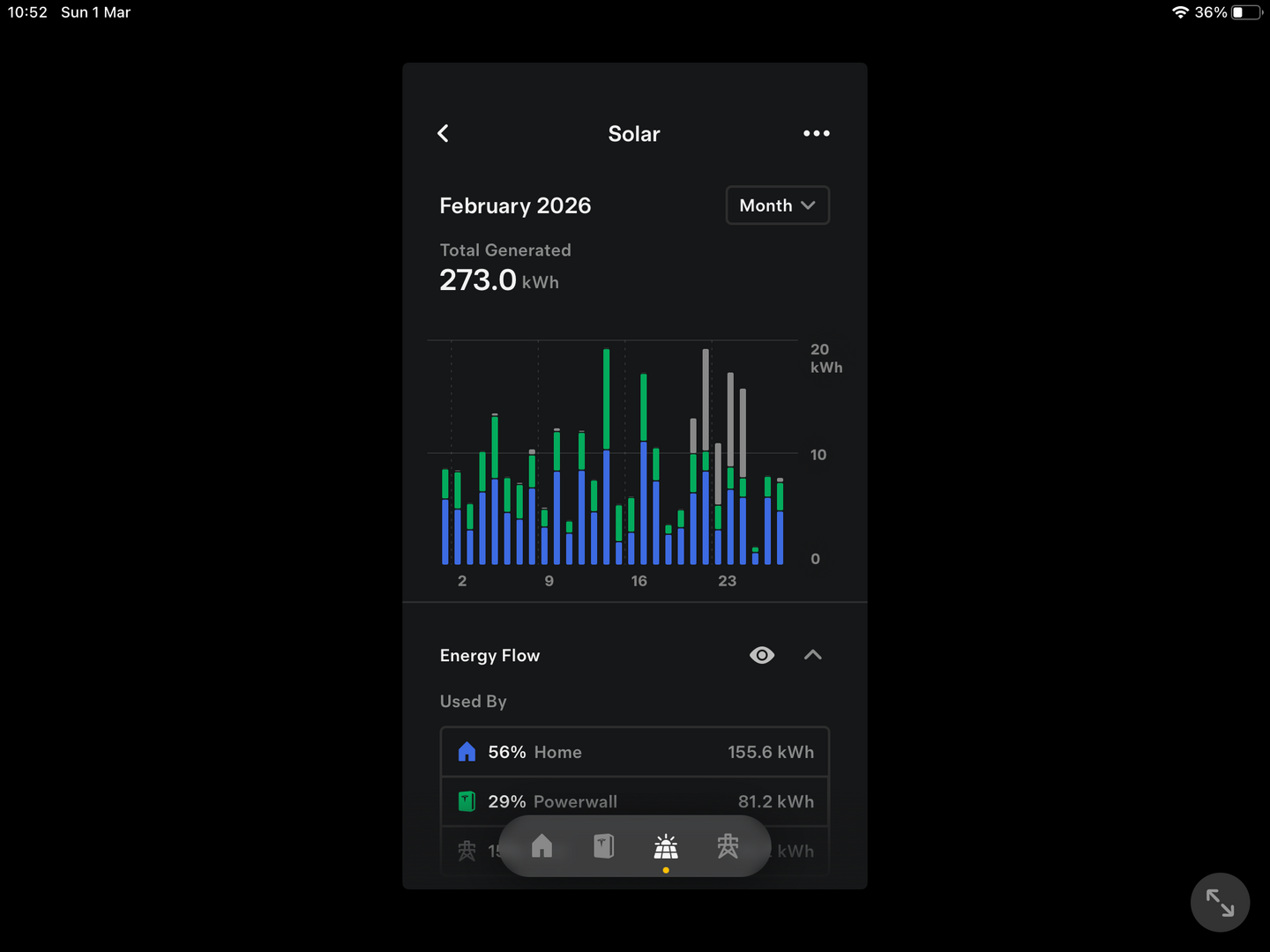
Thought it was picking up and actually started to export, but the constant cloud and rain returned. So decided to give it another week before switching to IOF as my export isn’t reliable for me yet. Irritating as the trees aren’t in leaf yet and in those rare hours of blue sky it flies, but so much heavy cloud every day and always at noon.
01/03/2026 11:58 am
@mk4 Sorry, I hope my green hue is not offending you.🤢 Toodles.
Toodles, heats his home with cold draughts and cooks food with magnets.

Latest Posts
-

RE: Daikin Altherma 3 LT compressor longevity question
This mess is intriguing: I wonder if this represent...
By bobflux , 21 minutes ago
-
RE: Say hello and introduce yourself
Hi. I'm Mike. Thank you for letting me join. My partn...
By Fretless6 , 2 hours ago
-
RE: Connecting Growatt SPH5000 over wired ethernet rather than wireless
The simplest wired option is usually the Growatt Ethern...
By Jonatan , 5 hours ago
-
RE: Peak Energy Products V therm 16kW unit heat pump not reaching flow temperature
ASHPs do have a minimum compressor speed. The minimum h...
By bobflux , 12 hours ago
-

RE: Electricity price predictions
@jamespa And it seems some of the nasty public cloud...
By Batpred , 12 hours ago
-
RE: Tell us about your Solar (PV) setup
Location: near Lyon, France 12kWp on the roof, 2x Sol...
By bobflux , 12 hours ago
-

RE: Jokes and fun posts about heat pumps and renewables
Technology is rapidly advancing. BBC News reported th...
By Transparent , 15 hours ago
-
What matters for flow and pressure drop is internal dia...
By bobflux , 16 hours ago
-
RE: Do Fridges and Freezers have COP ratings?
@editor Thank you all for your replies and submitted in...
By Toodles , 18 hours ago
-

I know and yes. The secondary deltaT wont necessaril...
By JamesPa , 22 hours ago
-
RE: Designing heating system with air to water heat pump in France, near Lyon
Just love the way you put it! 🤣
By Batpred , 2 days ago
-
RE: Safety update; RCBOs supplying inverters or storage batteries
Thank you for sharing. So it seems that your Schneid...
By Batpred , 2 days ago
-

RE: Forum updates, announcements & issues
@upnorthandpersonal thanks for the thoughtful, consider...
By Mars , 2 days ago
-
RE: Solar Power Output – Let’s Compare Generation Figures
@mk4 All 21 panels have their own Enphase IQ7a microinv...
By Toodles , 2 days ago
-
RE: Setback savings - fact or fiction?
Great, so you have proven that MELCloud is consistently...
By RobS , 3 days ago
-
RE: Mitsu PUHZ120Y 'Outdoor Temp 'error?
Thanks David & James It almos...
By DavidAlgarve , 3 days ago
-
RE: Surge protection devices SPDs
@trebor12345 - your original Topic about the right type...
By Transparent , 3 days ago
-
RE: Help needed with Samsung AE120RXYDEG
@tomf I’ve been sent this from a service engineer at Sa...
By Mars , 3 days ago
-
RE: Buying large amp bidirectional RCD and RCBO
Yes... I went through this particular headache and ende...
By bobflux , 4 days ago
-
O-oh! Let's take this as an opportunity to 'pass the ...
By Transparent , 4 days ago
-
RE: Homely setup on daikin heat pump
@craigh I refer to our somewhat elevated temperature of...
By Toodles , 4 days ago
-
RE: Air source heat pump roll call – what heat pump brand and model do you have?
My turn, this describes the future installation, only t...
By bobflux , 4 days ago