

Notifications
Clear all
Joining the Renewable Heating Hub forums is completely free and only takes a minute. By registering you’ll be able to ask questions, join discussions, follow topics you’re interested in, bookmark useful threads and receive notifications when someone replies. Non-registered members also do not have access to our AI features. When choosing your username, please note that it cannot be changed later, so we recommend avoiding brand or product names. Before registering, please take a moment to read the Forum Rules & Terms of Use so we can keep the community helpful, respectful and informative for everyone. Thanks for joining!
Safety, Regulations, Tools, Plumbing & DIY Installations
99
Posts
15
Users
24
Reactions
48.7 K
Views

26/08/2023 6:05 pm
In terms of ambient temperature considered I can see that sea level correction is applied, should there be any consideration to wind / how exposed a property is?
Asking as it is noticeably windier where we live now then where we've lived previously...

27/08/2023 4:55 am
No, I believe not. There is the correction for geographical location but not for exposure with the wind wash that can bring, which is why I erred to the lower figures in some measurements to compensate.

21/12/2024 1:37 am
@declan90 I did the Freedom one this week. I’m a way off replacing my gas boiler with a heat pump, but we are looking into making our sunroom and garage conversion into year-round usable rooms….exploring UFH, additional rads or A2A heat pump just across those rooms.
i ran the spreadsheet across the whole house, it’s a 1972 build and the upper half is tile clad…I assume tile…batten…felt…breeze block…plasterboard and no insulation?
anyway…depending on my assumptions, I get 18kw-20600kw heat loss. This seems high, our gas for heating and hot water is currently forecast to be around 13600kwh per year. The annex and conservatory/sunroom are pretty cold…trying to make a garage conversion cosy and usable all year is proving to be a real headache, I’m thinking about insulated plasterboard next
I just wanted to check what I do with these figures…measure up the output of my rads and see if I need to make up the difference anywhere?
I’m not entirely sure if the issue is too much heat loss…not enough heat output ie add more rads, pellet burner, air con etc…or both
not really sure where to start!
21/12/2024 9:25 am
depending on my assumptions, I get 18kw-20600kw heat loss. This seems high, our gas for heating and hot water is currently forecast to be around 13600kwh per year.
This is not uncommon. The Freedom calculator makes all sorts of assumptions, any of which may be wrong. An empirically derived heat loss ie how many kWhs you actually use to keep the house in a steady state at various OATs (outside air temps) is generally a much better estimate of the actual heat loss, after making sensible assumptions about your gas boiler's efficiency. If you have more detailed gas consumption and OAT data , you can plot gas use (again adjusted for efficiency) against OAT and work out heat loss at design temps that way.
Midea 14kW (for now...) ASHP heating both building and DHW


21/12/2024 10:00 am
anyway…depending on my assumptions, I get 18kw-20600kw heat loss. This seems high, our gas for heating and hot water is currently forecast to be around 13600kwh per year. The annex and conservatory/sunroom are pretty cold…trying to make a garage conversion cosy and usable all year is proving to be a real headache, I’m thinking about insulated plasterboard next
Assuming you actually heat the house (which, admittedly, it sounds like you may not fully) a gas consumption of 16kWh and a heat loss of 18kW are not anywhere near consistent. 13MWh/year would correspond to something like 4kW loss, 6kW tops.
I had a garage conversion which was absolutely horrible (single solid brick!). Battening it out followed by insulated plasterboard (walls and ceiling) fixed it, and its now cosy. If I were you I would do some judicious insulation and, if you haven't already got one, get yourself a smart meter so you have half hourly readings. Take photos while you are doing the insulation in case an installer which you otherwise prefer wont believe you without evidence. Once you have done that and if it suits your timescale analyse the half hourly readings to get a measured consumption to sense check/supplement/instead of the fabric spreadsheet. This will also help you size rads more accurately (and with the insulation smaller) which will be useful for aesthetics.
My house, 16kW according to two surveyors, is actually 7.5kW due to fabric upgrades over time. That makes a massive difference in many aspects of the installation.
4kW peak of solar PV since 2011; EV and a 1930s house which has been partially renovated to improve its efficiency. 7kW Vaillant heat pump.

21/12/2024 11:01 am
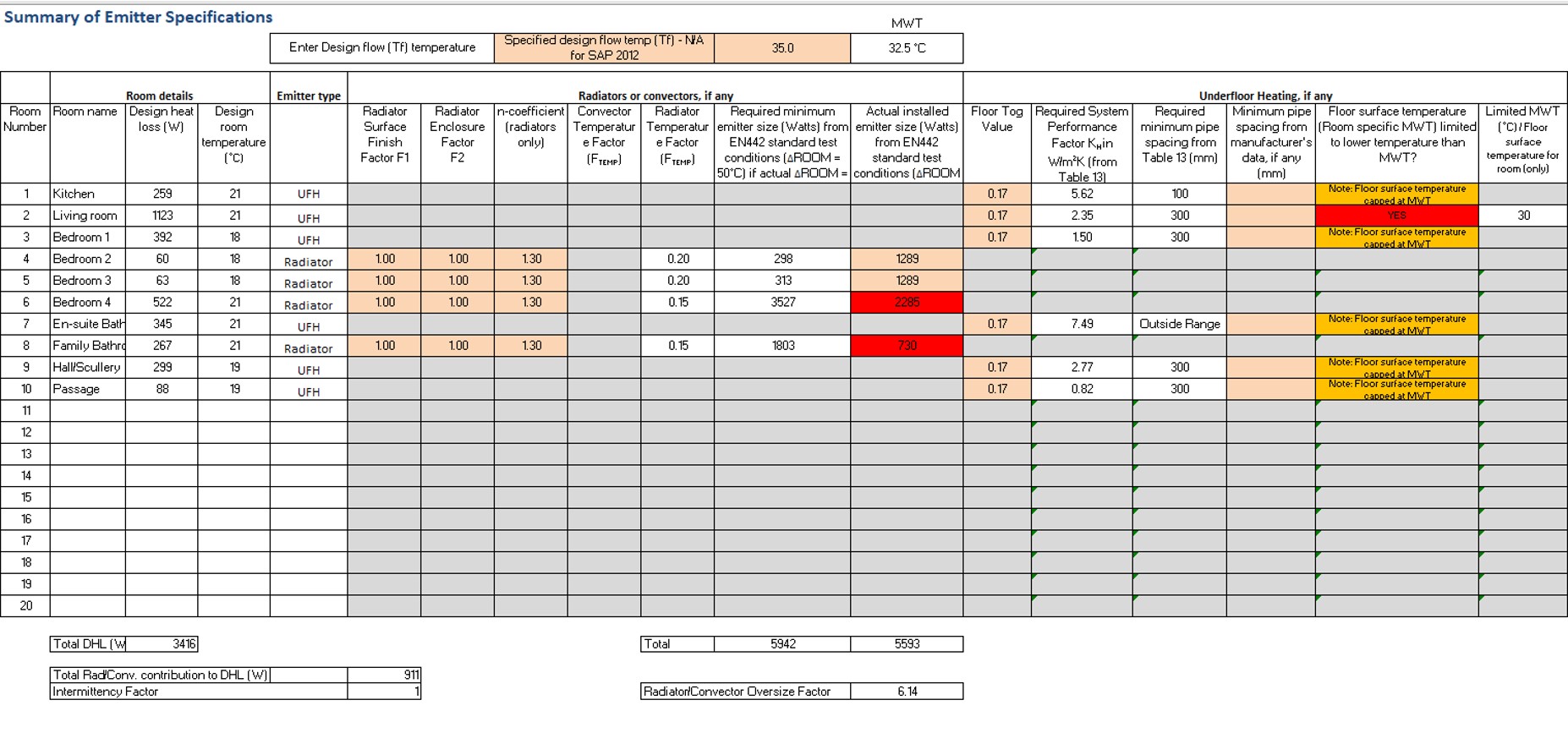
@editor Copy of information from my first post FYI. This tool is very comprehensive but not for the faint-hearted.
"To calculate the heat loss and design, use the free British Research Establishment (BRE) tool available at:
https://www.ncm-pcdb.org.uk/sap/lowtemperatureheating
The design tool in Excel is available at the bottom of the page (BRE - Calculation tool for design of low temperature domestic heating systems - V1.2). This tool will do everything for you to determine pipe spacings and radiator oversizing. Unfortunately, it has errors and has not been updated since 2014. It over-estimates heat loss due to over-ventilation but it is not too serious. You have to ignore the floor temperature blending part which is a load of bollocks. Select an inverter heat pump with a power output a bit larger than the calculated heat loss for a margin, depending on your confidence in the data entered into the model. Heat pump should run on low temperature (as set by you in the model simulation) with weather compensation and HW tank switched via 3-way valve for best efficiency. Take care on room temperatures and regional design temperature, which can be obtained from ASHRAE site for different % occurrence."
Private individual. No affiliation with commercial "Heat Geeks" of same coincidental name.
1
21/12/2024 12:19 pm
@jamespa what size/depth insulated board on the walls/ceiling? Did you also add loft insulation on top?
our conversion has no loft access, so taking the ceiling down would be a good chance to fix the en suite extractor fan and add wiring for downlights. If more insulation is needed on top, the easiest thing to do might be to add celotex between the rafters or joists…? Would that be overkill?
pretty sure most the walls on the old garage are single brick too
we have the heating on 2 zones, I’ve tried lowering the flow temperature to see if an ASHP is viable, I’ve tried smart radiator valves (crap), we added a supalite roof to the conservatory (definitely better) and now I’m looking into additional heating and maybe some insulation, so we sometimes only heat upstairs or downstairs but this year to be honest I’ve mostly just heated everything.
i looked into adding external wall insulation as well to save on room space…£5k just for the garage conversion, but it’d be interesting to see how much it’ll cost to sort insulated plasterboard + plastering etc
i’m just trying to work out where we need more heating ie are there rooms with insufficient heating. I don’t want it to cost too much to keep the house warm, but the conservatory and particularly annex are noticeably colder
21/12/2024 12:20 pm
@heatgeek I’ll give this a look later - thanks, it might be a bit complicated for me though, my knowledge is very basic
21/12/2024 12:27 pm
@cathoderay thanks I get what you’re saying…I just don’t know where I’d start to be able to do those sort of calculations
i was hoping there’d be a spreadsheet I can just find the data, add it, get some answers. The freedom one was a bit like that, it I’m a bit confused by my results
21/12/2024 12:39 pm
The freedom one was a bit like that
One problem with the Freedom one is that there are a lot of hidden cells where all sorts of things happen. Un-hiding them is not for the faint-hearted. The other problem is the spreadsheet makes assumptions, and they aren't always right - in my case, for example, the wall U values were too high. Air changes are another problem area. I've regularly called these spreadsheets classic examples of whatiffery ('what if my walls are ten foot thick solid granite' etc). That's why I and some others prefer empirical (actually measure something) methods. Not only are they simpler to understand, they also produce more credible results, but they do need fairly detailed data. Maybe if you can, start collecting it now? You need the house in a steady state ie indoor air temp stable, plus ideally hourly outside air temp and energy use, if not at a pinch daily average outside air temp and energy use will give you something to work with.
Midea 14kW (for now...) ASHP heating both building and DHW
21/12/2024 12:52 pm
@sicky and therein lies the greatest difficulty the simpler the spreadsheet the more assumptions it's making for you. It certainly sounds like you have a mixed bag of materials and it will only get more detailed (but details you will now know) as you improve the fabric.
Working back from the gas usage looks to have been the most accurate way of calculating the heat loss from those I tried pre installation. We run fairly comparably to how we did before, but it's a much more even heat now 🙂
MCS 021 (and the heat output figures for given rad sizes and types on stelrads website) were where I looked for oversizing factors.
I guess working out the theoretical heat output vs heat loss for each room would be a reasonable step to assessing if the calculations match your observations (i.e. certain rooms are difficult to keep warm). Or even I think just working out a reasonable estimate of heat output of your emitters at current flow temp and the room temperature achieved vs rough OAT might give reasonable results for you to get a ballpark figure
Another one is the air changes per hour make a massive difference - I think heat geek sometimes use 0.7 for older houses with modern ish windows etc (from one of their videos)?
Definitely feels like an area where homeowner leg work does provide benefits - you are the only one who knows how you operate your heating right now and what end results you get.
1
21/12/2024 1:53 pm
@cathoderay I did try measuring flow temperature vs kWh used to try and come up with an idea of cost per hour for our heating, but I don’t have any clamps to measure flow and return temps and admittedly I didn’t make note of OAT either so the data is probably mostly void. I was just keeping an eye on the temperature on the boiler and waiting for it to go steady and taking that as my current flow temp - very rough obviously. Maybe if I went back and added historical OAT data to that it might give me a few more answers but again gathering the data is often the easiest bit, interpreting what it’s actually telling you and what to do with that information is where I feel like I’m a bit lost
i had a thermal heat survey done on the house a year or 2 ago but again, not entirely sure what to do with that information…I thought they’d give me the answers but they didn’t!


SPONSORS

Degrees of Separation
Latest Posts
-

RE: How will removing the standing charge on gas bills benefit heat pumps?
I'm not sure it makes much of a difference to heat-pump...
By Temperature_Gradient , 2 hours ago
-
@editor Ouch, sorry to re start the tick. I had assume...
By DavidB , 3 hours ago
-
RE: Say hello and introduce yourself
@e-a-west as the good Major said, welcome to the forums...
By Mars , 4 hours ago
-
RE: New Build 3 Phase or 1Phase
We are on three phase power because it's an enormous li...
By EtchedPixels , 5 hours ago
-
RE: How much of your renewable and home setup would still work if the internet went down?
Yes I actually have a copy of a tool that whenever a ce...
By EtchedPixels , 13 hours ago
-
RE: Indevolt Batteries UK Support & Info Thread
@editor Hi, To resolve this, please tap on the A...
By Indevolt Tech , 21 hours ago
-
RE: Double or Triple Glazed Windows?
Posted by: @singlespeed With 9 years repairing windo...
By Rob of York , 2 days ago
-
@transparent we’re still running a secure version of PH...
By Mars , 2 days ago
-
RE: How quickly would you want/expect heat recovery to take from setback?
Much longer than that here. The heating isn't even on. ...
By bobflux , 2 days ago
-
RE: Passiv Smart Thermostat - Help & Forum Support
Obviously the weather is changeable but there's a defin...
By Singlespeed , 2 days ago
-
RE: The Changing Jet Stream Could Challenge UK Air Source Heat Pumps
@rob-of-york I must admit that when we had a Daikin hea...
By Toodles , 2 days ago
-
RE: Forum updates, announcements & issues
Get the Renewable Heating Hub heads-up on WhatsApp. I...
By Mars , 2 days ago
-
RE: Safety study for plug in batteries out to tender - looks like Q3 2027 at best before legal
@editor I pointed out to the one of the Fuse execs that...
By dansus , 2 days ago
-
RE: 15kw pump for 225m2 1990's house - over kill?
@seaviews As well as loft insulation, there are othe...
By Rob of York , 2 days ago




SPONSORS