

Notifications
Clear all
Joining the Renewable Heating Hub forums is completely free and only takes a minute. By registering you’ll be able to ask questions, join discussions, follow topics you’re interested in, bookmark useful threads and receive notifications when someone replies. Non-registered members also do not have access to our AI features. When choosing your username, please note that it cannot be changed later, so we recommend avoiding brand or product names. Before registering, please take a moment to read the Forum Rules & Terms of Use so we can keep the community helpful, respectful and informative for everyone. Thanks for joining!

07/06/2023 2:49 pm
@derek-m Hokay - please could you explain to what part of this process do the terms Flow Temperature and Return Temperature apply? (if they do). And why is it considered more economical for flow temperature to be as low as possible? And what is in those insulated two big pipes connecting the pump to my house - one with a blue lever, the other with a red lever. Is it fluid?
Assuming that you have a monobloc heat pump, the two insulated pipes will be carrying the water, or water antifreeze mixture, into your home.
The Flow temperature, often called Leaving Water Temperature (LWT), is the temperature of the warm water coming out of your heat pump and being supplied to the heat emitters or hot water cylinder.
The Return Temperature or Return Water Temperature (RWT) is the temperature of the water going back to the heat pump from the heat emitters or hot water cylinder.
When the heating system is working normally, the LWT should be approximately 5C higher than the RWT.
The water is heated by the refrigerant gas, which of course needs to be warmer than the water for thermal energy transfer to take place. If the heat pump is warming the water to a higher LWT, then the compressor will need to work harder, which in turn will use more electrical energy. It is therefore normally more efficient to operate the heat pump at the lowest LWT that meets the heat demand of your home.

07/06/2023 2:57 pm
@derek-m Hokay - please could you explain to what part of this process do the terms Flow Temperature and Return Temperature apply? (if they do). And why is it considered more economical for flow temperature to be as low as possible? And what is in those insulated two big pipes connecting the pump to my house - one with a blue lever, the other with a red lever. Is it fluid?

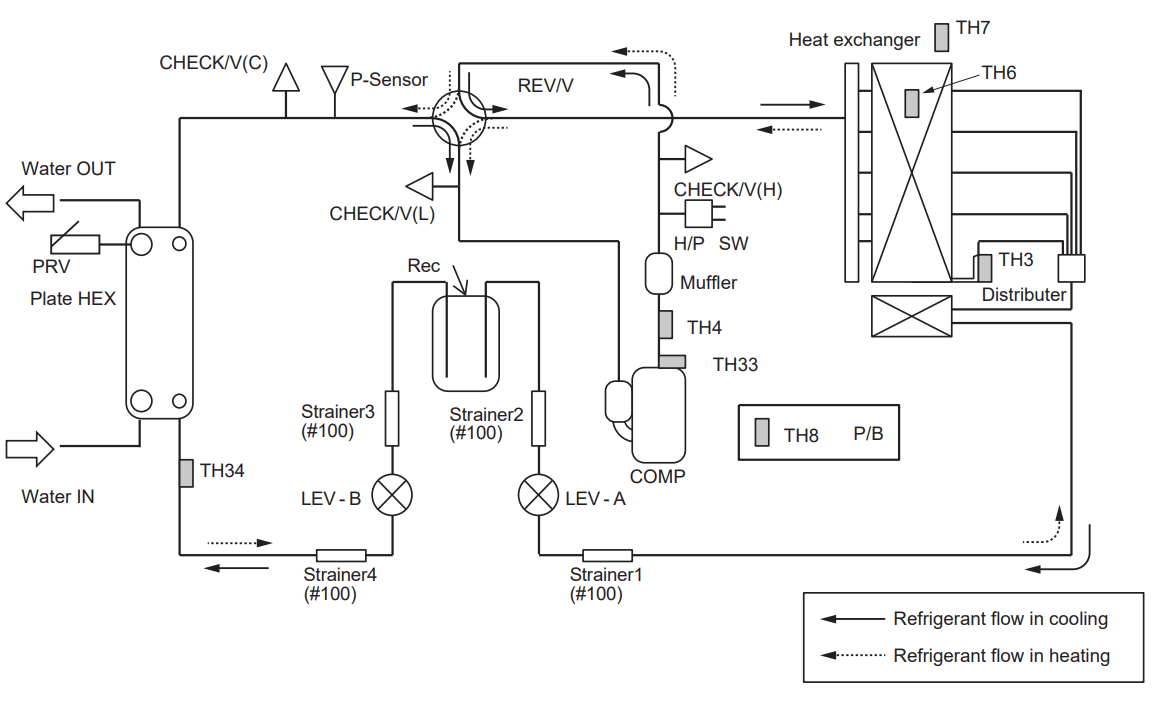


07/06/2023 3:17 pm
@fazel thanks….hmmm….those diagrams are on the More Technical side…but they do relate to the explanation given.


07/06/2023 3:26 pm
@amanda1 Yes, a lot of things happen inside that monobloc case! However, it is a well proven invention as we have been using refrigerators for many many years! The ‘fridge is delivered and apart from letting it stand for a while for the gas to settle before switching on and enjoying food storage advantages for some years without need to service the appliance; the heat pump needs installing with care / skils and requires setting up and if like many people on this forum know, their users take a great deal of care to ensure they are running as efficiently as possible. Of course they are normally outside and exposed to the elements and require servicing on a regular basis… Regards, Toodles.l
Toodles, heats his home with cold draughts and cooks food with magnets.

07/06/2023 3:49 pm
@amanda1 - I can offer a diagram which is somewhat less daunting, if it helps.

I'll assume that you are a teacher by profession.
Please feel free to comment if any of us are going too deep into technicalities.
Disseminating useful information must be a principle reason for the existence of this forum.
Save energy... recycle electrons!
07/06/2023 4:55 pm
@toodles thanks! I hope my Ecodan is as trusty as my Bosch Fridge/freezer - still going strong after 30 years!
07/06/2023 4:59 pm
@transparent thanks - I am assuming the compressor is inside the Monobloc? But is the condenser in there as well? What is the small red cylinder for?


07/06/2023 5:02 pm
@amanda1 Mine was after 12 years without even a service 🙂
House-3 bed partial stone bungalow, 5kW Samsung Gen 6 ASHP (Self install)
6.9 kWp of PV
10kWh DC coupled battery
Blog: https://thegreeningofrosecottage.weebly.com/
Heatpump Stats: http://heatpumpmonitor.org/system/view?id=60
1
07/06/2023 5:08 pm
I'm adding annotations to your photo, @amanda1
But is that cupboard within the heated envelope of the house or outside?
Save energy... recycle electrons!
07/06/2023 5:12 pm
@amanda1 This tank is used to apply a pressurised water feed to your circulating heating water. Normally the tank ispressurised from the water main to 1 - 1.5 bar; the tank contains a membrane (rubber or more modern equivalent?) so that the pressure is held and it is shown on a pressure guage attached to the tank. Normally the water main supply is isolated from the tank by two stop valves. Should the pressure drop (due to very slight leaks or evaporation etc., the tank pressure is topped up by opening the two stop valves until the pressure guage shows a level of pressure withing the red region - then the valves should be shut again. Sudden loss of pressure is however, an indication that there is a need for attention to the system. Regards, Toodles.
Toodles, heats his home with cold draughts and cooks food with magnets.
1

07/06/2023 5:17 pm
@amanda1 The red cylinder looks like an expansion tank, which will probably be on the central heating/hot water circuit. The CH/HW circuit will probably be a sealed system pressurised to 1 or 2 Bar, there should be a gauge and a filling loop as well. The expansion tank will regulate the water pressure as it expands and contracts over temperature. Old fashioned open systems had a tank in the loft.
I believe that all of the components of a mono block heat pump are in the one unit. There are also split designs in which only the fan and heat exchanger are outside and the rest is in another unit inside.

SPONSORS

Degrees of Separation

Latest Posts
-

RE: 15kw pump for 225m2 1990's house - over kill?
I would echo the comments made by jamespa. Insulate as...
By DavidB , 32 minutes ago
-
My heating has been off and DHW on throughout the summe...
By DavidAlgarve , 2 hours ago
-
RE: Anyone concerned about GivEnergy?
The GivE forum seemed to have survived the collapse of ...
By downfield , 3 hours ago
-
RE: How quickly would you want/expect heat recovery to take from setback?
@singlespeed I had better explain how my radiators are ...
By Toodles , 4 hours ago
-
RE: Cooling/heating with one unit
@mrkfm The Solo has a small capacity and only suitable ...
By dgclimatecontrol , 4 hours ago
-
RE: Renewables & Heat Pumps in the News
The irony is there's already an established internation...
By Temperature_Gradient , 6 hours ago
-
First you need to know how much thermal energy you'll n...
By bobflux , 16 hours ago
-
RE: Renewable Heating Hub Homeowners' Q&A Podcast
Come for the low-carbon homes. Stay for George Clarke’s...
By Mars , 2 days ago
-
RE: Octopus Cosy 12 Heat Pump Regret: Incredibly Loud, Poor Heating & Constant Hum - Help!
@razz, as we head into the heating season, I just wante...
By Mars , 2 days ago
-
RE: How should the Boiler Upgrade Scheme be reformed?
Not quite, regular A2W heat-pumps need a load of extra ...
By Temperature_Gradient , 4 days ago
-
RE: Heat Geek installations: share your experiences
one thing i learnt from reading people’s comments and e...
By Batpred , 4 days ago
-
RE: Do I add Air Con or MVHR to existing A2W ASHP?
We have ‘signed on the dotted line’ today for a Panason...
By Toodles , 4 days ago
-
RE: Heat pump branding. Clever, contemporary… or a bit too much?
...or it was there and was lost thanks to laziness and ...
By Majordennisbloodnok , 4 days ago
-
Bufferless design & control of Chinese air to water monoblock hybrid heat pump in Alberta, Canada
This post is about how I successfully configured a buff...
By Tony.Stolz , 4 days ago




SPONSORS
