

Notifications
Clear all
Joining the Renewable Heating Hub forums is completely free and only takes a minute. By registering you’ll be able to ask questions, join discussions, follow topics you’re interested in, bookmark useful threads and receive notifications when someone replies. Non-registered members also do not have access to our AI features. When choosing your username, please note that it cannot be changed later, so we recommend avoiding brand or product names. Before registering, please take a moment to read the Forum Rules & Terms of Use so we can keep the community helpful, respectful and informative for everyone. Thanks for joining!
Renewables News
572
Posts
38
Users
248
Reactions
151.6 K
Views

18/10/2026 12:48 pm
I seem to have got myself into a bit of trouble on LinkedIn with Octopus’s TJ Root for questioning the Cosy 12’s inclusion in TIME’s Best Inventions of 2026. I simply asked what sets it apart from comparable heat pumps, because the write-up highlights heating larger, older homes efficiently without explaining the particular innovation. Surely that describes plenty of heat pumps already on the UK market? What do you think? Is there something especially innovative about the Cosy 12 that I’m overlooking that warrants being added to Time's best inventions of 2026?
I don't think that you are at all out of order asking what is innovative about the Cosy 12 that warrants its inclusion in the list of TIME's best "inventions" in the household category for 2026.
There are some interesting contenders on that page:
https://time.com/collection/best-inventions/2026/
Looking at a few of the other "inventions" in the household category, the supporting text is often along the lines of, "XYZ technology has been around for 20 years, what makes this special is that" and then goes on to state the USP. The text about the Cosy 12 doesn't do that.
It possibly does have some USPs. It has a small footprint, since the casing is the same as the Cosy 9, but it runs a higher fan speed, so higher noise levels are the trade off for that. It comes with 4 Cosy pods that monitor room temps and humidity. Octopus engineers can monitor system performance remotely, spot inefficiencies, and deploy software adjustments or fixes. So there is a level of vertical integration that perhaps isn't there with other heat pumps.
I think the issue here is really the use of the word "invention" and the meaning of it. (Cambridge dictionary: An invention is a unique device, method, composition, or process that has never been made or existed before, created through study, experiment, or imagination). If instead it was "TIME's best new technology of 2026" then I don't think anyone would have any issue with it.
1

18/10/2026 1:11 pm
@toodles - innovative storage like that from RheEnergise doesn't need to be co-located at the Bulk Supply Point. It just needs spare capacity on the Distribution Grid to take the solar generation anywhere other than the 400kV Transmission Grid.
Pyworthy BSP has two separate 33kV 100mm² routes running east to Hatherleigh. That's situated within a hilly part of central Devon which would better lend itself to a pumped-hydro site. Coincidentally I'm running an energy seminar at Hatherleigh next week, 11am on Monday 26th.
The local population is concerned at a proposal from Xlinks to build a 1.8GW BESS and data centre on hills near Great Torrington.
But GB already has too much BESS and no more connections will currently be approved. This is shown in the following diagrams which were presented by NESO during a training webinar for RESP participants, so it has some authority behind it.
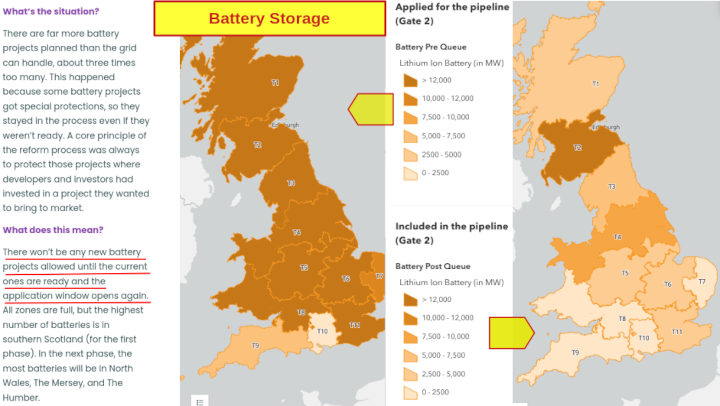
A pumped high-density hydro solution is likely to be viewed more favourably than 2000+ battery containers on the skyline. It's an idea which would be worthwhile mentioning to Parish and Borough Councillors to gauge their reaction.
Applications for the RESP roles are currently being evaluated by NESO. This is a good example of where local knowledge sees the opportunities which aren't large enough to feature on the national road-map.
This post was modified 4 weeks ago 2 times by Transparent
Save energy... recycle electrons!
18/10/2026 1:30 pm
Octopus engineers can monitor system performance remotely, spot inefficiencies, and deploy software adjustments or fixes.
Given the comments last week (13th Oct) by Sir Ken McCallum, Director General of MI5, the capability to remotely alter firmware in energy appliances should be regarded as a security risk.

Save energy... recycle electrons!
1

18/10/2026 1:45 pm
I worked partly in computer security. I saw things that would make people run screaming to unplug their devices from wifi.
Any device that is important and does not need to be connected to the internet should not be connected to the internet. Any that have to be really belong on a separate guest network where they can't talk to anything else in the house.
We've had Deye brick inverters remotely for being grey imports. We've had Tesla shut systems down and discharge them remotely with pretty much no warning because they shipped potentially dodgy batteries. Anything the vendor can do someone who hacks the vendor can do, or someone can do if their president goes off the rails and orders it to happen.
Some of the plug in batteries you can actually turn into bricks simply by sending them the right message, and when reverse engineering their highly insecure protocols people have done this by accident.
If it doesn't work entirely offline then you are at the mercy of the vendor, the vendor going bust, being sold, discontinuing support for your "obsolete" product, foreign powers, and probably the highest risk element of all - a bored teenager who just hacked their control system for the lolz
We've had week or more long outages at companies caused by hacking - even giant ones like JLR. You want a two week outage on your heatpump, or someone to brick the firmware so every single unit in the UK affected requires a site visit and a PCB change because someone burned the flash ?
This post was modified 4 weeks ago 2 times by EtchedPixels
2


18/10/2026 2:42 pm
Yes, it always astonishes me that critical bits of hardware have insecure internet connections. When I was working we had computers which weren't critical but would give us headaches if they were corrupted so we always made sure that there was an air gap between them and the internet. That was over 15 years ago and people seem to learn nothing. (And I'm not a computer professional.)
18/10/2026 3:12 pm
Any device that is important and does not need to be connected to the internet should not be connected to the internet.
Would you care to comment on the Government initiative for a Smart and Secure Energy System (SSES)?
In Nov'28 it will be mandatory for all heat pumps sold in the UK to be fitted with remote control capability. This will allow consumers to sign up for Demand Flexibility, whereby their heat-pump can be turned off remotely by a licensed Flexibility Service Provider (FSP).
Although that could have been implemented via protocols already inbuilt to our SMETS2 meters, DESNZ has decided it should be done using encryption across the internet.
The system will be administrated by Elexon, and costs recovered by additional charges on our electricity bills. Those who opt-in will receive a credit, automatically sent to their account with an Energy Supplier.
This provides hostile agents with an opportunity to wait until tens of thousands of heat-pumps get turned off during the early evening peak-demand period, and then launch an attack against Elexon and the FSPs to prevent them sending commands to "turn back on".
Neat, eh?
Is this a possible candidate for a future Time magazine inventions accolade?
This post was modified 4 weeks ago by Transparent
Save energy... recycle electrons!
1
18/10/2026 3:44 pm
Any device that is important and does not need to be connected to the internet should not be connected to the internet.
Would you care to comment on the Government initiative for a Smart and Secure Energy System (SSES)?
In Nov'28 it will be mandatory for all heat pumps sold in the UK to be fitted with remote control capability. This will allow consumers to sign up for Demand Flexibility, whereby their heat-pump can be turned off remotely by a licensed Flexibility Service Provider (FSP).
Although that could have been implemented via protocols already inbuilt to our SMETS2 meters, DESNZ has decided it should be done using encryption across the internet.
The system will be administrated by Elexon, and costs recovered by additional charges on our electricity bills. Those who opt-in will receive a credit, automatically sent to their account with an Energy Supplier.
This provides hostile agents with an opportunity to wait until tens of thousands of heat-pumps get turned off during the early evening peak-demand period, and then launch an attack against Elexon and the FSPs to prevent them sending commands to "turn back on".
Neat, eh?
Is this a possible candidate for a future Time magazine inventions accolade?
SMETS2 is already likely to be shifting to allowing internet based links for meters. The test roll out for smart meters talking over home internet services already happened and it's the easy path to fixing all the not spots and the long term path to getting out of spending billions on a now pointless radio network. The world has changed since smart metering so there really isn't any need for a whole vastly expensive meter service any more.
I think that's a fair assessment. SSES is at least trying to be a bit more secure than the average vendor. A true hostile agent though would be looking primarily at the ability to kill the flash memory on them so they required physical replacement. That would take many months for 10,000 units. Those are the kind of attacks we've seen deployed by both sides in the Ukraine/Russia war and I imagine are the kind of things that Iran will do in the USA if it gets ugly.
A lot of the proposed attacks on devices are heavily fictional. The grid is actually a lot more robust than many people assume because it already has to handle "a quarter of cardiff just went out for 2 seconds" type events anyway, and that's bigger than someone playing on/off tunes on heatpumps.
It's not btw as I understand it all heatpumps. In fact that would be basically impossible as it would mean millions of plug in the wall devices which don't have enough firmware in them or CPU power to do very much.

18/10/2026 4:29 pm
…
In Nov'28 it will be mandatory for all heat pumps sold in the UK to be fitted with remote control capability. This will allow consumers to sign up for Demand Flexibility, whereby their heat-pump can be turned off remotely by a licensed Flexibility Service Provider (FSP)
…
Just for clarity, let’s not forget that there’s a big difference between requiring the remote control capability to be fitted and for that functionality to be enabled. My son’s dishwasher can connect to a wifi network but it doesn’t mean he’s allowed it to do so.
Requiring kit to have some level of communication ability and enforcing some standards is a good thing as long as people can choose not to use it.
105 m2 bungalow in South East England
Mitsubishi Ecodan 8.5 kW air source heat pump
18 x 360W solar panels
1 x 6 kW GroWatt battery and SPH5000 inverter
1 x Myenergi Zappi
1 x VW ID3
Raised beds for home-grown veg and chickens for eggs
"Semper in excretia; sumus solum profundum variat"
2

18/10/2026 5:13 pm
Neat, eh?
Is this a possible candidate for a future Time magazine inventions accolade?
🙂
I assume that would be a step forward from the mechanisms that already exist elsewhere to limit air conditioning operation?
Then certainly worthy of the Time magazine leading edge award
8kW Solis S6-EH1P8K-L-PLUS hybrid inverter; G99: 8kW export; 16kWh Seplos Fogstar battery; Ohme Home Pro EV charger; Vaillant Arotherm Pro 7kW; 100Amp head, HA lab on mini PC
18/10/2026 7:05 pm
SMETS2 is already likely to be shifting to allowing internet based links for meters. The test roll out for smart meters talking over home internet services already happened and it's the easy path to fixing all the not spots and the long term path to getting out of spending billions on a now pointless radio network. The world has changed since smart metering so there really isn't any need for a whole vastly expensive meter service any more.
Yes, I am a member of the SEC, and therefore aware of the not-spot issue. Those premises are being permitted Smart Meters which utilise the internet.
The major radio network problems have been in the Northern Territory for which Arqiva holds the licence. They had expected to run the SMETS network using just 400-ish masts, but that transpired not to have sufficient coverage, especially with old stone-built castles!
The Central and Southern territories can be re-equipped with Communications Hubs that operate on a derivative of 4G and 5G rather than GSM.
It's not btw as I understand it all heatpumps. In fact that would be basically impossible as it would mean millions of plug in the wall devices which don't have enough firmware in them or CPU power to do very much.
The SSES Team at DESNZ used the capability to switch off HPs as the example to illustrate the technology. They then continued with that line of thought when drawing up the regulatory framework.
At first glance it sounds useful to switch off a proportion of HPs during times of high demand. But the electricity savings won't be significant whilst the operational costs will be high. Households not signed up for SSES face increased costs to pay for compensation to those who do participate, plus the Elexon running costs, plus profit for the Flexibility Service Providers (FSPs).
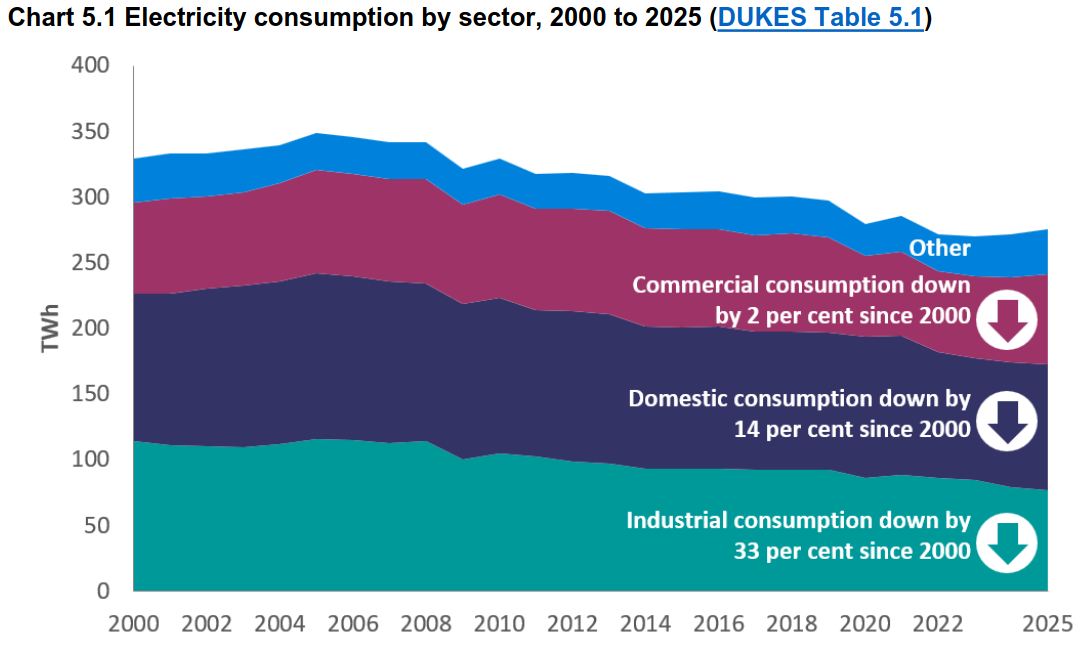
1: Domestic consumption over the past 4 years has been keeping steady at 29% - 30% of total GB generation. That's despite the increased use of electricity for heat-pumps and EVs.
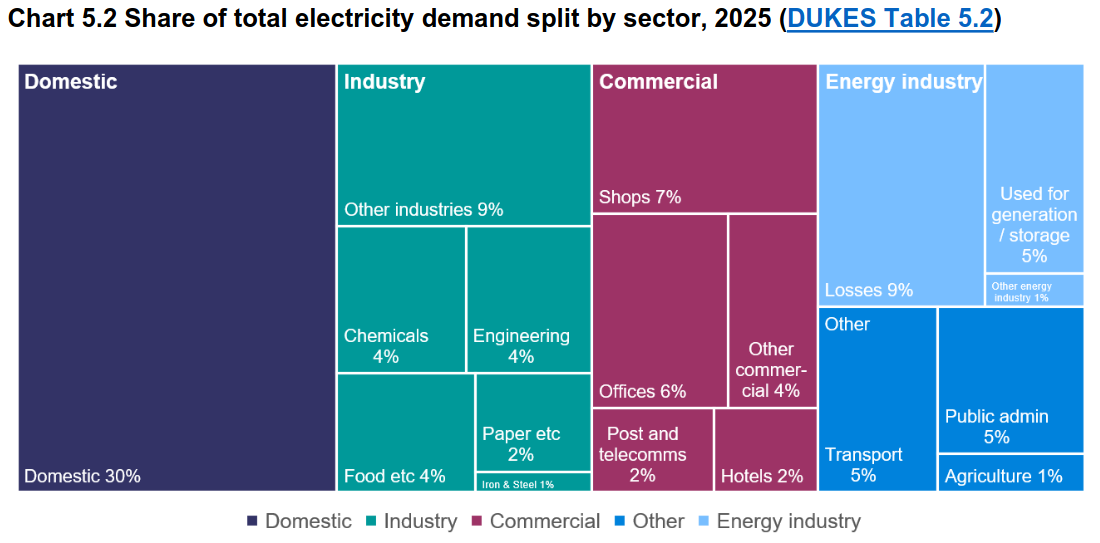
2: Overall GB electricity demand has been falling since 2005
3: All of those demand reductions achieved by SSES are about to be utterly overridden by the need for the grid to provide data-centres with 50GW, which is more than the forecast 48GW required for everything else in Britain.
4: Heat pumps don't contribute to a sufficiently high proportion of household demand that switching them off would be noticeable within national statistics. They're designed to be "low and slow" always-on appliances.
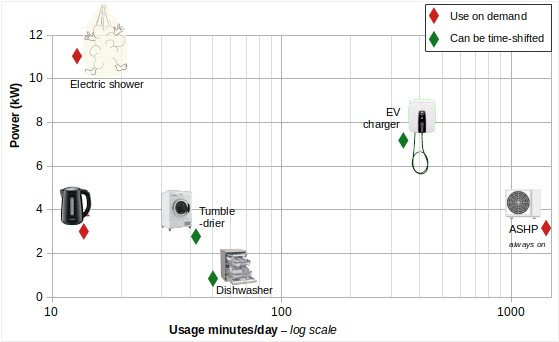
5: It will require more electricity to re-establish household temperatures when a heat-pump is re-energised than has been saved whilst it was switched off. The Flow needs to pass more energy to the heat-emitters, thereby decreasing the COP.
Save energy... recycle electrons!
1
19/10/2026 11:02 am
@majordennisbloodnok Unfortunately there's a rather more sinister game being played under the surface. Mandating a UK specific special magic set of software allows vendors to segment off the UK and massively up prices versus the rest of the world because there's no import competition.
That's very different to "for some reason my dishwasher has a wifi app"
19/10/2026 11:52 am
The feature which manufacturers need to add to heat-pumps for sale in the UK is one which allows it to be remotely turned off/on, but without the capability for it to be bypassed.
Otherwise canny homeowners would use a plug-in storage battery to operate the heat-pump for a couple of hours whilst it's off, and yet still benefit from the compensation payments which will be automatically credited to their account.
During the DESNZ Public Consultations on SSES, they suggested that Britain would sell or license this Demand Flexibility mechanism to other countries. I can't see how DESNZ expects that to happen. If any other country did want to implement such a system, the HP Manufacturers could simply supply them with the same variant which they'd created for the UK.
The problem here will be low take-up of the Demand Flexibility option. The Elexon operational costs will still need recouping from everyone else's bills.
Moreover the Manufacturers can charge more for a HP which contains the remote control mechanism.
Neither of those costs is likely to be offset by another country paying to buy-in to this new UK Standard.
Save energy... recycle electrons!

SPONSORS

Degrees of Separation
Latest Posts
-

RE: How Can I Prove Coal Was My Main Heating Source Without Receipts?
Got excepted for the grant now so thanks for the replie...
By Chilli304 , 1 hour ago
-
Welcome to the forums. That's a frustrating situation, ...
By Mars , 2 hours ago
-
RE: DIY powerflushing tutorial
Same 🤣 Near Lyon, France. Water has lots ...
By bobflux , 3 hours ago
-
RE: Buffer tank on a 2 x 14kw Ecodan system
Pretty much as I had guessed in my crude scaling from m...
By JamesPa , 5 hours ago
-
RE: Help me keep the faith with my air source heat pump installation
Well you have a vibration generator running at some fre...
By bobflux , 18 hours ago
-
RE: Why don't people choose heat pumps?
@susannasaunders The link I have found may provide a li...
By Toodles , 21 hours ago
-
RE: Who's your electricity provider and what's your tariff?
@downfield Thats a decent rate, I’m shocked they hadn...
By Papahuhu , 2 days ago
-
RE: Should Households Who Can Afford It Pay More for Energy to Help Those Who Can't?
@batpred I mentioned earlier that targeting the payment...
By Toodles , 2 days ago
-
RE: Adventures in heat loss calculations
@toodles thanks! So as suspected, around a doubling of ...
By SusannaSaunders , 2 days ago
-
Six books in three years and I think I’ve now covered j...
By Mars , 2 days ago
-
RE: Grant Aerona3 13kw - Buffer Tank - Heating Journey
@heymikey Well done in achieving as nearer a match acro...
By Toodles , 2 days ago
-
Grant Aerona - Weather Compensation and Schedules
Im trying to set up a friends Grant Aerona. The WC curv...
By bontwoody , 3 days ago
-
RE: Air-to-Air Heat Pumps & Air Conditioning: UK Heating and Cooling Q&A
@jamespa I agree, the efficiency of Cosy Cooler ought...
By Rob of York , 3 days ago
-
RE: How much of your renewable and home setup would still work if the internet went down?
I think you're right! 🤨
By Transparent , 4 days ago


SPONSORS
