

Notifications
Clear all
Joining the Renewable Heating Hub forums is completely free and only takes a minute. By registering you’ll be able to ask questions, join discussions, follow topics you’re interested in, bookmark useful threads and receive notifications when someone replies. Non-registered members also do not have access to our AI features. When choosing your username, please note that it cannot be changed later, so we recommend avoiding brand or product names. Before registering, please take a moment to read the Forum Rules & Terms of Use so we can keep the community helpful, respectful and informative for everyone. Thanks for joining!
Air Source Heat Pumps (ASHPs)
46
Posts
7
Users
14
Reactions
13.7 K
Views

13/11/2022 3:38 pm
What heat source do you have?
Like this:
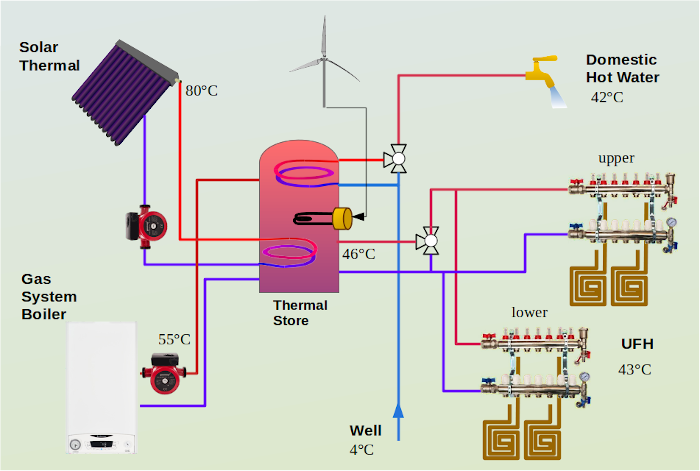
The UFH manifolds were bought 18 years ago. Those actuators define the characteristics of water-flow in the ufh loops.
Technology has moved on.
Save energy... recycle electrons!
1

13/11/2022 7:29 pm
@transparent You seam to have a system with a lot of potential. With a few alterations, it will improve conciderably and reduce your running costs. Your current system design only allows you to harvest aproximatly 10% of the available energy, if you significantly reduce your flow temperature in the under floor, you can probably quadrupal the output of free energy.
The manifolsd being 18 years old, is not a problem, they have not chainged much over the years. If you want your system to improve you need to control the flow temperature, run it 24-7 and significantly reduce the flow temperature.
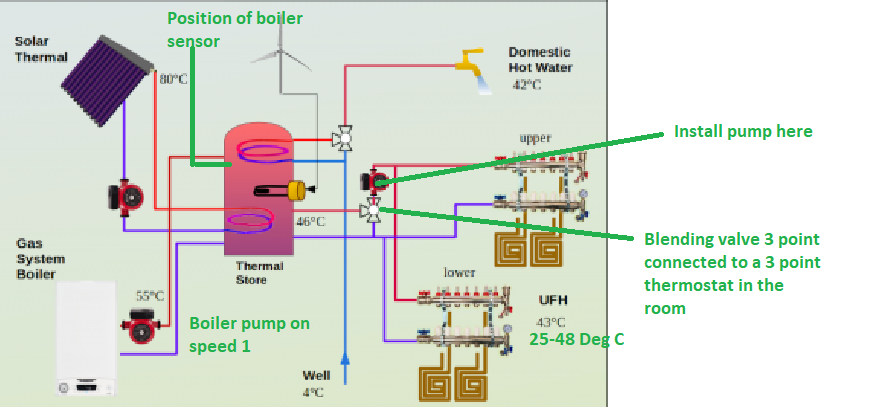
I have added some sugestions to your schematic. It it is piped exactly like this, with no pumps, blending valves thermostats (except in the bedrooms), it will work well. If you control the boiler like this, on speed 1 or less, it will work like a Mix Energy tank and by using the stratification, will supply good high temperature hot water whilst keeping the solar thermal temperature as low as possible, which will enable it to harvest free energy.
I hope this helps.
13/11/2022 8:50 pm
Thanks @heacol Your observations are well made.
Fortuitously the annotations you've added are already implemented (with one variation). It was my diagram which was deficient, and didn't provide sufficient detail on some points. Since others will read this in future, between us let's clarify what we're agreed on.
The boiler pump should indeed be on its lowest setting. However, the head (motor) has needed replacement recently, and I need to check that the new one has the required speed setting.
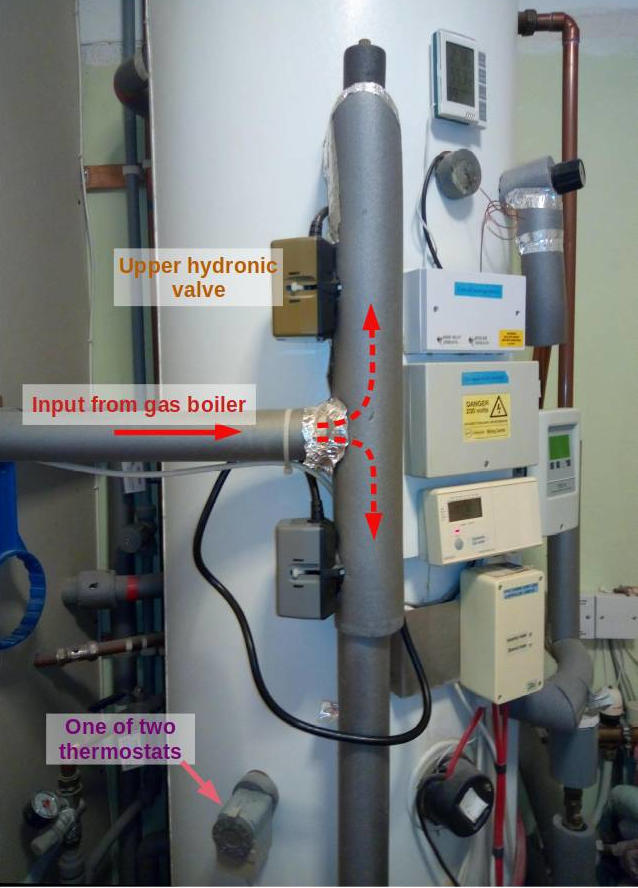
The boiler input to the thermal store is slightly more complex than I'd drawn. The heated water feed actually divides into two, each of which has a hydronic valve and a linked thermal sensor. That allows only the top half of the tank to be heated in the summer. It's a feature of minimal use here because the solar-thermal array will heat the whole cylinder anyway (for free)!
I do have a pump driving the ufh circuits. I was so busy drawing the adjacent 3-port blending valve position that I omitted the pump itself by mistake. The pump is a modulating type - the speed changes according to how many ufh actuators are open at the two manifolds.
The ufh blending valve is not connected to an external thermostat in 'the' room. It is preset to 46degC to prevent higher temperatures reaching the ufh loops if the solar-thermal should be having a particularly good day. That means the water-flow in the loops below wooden flooring can't rise high enough for the timber itself to reach 28degC. Thus stays flat and doesn't warp.
Each ufh loop actuator is linked to its own time/temperature clock in that room.

When I have a moment of 'spare' time, I want to replace the time/temp clock for the area which has a solid concrete pad. This obviously has a higher thermal mass than the ufh loops below suspended floors. So it needs to be driven by a 'look ahead' system that will assess the required temperature 3+ hours in advance. I already have access to the necessary data as part of my work on storage battery controls.
What would I change? If I was installing such a system today, I'd be using manifold actuators driven by ELV (24v DC) rather than 240v AC mains. That would more easily allow me to experiment with my own design of systems based on Raspberry-Pi or Arduino microcontrollers.
Save energy... recycle electrons!
13/11/2022 9:09 pm
@transparent You have too much micto contro for an efficient system. If you controlled the water temperature and blend it down with a proper temperature control system, you would use a lot less energy. I would seperate the control of the in screed under floor and the in joist under floor as they are compleatly different systems and require a totaly different control stratergy, similar to radiators. I refuse to install it as it is not efficient, but as you have it, make the best of it.
You are with your system waisting a lot of energy by not harvesting the solar thermal to it's best ability.

13/11/2022 9:29 pm
Yes, I get it 🙂
So if the ufh was taking water at a much lower temperature, then the solar-thermal would be better able to contribute to that. (I hope others are reading this in future and understanding what @heacol is suggesting).
That entails replacing the (expensive) existing 28mm diameter blending valve and replacing it with one that has an actuator/motor to vary the set temperature. Would you like to suggest what manufacturers and models you feel are well-engineered, resilient and likely to have long-term availability?
As for 'the room thermostat' to drive it, please feel free to make suggestions as to locations. Is this something you'd envisage being sited in the entrance hall, in similar fashion to the way in which gas boilers have a single temperature sensor for overall control?
This is a 300sq.m house with a number of energy systems under tests or in-house development. So I may note your advice on this issue, but then actually implement the blending valve control signals as another output from the 'day ahead' controller here!
The other, related matter to mention here is that the plan is to install a GSHP once the gas boiler expires. My intention/hope is to use solar-thermal as a pre-heater for that system.
That may not affect what @heacol and I are discussing here. There's still more south-facing roof on which additional solar-thermal can be mounted, and I have my own scaffolding too 😎
Save energy... recycle electrons!

13/11/2022 10:18 pm
@transparent I would also be keen to know which 3 port mixer (and associated room controller) to use for my mixture of rads and ufh. Hopefully Brendon can advise.
Off grid on the isle of purbeck
2.4kW solar, 15kWh Seplos Mason, Outback power systems 3kW inverter/charger, solid fuel heating with air/air for shoulder months, 10 acres of heathland/woods.
My wife’s house: 1946 3 bed end of terrace in Somerset, ASHP with rads + UFH, triple glazed, retrofit IWI in troublesome rooms, small rear extension.
17/11/2022 12:53 pm
And I'm sure @hughf that there will be others interested in the answer who find this thread in future.
My guess is that a professional heating engineer like @heacol will be extremely busy mid-week as the colder weather arrives. But I've just tagged him so he'll know we're here when he has a moment to respond.
When I was an invited observer to an online discussion group of homeowners with newly-installed ASHPs a couple of years ago, I noted that many of them had motorised valves of a type I hadn't met before. Since they'd had different installers and different control-systems, I was curious as to why there were a number of sites reporting errors associated with those valves.
I checked out the manufacturer's technical manuals online. It transpired that the valves came in around a dozen variants, each of which required configuring on-site by assembling the front bezel in a particular way. Ie it wasn't just for aesthetics! Some professional installers hadn't realised that, so the valves didn't perform as they should.
From that insight, I now put a high value on the recommendation of a professional who does actually have on-site experience to know the correct valve for a particular job.
Save energy... recycle electrons!
17/11/2022 1:53 pm
I imagine it will be something from Esbe, the valve being less important than the controller/actuator. Keen to know what parts to spec for the latter.
Off grid on the isle of purbeck
2.4kW solar, 15kWh Seplos Mason, Outback power systems 3kW inverter/charger, solid fuel heating with air/air for shoulder months, 10 acres of heathland/woods.
My wife’s house: 1946 3 bed end of terrace in Somerset, ASHP with rads + UFH, triple glazed, retrofit IWI in troublesome rooms, small rear extension.

17/11/2022 8:45 pm
@transparent This valve will control the flow temperature and on whether compensation and internal temperature, there are others on the market, but this one is probably the easiest to install and operate. Thanks for covering for me, we are exceptionally busy at the moment, unfortunately sorting out heat pump systems that do not work. Not the work we like to do (we do not make money out of it) but I feel that for the integrity of the industry we must do it.
2

17/11/2022 11:46 pm
So it is a positioning control valve with an inbuilt temperature controller, with inputs from both an outdoor temperature sensor and an indoor temperature sensor.
How would such a device be incorporated within an ASHP heating system?
18/11/2022 8:12 am
So it is a positioning control valve with an inbuilt temperature controller, with inputs from both an outdoor temperature sensor and an indoor temperature sensor.
How would such a device be incorporated within an ASHP heating system?
you wouldn’t need a weather compensated mixing valve in an ashp install as the ashp already has weather compensation.
This is for the edge case where you want a weather compensated mixed circuit from a buffer tank or thermal store that is at a higher temperature. For example a biomass install.
Or the sort of install that @transparent has.
Off grid on the isle of purbeck
2.4kW solar, 15kWh Seplos Mason, Outback power systems 3kW inverter/charger, solid fuel heating with air/air for shoulder months, 10 acres of heathland/woods.
My wife’s house: 1946 3 bed end of terrace in Somerset, ASHP with rads + UFH, triple glazed, retrofit IWI in troublesome rooms, small rear extension.
1

18/11/2022 8:23 am
you wouldn’t need a weather compensated mixing valve in an ashp install as the ashp already has weather compensation
This is not correct.. the floor works on a different slope from radiators and needs its own mixer.
The good news is this is a standard design and the heat pump control is modular, so all you need is an extension kit from the heat pump manufacturers..
and of course a valve.. the esbe is fine -if correctly specified
Professional installer

SPONSORS

Degrees of Separation

Latest Posts
-

RE: Adding additional Solar Panels to a DC coupled battery system
@transparent I was replying about the accuracy of "AI" ...
By EtchedPixels , 1 hour ago
-
RE: Vaillant ecoTEC Plus - Flow Temp and Set Up
I too found the same thing, so reduced the hysteresis. ...
By trebor12345 , 2 hours ago
-
RE: Replacing Storage Heaters with a Heat Pump in a Stone Cottage
@cathoderay The 'constant' has dimensions. Its the ...
By JamesPa , 3 hours ago
-
RE: Indevolt Batteries UK Support & Info Thread
SunSynk hybrid inverters also have the capability to as...
By Transparent , 3 hours ago
-
RE: Is This Initial Free Quote From Octopus Trusted Partner Reasonable?
If you've got a sash window or a door you can remove th...
By EtchedPixels , 4 hours ago
-
RE: Heat Geek Zero Disrupt: Are We Sleepwalking Into Another Race to the Bottom?
Roughly how most air/air is done except that step 3 doe...
By EtchedPixels , 4 hours ago
-
RE: Nook batteries from Octopus
@batpred If your energy use is low enough that just get...
By EtchedPixels , 4 hours ago
-
RE: Missing flow temperature in Heat Geek proposal
I suspect 4 yrs ago, their approach had not got to this...
By Batpred , 4 hours ago
-
RE: battery storage without solar
Also don't forget that in you may not be able to use th...
By JamesPa , 14 hours ago
-
RE: Tesla Powerwall (2) Calibration Cycles
One practical safeguard is to separate the calibration ...
By EnergyStorageTech , 16 hours ago
-
RE: tepeo ZEB UK Support & Info Thread
There is at least one large scale system in this catego...
By Toodles , 1 day ago
-
RE: Getting closer to a finished Haier system
Apart from sealing the external Primary Pro joints and ...
By Singlespeed , 1 day ago
-
RE: Air-to-Air Heat Pumps & Air Conditioning: UK Heating and Cooling Q&A
Our latest Homeowners’ Q&A episode has just dropped...
By Mars , 2 days ago
-
RE: Vaillant ecoTEC Plus with sensoCOMFORT and weather compensation
Yes, its described in the sensocomfort manual. Its als...
By JamesPa , 2 days ago
-
RE: Heat Geek installations: share your experiences
My summary, highlighting the oddities.
By Batpred , 2 days ago





SPONSORS
