
Notifications
Clear all
Joining the Renewable Heating Hub forums is completely free and only takes a minute. By registering you’ll be able to ask questions, join discussions, follow topics you’re interested in, bookmark useful threads and receive notifications when someone replies. When choosing your username, please note that it cannot be changed later, so we recommend avoiding brand or product names. Before registering, please take a moment to read the Forum Rules & Terms of Use so we can keep the community helpful, respectful and informative for everyone. Thanks for joining!

11/03/2026 10:14 am
As an aside, if your FTC6(?) is adding 2.8kWh to account for water pumps then your 8 hour (?) setback would save a third of that value (0.93 kWh) because the water pump will be off for that time.
Yes @robs you’re quite right there is an extra saving made during the setback period (because the circulation pump is not operating) but I haven’t deducted it from the MELCloud energy report. That might be seen as tampering with the data.
I outlined the breakdown of the 2.8 kWh energy add-on that MELCloud makes in a post earlier in this thread bottom of page 25. Copy below:-
No manual alterations are ever done. Since the system is operating 24/7 even on a setback. Therefore the inbuilt energy markup is the same for both 24 hour time periods and is quoted exactly as reported.
In our case our system is the FTC6 controller and is pre set with 2.8 kWh add on in a 24 hour period. So the pre installed consumption over estimates our daily use. This may be different for the newer FTC7 which may be more programmable.
if you only have 1 circulating pump like we have. Our circulating pump only consumes 29w per hour. (696w in 24 hours.) The FTC 6 monitoring system consumes around 600w in a 24 hour period. So our total monitoring/circulating consumption is 1.296 kWh per 24 hour period.
This means our data typically reports 1.5 kWh higher daily, than the actual energy use.
I do not deduct this amount so there is no question of altering the reported data. So as you can see there is nothing to hide it’s just the raw data.
11/03/2026 10:40 am
In our case as shown above the 2.8 kWh add-on is more than we actually consume.
Example: FTC monitoring PLUS PUMP CONSUMPTION = 1.296 kWh for the 24 hour period
So : 2.8kw - 1.296kw =1.504 kWh over compensation.k
Our only circulator pump would have used 232 wattHours during the 8 hour setback if it was continuously running.
So to correctly account for this the total over estimate should be 1.736 kWh in the 24 hour period.
This could indeed be the correction factor used to correctly raise the savings during the setback period. But for the sake of keeping the message simple I chose to ignore the extra saving of 232watts.
The data as reported by me in the above posts is unaltered from the MELCloud report so nobody can say they have been tampered with.
All reports therefore show identical compensation values from the MELCloud estimation system. All graphs have the same 1.504 kWh markup.
So the only differences in consumption are small but visible differences in ambient and the energy saved as a result of the setback.
11/03/2026 12:35 pm
Are you saying the 33kwh estimate and the 28.8 kWh estimate and for that matter the 28.5kwh estimate are each calculated so randomly by 40 to 60% that there would be no consistency or meaning to their values?
As I mentioned before (and above), MELCloud seems to be quite consistent in its inaccuracy. So it is no surprise that two similar days have a similar degree of inaccuracy, and hence similar reported energy consumption estimates.
Rob you haven’t answered the question. Or to be more precise your reply has become once again somewhat cryptic. It’s clear if it’s consistent to produce similar energy consumption estimates on similar climatic days it is consistent enough to report on the same climatic days on a setback.

11/03/2026 8:53 pm
As an aside, if your FTC6(?) is adding 2.8kWh to account for water pumps then your 8 hour (?) setback would save a third of that value (0.93 kWh) because the water pump will be off for that time.
Yes @robs you’re quite right there is an extra saving made during the setback period (because the circulation pump is not operating) but I haven’t deducted it from the MELCloud energy report. That might be seen as tampering with the data.
I outlined the breakdown of the 2.8 kWh energy add-on that MELCloud makes in a post earlier in this thread bottom of page 25. Copy below:-
No manual alterations are ever done. Since the system is operating 24/7 even on a setback. Therefore the inbuilt energy markup is the same for both 24 hour time periods and is quoted exactly as reported.
In our case our system is the FTC6 controller and is pre set with 2.8 kWh add on in a 24 hour period. So the pre installed consumption over estimates our daily use. This may be different for the newer FTC7 which may be more programmable.
if you only have 1 circulating pump like we have. Our circulating pump only consumes 29w per hour. (696w in 24 hours.) The FTC 6 monitoring system consumes around 600w in a 24 hour period. So our total monitoring/circulating consumption is 1.296 kWh per 24 hour period.
This means our data typically reports 1.5 kWh higher daily, than the actual energy use.
I do not deduct this amount so there is no question of altering the reported data. So as you can see there is nothing to hide it’s just the raw data.
Can I ask where the 2.8kWh figure comes from? I checked the FTC6 manual and it has the same settings for pump power as the FTC7 (see below from the FTC6 installers manual), so it also calculates the pump energy consumption using the pump power settings.
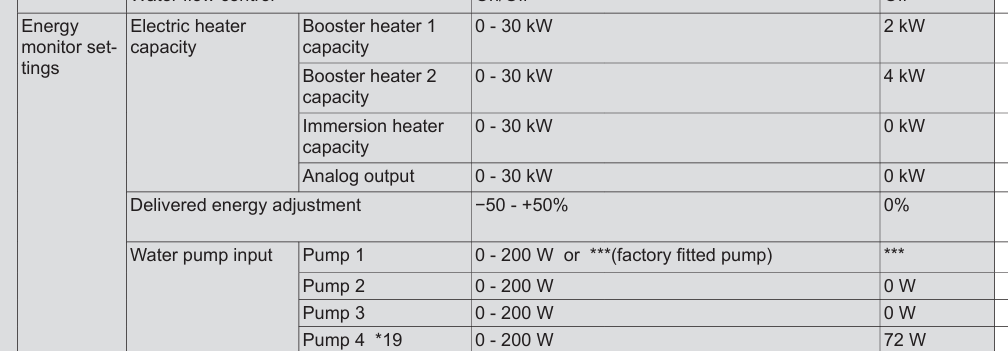
If your system is adding 2.8 kWh when you have an 8 hour setback (off period) it's presumably coming from an estimated 175W for each hour of the 16 hours of operating time. So ~165W for the pump(s) if we exclude the power consumption of the electronics. That's assuming the energy consumption estimate doesn't include water pump consumption when the system has switched the water pump off, hopefully it does this and not just assume the water pump(s) run all the time!
From your following post (reproduced below), 232Wh over 8 hours gives 29W water pump power consumption, thus 16 hours of 165-29 gives an over estimate for energy consumption of 2.18 kWh. So I think your system's estimates are even further out from reality than you suggest in the post below. Have you looked at the pump power settings on your FTC6? It would be interesting to know what they are set to that can result in the controller adding ~165W per hour to the energy consumption estimate.
In our case as shown above the 2.8 kWh add-on is more than we actually consume.
Example: FTC monitoring PLUS PUMP CONSUMPTION = 1.296 kWh for the 24 hour period
So : 2.8kw - 1.296kw =1.504 kWh over compensation.k
Our only circulator pump would have used 232 wattHours during the 8 hour setback if it was continuously running.
So to correctly account for this the total over estimate should be 1.736 kWh in the 24 hour period.This could indeed be the correction factor used to correctly raise the savings during the setback period. But for the sake of keeping the message simple I chose to ignore the extra saving of 232watts.
The data as reported by me in the above posts is unaltered from the MELCloud report so nobody can say they have been tampered with.
All reports therefore show identical compensation values from the MELCloud estimation system. All graphs have the same 1.504 kWh markup.
So the only differences in consumption are small but visible differences in ambient and the energy saved as a result of the setback.
I've not suggested that your figures have been tampered with just that MELCloud's estimates aren't very good. You only mention one water pump, so presumably you have an open loop system and no hydronic separation. I suspect that Mitsubishi's estimates are based on their standard cylinder/LLH setup that has a second water pump, and if they are estimating consumption from temperatures sensors and output power (that the controller can calculate from the sensors it has) then they have presumably included some level of inefficiency in their calculations for the LLH. If you also have an open loop system then your estimated consumption figures could well be as inaccurate as mine, but if you have a Mitsi cylinder & LLH they may be somewhat closer to reality.
11/03/2026 9:03 pm
Are you saying the 33kwh estimate and the 28.8 kWh estimate and for that matter the 28.5kwh estimate are each calculated so randomly by 40 to 60% that there would be no consistency or meaning to their values?
As I mentioned before (and above), MELCloud seems to be quite consistent in its inaccuracy. So it is no surprise that two similar days have a similar degree of inaccuracy, and hence similar reported energy consumption estimates.
Rob you haven’t answered the question. Or to be more precise your reply has become once again somewhat cryptic. It’s clear if it’s consistent to produce similar energy consumption estimates on similar climatic days it is consistent enough to report on the same climatic days on a setback.
The answer was in two parts in my reply, the second part that also answered some of your other points was:
"If you effectively eliminate the over reporting of MELCloud for a third of the 24 hour period (i.e. 8 hour setback) then a third of the over reporting will be absent from the reported estimate for that 24 hours. So the days with a setback will have lower consumption estimates solely due to the reduced period of over reporting."
So the two similar days with setbacks would be expected to be inaccurate by a similar amount and so have similar consumption estimates. While the day with no setback would have an extra 8 hours of consumption inflation and so would be expected to be even more inaccurate as a result.
Page 29 / 29
Prev

Latest Posts
-

RE: Octopus Cosy 12 Heat Pump Regret: Incredibly Loud, Poor Heating & Constant Hum - Help!
Balancing is a long process and its possible to mess th...
By JamesPa , 23 minutes ago
-
RE: Daikin Altherma 3 LT compressor longevity question
Up to a point yes. However every heat pump (and every ...
By JamesPa , 1 hour ago
-
Thanks everyone for the help, Havenwise now diasbled. q...
By Boycey , 3 hours ago
-
RE: Advice needed after a successful "leftfield" experiment.....
@pauli Depending on whether you can get an EV tariff, I...
By ChandyKris , 4 hours ago
-
-
RE: New Build ASHP Defects - Looking for Advice, Support & Shared Experiences
Is that a single pair only? If so it may be part if th...
By JamesPa , 6 hours ago
-
RE: Solar Power Output – Let’s Compare Generation Figures
@technogeek I think you are correct, but, it didn’t inf...
By Papahuhu , 6 hours ago
-

@batpred, you’re quite right; it does work well. I don’...
By Majordennisbloodnok , 7 hours ago
-

@Mars at the time of writing heating oil is £1.28 / ltr...
By TechnoGeek , 7 hours ago
-
RE: Ecodan Cylinder Possible Weeping Around Thermostat Port
Update: Mitsubishi sent an engineer around. It was li...
By Gruff2001 , 10 hours ago
-
RE: A Smarter Smart Controller from Homely?
@benson Agreed. I believe the COP gains with homely, i...
By Papahuhu , 10 hours ago
-
RE: Samsung Gen 7 16kW Integrated unit Modbus monitoring
The setup for this is a Samsung Modbus card. Connected ...
By antonical , 12 hours ago
-

RE: Forum updates, announcements & issues
@davidalgarve, if the emails are more than roughly a mo...
By Mars , 12 hours ago
-
How to Find All Your Posts and Topics on the Forum – A Quick Guide
If you’ve ever posted something on the forum and then s...
By Mars , 12 hours ago
-
RE: If a heat pump can only heat DHW to 50C then what? Issue with 18KW Heliotherm heat pump
Sorry to hear that but I'm not surprised TBH. Stratifi...
By JamesPa , 13 hours ago
-
RE: Say hello and introduce yourself
@pt151 welcome to the forums, and looking forward to he...
By Mars , 1 day ago
-
RE: Setback savings - fact or fiction?
The answer was in two parts in my reply, the second par...
By RobS , 1 day ago
-
Samsung Gen 7 16kW Integrated unit Modbus monitoring
Looking for some assistance to get modbus monitoring wo...
By antonical , 1 day ago
-
Ecodan control return to Melpump from Havenwise trial. settings check
Hi, Just got control back after being on the hav...
By Boycey , 1 day ago
-
RE: Refrigerant R32, is it now banned in the EU from 1st Jan 2027 for monobloc ASHPs?
I wonder if heat pump manufacturers will tone these sit...
By JamesPa , 1 day ago
-
RE: Who’s Caved and Switched the Heating On Already?
@editor yesterday we used 12kW of electricity for heat,...
By Judith , 1 day ago
-
RE: Rate the quality of your heat pump design and installation
Loss assessments can be a very serious case of GIGO. I...
By JamesPa , 1 day ago
-
RE: Who's your electricity provider and what's your tariff?
@jamespa Just bizarre. This is our data. I really don't...
By antonical , 2 days ago
-
RE: Mitsubishi Ecodan 11.2kW review
I think you said its an 11.2kW model and your house is ...
By JamesPa , 2 days ago