

Notifications
Clear all
Joining the Renewable Heating Hub forums is completely free and only takes a minute. By registering you’ll be able to ask questions, join discussions, follow topics you’re interested in, bookmark useful threads and receive notifications when someone replies. Non-registered members also do not have access to our AI features. When choosing your username, please note that it cannot be changed later, so we recommend avoiding brand or product names. Before registering, please take a moment to read the Forum Rules & Terms of Use so we can keep the community helpful, respectful and informative for everyone. Thanks for joining!
Air Source Heat Pumps (ASHPs)
68
Posts
8
Users
10
Reactions
1,646
Views

Topic starter
30/09/2026 11:05 am
@jamespa I assume getting the WC curve and rad balancing right is what gives you a decent heat pump system. I assume once you've set this up it doesn't need changing for the summer or does it?

30/09/2026 11:16 am
@jamespa I assume getting the WC curve and rad balancing right is what gives you a decent heat pump system. I assume once you've set this up it doesn't need changing for the summer or does it?
Yes. Basically the best way to run a heat pump system, in many, probably most, cases, in open loop 24x7, no controls other than weather compensation. TRVs and thermostats, if present, set a couple of degrees above the desired temperature to act as limiters not controllers. Best not to fit a thermostat as the heat pump native controller will invariably have a temperature sensor of its own and third party thermostats (particularly 'smart' ones) can mess badly with heat pumps unless specifically designed for the purpose (homeley, adia, passiv and Havenwise only at present)
In summer you can either manually switch off space heating or there may be a parameter like 'max temperature for heating that you can set so it switches itself off automatically. The first is simpler! A half decent heat pump will allow you to do all of this remotely.
This post was modified 3 weeks ago 2 times by JamesPa
4kW peak of solar PV since 2011; EV and a 1930s house which has been partially renovated to improve its efficiency. 7kW Vaillant heat pump.

30/09/2026 4:26 pm
As you have no pipework or radiators present, and the house is not occupied that many weeks per year, it would be well worth looking into Air-to-Air (A2A) heat pumps. Most people think of these as "air-conditioning" and they do that extremely well e.g. efficiency over 900% on cooling, however, they are also excellent on heating with over 500% achieved efficiency. A2A has a number of advantages over Air-to-Water (A2W) including cooling in summer, much faster warm up, and not needing water pipes and radiators. A2A can also be controlled remotely on a room-by-room basis.
See this thread for a discussion of the system we have that complements our gas boiler: https://renewableheatinghub.co.uk/forums/air-to-air-heat-pumps-air-conditioning/what-air-to-air-air-conditioning-system-do-you-have-and-how-efficient-is-it-on-heating-and-cooling/
A system where you keep your existing (I assume) electric boiler for hot water and add A2A may be a cost effective solution. Some level of mix and match may be appropriate. For example direct electric heating (electric radiators) in some rooms with low heating requirements, and A2A indoor units in others.
It is interesting that Norway, which has had copious relatively cheap electricity for years and hence started off with direct electric heating in most houses now has the most heat pumps per household in Europe at over 630 per 1000. However, over 90% of these are A2A. Without existing pipework and radiators, the simpler installation and lower cost made this the go to solution.
I suspect that installing a full A2W system with all the pipework and radiators will cost considerably more than the BUS grant, however, if you do go down that route, I would suggest that you step back from trying to have the most efficient system possible as the marginal gains will simply not be worth it, particularly given your low annual consumption. For example K2 radiators are much cheaper than K3s, available in many more sizes, and will result in a design maximum flow temperature that is only about 2C higher.
If you need 6000kWh of heating per year, then compared to 40C, a max design flow temperature of 45C, 50C, and 55C will cost you an extra £25, £60, and £100 per year - assuming full price electricity at 28p per unit. Using K2s would likely cost about £15 a year extra compared to K3s, which is going to take a very very long time to recoup.
This post was modified 3 weeks ago by Rob of York
1
Topic starter
30/09/2026 4:44 pm
@rob-of-york I had wondered about A2A. That's something else for me to think about and get quotes for. The current water heating is by immersion heater so that could be kept although it's not ideal.
As you say with such low use it doesn't make a great deal of sense to be chasing the most efficient configuration of radiators and flow temp.
I have just been thru' my heat loss calcs and realised that I hadn't revised it for the double glazing we added. I've also revised the air changes as I think they were probably OTT.
New estimate is 4099W which is probably closer to correct as the living room is now 1474W compared to 2202W.
The Quantum storage heater in the room gives out a max of 1500W and has always kept the room up to temperature even when it's been really cold outside without the use of the boost facility.
This post was modified 3 weeks ago by Paul1098

30/09/2026 4:58 pm
If it's reasonably well connected internally you will likely get away with fewer A2A outlets than you have rooms. In three domestic scale community centres I had a2A installed in main rooms only. Subsidiary areas either had no heating or electric mat. Very cost effective both to run and to install.
4kW peak of solar PV since 2011; EV and a 1930s house which has been partially renovated to improve its efficiency. 7kW Vaillant heat pump.
1
30/09/2026 5:02 pm
Posted by: @paul1098
I have just been thru' my heat loss calcs and realised that I hadn't revised it for the double glazing we added. I've also revised the air changes as I think they were probably OTT.
The latest guidance, since early 2026, is to use 0.5 ACH for all habitable rooms. That should far better reflect reality for a well sealed house e.g. double glazing, modern doors etc. than the per room ACH values of 1.5 and above that were used before.
In your heat loss calculations, did you include thermal bridging? Thermal bridging is when you have joins between walls and floor, walls and roof, wall and windows etc. and these joints in the construction lose a lot of heat compared to the theoretical U-values of the individual building elements.
rdSAP10 (section 5.15) has a table of values (Table 21) to use to take account of thermal bridging depending on the age band of the house.
For age bands A to I the factor is 0.15, for band J its 0.11, and for bands K,L, and M its 0.08.
All you need do to take account of thermal bridging is to add this factor to the U-values for every building component you have that interfaces with the outside e.g. walls, door, windows, ground floor, upstairs ceiling etc.
For my reasonably well insulated 1970's house, by my calculation, thermal bridging accounts for just under 20% of the heat loss, air changes just over 20% and the rest is thermal conduction. The two less well understood factors make quite a big difference.

30/09/2026 5:08 pm
New estimate is 4099W which is probably closer to correct
Thanks for posting the revised estimate, it is also a useful reminder of the need to check and re-check everything, and then check again. The previous estimate (6464W) is over 50% more that the current estimate. I'm only laying it on with a trowel because it is just so easy to get spreadsheet based heat loss estimates wrong, and we all need to be aware of that.
Midea 14kW (for now...) ASHP heating both building and DHW
Topic starter
30/09/2026 8:02 pm
@cathoderay Agree. The previous heat loss calc was from 2016 when I was working out heat loss for the Quantum storage heater. I have installed double glazing and new insulated front door since then. I was also being overly pesemistic on air changes and assuming that the houses either side would only be 10degC.
It is surprising how much difference it makes but I suppose all 3 changes are major rather than minor tweaks.
I've used an online calculator rather than a spreadsheet with click and select wall, floor, and window types that provide a suitable U value. There's probably a spreadsheet behind it but you don't see it.
This post was modified 3 weeks ago by Paul1098

01/10/2026 8:36 am
It is surprising how much difference it makes but I suppose all 3 changes are major rather than minor tweaks.
One thing a spreadsheet based heat loss calculator can do is allow you to indulge in some deliberate whatiffery, change some values and see what difference that makes, a sort of DIY sensitivity analysis. I suspect alterations to air changes per hour and wall U values are not trivial in their effects.
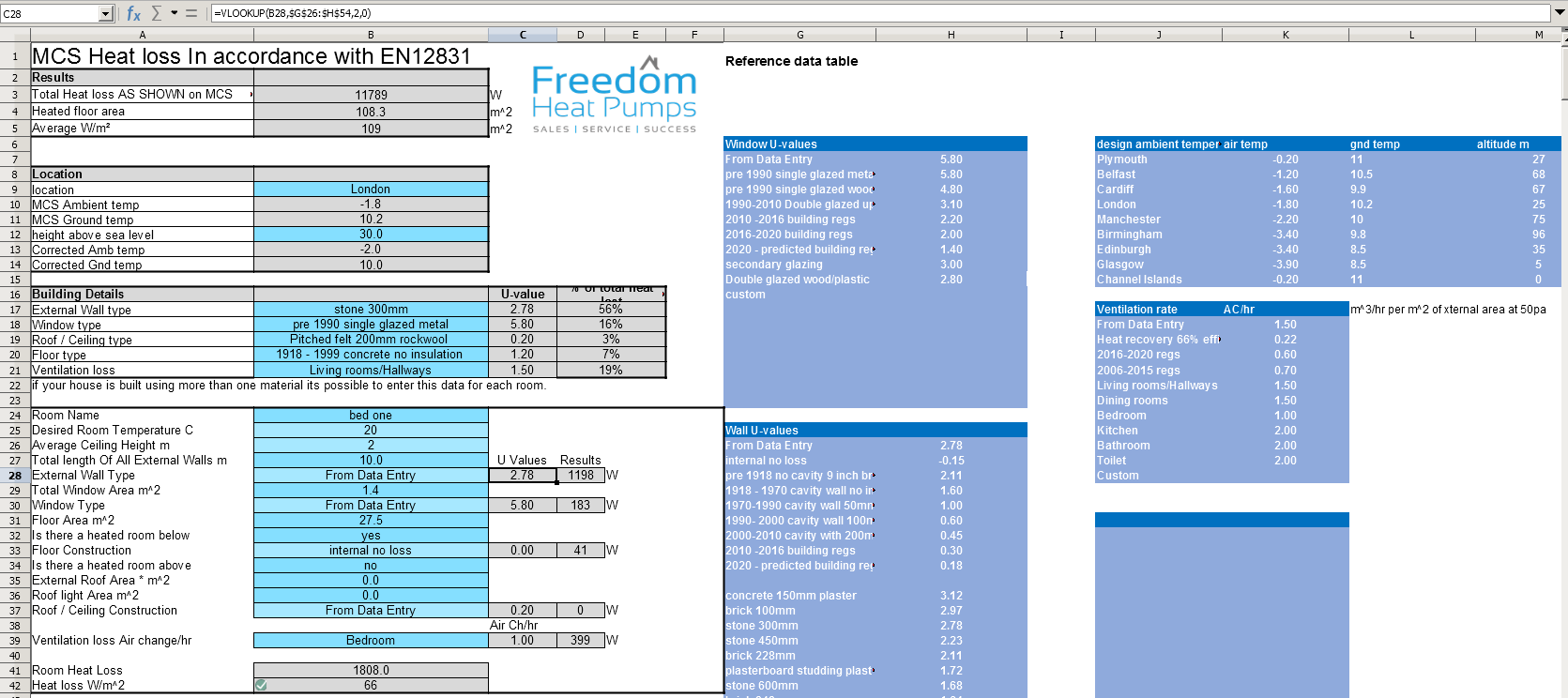
The Freedom Heat Pumps spreadsheet based heat loss calculator hides the U values, but they can be unhidden. Here you can see the normally hidden reference values, and how the main calculator uses a VLOOKUP to get the hidden values (cell C28 selected). With the reference data visible, you can of course edit it, and thereby indulge in unlimited whatiffery as extreme as you care to make it.
I've used an online calculator rather than a spreadsheet with click and select wall, floor, and window types that provide a suitable U value. There's probably a spreadsheet behind it but you don't see it.
More likely javascript. I'm always wary of online calculators where you can't see the calculations, because they are a classic black box. If you want to delve deeper, put your browser into developer mode, and look at the script files behind the webpage. Not so long ago I used an online bearing calculator provided by a respected bearing material manufacturer which gave the wrong results. I was able to find the javascript which did the calculations and thereby the problem: Imperial dimensions on an Imperial calculator converted to metric for the calculations but not then converted back to Imperial for the results. That's what happens when you leave it to the professionals!
Midea 14kW (for now...) ASHP heating both building and DHW
2
Topic starter
02/10/2026 4:34 pm
@cathoderay I suppose that's why you need to have a feel for and an expectation thru' experience of the result so a duff result stands out.
I've used the heat loss calc from Stelrad where you get a choice of radiators once it knows your rooms heat loss. you can see the U values used for the different wall types etc and change them manually if you so desire.
I think the number of air changes is a big one and is probably a lot lower than most people think even in an older house with some ventilation.
This post was modified 3 weeks ago by Paul1098
02/10/2026 4:58 pm
an expectation thru' experience
Experience certainly should help, but only if applied, and applied intelligently intelligently. One of my quotes looked as though the installer had used a random number generator to do the heat loss calculations, for example a smaller room with less exterior wall and less window area had a higher heat loss than a much larger room with more exterior wall and a larger window area. The same installer specified a hot water cylinder that would not fit in the available space. Even common sense, let alone experience, should detect these types of error.
It is precisely because of the high chance of errors that we advocate using a sanity check on heat loss estimates whenever possible. Doing that with an oil fired system is as previously discussed well nigh impossible based on fuel consumption, but it does occur to me there may be some merit at looking at what the oil based system's emitters can deliver. If, for example, the max output at design temps is 12kW, and the oil system kept the house warm in those conditions, then your heat loss might be about 12kW. But that of course assumes the emitters were correctly sized. If they were significantly over-sized, they would still warm the house adequately, but looking at their max output would over-estimate the heat loss.
Midea 14kW (for now...) ASHP heating both building and DHW
02/10/2026 5:04 pm
I've used the heat loss calc from Stelrad where you get a choice of radiators once it knows your rooms heat loss. you can see the U values used for the different wall types etc and change them manually if you so desire.
That sounds like a better approach (being able to see and edit if necessary U values). Do you have a link to the Stelrad calculator you can post here?
I think the number of air changes is a big one and is probably a lot lower than most people think even in an older house with some ventilation.
It seems the consensus is moving that way, indeed I think it was @rob-of-york who pointed out that the 'official' advice has caught up, and lower values are now recommended.
Midea 14kW (for now...) ASHP heating both building and DHW


SPONSORS

Degrees of Separation
Latest Posts
-

RE: How will removing the standing charge on gas bills benefit heat pumps?
@toodles GIGO always stands! My Cosy 6, as you can...
By Watcher , 2 hours ago
-
RE: Indevolt Batteries UK Support & Info Thread
@editor Mystery solved to some extent. Need to selec...
By dansus , 4 hours ago
-
RE: How much of your renewable and home setup would still work if the internet went down?
Interestingly we had an internet outage about a month a...
By Rob of York , 9 hours ago
-
RE: Double or Triple Glazed Windows?
Posted by: @singlespeed With 9 years repairing windo...
By Rob of York , 9 hours ago
-
@transparent we’re still running a secure version of PH...
By Mars , 12 hours ago
-
RE: How quickly would you want/expect heat recovery to take from setback?
Much longer than that here. The heating isn't even on. ...
By bobflux , 1 day ago
-
RE: Passiv Smart Thermostat - Help & Forum Support
Obviously the weather is changeable but there's a defin...
By Singlespeed , 1 day ago
-
RE: The Changing Jet Stream Could Challenge UK Air Source Heat Pumps
@rob-of-york I must admit that when we had a Daikin hea...
By Toodles , 1 day ago
-
RE: Forum updates, announcements & issues
Get the Renewable Heating Hub heads-up on WhatsApp. I...
By Mars , 1 day ago
-
RE: Safety study for plug in batteries out to tender - looks like Q3 2027 at best before legal
@editor I pointed out to the one of the Fuse execs that...
By dansus , 1 day ago
-
RE: 15kw pump for 225m2 1990's house - over kill?
@seaviews As well as loft insulation, there are othe...
By Rob of York , 1 day ago
-
RE: BT cuts you off, Plusnet blames Openreach... welcome to “seamless” broadband switching
Both of which (in most cases) use Openreach for the las...
By JamesPa , 1 day ago
-
RE: Renewables & Heat Pumps in the News
Yes, this is a swiss and german standard I believe, Vai...
By Batpred , 2 days ago
-
RE: Octopus Cosy 12 Heat Pump Regret: Incredibly Loud, Poor Heating & Constant Hum - Help!
@editor FWIW my problem was resolved, eventually, after...
By BigFish , 2 days ago





SPONSORS
