

Notifications
Clear all
Joining the Renewable Heating Hub forums is completely free and only takes a minute. By registering you’ll be able to ask questions, join discussions, follow topics you’re interested in, bookmark useful threads and receive notifications when someone replies. Non-registered members also do not have access to our AI features. When choosing your username, please note that it cannot be changed later, so we recommend avoiding brand or product names. Before registering, please take a moment to read the Forum Rules & Terms of Use so we can keep the community helpful, respectful and informative for everyone. Thanks for joining!
Air Source Heat Pumps (ASHPs)
68
Posts
8
Users
10
Reactions
1,782
Views

04/10/2026 8:26 am
https://www.ubakus.de/en/r-value-calculator/
This tool lets you input the makeup of your wall, ceiling, roof, etc, and calculates U/R-values.
It can also simulate summer comfort, thermal mass, dew points, condensation in the insulation, whether it will dry in the summer or not, etc. Extremely useful.

04/10/2026 10:21 am
This tool lets you input the makeup of your wall, ceiling, roof, etc, and calculates U/R-values.
Excellent find, thanks for posting the link here.
Midea 14kW (for now...) ASHP heating both building and DHW

Topic starter
04/10/2026 5:52 pm
@bobflux Thanks, that gives me something to check the inbuilt u values with. There looks like a lot more once you've found your way around it.
Topic starter
09/10/2026 11:44 am
@cathoderay https://www.stelrad.com/starsapp/login - you have to setup an account and I can't remember how onerous it is as it was 10 years ago when I started using it.
MCS and British standards do have air change values that generally seem to be 0.5 (I assume that's room volumes but not fully checked that yet) they also include for chimneys and extractors so comprehensive.
Just had my first quote of over £18k so if that's the general cost of an ASHP + central heating install for a small 2 bed cottage then my journey will be stopping and i'll go for LPG.
This post was modified 2 weeks ago by Paul1098

09/10/2026 11:53 am
you have to setup an account and I can't remember how onerous it is as it was 10 years ago when I started using it.
I fully sympathise with any wish not to have to sign up to spurious accounts but the link I posted was for the correction factor table, which is freely available, you then do your own calculations.
MCS and British standards do have air change values that generally seem to be 0.5
ACH value recommendations have come down recently, but again best to use numbers that make sense to you. I've always taken the value to .mean what it says' 1 ACH means the volume of air in the room is replaced every hour.
Just had my first quote of over £18k so if that's the general cost of an ASHP + central heating install for a small 2 bed cottage then my journey will be stopping and i'll go for LPG.
Is that with or without the BUS grant? And how much extra work does it include?
Midea 14kW (for now...) ASHP heating both building and DHW

09/10/2026 1:59 pm
I fully sympathise with any wish not to have to sign up to spurious accounts but the link I posted was for the correction factor table, which is freely available, you then do your own calculations
Standard rad output is proportinal to dt^1.3 where DT is the difference between room temp and average rad temp.
No need to sign up you can calculate it yourself unless you are using funky rads.
Just had my first quote of over £18k so if that's the general cost of an ASHP + central heating install for a small 2 bed cottage
Unless there are some major difficulties this is high, very high. It's standard practice throughout the construction industry to provide a very high quote if you don't want the work.
My recommendation is get more quotes and as @cathoderay invites tell us about the job so we can give you a steer.
This post was modified 2 weeks ago 2 times by JamesPa
4kW peak of solar PV since 2011; EV and a 1930s house which has been partially renovated to improve its efficiency. 7kW Vaillant heat pump.
09/10/2026 2:19 pm
Standard rad output is proportinal to dt^1.3 where DT is the difference between room temp and average rad temp.
No need to sign up you can calculate it yourself unless you are using funky rads.
The freely available table I linked to just simplifies the calculation to a single multiplication:
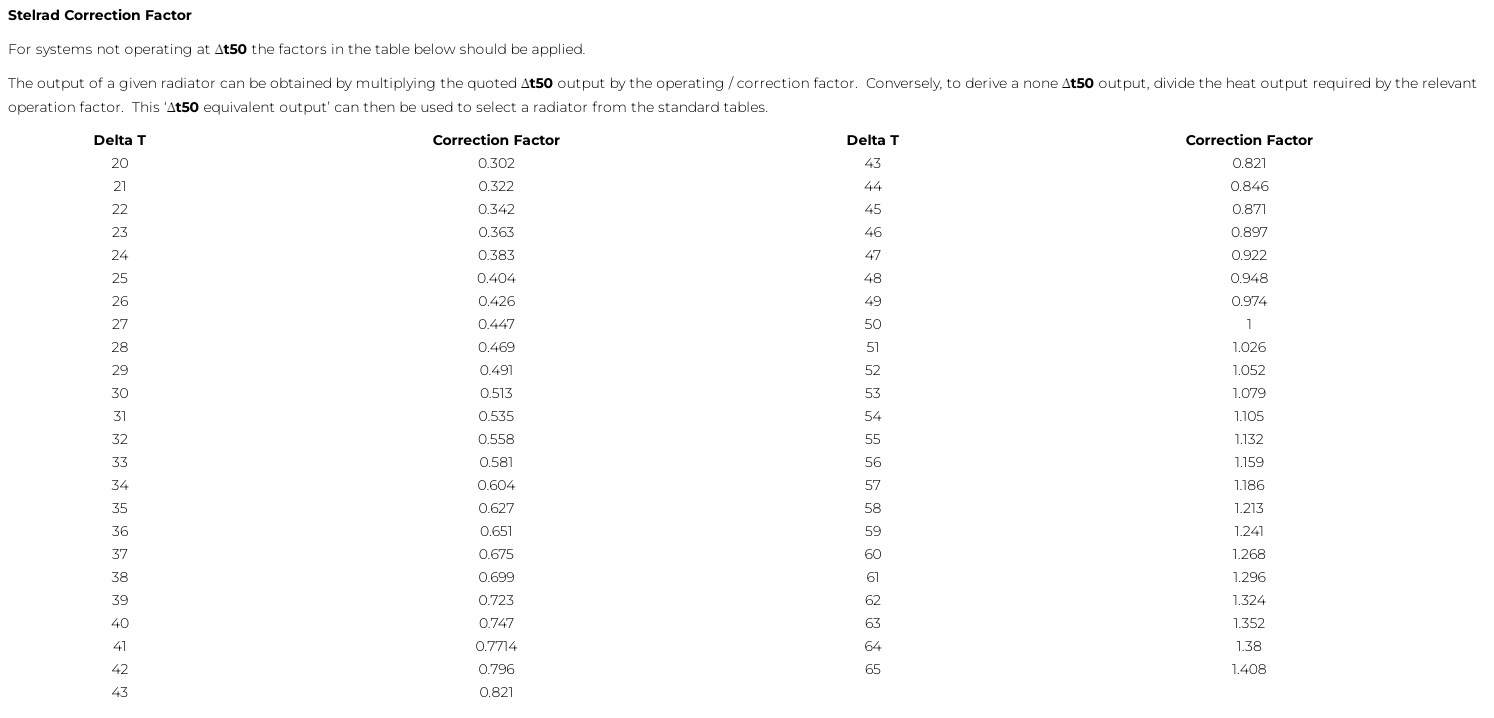
As you can see, the correction factor is about 0.5 at typical to higher (eg my system) heat pump delta t values, hence the half the delta 50 output rule of thumb. For lower delta t values, one third of the delta t output isn't a bad estimate. But for a full spec, you need to use the correct correction factor for your particular delta t.
Midea 14kW (for now...) ASHP heating both building and DHW

09/10/2026 3:34 pm
Posted by @paul1098Just had my first quote of over £18k so if that's the general cost of an ASHP + central heating install for a small 2 bed cottage then my journey will be stopping and i'll go for LPG.
Wow, that is expensive; however, I assume that it is for an air-to-water heat pump system with all the extra work and upheaval that fitting pipework and radiators entails, plus all the gold-plating required to get the BUS grant. Perhaps consider forgetting about the large subsidy that effectively pushes you down a route that is far from economically viable without it. Rather, I would suggest that you get multiple quotes for a simple air-to-air system with a multi-split outdoor unit and indoor units in only those rooms that really need them, likely no more than three. Some simple direct electric heating in other rooms (e.g. electric radiator, electric towel rail) and retain your existing immersion heater. A good competitive quote for that and you may well be looking at less than 1/3rd of the price you have been quoted for air-to-water. As a bonus you get highly efficient cooling in summer too!
Compared with A2A, LPG would be very expensive in terms of running costs, particularly if the property was occupied all year. I've just run the numbers for my brother based on 6000 kWh of heating with his new A2A system on a heat pump tariff. It is going to save him about £425 a year compared to mains gas. Considering A2A SCOP 5.2, 15p per unit electricity on a heat pump tariff, 9p per unit for gas 0.9 efficiency, £173 for A2A, £600 for gas. I think LPG works out around 14p per kWh at present, boiler still 0.9 efficiency, so that would be about £933 or over £760 per year more expensive than A2A - ouch!
If you want hot water and air-to-air via a heat pump then take a look at the Daikin Multi+ split system that does it all in one unit. That would be quite a lot more expensive assuming that you got a new hot water tank with it, but arguably a very good solution overall.
This post was modified 2 weeks ago 3 times by Rob of York
Topic starter
09/10/2026 5:21 pm
ACH value recommendations have come down recently, but again best to use numbers that make sense to you. I've always taken the value to .mean what it says' 1 ACH means the volume of air in the room is replaced every hour.
I always thought the same but I have seen m3/m2 quoted which is got me wondering but that could just be a mis-quote.
Is that with or without the BUS grant? And how much extra work does it include?
That included the BUS. It included for 5 rads, HWT, controller and central heating pipework.
Topic starter
09/10/2026 5:45 pm
@rob-of-york My reasoning for the move away from storage heaters was to make life easy when the house is sold.
I think that if i can get A2W at a sensible price then it would be more acceptable to the general public than A2A although A2A is probably preferable to storage heaters.
LPG might not be ideal but it is what a lot of people are used to when 'off grid' and not able to fit oil storage.
The first quote was a toe in the water to confirm that it was possible to fit an A2W system. More quotes required and probably from good old fashioned plumbers that do full systems as well as A2W and also some companies doing A2A.
The self imposed constraint i have is value for money, if the new heating system can be close to cost neutral when compared to the increase in house value then it's worth doing if not i'll stick with my storage heaters.
09/10/2026 6:07 pm
I always thought the same but I have seen m3/m2 quoted which is got me wondering but that could just be a mis-quote.
I have just had a look at how the freedom Heat Loss uses and calculates ACH values. The actual values are by default look up values based on room type from a hidden table, which has by it "m^3/hr per m^2 of xternal area at 50pa". Go figure... The actual calculation to get the resultant loss in watts for bedroom 1 is =((B25-$B$13)*0.33*(B31*B26)*C39) which breaks down to (design room IAT - design OAT) x 0.33 x (room height x floor area) x the looked up ACH value (1.00 in this case). Most online sources say the ACH number represents the number of total air changes within one hour, ie a value of 1 means all the air is changed once an hour, 2 means twice an hour etc ie our general understanding is correct. How that simple concept then ends up with units of "m^3/hr per m^2 of xternal area at 50pa" is beyond me. To me, the unit is 'air changes per hour' and it simply means what it says! 1 ACH means the air changes once an hour! No doubt others (@jamespa? @rob-of-york?) can enlighten us further.
That included the BUS. It included for 5 rads, HWT, controller and central heating pipework.
Just to be absolutely sure, total cost is just over £18k, of which you would pay that less any grant you get?
Midea 14kW (for now...) ASHP heating both building and DHW
09/10/2026 6:36 pm
1 ACH means the air changes once an hour! No doubt others (@jamespa? @rob-of-york?) can enlighten us further.
Exactly that. Dimensional analysis (the powerful and occasionally useful technique of working out what the answer and the formula is measured in, in terms of the fundamental dimensions of the universe - length, time, mass etc) will confirm. I will post the full explanation later if nobody else does and anyone is interested (both of which seem unlikely)
This post was modified 2 weeks ago 2 times by JamesPa
4kW peak of solar PV since 2011; EV and a 1930s house which has been partially renovated to improve its efficiency. 7kW Vaillant heat pump.


SPONSORS

Degrees of Separation
Latest Posts
-

RE: New Build 3 Phase or 1Phase
This is way more complex than I had hoped. I have conta...
By E A WEST , 32 minutes ago
-
RE: How will removing the standing charge on gas bills benefit heat pumps?
I think it has an enormous impact on air/air users. The...
By EtchedPixels , 3 hours ago
-
@editor Ouch, sorry to re start the tick. I had assume...
By DavidB , 20 hours ago
-
RE: Say hello and introduce yourself
@e-a-west as the good Major said, welcome to the forums...
By Mars , 21 hours ago
-
RE: How much of your renewable and home setup would still work if the internet went down?
Yes I actually have a copy of a tool that whenever a ce...
By EtchedPixels , 1 day ago
-
RE: Indevolt Batteries UK Support & Info Thread
@editor Hi, To resolve this, please tap on the A...
By Indevolt Tech , 2 days ago
-
RE: Double or Triple Glazed Windows?
Posted by: @singlespeed With 9 years repairing windo...
By Rob of York , 2 days ago
-
@transparent we’re still running a secure version of PH...
By Mars , 2 days ago
-
RE: How quickly would you want/expect heat recovery to take from setback?
Much longer than that here. The heating isn't even on. ...
By bobflux , 3 days ago
-
RE: Passiv Smart Thermostat - Help & Forum Support
Obviously the weather is changeable but there's a defin...
By Singlespeed , 3 days ago
-
RE: The Changing Jet Stream Could Challenge UK Air Source Heat Pumps
@rob-of-york I must admit that when we had a Daikin hea...
By Toodles , 3 days ago
-
RE: Forum updates, announcements & issues
Get the Renewable Heating Hub heads-up on WhatsApp. I...
By Mars , 3 days ago
-
RE: Safety study for plug in batteries out to tender - looks like Q3 2027 at best before legal
@editor I pointed out to the one of the Fuse execs that...
By dansus , 3 days ago
-
RE: 15kw pump for 225m2 1990's house - over kill?
@seaviews As well as loft insulation, there are othe...
By Rob of York , 3 days ago


SPONSORS

