

Notifications
Clear all
Joining the Renewable Heating Hub forums is completely free and only takes a minute. By registering you’ll be able to ask questions, join discussions, follow topics you’re interested in, bookmark useful threads and receive notifications when someone replies. Non-registered members also do not have access to our AI features. When choosing your username, please note that it cannot be changed later, so we recommend avoiding brand or product names. Before registering, please take a moment to read the Forum Rules & Terms of Use so we can keep the community helpful, respectful and informative for everyone. Thanks for joining!

Topic starter
11/10/2025 12:54 pm
We are booked in for a heat pump install with British Gas. So far we have been very impressed with them and it will be installed in around 10-12 weeks.
I'd like to run by your thoughts as to their radiator plans.
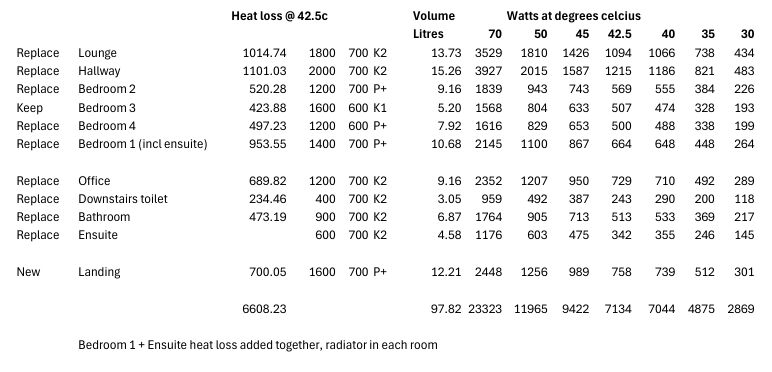
They look pretty sensible to me and have been designed at 42.5c (not 50c like Octopus).
They want to change all bar one of our radiators, including an additional on the landing and all much bigger than we have (which we are happy with).
They have sized the radiators at 21c in all rooms, including bedrooms. Only the bedrooms will have TRV's.
Will the bedrooms be too warm? Ideally we want to run the heat pump 24/7, with a small setback overnight.
Should we stick with the bedroom radiators at this size, or ask BG to resize them at a lower temperature?
Is it better to have the bedroom radiators oversized for greater volume and let the TRV's limit the flow to avoid overheating, or reduce the radiator sizes in the hope the TRV's won't need to kick in?
Heat pump will be a Daikin 8kw Altherma LT, 25l volumiser.
House heat loss was 6.2kw.
Attached is the radiator schedule.
Thanks.

11/10/2025 1:58 pm
Assuming the heat loss figures are accurate, the radiator sizings look sensible. We have Flow Regulating Valves (FRVs) installed on almost all our radiators. They make it very easy to balance the flow across all the radiators. I wonder whether they would be prepared to install them?
I am not sure whether it's OK to have TRVs as well as FRVs on bedroom radiators. Hopefully, someone else can advise.
We are finding that upstairs is about 1.0-1.5C higher than downstairs. I am not sure whether that is just natural stratification with the warm air rising from downstairs. So far, we are just running all our bedroom TRVs wide open. We find the bed is a bit cool at the beginning of the night, but we wake up a bit too warm. That may be due to our rather old Tempur foam mattress. Apparently, the latest ones breathe and release heat better. Still, it is really nice to be able to go downstairs and make a cup of tea without need to wear a dressing gown!
Grant Aerona 290 15.5kW, Grant Smart Controller, 2 x 200l cylinders, hot water plate heat exchanger, Single zone open loop system with TRVs for bedrooms & one sunny living room, Weather compensation with set back by room thermostat based load compensation


11/10/2025 2:13 pm
Good point about the FRVs, @grahamf. Renewable Heating Hub members get 10% off by using the discount code RHHFRV10 at checkout, if you buy from Firepower.
🔥 Britain’s Heat Pump Shitshow
How Installing a Heating System Became a National Nervous Breakdown
Free UK shipping.
📗 Heat Pumps Explained
A Jargon-Free Guide for Homeowners
Rewritten and updated for 2027
📘 From Zero to Heat Pump Hero
🛠️ Bodge Buster
New to heat pumps?
Take the Heat Pump Fundamentals course and use INTRO50 at checkout for 50% off.

11/10/2025 5:13 pm
We are finding that upstairs is about 1.0-1.5C higher than downstairs
So why not just turn down the frvs on these radiators? There is nothing sacrosanct about the 'design' flow rate
4kW peak of solar PV since 2011; EV and a 1930s house which has been partially renovated to improve its efficiency. 7kW Vaillant heat pump.

11/10/2025 5:16 pm
Will the bedrooms be too warm? Ideally we want to run the heat pump 24/7, with a small setback overnight.
If bedrooms are too warm just reduce the flow rate through them by turning down the lsvs (or frvs if you can get them fitted) This reduces the average rad temp this reducing the heat emitted. That's what I and others have done.
4kW peak of solar PV since 2011; EV and a 1930s house which has been partially renovated to improve its efficiency. 7kW Vaillant heat pump.
Topic starter
11/10/2025 6:37 pm
@jamespa Thanks, I'm assuming as I'll have a decent volume of around 120ltrs + pipework, the reduced flow shouldn't make much of a difference and better than allowing the TRVs to take over too much?
Topic starter
11/10/2025 6:40 pm
With the frvs, I assume looking at the blurb, they just make the balancing easier?
12/10/2025 10:14 am
@jamespa Thanks, I'm assuming as I'll have a decent volume of around 120ltrs + pipework, the reduced flow shouldn't make much of a difference and better than allowing the TRVs to take over too much?
With the frvs, I assume looking at the blurb, they just make the balancing easier?
Trvs switch the flow off altogether so anything which reduces flow rather than switching it off is better from a flow perspective.
Frvs are as you say sold to help with balancing. However given what they do is adjust the flow rate, they can be turned down or up from the 'design' setting thus doing the same job as lsvs but with better control. Another way to look at it is that they can be used to balance the rads for equal room temp (or desired temp differences) as opposed to equal deltaT.
4kW peak of solar PV since 2011; EV and a 1930s house which has been partially renovated to improve its efficiency. 7kW Vaillant heat pump.

Topic starter
12/10/2025 11:04 am
After months of research, that is my understanding, that you ideally don't want to remove a radiator from the system completely (the trv switching it off), as you want to keep as much of the entire system as possible flowing.
These frvs do look to be a better way than trial an error with a standard lock shield.
I assume you'd want the whole system balanced at point of install, that all radiators heat evenly.
Then as time goes by and you get a better idea of how each room heats up, you can reduce the flow to some rooms that may have a tendency to overheat, which will be pretty straightforward and more accurate with a frv.
Are these radiator frvs the same as what is used with underfloor heating?
This post was modified 1 year ago by Mars
12/10/2025 4:43 pm
After months of research, that is my understanding, that you ideally don't want to remove a radiator from the system completely (the trv switching it off), as you want to keep as much of the entire system as possible flowing.
These frvs do look to be a better way than trial an error with a standard lock shield.
I assume you'd want the whole system balanced at point of install, that all radiators heat evenly.
Then as time goes by and you get a better idea of how each room heats up, you can reduce the flow to some rooms that may have a tendency to overheat, which will be pretty straightforward and more accurate with a frv.
You are spot on.
Are these radiator frvs the same as what is used with underfloor heating?
I don't know TBH as I don't have them, they weren't available when my heat pump was fitted. They look that way though!
4kW peak of solar PV since 2011; EV and a 1930s house which has been partially renovated to improve its efficiency. 7kW Vaillant heat pump.

SPONSORS

Degrees of Separation

Latest Posts
-

RE: Why are ASHP installs so expensive?
@rob-of-york I think the most revealing question here i...
By Mars , 20 minutes ago
-
RE: Does anyone have experience of a smart water meter?
@downfield You are opening a whole can of cans there!
By Toodles , 21 minutes ago
-
RE: Renewables & Heat Pumps in the News
@majordennisbloodnok the argument you cite from that TE...
By Transparent , 2 hours ago
-
RE: Replacing Storage Heaters with a Heat Pump in a Stone Cottage
I found some interesting data about the price of heat p...
By Rob of York , 5 hours ago
-
RE: Air-to-Air Heat Pumps & Air Conditioning: UK Heating and Cooling Q&A
Thanks for that, quite interesting. I liked the bit a...
By springswood , 6 hours ago
-
RE: PV and battery long payback - sense check query
Thanks for all the comments. I finally got to the bott...
By DavidB , 7 hours ago
-
RE: Indevolt Batteries UK Support & Info Thread
People following this thread who are hoping that plug i...
By JamesPa , 17 hours ago
-
Safety study for plug in batteries out to tender - looks like Q3 2027 at best before legal
Whilst searching for other information I came across th...
By JamesPa , 17 hours ago
-
RE: Passiv Smart Thermostat - Help & Forum Support
By Singlespeed , 19 hours ago
-
RE: Help me keep the faith with my air source heat pump installation
just had Vaillant over to service the HP and asked abou...
By AdamK , 19 hours ago
-
RE: tepeo ZEB UK Support & Info Thread
OK so ZEB is basically a variant on a storage heater, b...
By JamesPa , 2 days ago
-
RE: Heat Geek installations: share your experiences
@editor I suspect that the Heat Geek online quote is a ...
By AndrewJ , 2 days ago
-
RE: Adding additional Solar Panels to a DC coupled battery system
Ah, yes. Thanks for clarifying.
By Transparent , 2 days ago
-
RE: Vaillant ecoTEC Plus - Flow Temp and Set Up
@trebor12345 I have been meaning to get home assista...
By Batpred , 3 days ago




SPONSORS

