

Notifications
Clear all
Joining the Renewable Heating Hub forums is completely free and only takes a minute. By registering you’ll be able to ask questions, join discussions, follow topics you’re interested in, bookmark useful threads and receive notifications when someone replies. Non-registered members also do not have access to our AI features. When choosing your username, please note that it cannot be changed later, so we recommend avoiding brand or product names. Before registering, please take a moment to read the Forum Rules & Terms of Use so we can keep the community helpful, respectful and informative for everyone. Thanks for joining!

Topic starter
10/07/2026 10:41 pm
Hey folks, I've been experimenting with cooling using my heat pump and thought I'd share my experiences here. If you have an ideas for making this work better I'm all ears! I have a 8kW Mitsubishi Ecodan ATW ASHP that was installed 4 years ago and has provided me with wonderfully cheap heating without burning stuff. Heat Pumps can, in theory, be reversed, so that instead of moving heat into the house by making your radiators hotter, it can move heat out of your house by making your radiators colder. I've seen the Heat Geek videos where they play around with reversing the heat pump to provide cold water to the radiators and conclude it's probably not worth it, but I gave it a go anyway.
How I did it
In short, I did this:
I turned off my heat pump at the Consumer Unit (or “fuse box” in old money), opened the cover of the indoor control unit, flipped a dip switch (SW2-4), turned it all back on, went to the settings on the LCD control panel, and lo and behold, it now has the option for cooling mode!
You need to do this because most heat pump installers will leave cooling mode disabled. My heat pump was pretty easy to enable cooling mode on, but yours might be more difficult. It might involve buying and installing a chip, which might seem more daunting. This probably won’t void your warranty, but I did wait until mine was more or less expired before doing it, just in case.
Why you shouldn’t do this
Installers leave this setting disabled because it’s very much outside the boundaries of what an ATW ASHP should be doing. Running cold water through radiators may cause problems. If the water in the pipes and radiators is below the dew point in your house, water will condense on those pipes. Over time, that water will start to cause potentially serious problems, such as rotting the wood that holds your floors and ceilings up. Installers don’t really want to be on the hook for that stuff, so they leave it off.
What to expect
Installers will also tell you that the cooling effect is minimal and not worth the risk of damange to your property or to the heat pump itself. They might be right. This isn’t air conditioning: your house won’t suddenly be 21 degrees when it’s 30 outside. It will lower your room temperatures by 1 degree, maybe 2 if you’re lucky.
But that 1 degree is hugely significant to how you will feel in your house when it’s ridiculously hot outside. It won’t do much on its own, but if you couple it with other cooling techniques such as using fans, having windows open at night and closed in the morning, curtains/blinds closed to reduce solar gain, etc., it will make your house feel much more pleasant on those really hot days.
The difference between 25 and 26 indoor temperature is, in my experience, very noticeable. And at night when it gets cooler and you open your windows again, you will be cooling your house down from 25 instead of 26, which makes the nights more bearable too as you reach lower temperatures sooner.
Some graphs and data
Here’s the comparison of temperature with and without the cooling. Both days were the same outdoor temperature, and nothing else was different. It’s about as fair a comparison as you’re going to get I think:
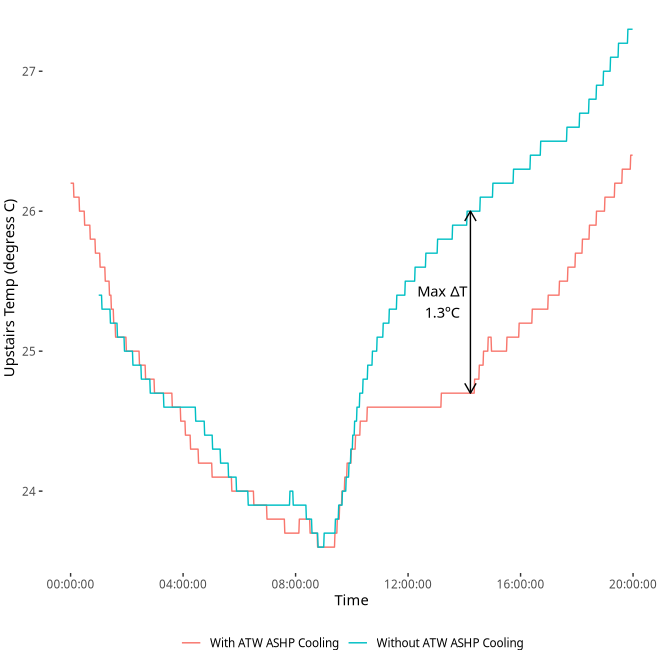
The important thing here is where it flattens off after I turn it on. For a good chunk of the day, between 11am and 3pm, the cooling power of the radiators was enough to match the heating power of the sun. Eventually, nature won and the temperature started to rise as it got hotter in the mid-afternoon. But for a good chunk of the day, the house simply didn't get hotter.
The heat pump did about 1.5 to 2kW of cooling on average over the 3 days I monitored it. It had a CoP of around 3, which is pretty rubbish for air conditioning, but I have solar panels so when it's this sunny I don't care!
Things I’ve learnt
The temperature of the radiators doesn’t matter that much
You can control the temperature of the water in your radiators; in fact, for my heat pump, that is the only possible setting in cooling mode. But it actually doesn’t matter that much when your house is already at 25 degrees. What really matters is how much heat from the air in your rooms can be transferred to the cold radiators. The colder your radiators, in theory, the more heat it will absorb from the air. But air is really crap at transferring heat. The normal way radiators work in heating mode is by circulating air via convection currents. The constant airflow created means that cold air is constantly being drawn up through the radiator, warming along the way, and being circulated back into the room. But this doesn’t work in reverse: the cold air from the radiator mostly just stays on the floor, meaning the air immediately surrounding the cold radiator gets cold, but the rest of the room stays hot.
Reducing the temperature of the radiator won’t improve this much. The amount of heat absorbed by the radiators when at 12 degrees is more or less the same as at 17 degrees.
So, to reduce the risk of condensation, I monitor the dew point and set the flow temperature to be 2 degrees above that. Typically, this means 15-17 degree flow temperatures.
What really matters is the Delta T between Flow and Return (at a given flow rate)
The basic equation for how much heat is being absorbed by the radiators is Q = m * C * DT, where Q is cooling power, m is the flow rate, C is the specific heat capacity of water, and DT is the difference between flow and return temperature to your radiators. I know from previous experiments that my heat pump measures m and DT fairly accurately, and therefore calculates Q fairly accurately, so I can more or less trust the measurements from the heat pump itself.
However, even if I don’t trust it, the basic physics is the same. All you have to worry about is whether the return temperature is higher than the flow temperature. If it is, then the cold water in your radiators are, in fact, absorbing heat and getting hotter, meaning your house is getting cooler! So just monitor the flow and return temperatures, either manually with a thermometer or automatically if you have the means and/or trust your heat pump.
You’ll want to do this anyway, in order to avoid condensation… On my unit, the flow temp is slightly below the temperature I set on the control unit, meaning the pipes near the unit are cooler than the 17 degrees I might set for the flow target. This means that I need to set the flow temp a couple degrees higher than the dew point, to ensure that the outgoing pipes aren’t colder than the dew point to avoid condensation.
Delta T is pretty much 2 degrees no matter what the flow temperature is
Anywhere between 12 degrees and 17 degrees, for me at least, DT is 2 degrees. Probably there’s some rounding in there, so 12 is closer to 2.4 and 17 is closer to 1.6, but in practice, the unit itself reports very little change in cooling output when I run it cold vs hot. I suspect this is because the temp of the rads simply isn’t the limiting factor here: you need to get push warm air to the radiators (or draw cold air away from the radiators), and this is what limits the cooling power of the radiators more than the temperature itself.
So don’t worry too much and set the flow temp to be a good amount above the dew point. I know I’ve said this 3 times but it’s important!
My unit reports that it does between 1.5 kW and 2 kW of cooling on average. This is pretty good! It’s enough to reduce the air temp by 1 to 2 degrees.
The Dew Point goes up slower than the indoor air temperature
Generally speaking, in the morning, the dew point is below 15 degrees, and by the evening, the dew point is more like 16. So the dew point rises by around 1.5 degrees throughout the day. Therefore, my flow temperatures rise by 1.5 degrees over the course of the day. But my indoor temperature goes up from 24 to 27 over that same period. This means that the difference in temperature between the air and the radiator actually increases as the temperature in the house increases, meaning that a 17 degree flow temp at 27 air temp will do more cooling than 15 flow at 24 air temp. So again, don’t worry about raising the flow temperature as the air in your house gets hotter - if it does make a difference at all, it will be in your favour as the day goes on.
Radiator fans don’t increase cooling output, but do make you feel a bit cooler
I spent nearly £400 for 5 rad fans, and they do nothing for cooling output. I was going to buy them anyway so wasn’t a total waste, but they do nothing to improve the cooling effect. They’re simply too small, and can’t draw air up through the radiators. The best use for them is to put them on the bottom of the radiator, so that the cold air goes onto your feet. This only works if your radiator is out on the open, and you’re able to sit relatively close to it. Probably it adds more to the cooling effect than the 6 watts or so that it draws (and therefore produces in heat), so I keep them on. But they are not worth getting if you don’t already have them, as the same thing can be accomplished cheaper and easier with a £10 desk fan.
An actual fan is much better
Point a big fan at a big radiator and the air will certainly move around. The air from the fan will disperse laterally mostly, at body height, so the cool air will be more likely to hit you rather than settle on the floor by your feet.
In any case, the basic problem with this set up is getting heat TO the radiators. The radiators don’t “radiate cooling” in the way that a hot object would normally radiate heat. Radiative heating works because the metal radiator heats up and emits photons. When those photons hit other objects, like your body or your sofa or whatever, the photon releases some of its energy as heat and warms up that object. Typically it gets reflected and bounces around a few times, releasing heat every time it hits something.
This doesn’t work in reverse. A cold metal radiator won’t “attract” photons to it purely by being cold. Photons need to be colliding with it for “radiative cooling” to happen. I don’t personally believe that this is a significant mechanism or effect. I think what people think of as “radiative cooling” is merely the cold air that surrounds the radiator being and feeling cold. But that’s conduction! The air is (slowly, poorly) conducting heat to the cold radiator, and getting cold itself. Then your body is (slowly, poorly) conducting heat to the cold air, reducing your body temperature slightly.
In my view, conduction is the thing we need to focus on. How can we conduct the heat away from the air to the cold object?
We have probably all heard of putting ice below a fan so that the fan blows icy cold air around. I think this is the best bet for ATW cooling. Set up fans so that they blow hot air over the cold radiator, and blow cold air from the radiator around the room. We can’t rely on convection, but we can use fans to replicate some of its effect.
(Another idea I had, which I don’t think is a good one, is using sand or ice packs on the bottom of the radiators. My theory is they slowly cool down, then I move them to a hot part of the house, e.g. the kitchen, where they absorb some of the heat from the kitchen. Then I move them back to the cold radiator. Basically, I am a manual heat pump, and sand/ice packs are my medium. …Yeah, I don’t think this is a good idea, but who knows? Worth a try.)
The house dries up pretty quickly
I turn the cooling on in the morning and off at night. This allows any condensation that I can’t see to dry up. To be clear, there is no condensation on any of the pipes or radiators that I can see. At most, I get some in the bathroom after a shower, but I leave the window open in there anyway (and shut the door) to reduce humidity. It is possible that the wood is rotting underneath the floorboards, or some other scary thing is happening, but I doubt it… Buildings are designed to get a bit wet and then dry off, and in any case I’m not running this thing 24/7/365. I’ll be running it for 12 hours a day, a week at a time, during the hottest, driest part of the year. I think the risk I am running is pretty low, personally, though other opinions are available!
Conclusion
I’m sat here in my living room when it’s 30 degrees outside and I’m a bit cold. I’m pretty impressed, quite frankly. It cost me nothing (other than sort of wasting money on those radiator fans), and provided light relief this past week. The theoretical performance is about 1.5 kW to 2kW, which in practice reduced the temperature in my house by 1 to 2 degrees or so. That’s impressive for something that cost me nothing!
Don’t get me wrong, this is by no means a replacement for any of the other things that people recommend doing to cool the house down. Those things are FAR more effective. But this actually does do something, it is pretty low risk the way I’m running it, and again, it literally cost me nothing. I have the kit in my house already, I just flipped a switch and now my house is a degree cooler than it was before.
Has anyone else experimented with this? What did you find? What worked well for you? Any tips?
Cheers!
This topic was modified 4 months ago by scrchngwsl
ASHP: Mitsubishi Ecodan 8.5kW
PV: 5.2kWp
Battery: 8.2kWh
4

11/07/2026 11:06 am
What an excellent extensive report. It sets my expectations back to 1-2degrees of cooling.
Thank you very much
2kW + Growatt & 4kW +Sunnyboy PV on south-facing roof Solar thermal. 9.5kWh Givenergy battery with AC3. MVHR. Vaillant 7kW ASHP (very pleased with SCOP >4) open system operating on WC

11/07/2026 3:47 pm
Great, and very helpful report thank you. I too was considering this option. We have 18 month old Ecodan units (2 of them…that work in tandem) and a large UFH floor area downstairs (250 m2) and radiators upstairs. I’m not sure whether the UFH side would work better or worse in this scenario ? And not sure exactly how to change the flow temp in cooling mode on the FTC… but I guess I’d work that out! ( is that the 16degree setting on the Home Screen of the FTC in the video?)
are there any other considerations for either tandem units (other than the 2 dip switches to flip) or UFH that you think I should consider?
This post was modified 3 months ago by Carpenterstation
Topic starter
11/07/2026 7:42 pm
@judith you're welcome!
@carpenterstation the flow temp is indeed the 16 degrees C on the FTC. Fairly easy to set and I think can be changed in the MELcloud app too if you use that.
I have 1 small loop of UFH that frankly wasn't well installed and doesn't do a whole lot of heating or cooling for me, so my experience with UFH isn't super useful. In theory I'd imagine that the basic problem of "how do I get hot air to the cold surface?" is easier to solve as a normal fan would circulate air pretty effectively and there's a larger surface area for warm air to come into contact with. In terms of perception / feeling comfortable, it's surprising how nice it is to walk on a cold surface. Some of our normal radiator pipes downstairs are embedded in the concrete floor pretty close to the surface, so they feel a bit like underfloor heating. Walking on those feels glorious on a hot day.
Regarding your two units, I have no idea how they would work, but my experience with my unit is that it simply pipes cold water round the property instead of hot, so I'd imagine you wouldn't need to do anything different......
My only worry if I had proper UFH would be that condensation on the UFH loop would probably have a worse impact over time than condensation on pipes going through wood? I'm not sure though.
ASHP: Mitsubishi Ecodan 8.5kW
PV: 5.2kWp
Battery: 8.2kWh
1


11/07/2026 11:08 pm
Office (blue) and Living Room (orange) have UFH, running 18°C water from the heat pump about 12 hours a day (on free PV).
Living room also has a mobile AC unit.
Bedrooms (purple) don't have any cooling installed.
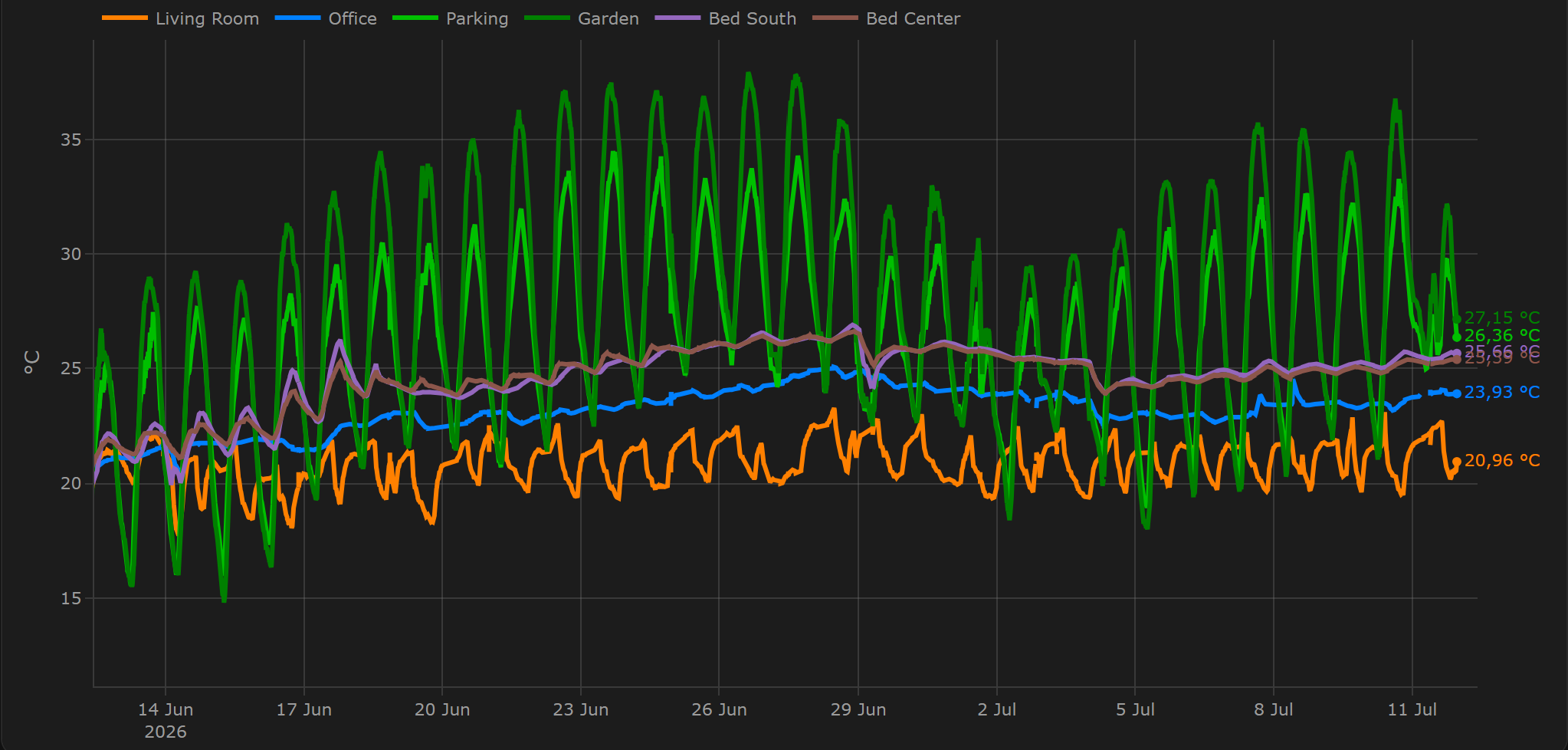
No condensation issues. Weather is quite dry, and the mobile AC unit also dehumidifies interior air.
UFH cooling seems to work. It is not as satisfying as real aircon, and it is very slow acting. The 12 hour cycles are smoothed by the thermal mass. Inside the room, it's not possible to tell whether it's working or not, but the temperature remains lower than in the rooms without it.
3

12/07/2026 8:25 am
My contribution is to wonder how your radiators are plumbed in? I think it's mentioned in the Heat Geek video on this that if the cold(er) water enters and leaves at the bottom then it doesn't spread through the radiator. It should be easy to feel if that's the case. If you plumb cold water to come in at the top and out at the bottom (in the jargon TBOE top bottom opposite ends) then the whole radiator comes into effect.
That should make a big difference with the radiator fans. If there's only a narrow strip at the bottom of the radiator where cold water is flowing then all the fans will do is blow the cooled air over the warm upper part of the radiator so that any air that comes out has been heated to room temperature before it can do any good.
As for radiative cooling I think it's easier to look at it as a question of area. In heating mode the infra red from the radiator, ~1m2 is absorbed by the whole room, ~80m2. In cooling mode it's the room that's radiating so the ratio is reversed. As you say the result is the effect is negligible. For under floor the area is so much bigger that radiative cooling could be significant. The relief of cool feet is probably greater though.
As you say it all comes down to delta T. I've been very aware of this in the current heat wave. It took a couple of days for my house to become uncomfortably hot. Like you the step from 25 to 26C seems significant. Once the heat is in the house I've found it hard to get it out again. Even maximising ventilation there's only around 5 degrees C difference and with the low specific heat capacity of air it just can't carry away much energy.
Which just makes me appreciate that this is a problem which has been solved with air to air heat pumps. I'm still weighing up whether that's the best way for me to go. Just now it has its attractions.
2
Topic starter
15/07/2026 10:39 am
@springswood - my radiators are plumbed the "normal" way, so that the cold water mostly stays on the bottom/left of the radiator. I'd say about 1/3rd of the radiator gets cold: the left hand side, and the bottom, with the top right staying mostly room temperature.
Good point about the radiator fans - pulling cold air up through the warm radiator won't actually help will it! I have indeed noticed that putting the fans at the bottom is better than the top.
As an aside, I thought of another way of thinking about this.
Imagine you're in the middle of winter, it's cold outside, and you're trying to keep your house 21 degrees. Now imagine you've noticed that one of your walls is really quite cold - 13 degrees say. You would expect that wall to be leaking heat, and you'd want to insulate it somehow. It wouldn't seem controversial that a cold wall, even one that is only 8 degrees below room temperature, would be removing a fair amount of heat from your house.
The situation is the same in the summer, except instead of one big wall, you have 6 or 7 smaller radiators, the room temperature is 25 degrees and the radiator is 17 degrees. It shouldn't be controversial that a bunch of cold radiators, even ones that are only 8 degrees below room temperature, would be removing a fair amount of heat from your house.
I'm not sure if this analogy is entirely fair but it's something to think about!
ASHP: Mitsubishi Ecodan 8.5kW
PV: 5.2kWp
Battery: 8.2kWh

15/07/2026 11:48 am
@springswood - my radiators are plumbed the "normal" way, so that the cold water mostly stays on the bottom/left of the radiator. I'd say about 1/3rd of the radiator gets cold: the left hand side, and the bottom, with the top right staying mostly room temperature.
Good point about the radiator fans - pulling cold air up through the warm radiator won't actually help will it! I have indeed noticed that putting the fans at the bottom is better than the top.
As an aside, I thought of another way of thinking about this.
Imagine you're in the middle of winter, it's cold outside, and you're trying to keep your house 21 degrees. Now imagine you've noticed that one of your walls is really quite cold - 13 degrees say. You would expect that wall to be leaking heat, and you'd want to insulate it somehow. It wouldn't seem controversial that a cold wall, even one that is only 8 degrees below room temperature, would be removing a fair amount of heat from your house.
The situation is the same in the summer, except instead of one big wall, you have 6 or 7 smaller radiators, the room temperature is 25 degrees and the radiator is 17 degrees. It shouldn't be controversial that a bunch of cold radiators, even ones that are only 8 degrees below room temperature, would be removing a fair amount of heat from your house.
I'm not sure if this analogy is entirely fair but it's something to think about!
Given the way radiation and convection effects don't work precisely the same for heating and cooling, I'm not sure your analogy stacks up, @scrchngwsl - at least not not enough to make it a like for like comparison. I don't doubt, however, your observed results and am very grateful for your posting them.
I'm not a big fan of A2W experiments in cooling, specifically because of the already mentioned point about condensation in awkward places; that if any pipework goes through any interstitial space where the temp/humidity mean a dew point above the temperature of the water, condensation will happen and you won't know anything about it, and the cooling benefit to the homeowner are subtle rather than dramatic.
HOWEVER...
I can still see one good case for running an A2W system in cooling mode at a flow temperature safely above the dew point. My largest room has underfloor heating and also suffers from solar gain. During this hot spell, I have noticed several times where water being circulated through the system has brought water from warmer parts of the house into the UFH and so the floor has felt as if the heating is on (though it's not - I checked). That floor is a huge slab of screed, so once it's warmed up it's a bit problem to cool down again. It strikes me that if the heat pump were gently cooling the slab, it might not cool the room but would slow its rate of warming up each day. There's only a subtle difference between the concepts of cooling a room and slowing its increase in temperature but I suspect there'd be a significant difference in living standard, so much as I am cautious about A2W cooling I might yet experiment a bit.
This post was modified 3 months ago by Majordennisbloodnok
105 m2 bungalow in South East England
Mitsubishi Ecodan 8.5 kW air source heat pump
18 x 360W solar panels
1 x 6 kW GroWatt battery and SPH5000 inverter
1 x Myenergi Zappi
1 x VW ID3
Raised beds for home-grown veg and chickens for eggs
"Semper in excretia; sumus solum profundum variat"
1

15/07/2026 10:43 pm
Watching with interest…..
16/07/2026 6:14 am
I can still see one good case for running an A2W system in cooling mode at a flow temperature safely above the dew point. My largest room has underfloor heating and also suffers from solar gain. During this hot spell, I have noticed several times where water being circulated through the system has brought water from warmer parts of the house into the UFH and so the floor has felt as if the heating is on (though it's not - I checked). That floor is a huge slab of screed, so once it's warmed up it's a bit problem to cool down again. It strikes me that if the heat pump were gently cooling the slab, it might not cool the room but would slow its rate of warming up each day. There's only a subtle difference between the concepts of cooling a room and slowing its increase in temperature but I suspect there'd be a significant difference in living standard, so much as I am cautious about A2W cooling I might yet experiment a bit.
+1 that works well
If most of the thermal mass is in the slab (the rest being drywall with interior insulation), and you can control the slab temperature with the heat pump (above dew point) then opening the windows at night cools the whole house much quicker since most of the thermal mass (the slab) is already cool.
Also it does take some heat out, especially heat from the sun shining through the windows onto the slab (although that's better handled by shutters or blinds to prevent heat from entering in the first place).
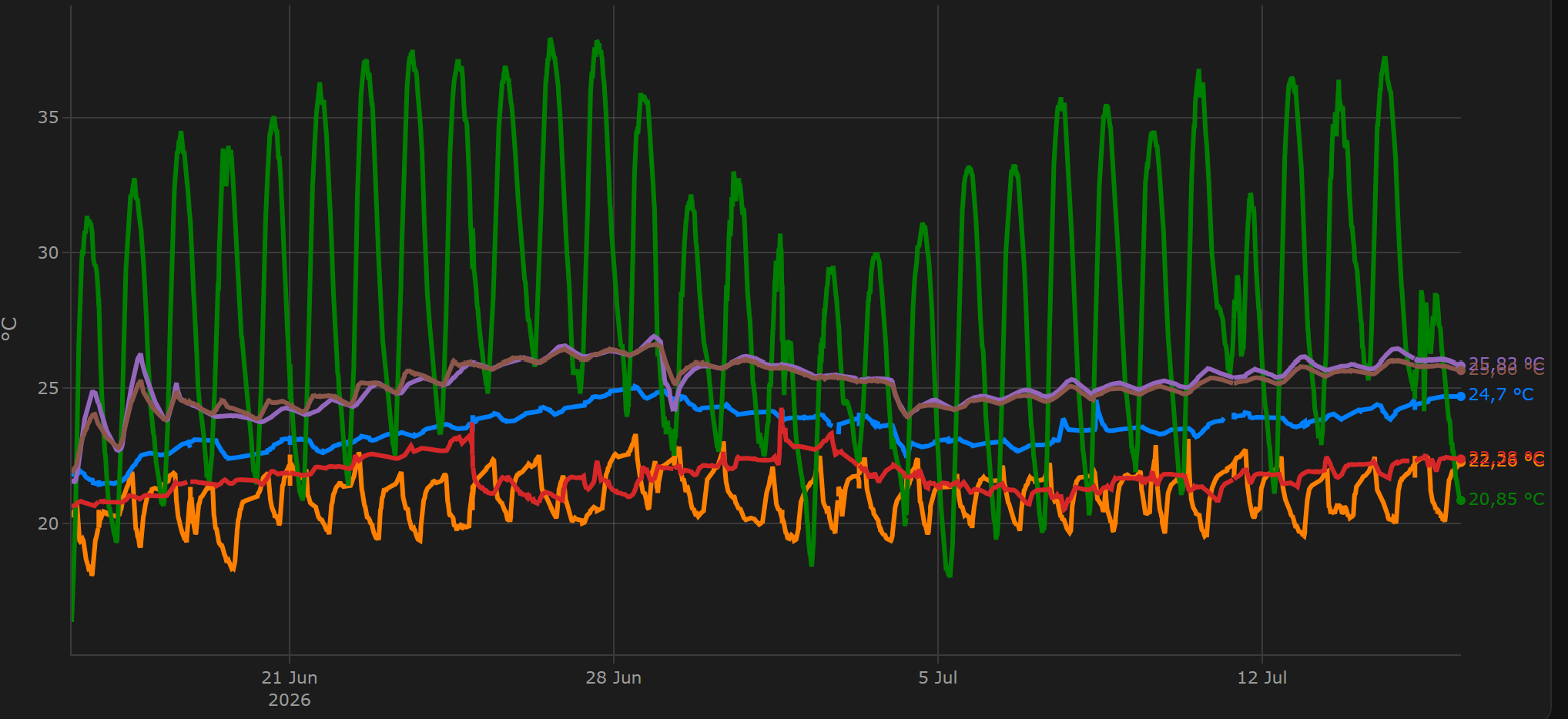
Test in my house in several different rooms...
Cooling is only active during the day (free PV electricity only).
Orange: slab cooling + mobile AC unit cooling.
Red: mobile AC unit only.
-> slab cooling makes no difference, the AC unit dominates.
Blue: slab cooling only
Purple: no cooling
-> slab cooling does makes a difference
Green: outside temp
4

17/07/2026 12:23 pm
Not sure if this link will work,
https://www.facebook.com/635180273/videos/911822707868589/
but seems an interesting idea.
if it doesn’t work, briefly, Octopus have bolted an A2A unit to a heat exchanger to radiators with the A2W running at 18c to avoid condensation.
17/07/2026 12:56 pm
I don't remember the manufacturer name, but I saw similar products. It looks like a fan coil, you can mount it in a ceiling. There's an air to water heat pump inside, and it can both heat and cool the air. On the water side, it is connected to the heating/cooling water loop like in the facebook video.
Page 1 / 2
Next

SPONSORS

Degrees of Separation
Latest Posts
-

RE: How will removing the standing charge on gas bills benefit heat pumps?
I'm not sure it makes much of a difference to heat-pump...
By Temperature_Gradient , 6 hours ago
-
@editor Ouch, sorry to re start the tick. I had assume...
By DavidB , 6 hours ago
-
RE: Say hello and introduce yourself
@e-a-west as the good Major said, welcome to the forums...
By Mars , 8 hours ago
-
RE: New Build 3 Phase or 1Phase
We are on three phase power because it's an enormous li...
By EtchedPixels , 8 hours ago
-
RE: How much of your renewable and home setup would still work if the internet went down?
Yes I actually have a copy of a tool that whenever a ce...
By EtchedPixels , 17 hours ago
-
RE: Indevolt Batteries UK Support & Info Thread
@editor Hi, To resolve this, please tap on the A...
By Indevolt Tech , 1 day ago
-
RE: Double or Triple Glazed Windows?
Posted by: @singlespeed With 9 years repairing windo...
By Rob of York , 2 days ago
-
@transparent we’re still running a secure version of PH...
By Mars , 2 days ago
-
RE: How quickly would you want/expect heat recovery to take from setback?
Much longer than that here. The heating isn't even on. ...
By bobflux , 2 days ago
-
RE: Passiv Smart Thermostat - Help & Forum Support
Obviously the weather is changeable but there's a defin...
By Singlespeed , 2 days ago
-
RE: The Changing Jet Stream Could Challenge UK Air Source Heat Pumps
@rob-of-york I must admit that when we had a Daikin hea...
By Toodles , 2 days ago
-
RE: Forum updates, announcements & issues
Get the Renewable Heating Hub heads-up on WhatsApp. I...
By Mars , 3 days ago
-
RE: Safety study for plug in batteries out to tender - looks like Q3 2027 at best before legal
@editor I pointed out to the one of the Fuse execs that...
By dansus , 3 days ago
-
RE: 15kw pump for 225m2 1990's house - over kill?
@seaviews As well as loft insulation, there are othe...
By Rob of York , 3 days ago




SPONSORS