

Notifications
Clear all
Joining the Renewable Heating Hub forums is completely free and only takes a minute. By registering you’ll be able to ask questions, join discussions, follow topics you’re interested in, bookmark useful threads and receive notifications when someone replies. Non-registered members also do not have access to our AI features. When choosing your username, please note that it cannot be changed later, so we recommend avoiding brand or product names. Before registering, please take a moment to read the Forum Rules & Terms of Use so we can keep the community helpful, respectful and informative for everyone. Thanks for joining!

24/06/2026 8:32 am
If you have two isolating valves (one on each end of each loop) which you should in order to isolate a loop in case the pipe or the pipe fitting leaks, then one of these valves can act as balancing.
Why build your own manifolds with tees? You didn't find suitable ones?

Topic starter
24/06/2026 3:44 pm
Only because I am not sure what the manifold is providing me, if i balance the pipes by length, and open lop weather compensated slab heating, i am not too worried about exact flow rates?
I can get a series of Tees cheaper, and with less of a pressure drop penalty than a preformed manifold?
If i have worked out a loop of my UFH has a PD of circa 3.4kPa and a FCU loop has a PD of circa 25kPa. Does this seem about right?
So this is where my knowledge may be incorrect. But, I have got these figures by saying I want 5kW of heating, with a deltaT 3K, giving me a desired flow rate of 24L/min.
I want to design this for UFH only so assuming each loop (of 10) handles 2.4L/min
Using the ridgeline pipework PD and added a bit for the tees at the manifold.
For the FCUs ive said i wanted to limit the flow to 3.5L/min each using a PICV (bare with me)
The i have fot the FCU low flow PD figures (low flow is still higher than 3.5L/min) and scaled it for a guesstimate of the PD, the minimum PD required for the PICV, the pipework and the manifold.
Now my understanding is the pump sees the highest PD if they are all in parallel, which they are, so the pump will see circa 25kPa when the FCUs are running (or FCUs and UFH). And 3.4kPa when it is just UFH
Now looking at the valiant arotherm graph in the manual, at a flow rate of 24L/min the ASHP has over 30kPA available feed pressure.
With the 7x 3 L/min FCUs, ie 21L/min it has even more. So for the FCUs OR the UFH on its own the pump can easily handle it.
Now if I do the case where I am heating with the slab and the FCUs for trim heating, the pump still sees the 25kPA PD. But now the flow rate will go up, taking it beyond the pumps curve? What happens here?
I am making the assumption that as the pump ramps up in this scenario, the UFH will end up taking more flow than is optimal (due to a lower PD) but I am not going to try and limit the UFH flow rate, as actually if that takes more, the house heats up. And the FCUs will throttle until closed and then the pump will go back down?
Is my simplistic understanding of what is happening correct (I guess what I am trying to achieve here is to show myself that just the ASHP can handle the circulation and flow rates in both my UFH and FCU loops)
24/06/2026 9:31 pm
UFH manifolds are horribly expensive usually, except Chinese models. However manifolds for domestic water (or for heating but not UFH) are quite cheap. Depends how much you like brazing copper I guess.
> 5kW of heating, with a deltaT 3K, giving me a desired flow rate of 24L/min. I want to design this for UFH only so assuming each loop (of 10) handles 2.4L/min
Correct
With these numbers you get 500W per loop max
>FCU low flow PD figures (low flow is still higher than 3.5L/min)
For FCUs if flow is balanced each FCU will get the heat pump power divided by the number of open FCUs. If you use zoning and open some of them, pipes have to be sized so the ones that are open can get more flow. That shouldn't be a problem, because the flow numbers aren't that high.
> Now my understanding is the pump sees the highest PD if they are all in parallel, which they are, so the pump will see circa 25kPa when the FCUs are running (or FCUs and UFH). And 3.4kPa when it is just UFH
Nope it's the opposite.
At identical flow, if something has higher pressure drop it means it has more resistance to flow. Water will follow the path of least resistance, so if you parallel stuff with high and low pressure drop, the low pressure drop stuff will get almost all the flow.
25kPa at 3.5 l/min seems high for a FCU, mine have 14kPa at 3.5 l/min and the pipes are pretty tiny. Can you link the FCU documentation?
> With the 7x 3 L/min FCUs, ie 21L/min it has even more. So for the FCUs OR the UFH on its own the pump can easily handle it.
Yes
> Now if I do the case where I am heating with the slab and the FCUs for trim heating, the pump still sees the 25kPA PD.
No, unless you close the valve to the UFH significantly to prevent it from taking almost all the flow, ie you raise the pressure drop of the slab to bring it to the same level as the FCUs.
> But now the flow rate will go up, taking it beyond the pumps curve? What happens here?
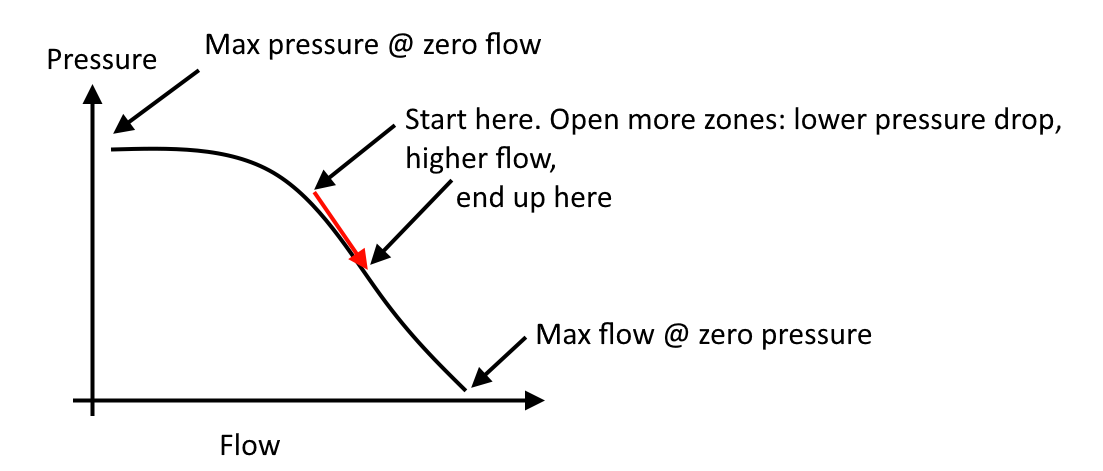
The pump has a max flow rate at which it generates no pressure drop, ie it can only push water through itself and not through extra pipes. So nothing happens beyond the pump curve, it will never go there.
Both ends of the curve are useless for heating. On the top left corner, the Max Pressure point has zero flow so you get no heating. Max flow at zero pressure drop never happens because the circulator is connected to pipes which will always create some pressure drop. The part of the curve that is actually used to do the job is around the middle where you have both useful flow and pressure.
> the UFH will end up taking more flow than is optimal (due to a lower PD) but I am not going to try and limit the UFH flow rate, as actually if that takes more, the house heats up.
If FCUs are closed, then more flow through the UFH is not a problem, it will just give better heat transfer. If FCUs and UFH are open at the same time then you need to balance the two otherwise UFH will get most of the flow and FCUs will get almost nothing.
At 2-4 l/min per circuit the extra pressure drop from flowmeters and balancing valves mounted on standard UFH manifolds is not really an issue. So here are options;
Option 1: UFH manifolds with flowmeters both for UFH and FCUs. Pros: allows you to visualize flow and balance manually to compensate for the FCU's much higher pressure drop versus UFH. Cons: needs more manifolds, and even when FCUs are not used, UFH balancing valves will remain in their set position and waste pressure drop ie slightly higher circulator power consumption.
Option 2: Manifold for FCU, manifold for UFH, both can be DIY, tees, whatever. Each manifold has: one flowmeter, one manual balancing valve, one motorized zone valve. This needs high-flow flowmeters. In this case the result is exactly the same, except you can put a motorized ball valve across the UFH balancing valve to short it and avoid throttling the flow to UFH when FCUs are not used.
Topic starter
25/06/2026 8:34 am
Okay thank you.
Lets say i go for option 2.
I like the option of a ball valve to bypass during UFH only times! Great idea.
Would a Caleffi autoflow (1271611M6) be appropriate?
1 inch (for my 28mm pipework), limited to 1.6m3/hr (approx 26L/min) so sized to not limit the 24L/min required by the UFH
This has a minimum PD of 20kPa, which gives my UFH loop a value of 23.4kPa.
The FCU coil drop I worked out was ~7kPa at my flow rates, the PICVs had a minimum Pd of 16kPa and the rest was pipework/manifold.
So just so I have a full understanding:
UFH only (autoflow valve bypassed), flow rate 24L/min, PD circa 3.4kPa = ASHP happy.
FCUs only (all PICVs fully open, but limiting each to 3L/m), flow rate 21L/min, PD circa 25kPa = ASHP happy.
UFH & FCUs (PICVs fully open), (autoflow valve on UFH NOT bypassed), flow rate allowed on UFH loop limited to 26L/min, rest to FCUs, PD on UFH side is now circa 20kPa, and on FCUs side is still circa 25kPa, in this regime is the ASHP happy?
I know I now wont get all the FCUs at the full 3L/min rate, however as they are trim heating that is okay. But I am essentially checking this nieche edge case to make sure the pump is not going to get sad at me!
The other side of the curve cases (ie min flow)
UFH - open loop. So no change
FCUs- worst case only one is demanded open and modulated down - control logic will open other PICVs to maintain at least 3 fully open, and just not run the associated FCU fans (aim to maintain minimum circa 12L/min) (minimum water volume here I reckon in the region of 25L, given this case is cooling, there is no defrost cycle, is this an issue?)
UFH & FCUs - UFH open loop so no change.

25/06/2026 10:43 am
I'd say it's up to you to decide between these two behaviors:
* Manual balancing valves *
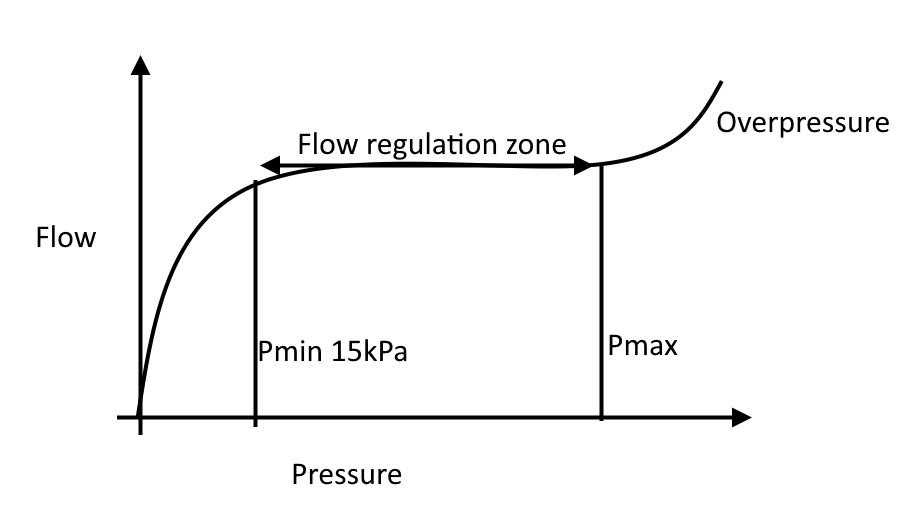
For example Caleffi 132 which has a manual valve and flowmeter. The flowmeter has to be activated by pulling the ring to get a reading. When active, it adds to the pressure drop, but when not active, it doesn't. That's nice because it lowers the pressure drop, but if you want to balance two circuits you need to pull both rings to make sure the extra pressure drop from the flowmeter is added to both.
In this case, with manual valves, the heat pump circulator can be set to variable speed. Each valve sets what fraction of the total flow each circuit gets, and flow in each circuit will be proportional to the total, which can be variable.
When running FCUs only, if some FCUs close:
- If circulator is in "speed" mode (either constant or variable speed) closing one FCU increases pressure drop, which lowers total flow, but increases flow in the other open zones.
- If circulator is in "pressure" mode (regulates speed for constant pressure) then closing one FCU increases pressure drop, circulator compensates by decreasing speed to get back to the pressure setpoint, which means flow remains constant in the other open zones.
* Autoflow *
In this case, the autoflow sets the max flow rate, so you have to run the circulator either on constant pressure or at least constant speed with enough speed to overcome the minimum requirement for the autoflow. That probably means you can't use variable speed mode, most likely it will be near max. I'd like to see the curve.
I see an issue in UFH+FCU mode:
> PD on UFH side is now circa 20kPa, and on FCUs side is still circa 25kPa, in this regime is the ASHP happy?
If they are in parallel, then pressure drop in both will be the same and flow will adjust accordingly. The electrical analog would be resistors in parallel: they all get the same voltage and each decides how much current it takes. Then, because UFH has much lower pressure drop than FCUs, this risks the autoflow on the FCUs not getting enough pressure to actually open, or just open a little bit, and you get too little flow to the FCUs. So you'd have to do the math to check if it'll work.
1
Topic starter
29/06/2026 4:39 pm
Okay so now another stupid question, can I change the pump mode on the aerotherms? I have not seen anything about that in the manuals?
At the moment I am still tempted by the autoflow on the UFH zone, with the bypass during UFH mode. And it used to roughly balance out the pressure drop during joint use (and limit the flow anyway)
I am still struggling to work out how I know if the circumstance of everything open is a problem. In my my mind, the FCUs could take up to 21L/min. The UFH 24L/min. But the pump will never give that.
Does that matter? The chance all FCUs are open fully is very slim, i just dont want the pump to throw a fault if it does happen.
If the issue is that the FCUs have low flow, and the UFH is capped at 24L/min by the autoflow, that seems fine to me, the FCUs will still act as a trim heater and then throttle themselves anyway.
29/06/2026 9:21 pm
If flow is too low, the heat pump will probably throw a fault.
High flow is not a problem for the heat pump, it'll work fine. Higher flow gives lower deltaT, increased COP, more turbulence in the heat exchanger which increases heat transfer, in other words better performance.
Topic starter
29/06/2026 10:12 pm
Okay, in which case have I converged on a semi sensible design?
Excuse the crude pen diagram, but just so we are on the same page.
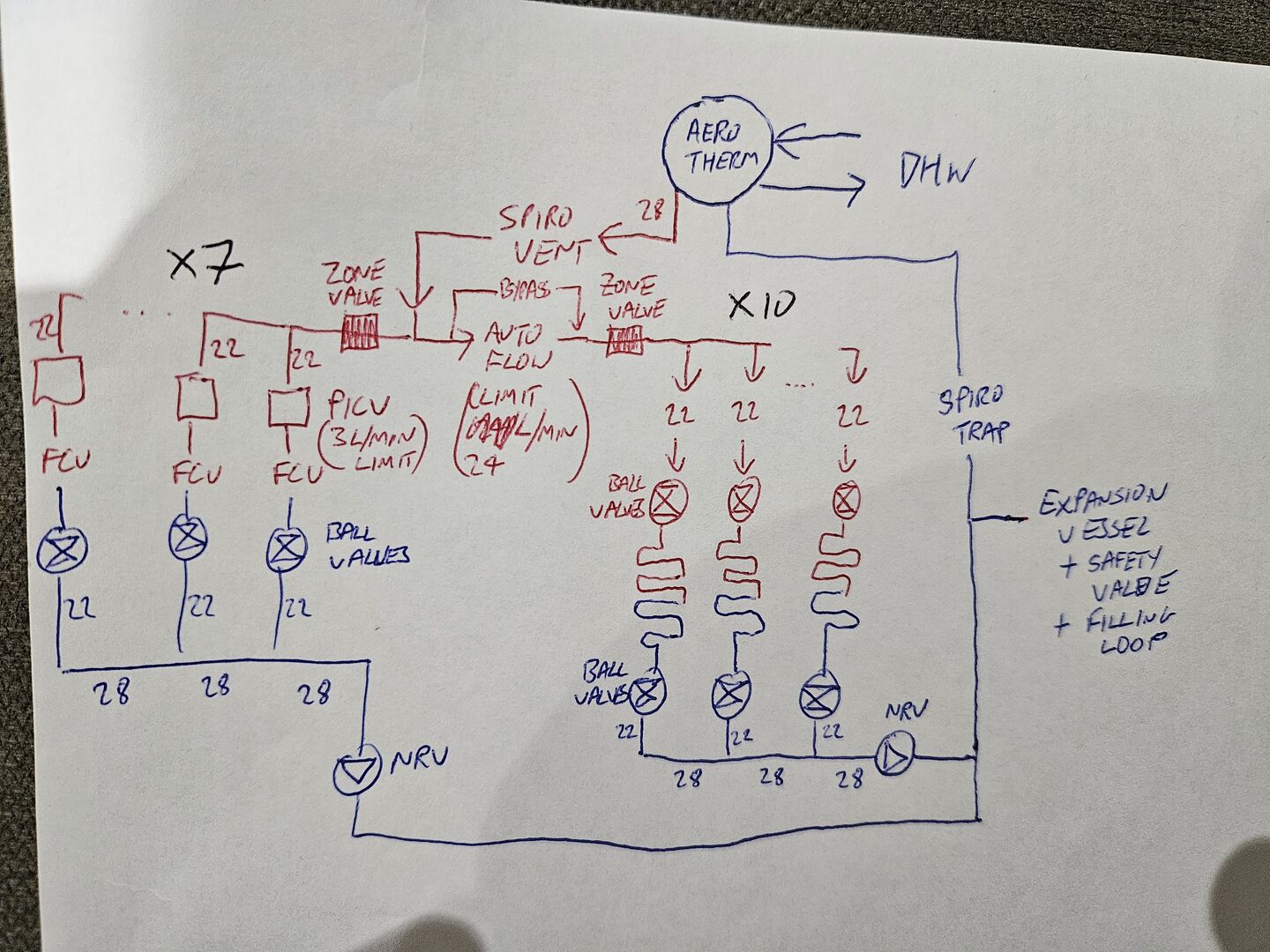
FCU loops have the PICVs set to 3L/min
The autoflow set to 24L/min
Backbone in 28mm, legs in 22mm.
UFH pipework in 22mm Ridgeline ECO max.
UFH loops are a DIY manifold, ball valves both ends, balanced in length, subtle difference is fine for a open loop, slab heating design.
Heating scheme:
Heating: open loop UFH with weather compensation curve. FCUs as trim.
Cooling: By day, FCUs at 7 degree flow temp. UFH zone closed.
By night, flow at dew point plus 2, UFH open, FCUs optionally as trim.
Whenever UFH only, autoflow valve is bypassed via a motorized valve.
Whenever FCUs only (cooling by day) a minimum number of PICVs open to ensure >10L/min. Controlled via KNX logic.
KNX to control both FCU fan and PICV modulation (0-10v).
Rough pressure drops: UFH (bypass) 3.4kPa
UFH (no bypass) 23.3kPa
FCUs 25kPa
At the moment this is deisgned around a 5kW heat requirement, with a delta T of 3. Giving flow rate for UFH of 24L/min.
Sizing the ASHP- could make the argument to go up to the 10kW for cooling capacity and pump ability in the all open regime.

30/06/2026 10:10 pm
The drawing is fine and perfectly understandable except "NRV" which has the symbol of a pump but I guess "NRV" means "Non return valve" or "Check valve" ? If this is the case you don't need them, because with only one circulator, pressure drop and flow can only go in one direction.
Personally I'd use manual balancing valves instead of PICV.
Depending on length, you should be able to get away with 20mm MLC pipes for your fan coils instead of 22mm copper. MLC is easier to work with and cheaper.
32mm MLC is cheaper than 28mm copper (internal diameter 26mm for both).
25mm MLC corresponds to 22mm copper (internal diameter 20mm for both).
Copper and MLC are complimentary. Brazed copper fittings are cheap, MLC crimp fittings are expensive. MLC pipe is cheap, copper pipe costs more. MLC is much easier to bend cleanly. MLC fittings reduce internal diameter and copper fittings don't. Thus MLC is best for long runs with no fittings (or just a few bends instead of elbows), and copper is best for short runs with lots of fittings.
Page 4 / 4
Prev

SPONSORS

Degrees of Separation
Latest Posts
-

RE: How will removing the standing charge on gas bills benefit heat pumps?
The shoulder months are very difficult to judge COP on ...
By scrchngwsl , 25 minutes ago
-
RE: Indevolt Batteries UK Support & Info Thread
@editor Hi, To resolve this, please tap on the A...
By Indevolt Tech , 7 hours ago
-
RE: How much of your renewable and home setup would still work if the internet went down?
Interestingly we had an internet outage about a month a...
By Rob of York , 22 hours ago
-
RE: Double or Triple Glazed Windows?
Posted by: @singlespeed With 9 years repairing windo...
By Rob of York , 22 hours ago
-
@transparent we’re still running a secure version of PH...
By Mars , 1 day ago
-
RE: How quickly would you want/expect heat recovery to take from setback?
Much longer than that here. The heating isn't even on. ...
By bobflux , 2 days ago
-
RE: Passiv Smart Thermostat - Help & Forum Support
Obviously the weather is changeable but there's a defin...
By Singlespeed , 2 days ago
-
RE: The Changing Jet Stream Could Challenge UK Air Source Heat Pumps
@rob-of-york I must admit that when we had a Daikin hea...
By Toodles , 2 days ago
-
RE: Forum updates, announcements & issues
Get the Renewable Heating Hub heads-up on WhatsApp. I...
By Mars , 2 days ago
-
RE: Safety study for plug in batteries out to tender - looks like Q3 2027 at best before legal
@editor I pointed out to the one of the Fuse execs that...
By dansus , 2 days ago
-
RE: 15kw pump for 225m2 1990's house - over kill?
@seaviews As well as loft insulation, there are othe...
By Rob of York , 2 days ago
-
RE: BT cuts you off, Plusnet blames Openreach... welcome to “seamless” broadband switching
Both of which (in most cases) use Openreach for the las...
By JamesPa , 2 days ago
-
RE: Renewables & Heat Pumps in the News
Yes, this is a swiss and german standard I believe, Vai...
By Batpred , 3 days ago
-
RE: Octopus Cosy 12 Heat Pump Regret: Incredibly Loud, Poor Heating & Constant Hum - Help!
@editor FWIW my problem was resolved, eventually, after...
By BigFish , 3 days ago





SPONSORS
