

Notifications
Clear all
Joining the Renewable Heating Hub forums is completely free and only takes a minute. By registering you’ll be able to ask questions, join discussions, follow topics you’re interested in, bookmark useful threads and receive notifications when someone replies. Non-registered members also do not have access to our AI features. When choosing your username, please note that it cannot be changed later, so we recommend avoiding brand or product names. Before registering, please take a moment to read the Forum Rules & Terms of Use so we can keep the community helpful, respectful and informative for everyone. Thanks for joining!

19/10/2026 7:25 am
@andrewj Its worth remembering that recovery is, at least in principle, asymptotic not linear, so whilst it might take 6 hours fully to recover most of the recovery happens in the first couple of hours. Ultimately its a function of your house, your emitters and yes the heat pump control algorithm as well as outside temperature, hence the impossibility of giving a definitive answer.
Houses have a large heat capacity ("thermal mass") and the system has to deal with that. My house, for example, has a heat capacity of about 15kWh/degC and a loss of 7kW. This means that, even at -2 outside, it takes 2 hours to cool by 1C even if the heating is completely switched off. Its therefore not surprising that it takes a while to warm up!. Thus even if the rads were heated to 70C it would still only warm up at a little over 1C/hr if its very mild outside, half that rate if its -2. Neither a heat pump nor a boiler, however sophisticated the algorithm, can do anything about that.
Is there a particular problem you are trying to solve or is the question just for interest?
I think the heat-pump manufacturers are going to have to raise their game on the control side, it
Thats why there is a market for Passiv, Havenwise Homely and Adia! Some heat pump controls are really fairly simplistic in their operation (by modern standards), although still way more sophisticated than many boilers. I think the first priority has to be user-friendliness however. Many heat pump manufacturers effectively rely on installers setting up the weather compensation curve perfectly, which clearly they cant unless they live in the house during the cold season.
This post was modified 3 weeks ago 9 times by JamesPa
4kW peak of solar PV since 2011; EV and a 1930s house which has been partially renovated to improve its efficiency. 7kW Vaillant heat pump.

Topic starter
19/10/2026 8:13 am
@jamespa no particular problem, just generally interested in how people would view such a situation. Would 6 hours to recover from 21c to 22c be too much? Actually, the start/end temperature isn’t that important - it’s not cold at 21c so you wouldn’t really care. If it was taking 18 hours to recover from 19c to 22c I definitely would care, it least because my wife would be bending my ear about how cold it is.
As I’ve mentioned, I have no access to any sort of detailed data so it’s hard to see what is going on. My other thought related to this was perhaps it is taking so long because I’ve dropped the flow temperature too far and the heat pump is cycling to cope. Maybe someone would recognise this and point out there may be an issue. I assume not given no responses in this vein except perhaps hints from other posts on the data and graphs shown.
Really, it was just a general interest in people’s thoughts. Since posting, I’ve turned off the setback I was using and further dropped the WC warm end temperature. It seems to be managing although it only got down to 8c last night so it’s a bit early to tell. My biggest problem is getting the house to warm evenly because of the thermostatic nature of operation.
On the control side, I see little reason for the majority of people to have a control for WC, holiday setback and overnight setback. Once the thing is set up and running you don’t really want to be touching anything and getting it set up and running, once the installer has left, is generally a matter of tweaking the WC. Under the covers there may be more going on but exposing it is probably just too confusing and unnecessarily worrying people. Octopus hide a number of settings in their Cosy Hub, accessible only by turning on its web server and logging onto its network; some of these are further hidden behind an installer password.

19/10/2026 9:02 am
The bit I'm wondering here, is given the house is several degrees below target temperature, in this situation it would appear better to raise the LWT to get the radiators dissipating more heat into the house
Yes, but out of the box a Midea unit can't do this. It can only follow the WCC (or set a fixed LWT, but that defeats a lot of the benefits of running a heat pump in WCC mode). The WCC only uses the OAT, there is no input from the IAT. 15°C (and above) OAT = 31°C LWT, full stop. The IAT could be zero, the Set LWT would still be 31°C.
[raising the LWT to} keep the heat-pump operating continually and get the house up to target temperature in a more reasonable time-frame.
Raising the LWT does not stop cycling until the WCC determines that the LWT should be 42°C at an OAT of 7°C or thereabouts. Here is the chart for 11th Jan this year. Overnight the OAT was below zero, and the heat pump did a lot of defrosting (LWT drops below RWT. About 0500 the OAT started to rise, and by 0700 had got to 'steady state' OATs or around 6-8°C, with the LWT at around 42°C and not cycling, apart from one cycle at 1200 (and a DHW reheat at 1300) until 1700, almost 12 hours of steady state running. The OAT then rose a bit more, and the heat pump started its regular slow cycling. I presume it cycles because the Set LWT is above a certain value, not because the OAT is above a certain value, though of course the two are connected by the WCC.
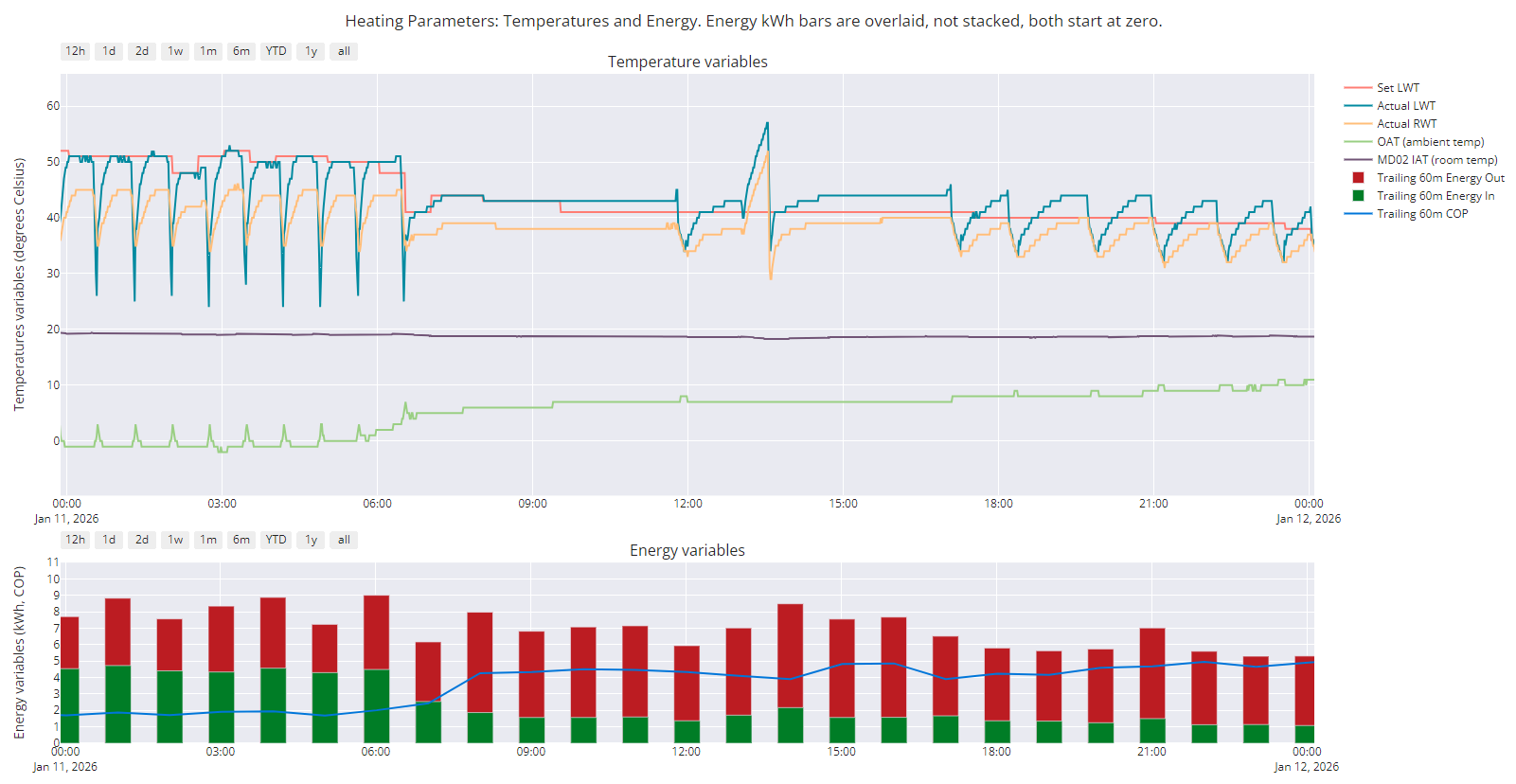
Notice what happens to the trailing hourly COP (blue line, lower chart). Also note the IAT - it remained remarkably steady at or just under 19°C, confirming the WCC is set pretty much where it should be.
What does the rest of the performance table look like - if you raised the LWT to 45 or 50 deg C in these conditions, what's the minimum power output and how much does it impact the COP? Is there actually much of a penalty to raise the temperature more rapidly
Here's the rest of that section of the table, excluding the high OAT values, which are on the next page:
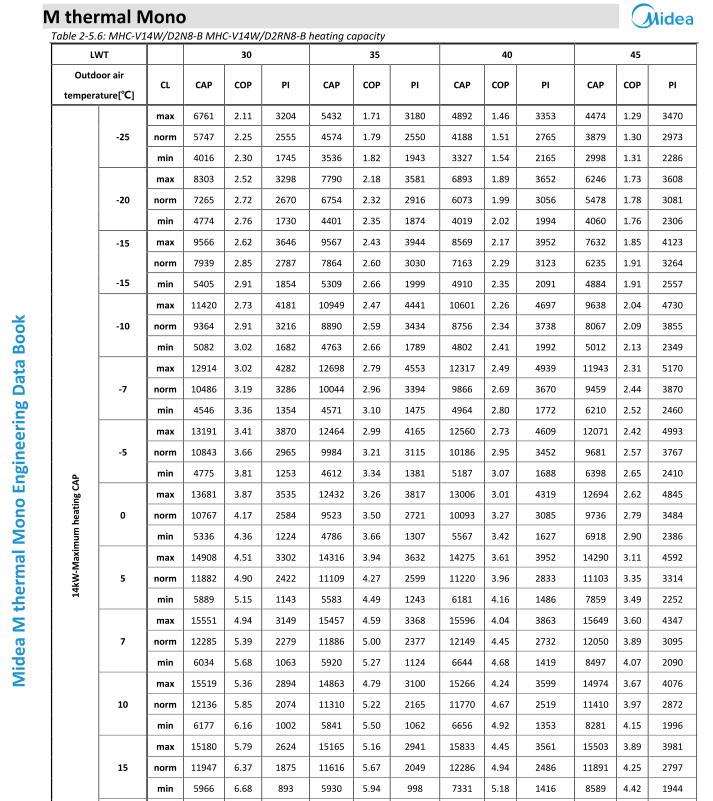
At 15°C OAT, and with a LWT of 45°, the minimum output rises from 5966W (at 30°C LAT) to 8589W (making cycling even more likely) while the COP falls from 6.68 4.42, a 34% reduction.
You mentioned you are running a script to dynamically adjust the LWT set-point, could you include a room temperature sensor input into the formula to raise/lower the LWT based on deviation of actual room temperature from room temp set-point?
That is exactly what the script does, as I said earlier. It checks the IAT, and moves the WCC up and down when the IAT has deviated from the desired IAT (10°C) by one degree or more. If actual IAT - desired IAT = 1 then move the WCC up 1 degree etc, the script is a series of If...then statements, up to a maximum of 3° either way. The script did kick in on 11th Oct, when the IAT was 4°C below where it should have been, because the heating had been off, but its influence fell off during 13th Oct, as the actual IAT approached the desired IAT.
I think the heat-pump manufacturers are going to have to raise their game on the control side, it shouldn't be taking days to raise the house temperature by just several degrees, particularly in undemanding ambient conditions while the head-pump is mostly sat there idly running at a fraction of its capacity, while the homeowner is stuck in a cold home.
I agree. As a heat pump owner, I should not have to write python scripts to make my heat pump work better, but still not perfectly. But that is a separate concern to the slow cycling one, which as I have said before is not of itself a great concern because it is slow cycling, and the mean actual LWT approximates to the Set LWT. If we take the cycle that starts just after 1800 on the 11th Jan chart, the Set LWT is 40°C, while the mean Actual LWT during the cycle is 41°, which is close enough to the Set LWT to be, I suggest, acceptable.
I can try tweaking my auto-adapt script. But the thing is the first start of the heating for the season, 11th October this year as in the earlier chart I posted, is is not typical of day to day running. The IAT was about as low as it gets, normally it doesn't go much below 17 degrees, and that only rarely, so there isn't normally much if any call for radical Set LWT boosting. At the moment the ratio is 1:1, if the IAT is 1° too low, the WCC goes up 1°, 2° for 2° and so on. I could try 1:2, move WCC 2° for each 1° deviation of the IAT, and see what happens.
Some heat pumps do have some sort of IAT awareness eg Ecodans, and it is very likely third party apps like Homely use the IAT as part of their control logic. But that still leaves a lot of heat pumps without such awareness (or more accurately the ability to make use of the IAT, my heat pump thinks it knows what the central IAT is, only it doesn't because it is in the airing cupboard with the DHW tank, and in any event it doesn't use the IAT at all when in WCC mode.
I would expect that there’s going to be a difference in operating approach between raising to temp and maintaining temp.
Indeed, and the key point is the WCC is set up to maintain the IAT, not raise the IAT. That is precisely why it struggles to raise the IAT...
I see no reason why you wouldn’t run a higher flow temp to get to a comfortable house temp and then knock it back.
But doing that manually is very tedious and boring, and likely to cause or exacerbate HPDHD (Heat Pump Deficit Hyperactivity Disorder), an insidious disorder with no known cure apart from emigrating to the tropics.
and was fed up with fiddling with it
Precisely. Once you have tweaked the WCC to your satisfaction, which can take some time, and may change if you make changes to the property, then the heating system should largely look after itself. If we choose to add overnight setbacks, then we do risk the possibility that on occasions the IAT may be a degree or two below where ideally we want it, but the point is it is our choice.
My original question was just to see what others were doing in respect to recovery times, without getting into realms of detailed technical data. We weren’t cold going from 21c to 22c but was 6 hours to raise 1c too slow in people’s view?
It is very difficult not getting stuck into detailed technical data when considering the detail of heat pump operation! But we do try to keep the language as jargon free as possible, and use graphics wherever possible.
It doesn't really matter what other people's view is, they don't live in your home! To answer the slightly different question, is it normal for it to take that long, then I strongly suspect the answer is yes, particularly when close to the desired IAT, because that is the way heat pumps. Such minor variations either way often happen because of solar gain and wind chill. Obliterating these small variations is likely to be a classical case of the law of diminishing returns.
Is it more efficient to raise temps quickly then cut back for maintaining? I was also interested in seeing if that sort of recovery time period was indicative of other issues given experience and my lack of access to detailed running data to see for myself.
In general terms, all other things being equal, higher LWTs mean lower COPs, but all other things are not equal, eg a Time of Use tariff may skew things in favour of an overnight boost while the rate is low. Your COP may fall, but the lower tariff more than compensates.
Can you remind us what heat pump you have, and what data you can currently access?
PS I see other comments have been posted while I wrote this post, with some addressing some of the points I have made in this post eg once set up, you really don't want to have to fiddle with your system.
I'm probably going to have another trial of overnight setback running over this autumn (now to the New Year, maybe longer), in yet another possibly futile attempt to answer the question can setbacks save energy without compromising comfort?
Midea 14kW (for now...) ASHP heating both building and DHW
19/10/2026 9:09 am
On the control side, I see little reason for the majority of people to have a control for WC, holiday setback and overnight setback. Once the thing is set up and running you don’t really want to be touching anything and getting it set up and running, once the installer has left, is generally a matter of tweaking the WC.
I agree, but some people love to 'fiddle' and think, generally incorrectly, that they can somehow do better than a well set up system. Also not all systems are well set up by installers.
Since posting, I’ve turned off the setback I was using and further dropped the WC warm end temperature. It seems to be managing although it only got down to 8c last night so it’s a bit early to tell. My biggest problem is getting the house to warm evenly because of the thermostatic nature of operation.
I dont exactly know how the Cosy control loop operates but if you have TRVs then the control loops for the heat pump and the radiators are potentially fighting each other - the master thermostat turning off before some rooms are sufficiently warm.
The 'classic' way to fix this is to open up all the TRVs to full, turn down the WC curve until the house is only just warmed, then balance the radiators for equal temperature (or desired temperature difference). This gives both greatest comfort and minimum operating cost (hich is a rare example of the laws of thermodynamics working in our favour!) I spent a couple of weeks doing that when I first got my (Vaillant) heat pump - it was late November so suitably cold. Then a few minor tweaks, and now leave it to do its thing.
I dont think that the Octopus thermostatic operation will negate this procedure, if the WC is 'correct' the thermostat will stay on for long periods (or continuously) which should minimise the impact or rooms other than the one in which it is placed. Possibly you can set the thermostst to a little higher than you actually want it (effectively disabling it) and just adjust the WC, which should eliminate problems with individual rooms once the rads are balanced, but it might 'auto adjust' the WC, who knows?
This post was modified 3 weeks ago 2 times by JamesPa
4kW peak of solar PV since 2011; EV and a 1930s house which has been partially renovated to improve its efficiency. 7kW Vaillant heat pump.

Topic starter
19/10/2026 1:56 pm
@jamespa Yes, we talked about this last year but I got to a point where I'd been fiddling pretty much non-stop for 3 months and I'd had enough - wife was happy with how it worked, I'd found a room where the thermostat worked best and radiators where already turned down to pretty much quarter turn. I gave up for the rest of the season! Back at it now starting with gradually dropping the "warm" weather end of the WC. It's not on constantly at the moment, still working on the hysteresis of the thermostat which tells me I can go further, although I've only got another 2c available at the warm weather end!
19/10/2026 2:10 pm
@jamespa Yes, we talked about this last year but I got to a point where I'd been fiddling pretty much non-stop for 3 months and I'd had enough - wife was happy with how it worked, I'd found a room where the thermostat worked best and radiators where already turned down to pretty much quarter turn. I gave up for the rest of the season! Back at it now starting with gradually dropping the "warm" weather end of the WC. It's not on constantly at the moment, still working on the hysteresis of the thermostat which tells me I can go further, although I've only got another 2c available at the warm weather end!
Thanks for reminding me! The warm weather end is probably impossible to get exactly right not least because solar gain is likely to take over. The Vaillant curves go right down to a FT of 20C at 20C OAT but in practice there is also a 'minimum FT' setting. Initially I had that set at 30 but dropped it to 27.
At the very ends of the season only I have mine in the mode where the heat pump shuts down if the room goes more than about 1C over temperature, much like a thermostat (for most of the season room temperature is ignored by the control loop - ie its pure WC). That pretty much does the job, at least as well and probably better than I could achieve with the controls on my boiler. If it overheats a couple of degrees Im not bothered, the energy cost is minimal by comparison the the total spend over the year.
Its better not to get too obsessed with this sort of thing!
4kW peak of solar PV since 2011; EV and a 1930s house which has been partially renovated to improve its efficiency. 7kW Vaillant heat pump.
Topic starter
19/10/2026 2:34 pm
Its better not to get too obsessed with this sort of thing!
That's my worry - Mrs J will be calling the ambulance with white coated men if I'm not careful.
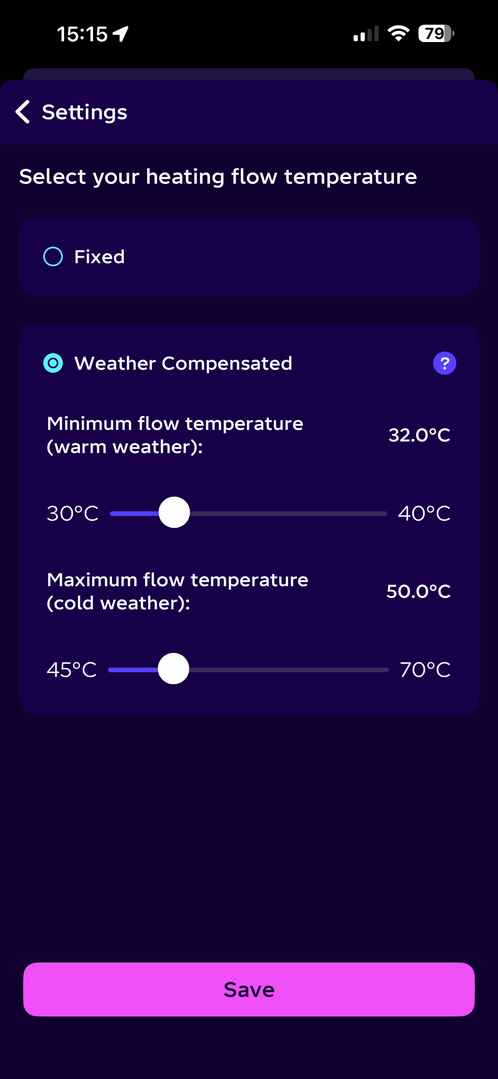
With Octopus we don't actually see a curve and the general belief is that it is linear from +12c to -10c (warm to cold). There's also a hidden setting in the Cosy Hub (controller) that by default is set to 50c at the design temp, so -3c for me, and I don't know how that interacts with the cold weather end of the WC. With all the trouble overheating last year, this was adjusted so it is now 50c at -10c so I'm going to assume that it has no impact - I guess if I set the cold weather end to 45c so that at -9c it was pretty much 45c then at -10c it jumped to 50c but who knows. Never gets that cold anyway.
Octopus also design to the MCS guidelines for room temps as if it's a mandatory requirement rather than a minimum to achieve. This means that radiators are sized appropriately and I can't help but feel that it means there's some inherent imbalance built in vs a design to achieve the same temp across every room, e.g. 22c. Not sure....In any case I firmly believe that my Cosy is oversized and the heat loss survey was unduly pessimistic. They even re-surveyed, decided that the actual heat loss was 1kW lower than original and came back with a radiator schedule that provided 1kW MORE heat than originally. I'd like to say you can't make it up but empirical evidence proves the contrary (and I still have a massive radiator 333% larger than required for the space!)
19/10/2026 3:54 pm
This means that radiators are sized appropriately and I can't help but feel that it means there's some inherent imbalance built in vs a design to achieve the same temp across every room, e.g. 22c
Yes but.. there is now way single room loss calculations are that accurate anyway. Radiator balancing fixes this
I'd like to say you can't make it up but empirical evidence proves the contrary (and I still have a massive radiator 333% larger than required for the space!)
Personally I regard even the best survey results as guidance, to be sense checked if at all possible before installation and subsequently validated (or not) by experiment. There are too many genuine unknowables (or at least unknowns) and as many opportunities for surveyors to screw up big time. The sense checking, done properly, eliminates the big time screw ups, but that still leaves the unknowables.
The unknowns should be sufficiently small that gross oversizing, to the point of materially compromising efficiency, wont happen provided the heat pump is reasonably tolerant of oversizing (I have the impression that Cosys are) but are certainly not sufficiently small that radiators are precisely sized. Radiator balancing, (or possibly if some recent evidence is to be believe, a small percentage of mechanical, not electronic, TRVs) deal with this
Thats life.
This post was modified 3 weeks ago 3 times by JamesPa
4kW peak of solar PV since 2011; EV and a 1930s house which has been partially renovated to improve its efficiency. 7kW Vaillant heat pump.


19/10/2026 4:08 pm
@jamespa And ‘Decorator’s Caps’ are relatively cheap and provide controllable means to replace those pesky TRV heads. Toodles.
Toodles, heats his home with cold draughts and cooks food with magnets.

19/10/2026 5:29 pm
those pesky TRV heads. Toodles.
They arent pesky!
Unless they are sticking open or closed (broken) , or the person twiddling the dial isn't aware of what the valve does and they adjust it too far, too often instead of a small tweak and see how it does over several hours or ideally a day. Somewhere between 2 and a little bit, up to 3 and a half is likely to be the comfortable point for most rooms.
If your using a decorators cap for adjustment, why not set the TRV to 5 (fully open) and use the lockshield as intended to balance the system?
19/10/2026 6:06 pm
@singlespeed I was thinking in terms of how they may close down a number of radiators in a system and cause a considerable change in the available flow through the system and changing the load as seen by the heat pump. I have decorator’s caps on our TRV’s ensuring they stay fully opened and control the flow balancing the system via the LSV’s. Leaving the head on a TRV, I found that even fully open, the valve head occasionally started to shut the valve down.
I haven’t gone as far as having the valve bodies of the TRV’s replaced as generally, a decorator’s cap provides sufficient stability leaving the valve fully open.
I know that some readers have used the partially closed decorator’s caps to provide controllable restriction to the flow and it has been said that this control may be better than that available from the ‘nearly shut’ LSV. Regards, Toodles.
Toodles, heats his home with cold draughts and cooks food with magnets.
Topic starter
19/10/2026 6:16 pm
@toodles Also, in my case, in some rooms I have the LSV shut down to within a quarter of a turn and it wasn't enough. The decorator's cap, as you said, allows some flow but further controls the room temp without the what feels like open or shut TRV operation. In our bedroom I tried a TRV but either the room heated over, or cooled down below, what we wanted. I couldn't find any sort of sweet spot with the TRV. TRVs are fine in my study with its 233% sized radiator and in the kitchen with its 333% sized radiator but only in conjunction with nearly fully closed LSVs. Ditto the bathrooms but they are not over sized radiators (according to the design anyway but I feel that's a bit shonky!)
SPONSORS

Degrees of Separation
Latest Posts
-

RE: How Can I Prove Coal Was My Main Heating Source Without Receipts?
Got excepted for the grant now so thanks for the replie...
By Chilli304 , 1 hour ago
-
Welcome to the forums. That's a frustrating situation, ...
By Mars , 2 hours ago
-
RE: DIY powerflushing tutorial
Same 🤣 Near Lyon, France. Water has lots ...
By bobflux , 2 hours ago
-
RE: Buffer tank on a 2 x 14kw Ecodan system
Pretty much as I had guessed in my crude scaling from m...
By JamesPa , 5 hours ago
-
RE: Help me keep the faith with my air source heat pump installation
Well you have a vibration generator running at some fre...
By bobflux , 18 hours ago
-
RE: Why don't people choose heat pumps?
@susannasaunders The link I have found may provide a li...
By Toodles , 20 hours ago
-
RE: Who's your electricity provider and what's your tariff?
@downfield Thats a decent rate, I’m shocked they hadn...
By Papahuhu , 2 days ago
-
RE: Should Households Who Can Afford It Pay More for Energy to Help Those Who Can't?
@batpred I mentioned earlier that targeting the payment...
By Toodles , 2 days ago
-
RE: Adventures in heat loss calculations
@toodles thanks! So as suspected, around a doubling of ...
By SusannaSaunders , 2 days ago
-
Six books in three years and I think I’ve now covered j...
By Mars , 2 days ago
-
RE: Grant Aerona3 13kw - Buffer Tank - Heating Journey
@heymikey Well done in achieving as nearer a match acro...
By Toodles , 2 days ago
-
Grant Aerona - Weather Compensation and Schedules
Im trying to set up a friends Grant Aerona. The WC curv...
By bontwoody , 3 days ago
-
RE: Air-to-Air Heat Pumps & Air Conditioning: UK Heating and Cooling Q&A
@jamespa I agree, the efficiency of Cosy Cooler ought...
By Rob of York , 3 days ago
-
RE: How much of your renewable and home setup would still work if the internet went down?
I think you're right! 🤨
By Transparent , 4 days ago


SPONSORS
