

Notifications
Clear all
Joining the Renewable Heating Hub forums is completely free and only takes a minute. By registering you’ll be able to ask questions, join discussions, follow topics you’re interested in, bookmark useful threads and receive notifications when someone replies. Non-registered members also do not have access to our AI features. When choosing your username, please note that it cannot be changed later, so we recommend avoiding brand or product names. Before registering, please take a moment to read the Forum Rules & Terms of Use so we can keep the community helpful, respectful and informative for everyone. Thanks for joining!

Topic starter
17/10/2026 9:44 am
Now into year 2 with my Cosy 9. I currently have it set to keep the house at 22c (runs off a thermostat if you recall) with a setback to 21c 23:00 to 03:30. Hot water runs 02:30 to 03:30. I have the house set to warm back to 22c at 03:30 because I’m on an overnight tariff of 6.6p until 05:30 so it make sense to do “heavy lifting” before the peak period starts and it pulls on my battery.
Last night at 23:00, the house temperature was 22.6c and the heating hadn’t been on all day because it was warm enough to heat the house from just the sun. OAT dropped to 6.2c (reported by the Cosy unit) at 03:30 with the house temperature at 21.2c. At 07:30, the house was at 21.7c and it finally reached 22c at around 09:30 when the OAT had reached 9.5c. It took 6 hours to raise the temperature by 1c.
My flow temperatures are 50c@-10c OAT and 33c@12c OAT. This is a drop from 36c@12c OAT I ran last year. As far as I know the WC curve is linear. At that flow temperature setting, the house can reach temp and I have to say it is more comfortable for having the heating on for that time period because the internal air actually feels warm.
Is there any consensus on how long you would want to take to warm up by 1c? Is there anything in the above that says I may have dropped the flow temperature too far given it’s likely to get colder? Perhaps there is scope to drop the flow temperature further? Really it’s more a discussion point than an actual query: if it meets temperature, we are comfortable and it isn’t costing the earth then all is good right!
Remember, Octopus control their Cosy units via a thermostat with the hysteresis set to -0.1c to +0.2c. So with a setting of 22c, heating comes on at 21.9c and off at 22.2c. These are reported temperatures of course, I doubt the sensors are that accurate!
On a semi-related subject, I’m inclined to think it isn’t worth doing a setback for just 3.5hours. I suppose then it becomes more a question of whether the flow temperature is sufficient to recover from the 1hr water heat cycle when it is colder.

17/10/2026 11:32 am
I think a lot depends on how sophisticated the control algorithm is (do Octopus actually document this, or is it a black-box?) whether it is simply regulating flow temperatures to follow the fixed weather compensation curve and using the thermostat to switch the system on/off, or whether there's some additional adjustment (proportional/integral/derivative of deviation from set-point) applied to the flow temperatures to raise/lower flow temps to ensure the required room temperature is reached under all conditions.
If it's the former, and you get the weather curve wrong then the room won't reach temperature in some conditions, or it reaches it too quickly and the systems is stopping/starting more frequently. If it's the later, then it should be ok.
One topic I've seen raised about low flow temperatures, is the risk of frequent compressor cycling, because if the flow temp is low then the heat output from the radiators is likewise lower, if this then falls below the minimum continuous output of the heat-pump at its lowest modulation, the compressor then starts cycling on/off to maintain that low flow temp, which can itself then reduce the efficiency of the heat-pump.

17/10/2026 12:23 pm
Is there any consensus on how long you would want to take to warm up by 1c?
I think a lot depends on how sophisticated the control algorithm is (do Octopus actually document this, or is it a black-box?) whether it is simply regulating flow temperatures to follow the fixed weather compensation curve and using the thermostat to switch the system on/off, or whether there's some additional adjustment (proportional/integral/derivative of deviation from set-point) applied to the flow temperatures to raise/lower flow temps to ensure the required room temperature is reached under all conditions.
Definitely that, also the thermal characteristics of your house and of your emitters. Its a bit of a 'how long is a piece of string question' best determined by experiment in the individual house.
On a semi-related subject, I’m inclined to think it isn’t worth doing a setback for just 3.5hours. I suppose then it becomes more a question of whether the flow temperature is sufficient to recover from the 1hr water heat cycle when it is colder.
I think you are almost certainly right unless you live in a tent. If your house dropped to OAT instantly for 3.5 hours (and also recovered instantly) then the saving in energy would be 14%. More likely it drops steadily by at most 2C peak, in which case the saving is perhaps around 2% ignoring any inefficiency caused by the fact the heat pump will have to work harder to recover. You are almost certainly better off playing with tariff optimisation - for example overheat during off peak rate periods and under heat (by the same amount) during peak rate periods.
This post was modified 4 weeks ago by JamesPa
4kW peak of solar PV since 2011; EV and a 1930s house which has been partially renovated to improve its efficiency. 7kW Vaillant heat pump.
Topic starter
17/10/2026 12:54 pm
I have no idea how the control loop works with the Cosy. They make frequent changes which are uploaded automatically and which they don't publish the details of. The other unfortunate element is there is no way of knowing how it is/isn't cycling: the app shows us that in any one hour period the Cosy was on and it consumed xkW - it doesn't say how often or for how long it was on in that one hour. I would need something like a Shelley monitor.
However, I was really interested in people's thoughts on how long they would want recovery from a setback to take, appreciating it is a piece of string. I'm thinking that 6 hours to recover 1c internal temperature is a long time so that leads me to think that perhaps the flow temp is too low. On the other hand, it did recover that 1c so the flow temp is capable of it. Indeed, it almost feels like it's at a level very close to being "always on" rather than thermostat controlled.


17/10/2026 6:49 pm
Here's one of my bits of string...
Untweaked, most heat pumps will take hours if not days to recover from a setback. This is because they are not meant to be run fast and furious to heat up a house from cold, instead, they maintain a steady room temp by running low and steady. Here's my heat pump dealing with a cold start on the 11th Oct when I put the heating on for the first time this autumn. The OAT (outside air temp) had dropped to 10°c, and the IAT (indoor air temp) to 15°C, against a target of 19-20°C. My fingers were starting go a bit blue at the tips:
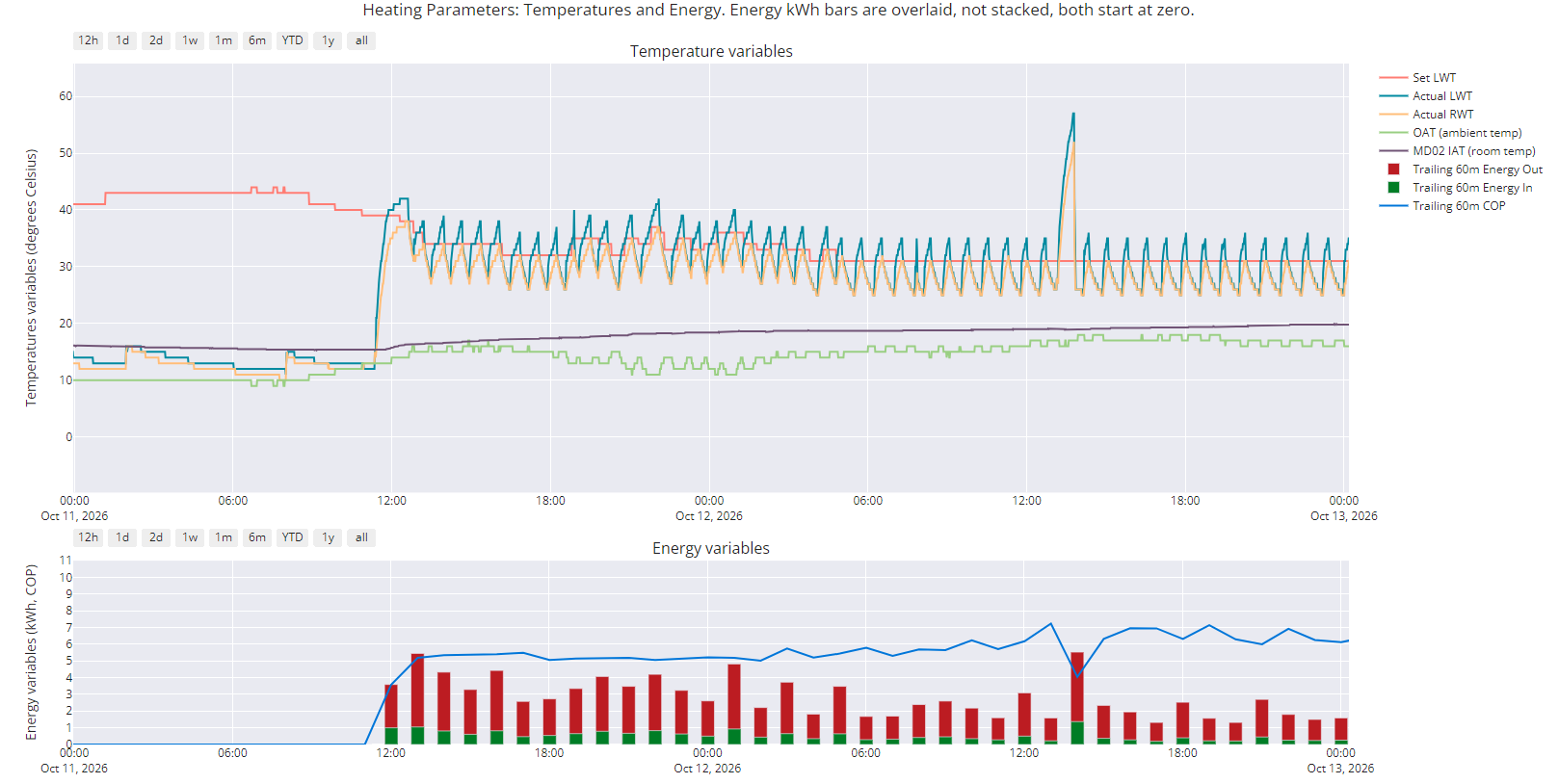
Note that I do have a tweak, my auto-adapt script, which shifts the weather compensation curve up or down when the IAT is to low or high respectively, and it was in operation (confirmed by checking the auto-adapt log) during the 11th Oct start up period. Even so, the IAT took 24 hours to reach the lower target temperature (19°C). However, it was complicated by the fact the OAT rose during the period, which lowered the Set LWT (it hit the right hand end point, 31 degrees at 15 degrees OAT, 0600 on 12th onwards), which had the effect of stretching out the bit of string even more.
Summary for this bit of string: 24 hours to get from 15°C IAT to 19°C IAT.
Midea 14kW (for now...) ASHP heating both building and DHW
1
Topic starter
17/10/2026 7:12 pm
@cathoderay interesting. So, effectively, the same duration as mine - 1c in 6 hours. I think I would be speaking in Contralto if the house got to 15c!
17/10/2026 8:31 pm
Summary for this bit of string: 24 hours to get from 15°C IAT to 19°C IAT.
But looking at your graphs, why are your LWT and RWT cycling so much, for about 50% of the time the LWT/RWT is rising so presumably the compressor is running pumping heat, then for the next 50% of the cycle the LWT/RWT is falling, is the compressor running and drawing power during this cool-down part of the cycle? (I can't see a plot of instantaneous power demand)
I'm looking at that graph and wondering whether for 50%, so ~12 hours out of 24 hours, is that heat-pump actually pumping heat? Is it just sat there circulating the water, slowly heating the house, waiting for the LWT/RWT temp to fall to the control value before the compressor starts again.
Would you actually get much faster heating and better performance, by having a higher LWT/RWT set-point so the radiators then emit more heat, greater power output into the house, which then lets the heat-pump operate continuously, modulating its output without having to shut-off for a large part of the time?
[Edit] Yes, during the 50% of the cycle when LWT/RWT is falling, the two temperatures are identical, if the heat-pump compressor was running, pumping heat then the LWT must be higher than the RWT. So the compressor must be off, it must simply be circulating water round the system without actually pumping any heat.
So that's why it takes 24 hours to raise the house temperature by 4 degrees, for around 12 hours the heat pump isn't actually pumping any heat, it's just circulating water because the temperature differential across across the radiators-to-room temperature is too low to get sufficient power flow of heat into the house to let the heat-pump run.
[Edit 2] In fact, looking at those graph curves, it looks like the ratio between on/off is worse than 50/50, it looks more like it's only running, pumping heat for something around 1/3rd of the time, off for 2/3rds for a large part of the 24 hour period, that's why the temperature change is so incredibly slow. During the few periods when the LWT/RWT set-point is higher, 37-40 deg C, the heat-pump runs for more than 50% of the time.
I don't think the issue is with the heat-pump, it's the configuration, the LWT set-point is too low to allow it to operate continuously, it's forcing it to cycle and sit idle for a large portion of the time.
This post was modified 4 weeks ago 3 times by Temperature_Gradient
18/10/2026 8:25 am
So, effectively, the same duration as mine - 1c in 6 hours.
Exactly, and this is the point, a heat pump operating normally will not be able to achieve a rapid rise in IAT. In their defence, they are not designed to do that, rather they supply low but steady heat to maintain a desired IAT. To increase the rate of heating, you have to add some sort of over-ride. Some heat pumps can do this natively eg Ecodans with their dynamic Auto-Adaptive controls, but many heat pumps as supplied can't do this, meaning you have to add it, either with third party controls eg Homely, or by using a DIY approach, which is what I do. The mini-pc that does the monitoring behind the charts has a modbus connection to the heat pump, and it can write as well as read settings. I have a python script that runs once an hour which reads the IAT, and if it is more than one degree above or below where it should be, the script adjusts the Set LWT by moving the end points of the weather compensation curve up or down by a corresponding amount, up to a maximum of three degrees either way. It does accelerate the heating up of the house, it would take more than a day to get from 15 to 19 degrees without it, but not by a huge amount.
This 'by design' inability to achieve a rapid re-heat has important implications for setback operation. Firstly, you can't let the house cool too much, and secondly, you have to have the heating come back on several hours before you want it to get to your preferred IAT. When I run a setback, it operates from 2100 to 0300, and the house loses a degree or two, and then usually manages to recover in time for breakfast.
This means their is a potential comfort penalty if you don't get the settings right, the house is cooler than you want when you get up in the morning. Whether setbacks save energy consumption, and so costs, is a very moot point. It is not as simple as the heat pump was off for six hours, I have saved six hours of energy use, because you, in effect, have to put back the energy you didn't put in during the setback, through a post setback boost, that uses more energy than would have been the case had you not had the setback. The general consensus these days seems to be that most houses, and especially high thermal mass houses, might see a small net saving, perhaps more so at lower OATs. Because all the other variables tend to change all the time, measuring this saving can be rather tricky, as many pasts threads have demonstrated.
But looking at your graphs, why are your LWT and RWT cycling so much, for about 50% of the time the LWT/RWT is rising so presumably the compressor is running pumping heat, then for the next 50% of the cycle the LWT/RWT is falling, is the compressor running and drawing power during this cool-down part of the cycle? (I can't see a plot of instantaneous power demand).
I'm looking at that graph and wondering whether for 50%, so ~12 hours out of 24 hours, is that heat-pump actually pumping heat? Is it just sat there circulating the water, slowly heating the house, waiting for the LWT/RWT temp to fall to the control value before the compressor starts again.
You are quite right to spot the cycling, but it is slow cycling, around 8 cycles per six hour period in the chart, and this is normal for Midea M-Thermal heat pumps. They only achieve steady state running at around 7-8°C OAT, above that OAT they slow cycle, below that OAT they start using defrost cycles. Why Midea heat pumps routinely use cycling is one of the great mysteries on the universe, to which the answer is probably 42.
I do collect both flow rate and compressor activity but don't normally plot them, as the charts get too busy, but yes you are right, the compressor (and everything that goes with it) kicks in and out for each cycle. Here is the rather busy plot for 1800-2359 on 12th October showing LWT, RWT, 'Ability' (Midea speak for a number that is supposed to by instantaneous power in in kW, as I understand it), Compressor frequency, Amps in and Flow rate:
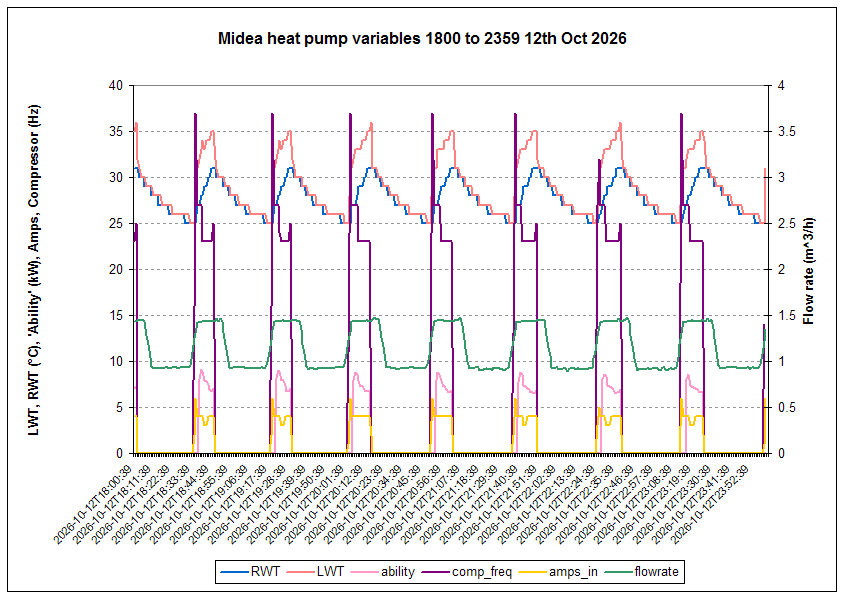
The chart also makes visible another Midea quirk, the circulating pump only has two settings, just under 1m^3/h and just under 1.5m^3/h. Again. no one knows why this is the case, let alone why it isn't one setting of 4.2m^3/h.
Would you actually get much faster heating and better performance, by having a higher LWT/RWT set-point so the radiators then emit more heat, greater power output into the house, which then lets the heat-pump operate continuously, modulating its output without having to shut-off for a large part of the time?
Yes, possibly, but just faster, not much faster, and certainly at the cost of a (small?) loss of efficiency, ie lower COP (higher LWT = lower COP). General note: performance is a slippery word, a sports car might perform very well, but at the same time be very inefficient. In the above paragraph, 'better performance' means faster heating, but says nothing about efficiency, which will actually decrease.
So that's why it takes 24 hours to raise the house temperature by 4 degrees, for around 12 hours the heat pump isn't actually pumping any heat, it's just circulating water because the temperature differential across across the radiators-to-room temperature is too low to get sufficient power flow of heat into the house to let the heat-pump run.
Not quite, this is rather by accident so to speak, because the weather compensation curve is set to maintain an IAT, not raise it. In a normal setup (no auto-adaption) the heat pump has no idea what the IAT is, it just outputs what it thinks the property needs given the current OAT. Since this will be slightly more that that needed to maintain the lower setback IAT, the IAT will rise, but only very slowly. To get a faster rise in IAT, you have to add something extra, ie a post setback boost.
I don't think the issue is with the heat-pump, it's the configuration, the LWT set-point is too low to allow it to operate continuously, it's forcing it to cycle and sit idle for a large portion of the time.
The Set LWT is the LWT set by the weather compensation curve (WCC) to maintain the IAT given the current OAT. The WCC itself is 'set' empirically, ie by manual teaks until it is about right. If you eyeball the actual LWT (better done on the left hand side of the first chart), it sort of averages out at the Set LWT, such that an average over an out is about the Set LWT, although I do agree that on the right hand side the on periods appear shorter. This may be because it has hit the WCC endpoint (31° Set LWT at 15° and above OAT), and the only way it can reduce output further is by being on for shorter periods. But that right hand end is atypical (insofar as it is actually a period when the heating does not need to be on - in effect I turned it on too early!), but more generally the Set LWT at various OATs as set by the WCC is set to the right level, shown by the fact that in normal operation the desired IAT is well maintained. If I raised the Set LWT the IAT would oveshoot, and my costs would increase. It is about where it should be, with Midea adding some quirky behaviour on top, so far as we can tell to modulate total output.
Much of this, particularly the relationship between the OAT, the WCC and the IAT (but not the quirky Midea slow cycling behaviour), is fundamental to how heat pumps work in practice, and is well worth getting your head round!
Midea 14kW (for now...) ASHP heating both building and DHW

18/10/2026 9:55 am
Exactly, and this is the point, a heat pump operating normally will not be able to achieve a rapid rise in IAT. In their defence, they are not designed to do that, rather they supply low but steady heat to maintain a desired IAT.
That's the issue, those graphs show your heat-pump (in those conditions) is not supplying low steady heat, the heat-pump unit is cycling and the compressor is switched off for at least 50% of the time, it's behaving like a traditional gas boiler, cycling to maintain the LWT set-point temperature.
With better controls, the heat-pump could operate continuously at its lowest power output, getting the house up to temperature efficiently in a reasonable time period.
They only achieve steady state running at around 7-8°C OAT, above that OAT they slow cycle, below that OAT they start using defrost cycles. Why Midea heat pumps routinely use cycling is one of the great mysteries on the universe, to which the answer is probably 42.
I suspect that it won't be the OAT which is directly determining the cycling, rather I expect it will be your LWT/RWT set-point in conjunction with your radiator's heat output, if your set-point is too low then the radiators cannot dissipate the minimum heat output of the heat-pump at its lowest modulation. It's heat balance, the heat-pump pushes heat into the system, the radiators dissipate heat from the system into the house, if you push the LWT too low, then output from the radiators drops below the minimum continuous output from the heat-pump, so heat input > heat output, so the LWT/RWT temperature rises until it hits the control limit, then shutting off the heat-pump, causing the cycling.
The cycling won't be a mystery of Midea, it will be the heat-pump control interacting with your set-points and your system's parameters.
I suspect what is actually happening is that at 7-8 deg C OAT, your LWT/RWT set-point from your WCC is higher which in conjunction with the heat-pump minimum output under those conditions (LWT/RWT and OAT) puts the system into a happy operating state where the heat-output from the radiators matches the minimum heat output of the heat-pump, (heat input ~= heat output) so it can run at a steady state, avoiding the cycling.
If I raised the Set LWT the IAT would oveshoot, and my costs would increase
Are there no room thermostats, to modulate the LWT set-point, or simply switch off the heat pump once the room temperature is reached?
It's an interesting control problem and the problem lies with the control, not with the heat-pump itself (as in the refrigeration system moving the heat). The graphs are pretty clear, for most of the time the refrigeration system is sat idle, not pumping heating, it could get the house upto temperature far quicker with better control to ensure it operates for a greater proportion of the time.
18/10/2026 6:53 pm
That's the issue, those graphs show your heat-pump (in those conditions) is not supplying low steady heat, the heat-pump unit is cycling and the compressor is switched off for at least 50% of the time, it's behaving like a traditional gas boiler, cycling to maintain the LWT set-point temperature.
I agree it looks like a traditional fossil fuel boiler, modulating using on and off, but it (the slow cycling) is normal Midea behaviour. Others who have posted similar charts for their Midea heat pump show similar behaviour. It is also worth noting that the right hand half of the first chart and all of the second chart are very much in a boundary condition, where the demand for heat from the heat pump is approaching zero, which happens when the OAT reaches 16°C or so.
With better controls, the heat-pump could operate continuously at its lowest power output, getting the house up to temperature efficiently in a reasonable time period.
I think I am stuck with the fact it can only go down to about 6kW, way more than is needed in the charted conditions. The heat pump is badged at 14kW, but at 15°C OAT and a LWT of 30°C (the closest to the particular conditions), the minimum output is 5966W, as I say way more than is needed, meaning cycling is inevitable. Here's the data from the Midea Engineering Data manual:
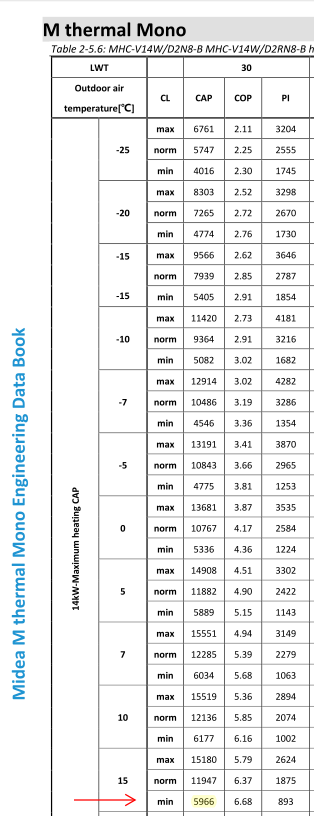
If you look at the lower energy chart in the first chart, for most of the 1800 to 2359 period it is putting out between 1 and 2 kWh per hour, ie running at an average power of between 1 and 2 kW over the hour. If the Engineering Data manual is to be believed, it has to cycle.
And here's the only domestic Midea M-Thermal heat pump (in Hampshire) on heatpumpmonitor.org for 12th October (the 'controls' are far from obvious: get the dates in view, then drag over the relevant interval to zoom):
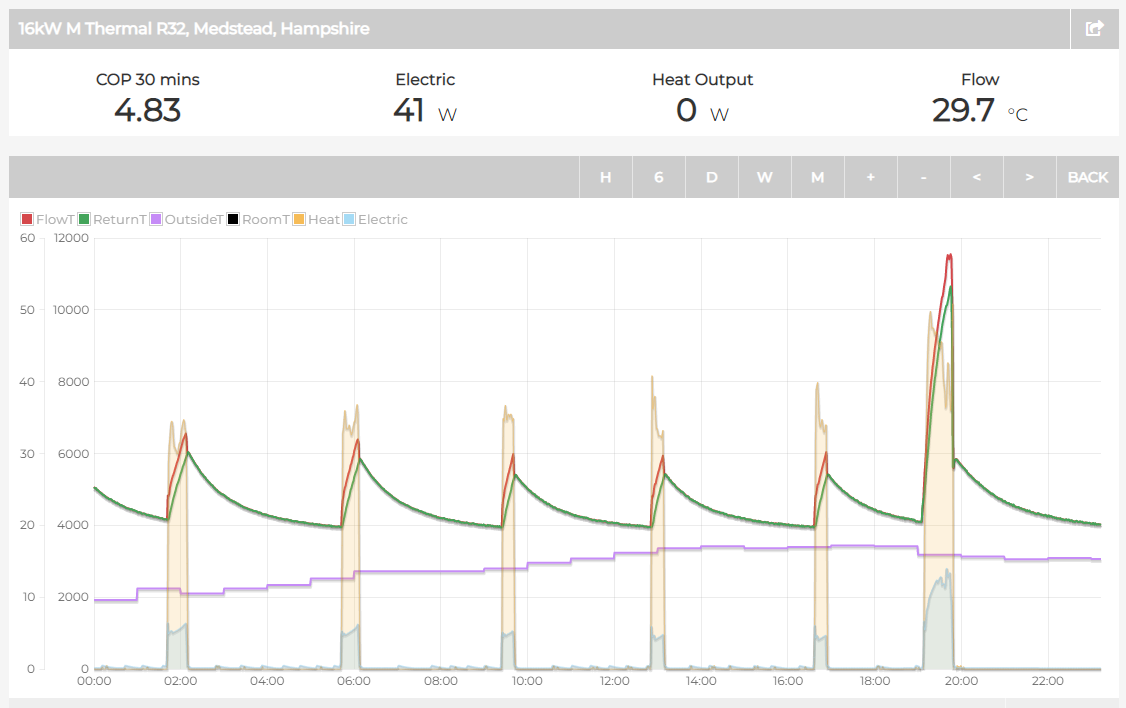
It is also slow cycling, albeit to a different on/off ratio (even less on time) with the OAT rising from around 10°C to a peak of around 17°C mid to late afternoon. The larger pre-2000 hour peak is almost certainly DHW. Other Midea M-Thermal data posted here on the forum shows similar cycling behaviour. It appears to be the way Midea M-Thermal heat pumps work (and, outside Midea, know one appears to know why).
These conditions in these charts are mostly extremely mild, but the same cycling pattern is present as mentioned above down to around 7-8°C. I will post some charts tomorrow.
I will get back to you tomorrow on the control logic. Don't forget the default option on a Midea is just WCC, no auto-adaption unless added in some third party way. The ordinary Midea M-Thermal owner is stuck with whatever the WCC says for each OAT.
Midea 14kW (for now...) ASHP heating both building and DHW
18/10/2026 9:44 pm
I think I am stuck with the fact it can only go down to about 6kW, way more than is needed in the charted conditions. The heat pump is badged at 14kW, but at 15°C OAT and a LWT of 30°C (the closest to the particular conditions), the minimum output is 5966W, as I say way more than is needed, meaning cycling is inevitable. Here's the data from the Midea Engineering Data manual:
The bit I'm wondering here, is given the house is several degrees below target temperature, in this situation it would appear better to raise the LWT to get the radiators dissipating more heat into the house, keep the heat-pump operating continually and get the house up to target temperature in a more reasonable time-frame.
What does the rest of the performance table look like - if you raised the LWT to 45 or 50 deg C in these conditions, what's the minimum power output and how much does it impact the COP? Is there actually much of a penalty to raise the temperature more rapidly, over
You mentioned you are running a script to dynamically adjust the LWT set-point, could you include a room temperature sensor input into the formula to raise/lower the LWT based on deviation of actual room temperature from room temp set-point?
I think the heat-pump manufacturers are going to have to raise their game on the control side, it shouldn't be taking days to raise the house temperature by just several degrees, particularly in undemanding ambient conditions while the head-pump is mostly sat there idly running at a fraction of its capacity, while the homeowner is stuck in a cold home.
Topic starter
19/10/2026 6:25 am
I would expect that there’s going to be a difference in operating approach between raising to temp and maintaining temp. I see no reason why you wouldn’t run a higher flow temp to get to a comfortable house temp and then knock it back. Certainly, if our house was 15c and we were at home, I would want to raise it as quickly as possible and damn the cost. My house insurance demands a minimum of 15c internal temps so that’s what I set it too when we went on holiday. I gradually raised the temp back up to 22c over 4 days prior to returning home.
I’m just experimenting with the flow temps right now. Last year, once I was able to get over the overheating issue and Octopus changed the app to allow lower flow temps, I ran at 36c - 50c WC. Frankly, after 3 months I was glad for it to be stable temperatures in the house and was fed up with fiddling with it.
Right now I have stopped the setback so I’m trying to maintain a 22c internal temp. WC is currently 32c to 50c and it is maintaining fine with the current OAT - that would be more the 32c end of the WC. It may be too low as it gets colder but we shall see.
My original question was just to see what others were doing in respect to recovery times, without getting into realms of detailed technical data. We weren’t cold going from 21c to 22c but was 6 hours to raise 1c too slow in people’s view? With a WC of 36c to 50c it took less than 2 hours to raise 1c. Is it more efficient to raise temps quickly then cut back for maintaining? I was also interested in seeing if that sort of recovery time period was indicative of other issues given experience and my lack of access to detailed running data to see for myself.
Page 1 / 3
Next
SPONSORS
Degrees of Separation
Latest Posts
-

RE: How Can I Prove Coal Was My Main Heating Source Without Receipts?
Got excepted for the grant now so thanks for the replie...
By Chilli304 , 7 minutes ago
-
Welcome to the forums. That's a frustrating situation, ...
By Mars , 1 hour ago
-
RE: DIY powerflushing tutorial
Same 🤣 Near Lyon, France. Water has lots ...
By bobflux , 2 hours ago
-
RE: Buffer tank on a 2 x 14kw Ecodan system
Pretty much as I had guessed in my crude scaling from m...
By JamesPa , 4 hours ago
-
RE: Help me keep the faith with my air source heat pump installation
Well you have a vibration generator running at some fre...
By bobflux , 17 hours ago
-
RE: Why don't people choose heat pumps?
@susannasaunders The link I have found may provide a li...
By Toodles , 19 hours ago
-
RE: Who's your electricity provider and what's your tariff?
@downfield Thats a decent rate, I’m shocked they hadn...
By Papahuhu , 2 days ago
-
RE: Should Households Who Can Afford It Pay More for Energy to Help Those Who Can't?
@batpred I mentioned earlier that targeting the payment...
By Toodles , 2 days ago
-
RE: Adventures in heat loss calculations
@toodles thanks! So as suspected, around a doubling of ...
By SusannaSaunders , 2 days ago
-
Six books in three years and I think I’ve now covered j...
By Mars , 2 days ago
-
RE: Grant Aerona3 13kw - Buffer Tank - Heating Journey
@heymikey Well done in achieving as nearer a match acro...
By Toodles , 2 days ago
-
Grant Aerona - Weather Compensation and Schedules
Im trying to set up a friends Grant Aerona. The WC curv...
By bontwoody , 3 days ago
-
RE: Air-to-Air Heat Pumps & Air Conditioning: UK Heating and Cooling Q&A
@jamespa I agree, the efficiency of Cosy Cooler ought...
By Rob of York , 3 days ago
-
RE: How much of your renewable and home setup would still work if the internet went down?
I think you're right! 🤨
By Transparent , 4 days ago


SPONSORS

