

Notifications
Clear all
Joining the Renewable Heating Hub forums is completely free and only takes a minute. By registering you’ll be able to ask questions, join discussions, follow topics you’re interested in, bookmark useful threads and receive notifications when someone replies. Non-registered members also do not have access to our AI features. When choosing your username, please note that it cannot be changed later, so we recommend avoiding brand or product names. Before registering, please take a moment to read the Forum Rules & Terms of Use so we can keep the community helpful, respectful and informative for everyone. Thanks for joining!

27/02/2025 7:14 pm
So... where would you install the volimiser?
I'm embroiled in a discussion with over 50 installers on this subject. The bulk (90%) say on the return, including some very notable installers. The 10% include some big names and experienced installers too, and I don't fully understand why it would go on the return.
I recently replied to an installer who commented on this on a YouTube video and I'll use the same reply here.
The volumiser isn’t storing temperature or energy – it’s storing volume. Since the volumiser is at the same temperature as the return, there’s no thermal advantage to placing it on the return side. Instead, its primary purpose is to assist with defrost cycles, and this is where positioning matters most.
During a defrost cycle, cold water enters the heat pump, is cooled further, and then pushed back into the system.
If the volumiser is on the return, this cold water flows directly to the radiators, potentially causing significant cooling and discomfort.
However, if the volumiser is on the flow, the cold water first mixes with the warmer water in the volumiser, which helps to moderate its temperature before it reaches the radiators. This prevents cold shocks to the system and maintains comfort levels in the home.
There’s also a secondary benefit to placing the volumiser on the flow. By acting as a buffer, it helps to stabilise the system during defrost cycles, reducing the risk of temperature fluctuations and improving overall performance. On the return side, the volumiser offers no such advantage – it simply becomes a passive component with no meaningful role.
The volumiser’s placement on the flow side is not just theoretically sound but practically essential for maintaining comfort and system integrity during defrost cycles.
While return-side placement might seem intuitive, it fails to address the critical need for temperature moderation, rendering the volumiser ineffective. For installations prioritising performance and user comfort, flow-side positioning is the clear choice.
There are some compelling arguments for putting the volume on the flow side and I’m almost persuaded. However the emphasis appears more weighted on defrost recovery and there appears to be very little detailed reasoning for improving short cycling.
I can’t help feeling there’s another reason to putting the volumizer on the return side. Firstly defrosts are quite short but the recovery of the return temperature can be upwards of 30 minutes.
Firstly is it true that the circulation pump continues to push the flow and return water around the heating circuit during the defrost? Secondly is it true that there is no heating of any water as it passes through the heat pump…. Contrary to that, the circulated slug of water will be chilled by the defrost process and move on into the heating circuit for approximately 3 minutes of flow. So at 20 lpm there would have been 60 litres of chilled water.
Is it not better to allow this water to move through the radiator system then fully mix at the return end of the circuit allowing the return cold and warm water to mix in the volumiser at the back of the circuit?
Here is a typical defrost for our system

Several trips around the buoy…..

27/02/2025 11:12 pm
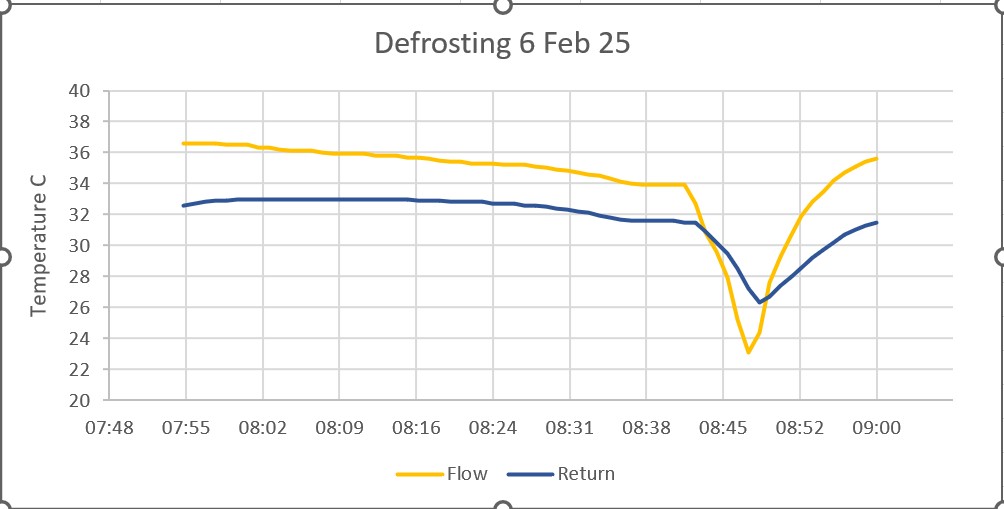
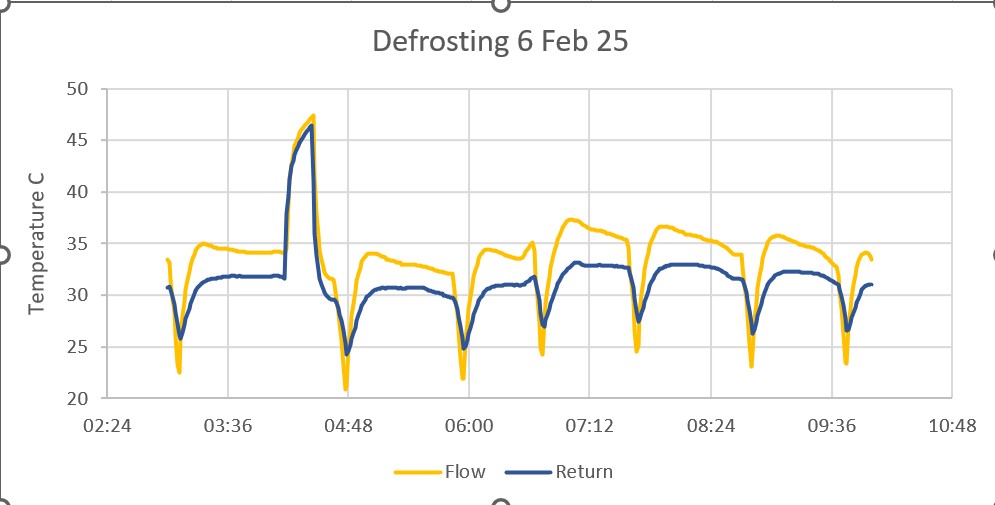
I've also got some potentially relevant data because I bought a pair of Elitech recording temperature sensors and fixed them to the flow and return pipes close to my cylinder (I would have preferred to have put them next to the heat pump but it was too much hassle to remove the pipe insulation). I've got 32,000 rows of 1 minute data to wade through so I just looked at the coldest night in the data period (6th Feb 2025) when the outside temperature was below 0C and there was a series of defrosting events. The graphs below show the overall sequence and the details for one event. My system (7kW Arotherm+ with a 50 litre buffer tank) runs at a lower temperature than most with the flow temperature normally being about 4C higher (but reducing as frost builds up) than the return but flipping to briefly being 4C lower than the return during the defrosting.

27/02/2025 11:38 pm
Ours is on the flow side at your position C after the DHW-CH change-over valve. It is plumbed in series.
2kW + Growatt & 4kW +Sunnyboy PV on south-facing roof Solar thermal. 9.5kWh Givenergy battery with AC3. MVHR. Vaillant 7kW ASHP (very pleased with SCOP >4) open system operating on WC


27/02/2025 11:42 pm
Firstly is it true that the circulation pump continues to push the flow and return water around the heating circuit during the defrost? Secondly is it true that there is no heating of any water as it passes through the heat pump
Great question… I hope that @heacol can pick this one up.
🔥 Britain’s Heat Pump Shitshow
How Installing a Heating System Became a National Nervous Breakdown
Free UK shipping.
📗 Heat Pumps Explained
A Jargon-Free Guide for Homeowners
Rewritten and updated for 2027
📘 From Zero to Heat Pump Hero
🛠️ Bodge Buster
New to heat pumps?
Take the Heat Pump Fundamentals course and use INTRO50 at checkout for 50% off.


28/02/2025 9:46 am
Firstly is it true that the circulation pump continues to push the flow and return water around the heating circuit during the defrost? Secondly is it true that there is no heating of any water as it passes through the heat pump
It certainly is with mine (Vaillant).
The source of the defrost energy is basically the water in the system and during defrost the heat pump extracts energy from the water rather than putting energy into it. I have seen reference to the idea that one or other heat pump might be fitted with an electrical heater for defrost, but I haven't verified this and I have seen plenty of plots where the temperature of the LWT goes below that of the RWT thus showing that those pumps at least simply use the energy in the system water for defrost, and continue pumping.
4kW peak of solar PV since 2011; EV and a 1930s house which has been partially renovated to improve its efficiency. 7kW Vaillant heat pump.
28/02/2025 11:13 am
Some points arising from comments above:
1. The heat pump can't defrost and produce heat at the same time. It's the process of extracting heat from the air which causes the frosting (which depends on air temperature and humidity - damp British air causes more frosting than drier air in central Europe) so the heat pump has to temporarily stop generating heat while clearing the ice.
2. The heat pump needs a source of heat for the defrosting and therefore needs to use some warm water, hence the temporary drop in the flow and return temperatures as shown on my graphs above. However, while radiators will temporarily feel cooler, it's unlikely that they will go cold. My detailed graph shows the flow temperature dropping for 6 minutes before starting to rise again. That's for water which started at less than 35C. I would expect a higher temperature system to defrost even faster.
3. My buffer tank contains a pocket for an immersion heater element (none fitted). I understand that this is a frost protection option by providing a source of warm water to circulate through the heat pump should the compressor fail but the circulating pump is still working. It wouldn't give protection against an electricity failure. It would be technicially possible to turn this immersion heater on during the defrost cycle instead of cooling the CH circuit (a 4-port buffer system is needed to semi-isolate the primary circuit through the heat pump from the secondary CH circuit). However, an immersion heater is a much less energy-efficient source of heat than the heat pump itself.
01/03/2025 11:12 am
Firstly is it true that the circulation pump continues to push the flow and return water around the heating circuit during the defrost? Secondly is it true that there is no heating of any water as it passes through the heat pump
Great question… I hope that @heacol can pick this one up.
I didn’t see your earlier reply to @old_scientist which goes a lot further in detail. Which is pretty convincing.
ive copied it here for a reminder.
@old_scientist, you’re right that the volumiser stores heat energy, and a larger volume does reduce the overall temperature drop during defrost. However, the key issue is where this stored energy is most effectively utilised. On the flow side, the volumiser contains warmer water from prior heating cycles. During defrost, this stored warmth moderates the cold influx, reducing the temperature gradient between the incoming cold water and the water entering the radiators. This minimises discomfort and stabilises the system. By moderating the cold influx, the flow-side volumiser reduces the energy required to reheat the system after defrost, aligning with the First Law of Thermodynamics (conservation of energy).
On the return side, while the volumiser does store energy, it’s less effective during defrost because the return water is already at a lower temperature. Cold water from defrost mixes with this cooler water, exacerbating the temperature drop and forcing the heat pump to work harder to reheat the system. This increases energy consumption and reduces efficiency, negating the benefits of the stored energy.
You’re also correct that at high flow rates (e.g., 25L/min), a 50L volumiser will empty in about 2 minutes. However, the critical factor is what happens during those 2 minutes. On the flow side, the volumiser’s stored warmth moderates the cold influx, preventing cold shocks to the radiators. This is crucial for maintaining comfort and system stability. Even after the volumiser empties, the moderated water temperature reduces the overall temperature drop, making it easier for the heat pump to recover.
On the return side, the volumiser’s stored energy does little to moderate the cold influx, as the return water is already cooler. This means the radiators receive colder water almost immediately, potentially causing discomfort and increasing the energy required to reheat the system.
While the volumiser on the return side does provide a larger system volume and some energy storage, its role is passive and less effective compared to flow-side placement. The flow-side volumiser actively moderates temperature fluctuations, reduces energy consumption and improves comfort – benefits that the return-side volumiser cannot match.
So by moderating cold influxes during defrost, the flow-side volumiser aligns with thermodynamic principles to improve efficiency, reduce energy consumption and maintain comfort.
This reply makes a lot of sense since it seems to confirm that the volumiser is doing more than just adding volume. It is clearly adding surplus volume but it’s also adding a huge reservoir of FLOW TEMPERATURE FLUID.
furthermore by placing it at the LWT end of the installation this means it has the greatest opportunity of absorbing and mixing with the cold defrost slug of water which might be as much as 50 or 60 litres in volume.
so in my own clumsy way here is a few possible scenarios of the mixing journey of the defrost water…. Which may or may not be true…
So if the cold water dilution and blending process is going to work, the system needs to mix all of its surplus Flow Temperature volume held in the volumiser as the cold slug leaves the HP. but THIS MIGHT ONLY PARTIALLY BLEND as it flows through the volumiser itself. If the defrost recovery is going to be shortened or lessened the cold slug needs to be fully mixed with the 200 litre circuit volume and preferably in one cycle of the heating pipework.
My interpretation is that the rest of the mixing then continues as the water enters each radiator. But it’s also important to see that each radiator has a different pipe length meaning that the temperature gradients are further blended as the return flows enter the CH return pipework at the different mixing points along the lengths of the flow and return pipework.
So does this mean that by placing the volumiser at the LWT position in the system, (Position A or C on the sketch) the extra volume is capable of cancelling out the chill down and slow recovery of a typical defrost.
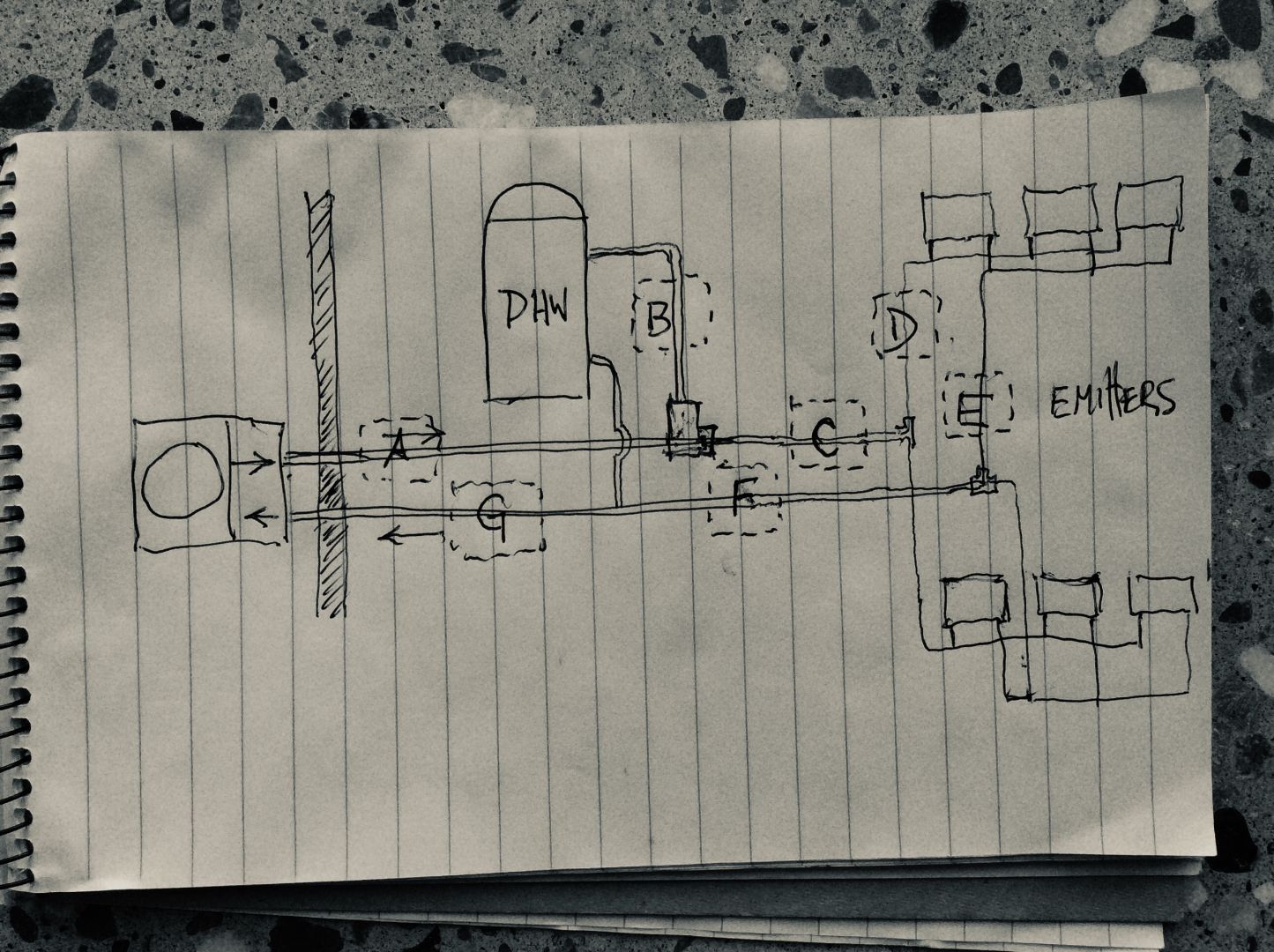
@editor does this scenario work for you and perhaps of equal importance which position are you saying the volumiser should be placed on the sketch?

01/03/2025 12:25 pm
@sunandair You are correct, the volumisor on the flow will buffer the cold shock comming from the heat pump going to the radiators and the asociated discomfort during defrost. The water will eventually cool down and it will take longer to come up to temperaure again, but it is a gentel reduction that will rarely be noticed. Some of the better unit have an immersoin on the flow that does exactly the same thing and they do not require a large system volume. Panasonic only require 25 liters open system volime up to the 9 Kw unit, and I think 50 liters up to 16 Kw.
1

01/03/2025 12:32 pm
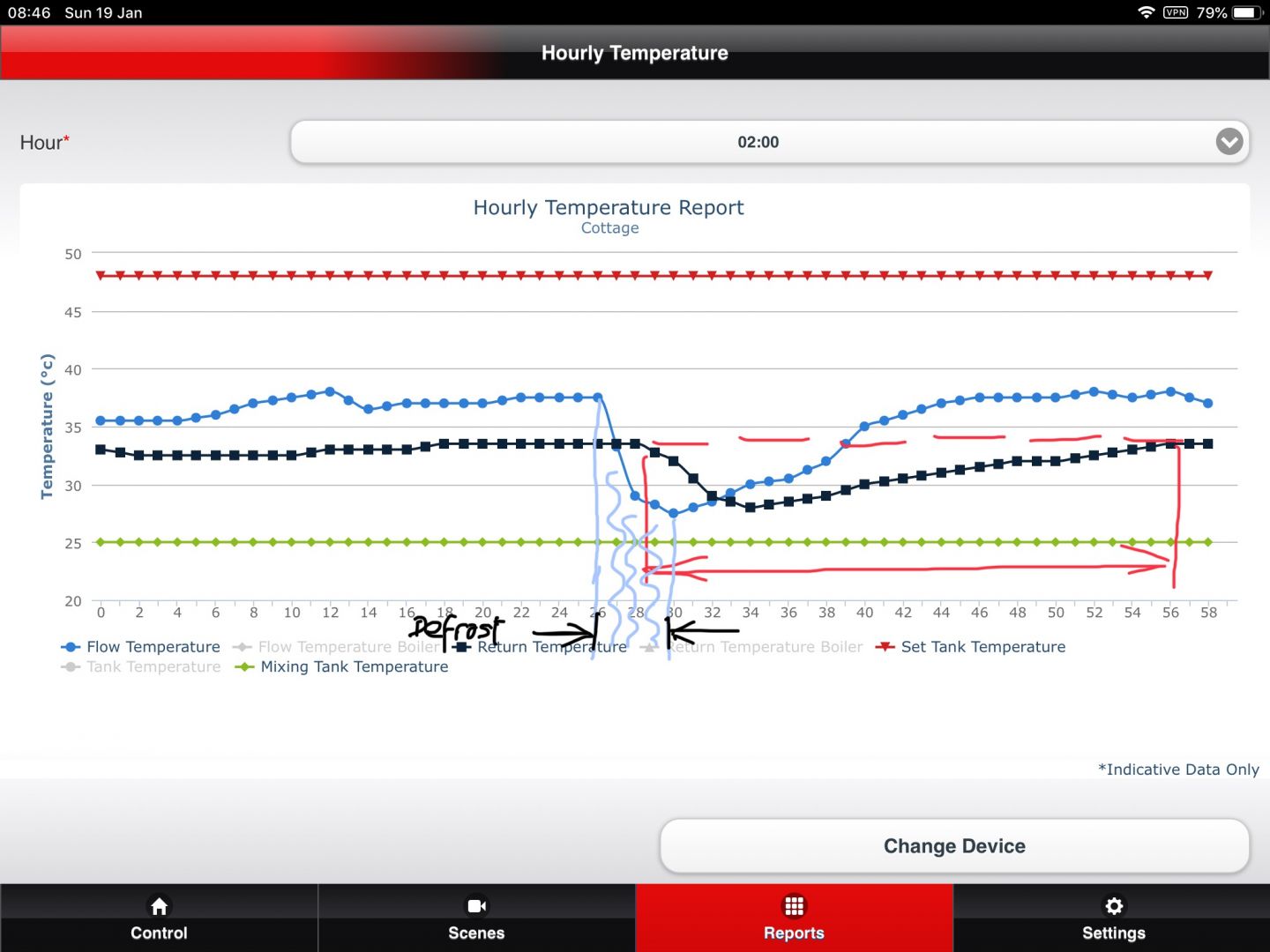
Just to confirm… our system does not have a volumiser, buffer tank or LLH.
Here is a chart showing how our defrosts occur. There is a 2 or 3 minute defrost followed by a slow recovery to the mean water temperature. It’s not a noticeable issue but I guess we haven’t been looking for it. If we were in a colder climate it might be an issue with repeat defrosts.
01/03/2025 12:47 pm
@sunandair That is what I would expect from a system with adiquate volume. The panasonic prevents the flow temperature dropping below 25 Deg C which is higher than the flow temperature and therefor you will not notice it.
01/03/2025 2:17 pm
@heacol I’ve also herd that a volumiser can help with short cycling.
I wondered if short cycling would be reduced if it was caused by mild outdoor ambient circa 10c and a corresponding low flow temperatures and possibly insufficient radiator capacity at low flow temperatures…. Can you use a volumiser as a replacement for increased radiator capacity to reduce cycling? Eg. Flow temps down to 30c and rad capacity sized for 50c at -3c might not be large enough… as an example.
or is this just a red herring?

SPONSORS

Degrees of Separation
Latest Posts
-

RE: New Build 3 Phase or 1Phase
@etchedpixels I've just looked back, it was March this ...
By E A WEST , 1 hour ago
-
RE: How will removing the standing charge on gas bills benefit heat pumps?
I'm not sure it makes much of a difference to heat-pump...
By Temperature_Gradient , 15 hours ago
-
@editor Ouch, sorry to re start the tick. I had assume...
By DavidB , 16 hours ago
-
RE: Say hello and introduce yourself
@e-a-west as the good Major said, welcome to the forums...
By Mars , 17 hours ago
-
RE: How much of your renewable and home setup would still work if the internet went down?
Yes I actually have a copy of a tool that whenever a ce...
By EtchedPixels , 1 day ago
-
RE: Indevolt Batteries UK Support & Info Thread
@editor Hi, To resolve this, please tap on the A...
By Indevolt Tech , 1 day ago
-
RE: Double or Triple Glazed Windows?
Posted by: @singlespeed With 9 years repairing windo...
By Rob of York , 2 days ago
-
@transparent we’re still running a secure version of PH...
By Mars , 2 days ago
-
RE: How quickly would you want/expect heat recovery to take from setback?
Much longer than that here. The heating isn't even on. ...
By bobflux , 3 days ago
-
RE: Passiv Smart Thermostat - Help & Forum Support
Obviously the weather is changeable but there's a defin...
By Singlespeed , 3 days ago
-
RE: The Changing Jet Stream Could Challenge UK Air Source Heat Pumps
@rob-of-york I must admit that when we had a Daikin hea...
By Toodles , 3 days ago
-
RE: Forum updates, announcements & issues
Get the Renewable Heating Hub heads-up on WhatsApp. I...
By Mars , 3 days ago
-
RE: Safety study for plug in batteries out to tender - looks like Q3 2027 at best before legal
@editor I pointed out to the one of the Fuse execs that...
By dansus , 3 days ago
-
RE: 15kw pump for 225m2 1990's house - over kill?
@seaviews As well as loft insulation, there are othe...
By Rob of York , 3 days ago




SPONSORS

