

Notifications
Clear all
Joining the Renewable Heating Hub forums is completely free and only takes a minute. By registering you’ll be able to ask questions, join discussions, follow topics you’re interested in, bookmark useful threads and receive notifications when someone replies. Non-registered members also do not have access to our AI features. When choosing your username, please note that it cannot be changed later, so we recommend avoiding brand or product names. Before registering, please take a moment to read the Forum Rules & Terms of Use so we can keep the community helpful, respectful and informative for everyone. Thanks for joining!

01/03/2025 4:18 pm
@heacol I’ve also herd that a volumiser can help with short cycling.
I wondered if short cycling would be reduced if it was caused by mild outdoor ambient circa 10c and a corresponding low flow temperatures and possibly insufficient radiator capacity at low flow temperatures…. Can you use a volumiser as a replacement for increased radiator capacity to reduce cycling? Eg. Flow temps down to 30c and rad capacity sized for 50c at -3c might not be large enough… as an example.
or is this just a red herring?
As you say, short cycling can occur during milder ambient conditions where the flow temps are reduced and the radiators/emitters then cannot dissipate the heat that is being produced. This causes the return temperature to rise (as the heat cannot be effectively dissipated into the property) thus narrowing the dT between flow and return. When this happens, the heat pump can cycle off to allow the water to cool and maintain a more optimal dT (somewhere in the controller logic the heat pump decides when dT drop below a certain value, the heat pump should cycle off).
Having a volumiser is not going to change the above fundamentals, as unlike a radiator it cannot dissipate heat (it's well insulated so it is reasonable to assume near zero heat loss relative to a radiator or other emitter). Consider it as simply a well lagged fat pipe, so there is more volume of water in the system. It may take longer to reach the initial point of cycling as there is initially more water to heat, so at best it may extent the periods between cycling (so short cycling now becomes longer cycling). Extending this premise, if the system volume were infinitely large, the return temperature would never rise to the point where the dT narrows to cause cycling, so there is a point of diminishing returns and as long as the system volume is large enough, then short cycling shouldn't be an issue. I do not know what this point is, but I have heard recommendations of having a system volume that is 3-4 times the recommended minimum system volume.
Samsung 12kW gen6 ASHP with 50L volumiser and large radiators. 7.2kWp solar (south facing), Tesla PW3 (13.5kW). Net Zero

01/03/2025 5:51 pm
When this happens, the heat pump can cycle off to allow the water to cool and maintain a more optimal dT (somewhere in the controller logic the heat pump decides when dT drop below a certain value, the heat pump should cycle off).
Not sure this is precisely what happens or how the control loop works. What I observe on plots I have seen (including mine) is that the flow temperature rises above the set point (because the heat pump is putting in more heat than the radiators are emitting). Eventually the flow temperature exceeds the target + allowable hysteresis, at which point the heat pump will shut down. You could in fact restore deltaT by simply slowing down the water pump, but the flow temperature will still rise above the target value because the heat pump is putting in more heat than the radiators are emitting.
Having a volumiser is not going to change the above fundamentals, as unlike a radiator it cannot dissipate heat (it's well insulated so it is reasonable to assume near zero heat loss relative to a radiator or other emitter). Consider it as simply a well lagged fat pipe, so there is more volume of water in the system. It may take longer to reach the initial point of cycling as there is initially more water to heat, so at best it may extent the periods between cycling (so short cycling now becomes longer cycling)
Agreed, particularly with the sentence in brackets. A volumiser changes the period of the cycling but not the on/off ratio.
4kW peak of solar PV since 2011; EV and a 1930s house which has been partially renovated to improve its efficiency. 7kW Vaillant heat pump.

01/03/2025 6:29 pm
Not sure this is precisely what happens or how the control loop works. What I observe on plots I have seen (including mine) is that the flow temperature rises above the set point (because the heat pump is putting in more heat than the radiators are emitting).
Here might be a case in point James.
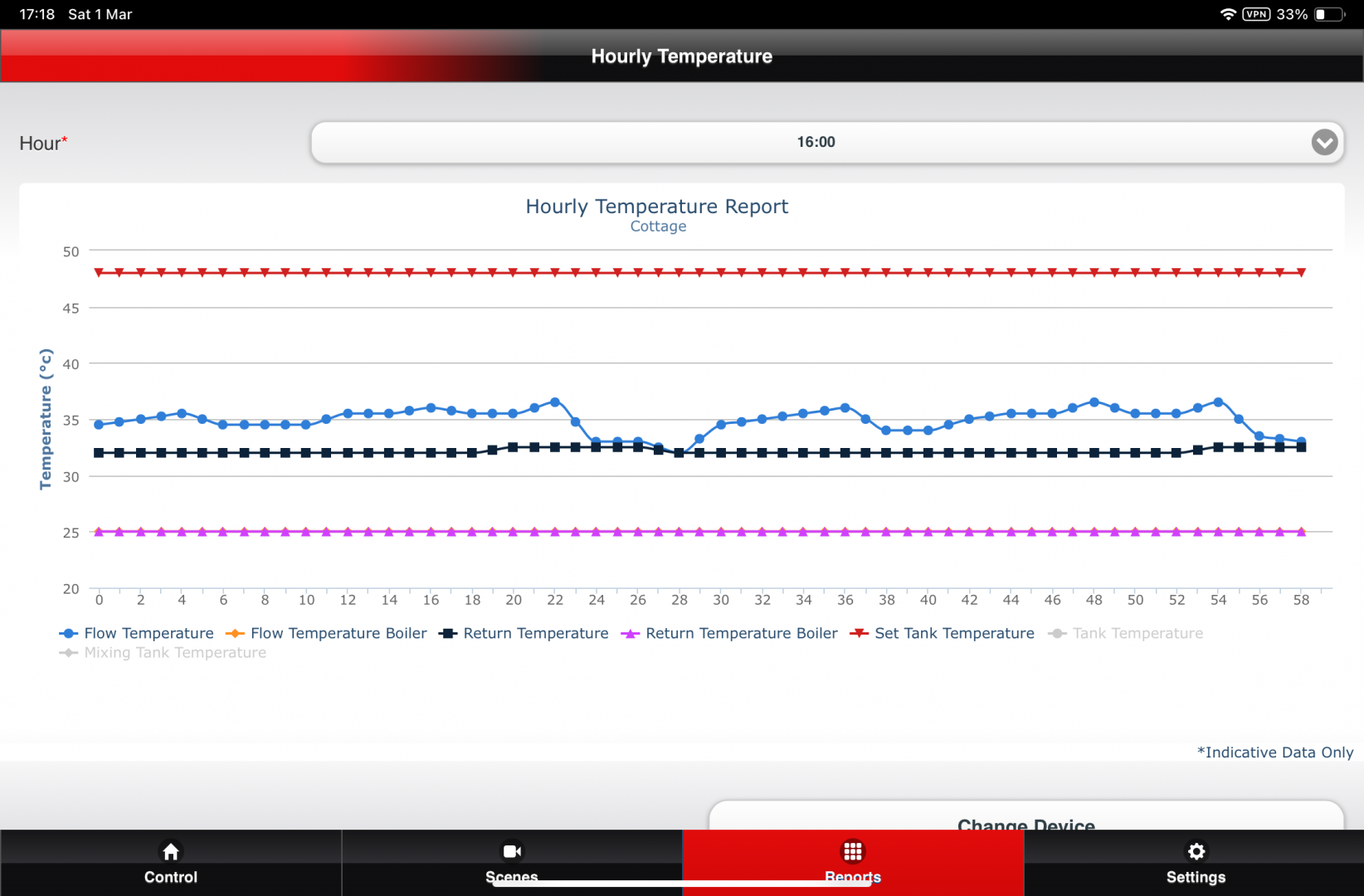
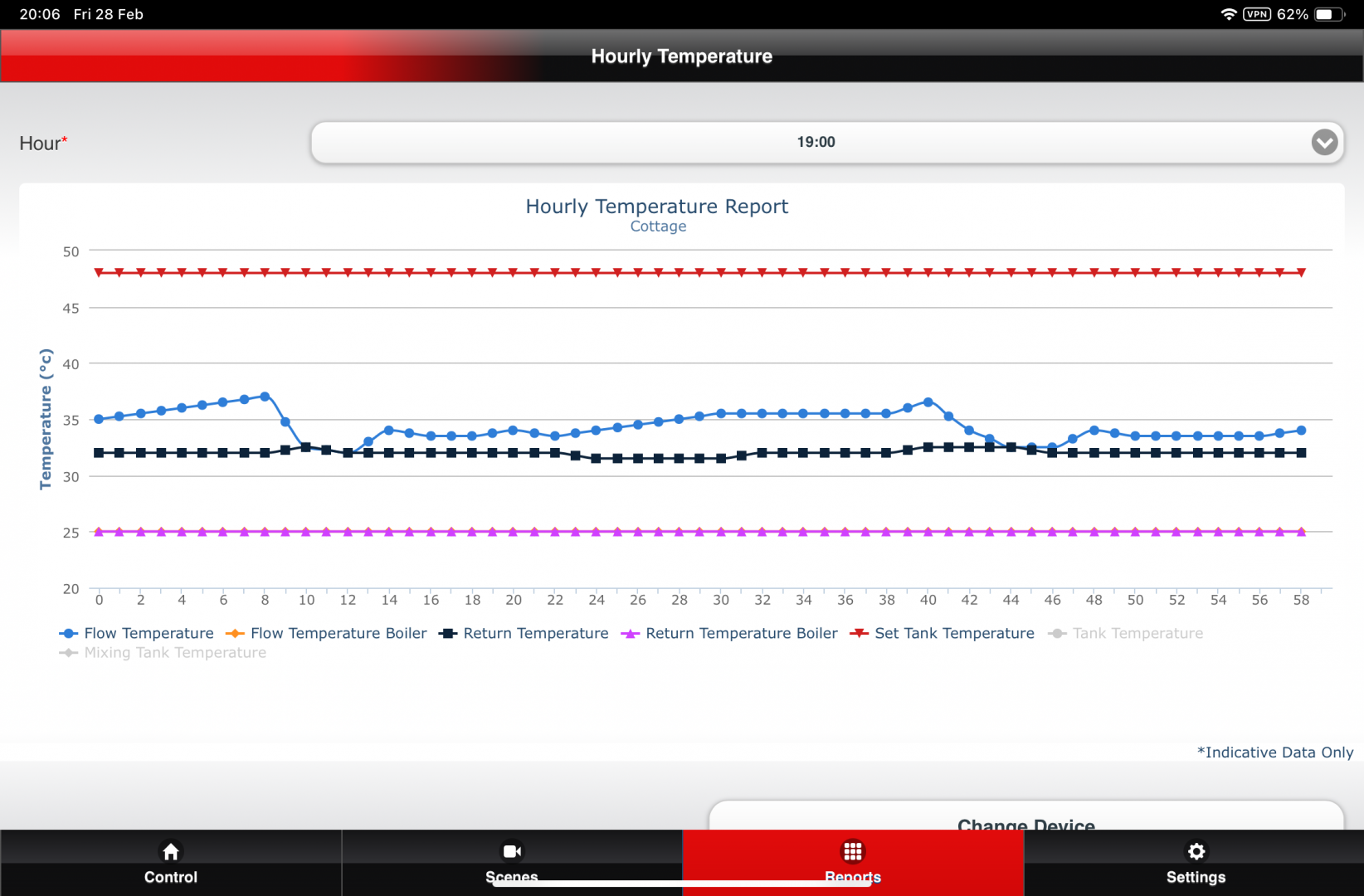
Here are 2 hourly charts showing flow and return. These are supposed to be operating at fixed flow 34C and 35C respectively. They both have a little burst of temperature before closing down for around 4 minutes. I’ve always assumed this was a deliberate duty cycle function to bridge the shutdown temp drop… but it’s just a guess. There is no thermostat controlling, it’s just fixed flow. The room temp is close to 21 with an ambient of around4C last night and 9C for this afternoons chart
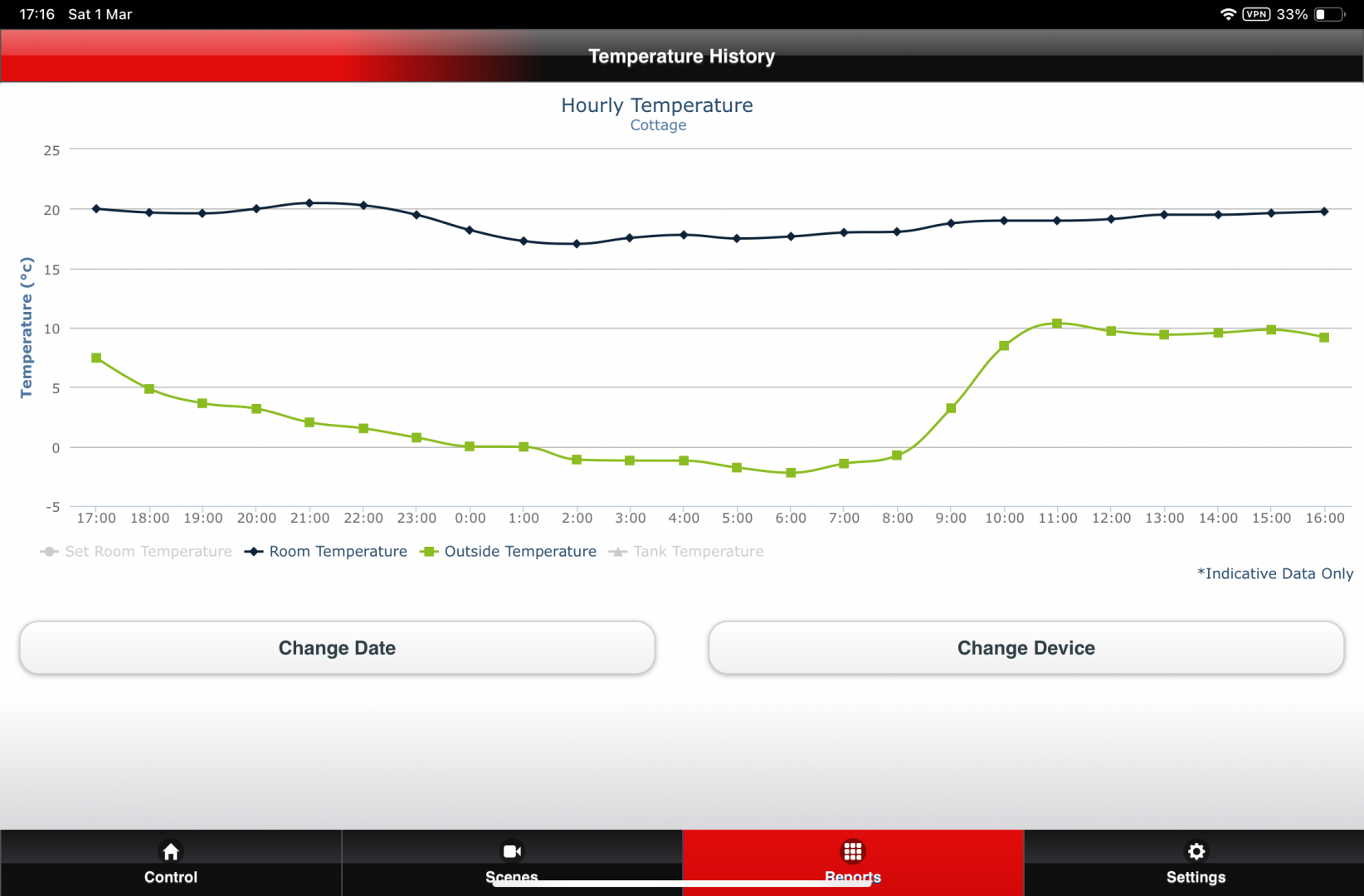
This 24 hour indoor/outdoor temp chart covers both hourly graphs above.
Page 4 / 4
Prev

SPONSORS
Degrees of Separation

Latest Posts
-

RE: Getting closer to a finished Haier system
Apart from sealing the external Primary Pro joints and ...
By Singlespeed , 52 minutes ago
-
RE: Missing flow temperature in Heat Geek proposal
@majordennisbloodnok I think the reason for my frust...
By Jo2255 , 2 hours ago
-
tepeo ZEB UK Support & Info Thread
Heat batteries offer another way to electrify home heat...
By Mars , 4 hours ago
-
RE: Are We Sleepwalking Into Another Race to the Bottom?
@jamespa Hope someone tries it! As a consumer, I woul...
By Batpred , 21 hours ago
-
RE: Air-to-Air Heat Pumps & Air Conditioning: UK Heating and Cooling Q&A
Our latest Homeowners’ Q&A episode has just dropped...
By Mars , 1 day ago
-
RE: Vaillant ecoTEC Plus with sensoCOMFORT and weather compensation
Yes, its described in the sensocomfort manual. Its als...
By JamesPa , 1 day ago
-
RE: Heat Geek installations: share your experiences
My summary, highlighting the oddities.
By Batpred , 1 day ago
-
RE: Renewable Heating Hub Homeowners' Q&A Podcast
What a day yesterday! Two podcasts recorded, brilliant ...
By Mars , 2 days ago
-
RE: Tesla Powerwall (2) Calibration Cycles
@davesoa I’m rather a Luddite, but when I was running I...
By Papahuhu , 2 days ago
-
RE: Adding additional Solar Panels to a DC coupled battery system
I too use AI when researching online. It's able to co...
By Transparent , 2 days ago
-
RE: Indevolt Batteries UK Support & Info Thread
There is now a new Secretary of State for Energy Securi...
By Transparent , 3 days ago
-
RE: Do I add Air Con or MVHR to existing A2W ASHP?
@rob-of-york Looks like an impressive bit of kit. Just ...
By Batpred , 3 days ago
-
RE: DIY Heat Pump Installations: Navigating Legal and Regulatory Hurdles
The idealist in me says pioneers in this space should b...
By Batpred , 3 days ago
-
RE: How should the Boiler Upgrade Scheme be reformed?
Ah, that makes sense when a combi is in place. The boil...
By Batpred , 4 days ago
-
RE: Replacing Storage Heaters with a Heat Pump in a Stone Cottage
@bobflux Thanks, that gives me something to check the i...
By Paul1098 , 4 days ago




SPONSORS

