

Notifications
Clear all
Joining the Renewable Heating Hub forums is completely free and only takes a minute. By registering you’ll be able to ask questions, join discussions, follow topics you’re interested in, bookmark useful threads and receive notifications when someone replies. Non-registered members also do not have access to our AI features. When choosing your username, please note that it cannot be changed later, so we recommend avoiding brand or product names. Before registering, please take a moment to read the Forum Rules & Terms of Use so we can keep the community helpful, respectful and informative for everyone. Thanks for joining!

27/12/2023 7:49 pm
I'm told 48v as the cut off is the best options as that is approx 10% soc. Is this your view and can you provide any advised values for me to confirm what I've read (or not).
Also, I'm assuming Pylontech setting for the inverter should work with the seplos BMS?
Let's deal with the BMS settings first.
Very few people seem to question what is meant by an assertion that a BMS or inverter is somehow compatible with a product from a different manufacturer.
It might be referring to the voltage settings which are required for the connected devices...
... or it might be that data is being transferred across a CANbus or Modbus communications link.
That would enable measurements made by the BMS get reported/recorded by the App issued for the Inverter, or vice versa.
It may have nothing to do with protecting your precious batteries.
So beware!
There are also many views across the internet as to the 'best' parameters which you should apply to your LiFePO4 cells.
Will Prowse, who has been publishing hundreds of You Tube tutorials on inverters, solar panels and batteries over the years, currently suggests:
48V LiFePO4 Battery w/ BMS
- Absorption: 58V
- Float: 54.4V
- Inverter Cut-off: 42.8V-48V
Individual 3.2V LiFePO4 Raw Cell (for individual cell capacity testing)
- Absorption: 3.625V
- Float: 3.4V
- Low voltage disconnect for capacity testing: 2.5V
Whoever you choose to believe, the basic principle remains the same.
The Inverter/Charger parameters are those which you set to define the voltage envelope within which your batteries are charged and discharged.
The BMS parameters are set outside of those.
The BMS acts rather like a fuse. If there's a fault, or an error in configuring the inverter, then it will step in and disconnect the battery before any damage is done.
Putting it the other way around; The inverter parameters are inset from those of the BMS.
Here are the absolute maximum and minimum voltages you should consider using: with a LifePO4 cell.
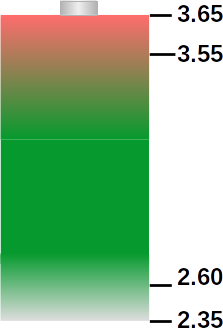
The inner pair of voltages are those which are set in the inverter (or charger) per cell.
A cell should not fall below 2.6v, nor be charged higher than 3.55v
which equates to a range of 41.4v to 56.8v for a 16S battery (sixteen cells in series).
The outer pair of voltages are applied to the BMS.
If the charge/discharge system fails, then the BMS prevents any cell falling below 2.35v or rising above 3.65v
You might suppose that equates to a maximum voltage of 16 x 3.65v (58.4v) for a 16S battery.
But that's not so.
Remember, the BMS has sense wires across each individual cell.
It will cut off the charge-current as soon as the first cell in that battery rises to 3.65v.
In practice I wouldn't configure my inverters and battery BMS units to these absolute minimum and maximum values.
But everyone will have their own opinion on how much they wish to inset from those extremes.
Save energy... recycle electrons!
1

16/03/2024 8:57 am
@robl when i assembled mine last year around June time i think it was, i used a piece of 18mm melamine (kitchen cupboard shelf) in the bottom, i used EVE 280AH cells and ignored the plastic strips but used the foam between the cells. Using 18mm melamine meant that i could then hold the cells in compression.
some others have 3d printed a mesh type support that fits neatly in the bottom of the case. i have also recently heard that Seplos have now sorted the issue ....?
Page 16 / 16
Prev

SPONSORS

Degrees of Separation
Latest Posts
-

RE: How will removing the standing charge on gas bills benefit heat pumps?
The BUS grant funding for 2026/27 will run out at the c...
By Rob of York , 3 hours ago
-
RE: The Changing Jet Stream Could Challenge UK Air Source Heat Pumps
Thanks @susannasaunders for reviving the topic I find i...
By springswood , 4 hours ago
-
RE: New Build 3 Phase or 1Phase
Not so any more.... 1: It's now the...
By Transparent , 17 hours ago
-
@editor Ouch, sorry to re start the tick. I had assume...
By DavidB , 2 days ago
-
RE: Say hello and introduce yourself
@e-a-west as the good Major said, welcome to the forums...
By Mars , 2 days ago
-
RE: How much of your renewable and home setup would still work if the internet went down?
Yes I actually have a copy of a tool that whenever a ce...
By EtchedPixels , 2 days ago
-
RE: Indevolt Batteries UK Support & Info Thread
@editor Hi, To resolve this, please tap on the A...
By Indevolt Tech , 2 days ago
-
RE: Double or Triple Glazed Windows?
Posted by: @singlespeed With 9 years repairing windo...
By Rob of York , 3 days ago
-
@transparent we’re still running a secure version of PH...
By Mars , 3 days ago
-
RE: How quickly would you want/expect heat recovery to take from setback?
Much longer than that here. The heating isn't even on. ...
By bobflux , 4 days ago
-
RE: Passiv Smart Thermostat - Help & Forum Support
Obviously the weather is changeable but there's a defin...
By Singlespeed , 4 days ago
-
RE: Forum updates, announcements & issues
Get the Renewable Heating Hub heads-up on WhatsApp. I...
By Mars , 4 days ago
-
RE: Safety study for plug in batteries out to tender - looks like Q3 2027 at best before legal
@editor I pointed out to the one of the Fuse execs that...
By dansus , 4 days ago
-
RE: 15kw pump for 225m2 1990's house - over kill?
@seaviews As well as loft insulation, there are othe...
By Rob of York , 4 days ago


SPONSORS

