

Notifications
Clear all
Joining the Renewable Heating Hub forums is completely free and only takes a minute. By registering you’ll be able to ask questions, join discussions, follow topics you’re interested in, bookmark useful threads and receive notifications when someone replies. Non-registered members also do not have access to our AI features. When choosing your username, please note that it cannot be changed later, so we recommend avoiding brand or product names. Before registering, please take a moment to read the Forum Rules & Terms of Use so we can keep the community helpful, respectful and informative for everyone. Thanks for joining!

09/12/2023 11:53 am
Hang on... I'm still answering the question before last!
Have a look at these two photos:
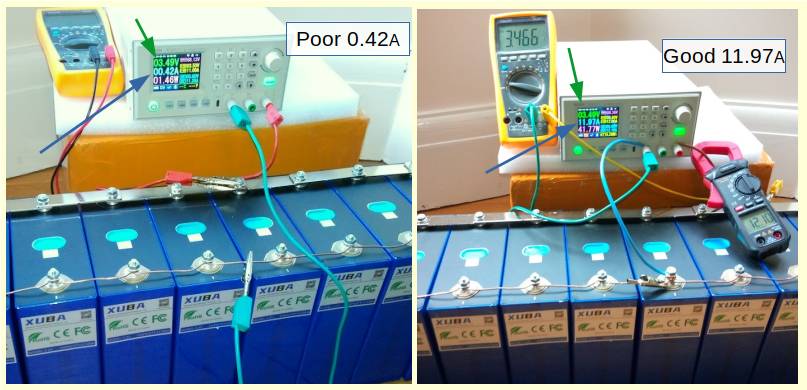
These show top-balancing at the same point in the process.
In each case the power supply unit is measuring 3.49v at its output terminals (green arrow).
The left photo uses connection cables that suffer from three deficiencies:
- push-in banana-plug at the power supply end
- wire is 2.5sq,mm
- crocodile clip at the battery end
The right-hand photo addresses those three issues
- wire is clamped to the power supply output terminal using the screw-down feature
- wire is 4sq.mm (left over from house wiring)
- clamped with a M6 nut at the battery end
Now look at the current being achieved by the same power supply (blue arrow) under those two different sets of conditions.
And you'll notice that I'm using separate voltage and current meters to measure what's actually being 'seen' by the cells.
Note too that I'm feeding the charge-current into a line of cells (in parallel) at the halfway point of the run.
There are 8 cells each side of the connection point, which reduces the resistance imposed by the connections to the cell terminals.
I've actually used proper bus-bars for the positive terminals and a bare 2.5sq.mm copper wire looped around the M6 terminal posts for the negative connections.
There was hardly any difference between those two approaches (based on the same torque being applied to the M6 nuts).
Save energy... recycle electrons!

Topic starter
09/12/2023 12:11 pm
Got it. I can actually wire directly to the unit at the back and have some cable available to do so.
09/12/2023 12:29 pm
Please take photos as you progress...
... including the things that didn't go as expected.
That's why I now have a library I can draw from in order to post information to this forum!
I've just had a look on Amazon at the internal photos of the unit, and the wires they use to connect to those front & rear terminals.
I think they're at the limit of what might be capable of delivering 30A.
Remember, if it doesn't meet the advertised ratings, then you have the right to a refund, both as a consequence of buying from Amazon, and because of the Consumer Rights Act.
For that reason, some of the comments I will post here will be deliberately using phrases from that Act.
Should you ever need to, you can then use those posts as 'evidence'.
Save energy... recycle electrons!
Topic starter
09/12/2023 1:13 pm
@transparent will do. It is a 20 amp unit and I was planning at running just below that.

09/12/2023 1:23 pm
You can't 'plan to run just below' 20A.
The power supply doesn't operate like that.
You fix the voltage (3.6v), and the power supply chooses the current which it can deliver to meet that set-point.
Two more points at this stage:
1: I've just posted photos of the top-balancing operation showing the cell terminals uncovered and facing up.
I would never work on the connections, nor leave the operation in progress in such a condition.
There's too high a risk of an accidental short circuit by dropping a metal tool!
Use two strips of insulation (cardboard or plastic) to cover the +ve and -ve terminals.
Only remove one strip at a time when you work on the connections.
Hold the strips in place using a few tabs of PVC tape.
2: Here's the classic LiFePO4 voltage/current curve:
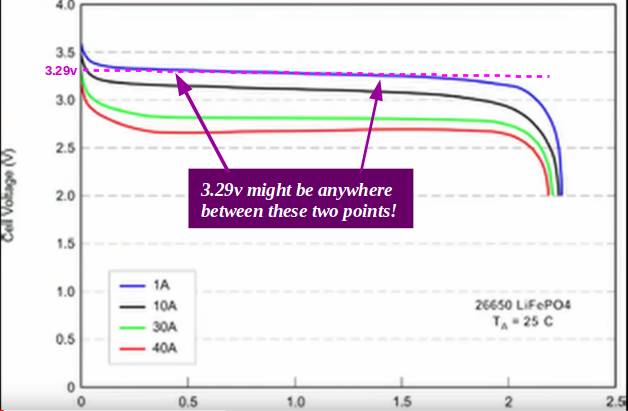
During the top-balancing operation, the voltage will hardly shift at all over the days and hours.
It then moves more rapidly as the current tails off towards the end.
Save energy... recycle electrons!
Topic starter
09/12/2023 4:57 pm
Power supply is here. Turns out it comes with 4mm cables and lugs for the 20 amp connection.
1
09/12/2023 7:49 pm
As the power supply has current limiting, you can check to see if it really will deliver the full 20A.
Set a lowish voltage; 3v will do.
Then connect a dead short circuit across the rear terminals.
What current do you get on the display when you turn on?
Does it remain steady at that current, or reduce as the electronics gets warm inside?
If it blows a fuse at this stage then you might as well return it for a refund.
Not being able to deliver 20A means it isn't fit for the purpose for which it's intended!
What happens if you set up a voltage or max current, and then switch the mains input off and on again?
Does it 'remember' the previous settings, or default to something different?
If it forgets what you've configured, then you can't leave it to top-balance cells unattended.
A short outage on the mains risks damaging the cells.
Save energy... recycle electrons!
Topic starter
10/12/2023 10:32 am
So I tested as suggested and it read 20.4 amps throughout. The voltage however stayed at 0.2v regardless of setting. I'm assuming some kind of shirt circuit protection in play?

10/12/2023 11:45 am
Yes, that's fine, @makia2023.
To deliver the 20A+ across the short-circuit, it can drop the voltage.
That's what we'd expect.
The current-limiting is working.
BTW - a shirt circuit is different.
You normally see that on a rotary clothes-line on a blustery day 🤨
Save energy... recycle electrons!
10/12/2023 2:35 pm
Here's a graphic of a cell-voltage chart which I print out and keep handy beside my batteries.
It saves you trying to multiply by 16 to two decimal places in your head 🤨

Save energy... recycle electrons!

10/12/2023 4:33 pm
@transparent Isn’t one a ‘collary’ of the other?😉 Regards, Toodles.
Toodles, heats his home with cold draughts and cooks food with magnets.
15/12/2023 12:14 pm
The price of these EVE 280Ah cells continues to fall whilst the shipment ordered by @makia2023 has been on the high seas.
It's now down to $69 per unit (+VAT of course).
That's £1085 for a set of 16 cells incl VAT.
Shipping costs are calculated by weight at the time of ordering.
Maritime delivery is typically 6 weeks and $225-$250 per 16-cell set.
That may not not sound like great news for @makia2023, but he'll get over it.
His order is scheduled to dock at Felixstowe tomorrow (16th) 🙂
Save energy... recycle electrons!

SPONSORS

Degrees of Separation

Latest Posts
-

RE: Nook batteries from Octopus
just wondering if anyone has got any Nook to confirm wh...
By Batpred , 31 minutes ago
-
RE: Missing flow temperature in Heat Geek proposal
Of course we do not know for sure what the future will ...
By Batpred , 3 hours ago
-
RE: tepeo ZEB UK Support & Info Thread
There is at least one large scale system in this catego...
By Toodles , 6 hours ago
-
RE: Getting closer to a finished Haier system
Apart from sealing the external Primary Pro joints and ...
By Singlespeed , 11 hours ago
-
RE: Are We Sleepwalking Into Another Race to the Bottom?
@jamespa Hope someone tries it! As a consumer, I woul...
By Batpred , 1 day ago
-
RE: Air-to-Air Heat Pumps & Air Conditioning: UK Heating and Cooling Q&A
Our latest Homeowners’ Q&A episode has just dropped...
By Mars , 1 day ago
-
RE: Vaillant ecoTEC Plus with sensoCOMFORT and weather compensation
Yes, its described in the sensocomfort manual. Its als...
By JamesPa , 1 day ago
-
RE: Heat Geek installations: share your experiences
My summary, highlighting the oddities.
By Batpred , 1 day ago
-
RE: Renewable Heating Hub Homeowners' Q&A Podcast
What a day yesterday! Two podcasts recorded, brilliant ...
By Mars , 2 days ago
-
RE: Tesla Powerwall (2) Calibration Cycles
@davesoa I’m rather a Luddite, but when I was running I...
By Papahuhu , 2 days ago
-
RE: Adding additional Solar Panels to a DC coupled battery system
I too use AI when researching online. It's able to co...
By Transparent , 3 days ago
-
RE: Indevolt Batteries UK Support & Info Thread
There is now a new Secretary of State for Energy Securi...
By Transparent , 3 days ago
-
RE: Do I add Air Con or MVHR to existing A2W ASHP?
@rob-of-york Looks like an impressive bit of kit. Just ...
By Batpred , 3 days ago
-
RE: DIY Heat Pump Installations: Navigating Legal and Regulatory Hurdles
The idealist in me says pioneers in this space should b...
By Batpred , 3 days ago
-
RE: How should the Boiler Upgrade Scheme be reformed?
Ah, that makes sense when a combi is in place. The boil...
By Batpred , 4 days ago


SPONSORS
