
Notifications
Clear all

Topic starter
24/11/2025 10:04 pm
In my case, my voltage reads are now 240V. They should be 230V, so should I consume less?
...
The 'Declared Voltage' for LV is currently stated as 230v RMS
..
Since inverters have been pre-certified to G98/G99, they are more likely to decouple themselves from the grid due to low-volts detection.
Ok, my Solis can work to a huge variety of global grid standards. At the moment, it is working on G99, it is something that the engineers asked me early on to confirm before it connected to anything beyond the battery. Is the name for this new standard cenelec something or has bsi come up with a different prefix? I believe this type of info on grid standards is deployed to inverters via firmware updates.
A small setup like mine (where I do not think I will ever have more than 4kw solar with current panels) will just be expected to have an inverter that backs off if the local grid has a problem, or am I missing anything? To enable normal recovery of the grid, after which my Inverter would connect back to the grid?
It would be nice to be able to confirm that the standard that will replace g99 is in a future Solis update..
8kW Solis S6-EH1P8K-L-PLUS hybrid inverter; G99: 8kw export; 16kWh Seplos Fogstar battery; Ohme Home Pro EV charger; 100Amp head, HA lab on mini PC
Topic starter
25/11/2025 11:37 am
Given the underspent for the budget of the Solis inverter and battery 😀 😉, we are considering the next step: adding PV panels.
Just wanted to share our schedule of works and get views:
"We are taking care of the G99 approval with UK Power Networks. We expect to get SEG 8kw export via smart meter in a few weeks..
What we are looking for:
An estimate for a PV install, to have >4 kWp on the 23 m² flat felt/bitumen roof (the loft has been converted), tying into the existing Solis S6-EH1P8K-L-Plus hybrid inverter + 16 kWh battery.
We assume you would use flat-roof ballasted frames (without penetrations) and a one-storey rear scaffold mounted in the back extension only. The roof has no shading except a small chimney.
Essentially this may be the PV system that we need: Array size: ~10–12 panels @ 420–440 W on 10–15° tilt frames without parapet ⇒ 4.2–5.3 kWp.
We are interested in supply & fit:
A. Panels & mounting (flat-roof ballasted trays/frames, rails, clamps, ballast). Mounting on felt/bitumen. Would you install it as 2 strings into the existing hybrid inverter?
A. Panels & mounting (flat-roof ballasted trays/frames, rails, clamps, ballast). Mounting on felt/bitumen. Would you install it as 2 strings into the existing hybrid inverter?
B. Balance of system & works (cables, isolators, DC combiner if used, roof protection mats, labelling, testing & commissioning into existing Solis)
C. Scaffolding (one-storey rear access, small run, 1 week hire?)
D. Bird spikes along top edge (say 6–12 m)
C. Scaffolding (one-storey rear access, small run, 1 week hire?)
D. Bird spikes along top edge (say 6–12 m)
"
8kW Solis S6-EH1P8K-L-PLUS hybrid inverter; G99: 8kw export; 16kWh Seplos Fogstar battery; Ohme Home Pro EV charger; 100Amp head, HA lab on mini PC
Topic starter
04/12/2025 3:16 pm
So I submitted the SEG application to Octopus. Fingers crossed, perhaps it will not be tripped by any silly building regs "checking the checkers" process.
I did not manage to confirm if the G99 standard for low voltage is 230V. And is it replacing G59?
My DNO (UK PN) seems to supplying 240V in my area... Should my inverter be set to work at G59 in the meantime?
Or would there be another name for UK's 230V?
From what I see, the G99 Type A from ENA is a relevant document..
8kW Solis S6-EH1P8K-L-PLUS hybrid inverter; G99: 8kw export; 16kWh Seplos Fogstar battery; Ohme Home Pro EV charger; 100Amp head, HA lab on mini PC

04/12/2025 3:55 pm
G59 has already been replaced by G98 five years ago.
It's the type certification against which manufacturers of inverters are required to have their products tested.
G99 applies to installations which have more than one G98-certified device,
or where the electricity to be exported exceeds 16A per phase.
The voltage level of the mains supply isn't defined within the EREC G-standards.
The 'Declared Voltage' is already referenced to 230v, and not 240v AC
Thus the interpretation of the Electricity Specifications [...] Act
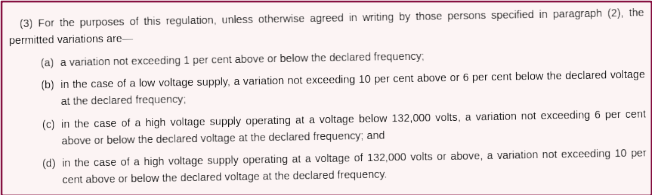
is that LV must be between 216.2v and 254v AC, single phase.
UKPN, in common with all other DNOs, would normally keep the LV supply at 240v.
That allows greater voltage-drop to occur before G98-certified equipment would remove itself from the grid.
The Electrical Networks Association (ENA) is discussing the possibility of reducing the notional grid voltage to actually be 230v.
That wouldn't require any additional legislation of course.
However, for appliances which adjust their electricity-demand based on watts, such as EV chargers, PCs, televisions and heat-pumps,
the grid current would increase to compensate for the lower voltage.
That creates problems on the 11kV level of the distribution grid...
... which might be reflected in more outages due to thermal overload.
There is no easy answer within the scope of DNOs.
This post was modified 2 months ago 2 times by Transparent
Save energy... recycle electrons!
Topic starter
04/12/2025 4:52 pm
A quick check shows the Solis inverter includes G59/3, G98 and G99 settings.
Based on the fact that the DNO approved 8kW export (so over 32Amp), I understand that I should keep it set to G99.
8kW Solis S6-EH1P8K-L-PLUS hybrid inverter; G99: 8kw export; 16kWh Seplos Fogstar battery; Ohme Home Pro EV charger; 100Amp head, HA lab on mini PC
04/12/2025 8:04 pm
If the Solis inverter has a configuration setting labelled G99, then by all means leave it set for that.
But it's a misinterpretation of the regulations by Solis.
Their inverter can't 'know' what other in-house devices are counting towards the export levels approved by a DNO.
This is the sort of detail I feed back to manufacturers.
In this case it would perfectly satisfactory to have configuration 'G98' because that's what they were required to test the inverter for.
Provided that setting still allows you to configure export levels above 16A/phase, then there is no reason why there should be an option to define 'G99' in that field.
Save energy... recycle electrons!
1
Topic starter
04/12/2025 11:06 pm
If the Solis inverter has a configuration setting labelled G99, then by all means leave it set for that.
But it's a misinterpretation of the regulations by Solis.
Their inverter can't 'know' what other in-house devices are counting towards the export levels approved by a DNO.
This Solis inverter being rated 8kw and (I expect, as I did not test) also allowing export of max 8kw, it should be operating to g99 when connecting to the grid.
The solis does allow the voltage on the backup port to be independently set. But that is only effective when the grid port does not sense power and the port is fed from dc sources (perhaps also if the grid power is outside the expected parameters). In normal circumstances, the backup port power mirrors the grid input.
8kW Solis S6-EH1P8K-L-PLUS hybrid inverter; G99: 8kw export; 16kWh Seplos Fogstar battery; Ohme Home Pro EV charger; 100Amp head, HA lab on mini PC
Topic starter
13/01/2026 7:18 pm
So I hear the export MPAN that UKPN assigned should be put to use soon. 🙂
My learning in this process will be to argue more robustly (and immediately) when an electricians' firm (no matter how large) claims they can replace your consumer unit without notification.
8kW Solis S6-EH1P8K-L-PLUS hybrid inverter; G99: 8kw export; 16kWh Seplos Fogstar battery; Ohme Home Pro EV charger; 100Amp head, HA lab on mini PC
Topic starter
26/01/2026 7:03 pm
I feel that the topic of labelling an inverter installation correctly is important enough to justify adding it to this thread (since critical for safe work by any electrician working in your home in the future).
The regulation mandates labels indicating that there are multiple generation sources in the site.
Would you care to say which regulation you're referring to?
When I was looking for the regs for labelling when introducing an inverter able to export, I started with some of the questions present in the G99 commissioning form like:
- Generator’s Installation satisfies the requirements of BS7671 (IET Wiring Regulations).
- Suitable lockable points of isolation have been provided between the PGMs and the rest of the Generator’s Installation.
- Labels have been installed at all points of isolation in accordance with EREC G99.
As I wanted to make sure the electrician would have the required labels, I bought a set of labels that was suitable for a PV installation in advance. A subset of these were then applied in and around the consumer unit and inverter. By this I mean something like the set below:

For guidelines and an overview of labelling, this IET article may help. Ultimately qualified electricians have access to the current regulations.
And of course, always make sure to use a registered electrician.
This post was modified 2 weeks ago 2 times by Batpred
8kW Solis S6-EH1P8K-L-PLUS hybrid inverter; G99: 8kw export; 16kWh Seplos Fogstar battery; Ohme Home Pro EV charger; 100Amp head, HA lab on mini PC
Page 4 / 4
Prev

Latest Posts
-
RE: If a heat pump can only heat DHW to 50C then what? Issue with 18KW Heliotherm heat pump
Hi, Nothing yet. I've asked customer to measure flow...
By errmm , 5 hours ago
-

RE: High Temp Heat Pumps for fast warm-up of house
I don't know exactly how long it takes to heat up (and ...
By JamesPa , 6 hours ago
-
RE: Need help maximising COP of 3.5kW Valiant Aerotherm heat pump
OK. What Im seeing looks fairly normal TBH: 1 start ...
By JamesPa , 6 hours ago
-
RE: Vaillant Tech Support Flagged Low DT: UFH Return Cold, Suspected Zero Flow
@editor thanks for the tips which I will try before cal...
By DavidB , 8 hours ago
-
RE: Daikin 6kw setup with Dixell controller
@jamespa Many thanks for your reply, a very detailed an...
By CraigH , 8 hours ago
-
RE: Exploring the role of alternative clean heating solutions - Government Consultation
Despite reservations, I found some time to respond to t...
By Rusty , 8 hours ago
-

RE: New Vaillant aroTherm Plus in black - When will it come to the UK?
@crankplus, nope, still not, and I've followed up with ...
By Mars , 8 hours ago
-
RE: Octopus Cosy Heat Pump Owners & Discussion Thread
@agentgeorge Probably, but temperature change at -10 ha...
By AndrewJ , 9 hours ago
-
RE: External wall insulation - your experience
To be clear, my experience was very positive. The journ...
By Batpred , 11 hours ago
-

@foxesfan Re: ‘Servicing’ as @editor has covered in his...
By Toodles , 11 hours ago
-
RE: A Smarter Smart Controller from Homely?
@benson No idea why mine doesn’t work, all I see on ...
By Papahuhu , 12 hours ago
-
RE: Battery sizing - How low can you go!
It seems I am seeing something similar to what you do, ...
By Batpred , 13 hours ago
-
RE: Gaslighting in the heat pump industry – has anyone else experienced this?
Don’t know if this is relevant to this thread, but my A...
By Gruff2001 , 14 hours ago
-
RE: Bosch CS5800i 5kW - Experience So Far
@majordennisbloodnok While getting Home Assistant runni...
By Steelbadger , 1 day ago
-
RE: MCS - BS EN 12831-1:2017 – Heat Loss Survey
Since May 2025 it no longer a requirement in England to...
By JamesPa , 1 day ago
-
RE: Air source heat pump roll call – what heat pump brand and model do you have?
Forum Handel @jancold Manufacturer: Daikin Model: E...
By Jancold , 1 day ago
-
RE: Octopus Cosy 12 Heat Pump Regret: Incredibly Loud, Poor Heating & Constant Hum - Help!
@harriworld it was roughly 3am for an hour as that’s ...
By L2jad , 1 day ago
-
RE: Hoped for improvements not being realised on my Mitsubishi heat pump
I have been wondering that myself. The fact is that, ...
By JamesPa , 1 day ago
-

RE: Filtering Tap Water – Share Your Setup for Cleaner, Better-Tasting Water
I remember when I was in my early 20s I was introduced ...
By Majordennisbloodnok , 1 day ago
-

RE: Setback savings - fact or fiction?
But if it is recorded an an integer, which it seems it ...
By cathodeRay , 2 days ago