

Notifications
Clear all
Joining the Renewable Heating Hub forums is completely free and only takes a minute. By registering you’ll be able to ask questions, join discussions, follow topics you’re interested in, bookmark useful threads and receive notifications when someone replies. Non-registered members also do not have access to our AI features. When choosing your username, please note that it cannot be changed later, so we recommend avoiding brand or product names. Before registering, please take a moment to read the Forum Rules & Terms of Use so we can keep the community helpful, respectful and informative for everyone. Thanks for joining!

07/09/2026 9:45 am
I’ve had an EV with wall charger for over 3 years and this is my perspective, in no particular order.
- Where does your main supply enter the house, is it close to where you can place the charger? Adding a Henley block in your meter box to the tails that go to your consumer unit with a supply then going to an external, IP65 consumer unit for your charger is the ideal solution. I guess this could be added at the CU if possible but the main point is to separate the charger and “rest of house load”. Also note that the charger will use a current clamp on the house tails to manage load which may be more awkward at an existing CU (but the installer’s problem really.) Separation allows you to separate out your house load and any future battery system from knowledge of your charger. If added to an existing CU it will become much more awkward without additional automation from something like Home Assistant which I personally find non-trivial.
- Having an EV opens up good tariffs for charging from the likes of Octopus and EDF. This will allow you to charge the car at 7p/8p or similar. Future battery/PV will allow you to export at 12p (currently) and separating the charger from house load will mean you can export excess rather than dump it into the car when it starts charging (why forego 12p when it only costs you 8p?) There are some non-complex considerations concerning import/export simultaneously but separation helps this.
- Even if you don’t go with Octopus for an EV tariff get a charger that is supported by Octopus Intelligent Go. Check other suppliers compatibility as well. Having the supplier scheduling through the charger is much better than scheduling through the car because (a) it allows you to use more than one car on the tariff; and (b) the car typically starts charging immediately, possibly at higher cost depending upon the time of day, until it informs the supplier it is plugged in.
- Hypervolt Pro 3 is a nice charger with a good app, 10m cable choice and helpful support but it doesn’t play at all well with mesh wi-fi systems. It may be ok with a mesh system if you can set up a separate 2.4GHz only “guest” network but I have had problems with that approach with my ASUS system. I’ve had to get a 2.4GHz only WiFi extender to keep my Hypervolt attached to the network. This isn’t a signal strength thing, but, my current theory, a band steering/interference thing with mesh networks. It could just be an ASUS problem! It is possible to connect it via Ethernet.
- It is possible to use a cable from the meter cupboard/CU that has a built in Ethernet cable. This may improve your options for subsequent Ethernet routing. You’ll probably pay more for it of course but could be worth it.
- Zappi has the best PEN fault detection built in but see the earlier points about customer service. All others, as far as I am aware, just check for overvoltage and crap out. This happens way more often in summer than you may imagine if you have PV and/or lots of neighbours in the area with PV. DNO may be able to make adjustments but for me it requires a new cable from the substation!
Hope this helps, if I think of anything else I’ll add it.
2

Topic starter
07/09/2026 9:48 pm
Where does your main supply enter the house, is it close to where you can place the charger? Adding a Henley block in your meter box to the tails that go to your consumer unit with a supply then going to an external, IP65 consumer unit for your charger is the ideal solution.
On the front wall. The meter tails go into a Henley block which splits to a garage/house #2 CU feed and a house CU #1 feed. Looks like there is a spare slot in the Henley block. I would like/expect a small EVSE CU inside the meter cupboard with a cable feed to the charger. I assume that the CT clamp can go on the incoming feed cable as there is no access between the cut-out/fuse and the meter at the moment.
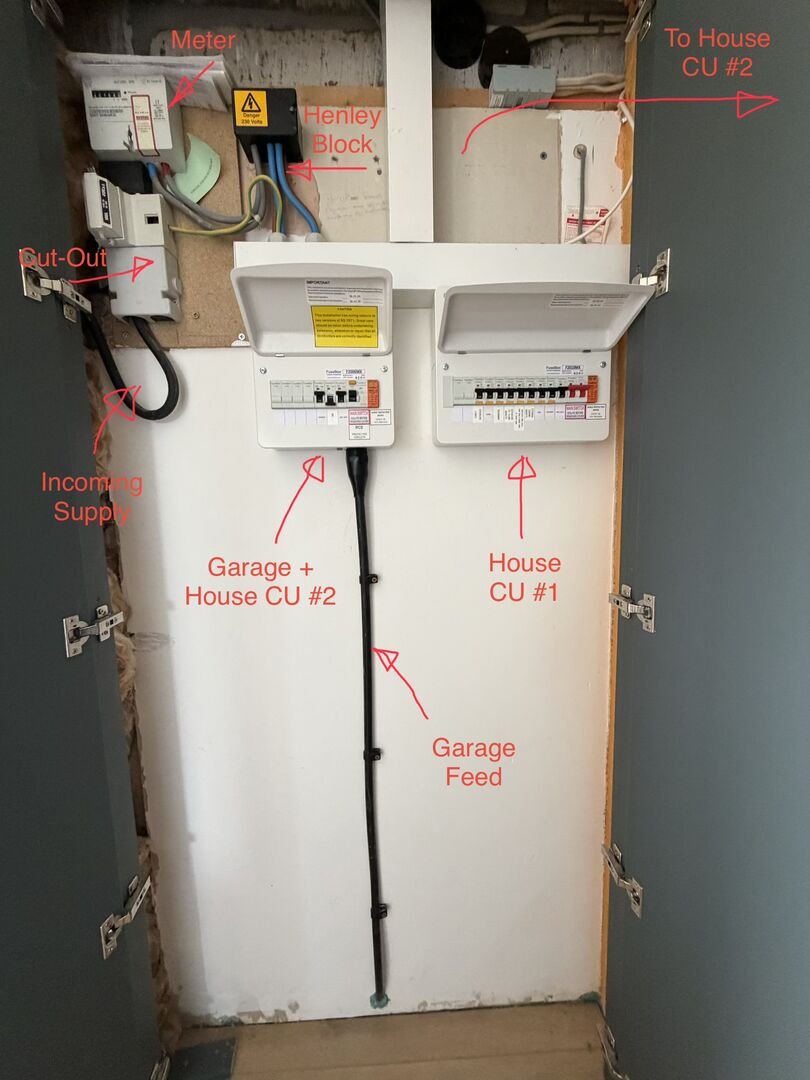
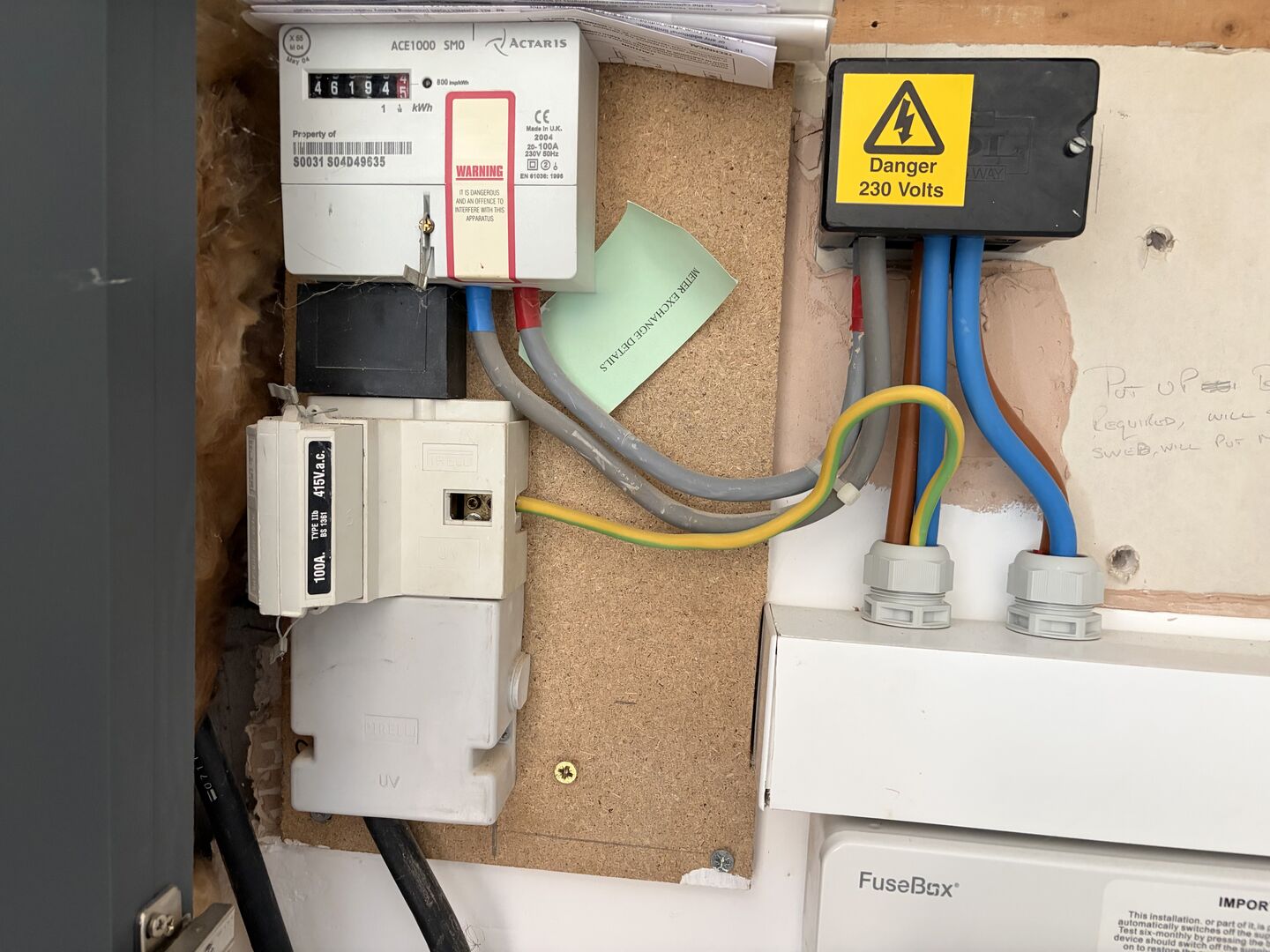

Outside wall directly behind meter cupboard. Garage cable is 3x10mm^2 SWA so probably good for @60A in underground duct, but 40A protection at moment.
Even if you don’t go with Octopus for an EV tariff get a charger that is supported by Octopus Intelligent Go.
Good point, we are with Octopus at present, though I would need to get a smart meter to take advantage. Hopefully adding this later can be arranged with little disruption.
Hypervolt Pro 3 is a nice charger with a good app
On the list, stealth mode required, does it have to have disco light mode? Neighbour has a twin Tesla battery pack with a giant glowing ‘T’ on it. Dark sky area!
Also considering the Zappi (glo?), I will re check the customer service. I’ve dropped a few technical questions to a number of manufacturers, but so far only S&P have acknowledged.
All others, as far as I am aware, just check for overvoltage and crap out. This happens way more often in summer than you may imagine if you have PV and/or lots of neighbours in the area with PV.
Interesting, I will look into this further. By chance, I have left a power meter connected to a socket over the summer and have been noting on a random basis the supply voltage. We now have three neighbours with PV/batteries of differing sizes all connected to the same underground supply from a pole mounted 11kV single phase dustbin transformer. This indicates that the supply is varying between around 250V to 230V, within spec but close. I was wondering if the variation was due to supplier or local generation when being exported. I assume that the inverters will top out at 230V +10% -7% to maintain the DNO requirements. I understand that there is a consultation to allow the DNO to supply a wider range of 230V +/- 10% to allow for “adjustment” due to local generation.
Not sure I understand PEN protection properly, I thought the earth voltage rise had to be measured and all three wires isolated sharpish.
Thanks for the input.
07/09/2026 11:27 pm
@rusty Looks like there’s plenty of room in there for a CU and another Henley block if needed. The current clamp would likely go around one of those grey wires; I have a feeling they would add a other Henley block, put the meter tails into it,then more meter tails into your existing Henley block. In any case, I think that’s probably the best location.
Proper PEN fault detection would look at some discrepancy between live and neutral (tbh, not sure) but the charger manufacturers just implement it as over voltage and then faults until the over voltage clears. For PV, to export, the inverter has to raise its voltage to slightly higher than grid; next house does the same but a bit higher; next one higher still etc… doesn’t take long to hit the 254v level on a sunny day with a number of houses doing the same.
The Hypervolt has a light and a light show feature. The LED rightness can be turned down to zero so you can have it off or dim. It’s used for status indication.
I’m sure you know you can get a smart meter at any time for free and it’s a direct swap. Octopus run saving sessions, “use it up” sessions etc regularly but only if you have a smart meter of course. You really don’t want to be charging a car at home on a non-EV tariff really as the price difference is substantial. I’d definitely be arranging that now.
Topic starter
08/09/2026 12:33 pm
The current clamp would likely go around one of those grey wires
Doh, not sure that I was thinking straight there, less haste required 😳, yes the grey live (red) wire from the meter, thanks for that. As you say, possibly an upgrade to the Henley block.
For PV, to export, the inverter has to raise its voltage to slightly higher than grid; next house does the same but a bit higher; next one higher still etc…
That was also what I was wondering about, as you say, the inverter has to drive a higher voltage than the grid, hence multiple sources are likely to end up in a race to the top if local demand is low. Presumably the inverters will throttle back from the export cap and eventually cut off probably complicated by local cable impedance and demand.
You really don’t want to be charging a car at home on a non-EV tariff really as the price difference is substantial. I’d definitely be arranging that now.
Indeed, thanks.

Page 3 / 3
Prev

SPONSORS

Degrees of Separation
Latest Posts
-

RE: Indevolt Batteries UK Support & Info Thread
@editor Hi, To resolve this, please tap on the A...
By Indevolt Tech , 4 hours ago
-
RE: How will removing the standing charge on gas bills benefit heat pumps?
@toodles GIGO always stands! My Cosy 6, as you can...
By Watcher , 13 hours ago
-
RE: How much of your renewable and home setup would still work if the internet went down?
Interestingly we had an internet outage about a month a...
By Rob of York , 19 hours ago
-
RE: Double or Triple Glazed Windows?
Posted by: @singlespeed With 9 years repairing windo...
By Rob of York , 20 hours ago
-
@transparent we’re still running a secure version of PH...
By Mars , 23 hours ago
-
RE: How quickly would you want/expect heat recovery to take from setback?
Much longer than that here. The heating isn't even on. ...
By bobflux , 2 days ago
-
RE: Passiv Smart Thermostat - Help & Forum Support
Obviously the weather is changeable but there's a defin...
By Singlespeed , 2 days ago
-
RE: The Changing Jet Stream Could Challenge UK Air Source Heat Pumps
@rob-of-york I must admit that when we had a Daikin hea...
By Toodles , 2 days ago
-
RE: Forum updates, announcements & issues
Get the Renewable Heating Hub heads-up on WhatsApp. I...
By Mars , 2 days ago
-
RE: Safety study for plug in batteries out to tender - looks like Q3 2027 at best before legal
@editor I pointed out to the one of the Fuse execs that...
By dansus , 2 days ago
-
RE: 15kw pump for 225m2 1990's house - over kill?
@seaviews As well as loft insulation, there are othe...
By Rob of York , 2 days ago
-
RE: BT cuts you off, Plusnet blames Openreach... welcome to “seamless” broadband switching
Both of which (in most cases) use Openreach for the las...
By JamesPa , 2 days ago
-
RE: Renewables & Heat Pumps in the News
Yes, this is a swiss and german standard I believe, Vai...
By Batpred , 2 days ago
-
RE: Octopus Cosy 12 Heat Pump Regret: Incredibly Loud, Poor Heating & Constant Hum - Help!
@editor FWIW my problem was resolved, eventually, after...
By BigFish , 3 days ago





SPONSORS
